Introduction:
For years, I’ve heard about Costa Rica, which seems like a country "made for me"—nature, not cities.
I almost went in 2019, but a family issue made me cancel.
Initially, I wanted to spend at least three weeks there, planning to go in our summer despite it being the rainy season. Then I realized what I wanted to do could fit into two weeks, so I ended up going in February.
Plus, January’s weather was so awful that some sunshine should do me good.
I found a flight at a decent price, but with two downsides.
The first is that it leaves from Paris CDG, and the second is that it’s with Air France—a airline I’d sworn off after my misadventures with them back in 2008. We’ll see how it goes!
Taking advantage of the quiet days that Covid-19 has brought us, I thought it was time to share my experience in Costa Rica. Once again, I found a lot of helpful information on this forum, so if I can help in return, I’d be happy to!
Here’s some general info:
- 2-week trip in a 4x4 during the dry season, from 01/27 to 02/10
- Two 27-year-old travelers, no kids
And here’s our itinerary:
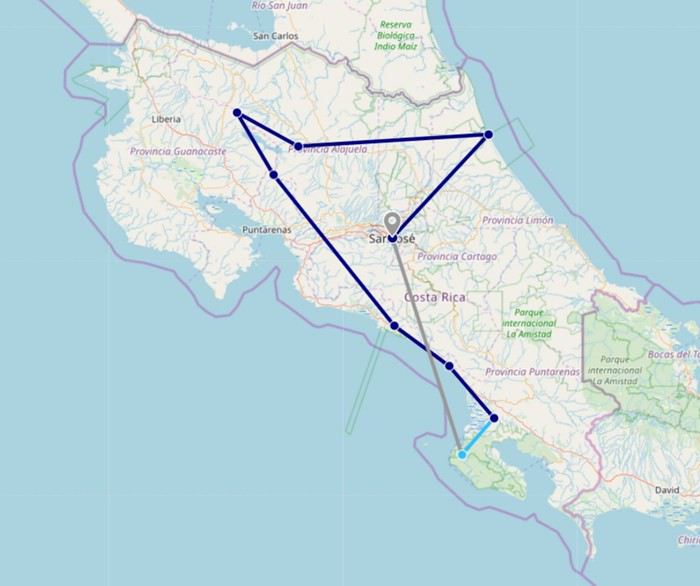
Day 1: Arrival in San José
Day 2: San José - Tortuguero
Day 3: Tortuguero
Day 4: Tortuguero - Arenal
Day 5: Arenal
Day 6: Arenal - Tenorio
Day 7: Tenorio - Monteverde
Day 8: Monteverde - Quepos
Day 9: Quepos
Day 10: Quepos - Uvita
Day 11: Uvita - Sierpe - Bahía Drake
Day 12 & 13: Bahía Drake
Day 14: Bahía Drake - San José
Day 15: Flight back to Switzerland...
Of course, we had to make choices—it’s impossible to see everything in two weeks—but honestly, we’re *really* happy with our route. We even saw more than we expected!
So, ready 😉? Here we go!
DAY 1 – Arrival in San José
After a smooth Zürich-Frankfurt-San José flight, we finally made it to San José 😎!! After months of planning and excitement, we’re here! Since we’d booked a 4x4 with the ToutCostaRica agency for the next day, we stayed at one of their hotels, the Melrost. One of their agents was there to pick us up at the airport and take us to the hotel, which is really close. It was early evening, and it was already dark, so no exploring the city tonight. We treated ourselves to a first local beer on the terrace, listening to the birds, and then headed straight to bed.
Hotel Melrost: A simple little building, but super convenient for just one night in San José (well, Alajuela) before moving on. The room was great, and breakfast was excellent!
DAY 2 – Off to Tortuguero
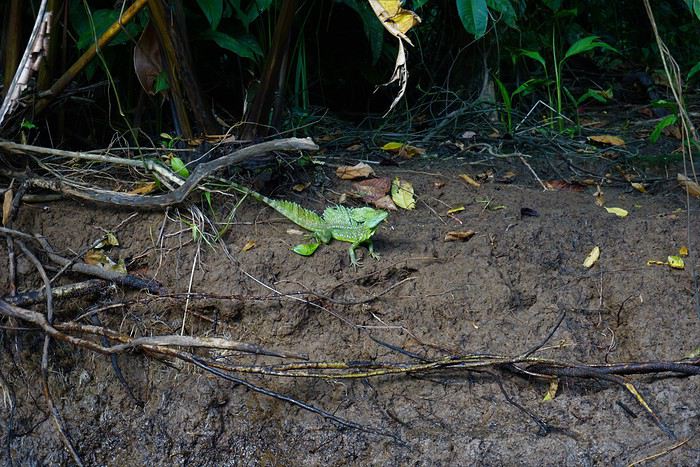
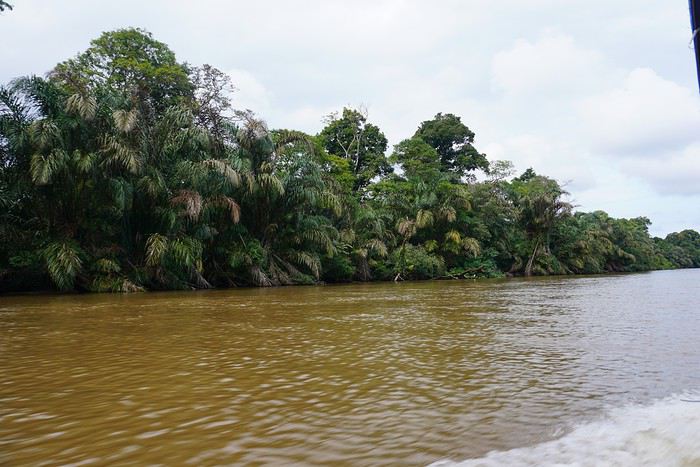
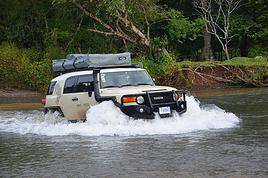
This morning, we had a meet-up at the hotel with ToutCostaRica, where we’d rented our 4x4. They held a briefing in small groups for all the car renters to discuss our routes, tips, the country, and other advice. We found it interesting, but *way* too long! They could’ve kept it shorter—reminding us to wear sunscreen in the sun and not to leave valuables in the car seems pretty obvious... Anyway, after a while, we thanked them for all the advice and set off in our brand-new Toyota Rav4! The rental went perfectly with TCR—everything was great. After leaving the traffic jams of San José behind, we hit some pretty little roads (some in better shape than others) until we reached La Pavona. There, we left our car in a guarded parking lot and took a boat (departure at 3:00 PM) to Tortuguero on the Caribbean coast. Just the boat ride was amazing—we were lucky enough to spot a basilisk, iguanas, and tons of birds. After 40 minutes, we docked right at the pier of our hotel, Casa Marbella. After dropping off our stuff in the room, we headed out to explore the village via its one main street. Lively, colorful, and hot! Since we didn’t have anything else planned for the day, we went back to the hotel terrace to enjoy a juice by the canals. Then, a quick dinner and off to bed to be fresh for tomorrow morning!
Casa Marbella: Really nice, with a convenient pier/terrace for arriving and leaving by boat. Breakfast was absolutely delicious! The room was good, though the AC wasn’t working.
Hello everyone, I’m happy to welcome you to this new travel journal.
We’re heading to Costa Rica together—a Central American destination that dreams are made of for many French travelers and attracts crowds from France.
It was the country’s wild nature and safety that convinced us to go, since we’re traveling with our 7-year-old little one.
We didn’t have much vacation time in February 2026 (only 12 days), so we optimized as much as possible.
Here’s the itinerary:
Wednesday, February 11: Flight from Marseille to San Jose via Paris and Atlanta
Thursday, February 12: Pick up the car, drive to Poas Volcano, visit La Paz Waterfall Gardens
Friday, February 13: Poas Volcano and drive to Manuel Antonio
Saturday, February 14: Manuel Antonio National Park
Sunday, February 15: Nauyaca Waterfall and Playa Linda
Monday, February 16: Drive to Monte Verde and Santa Elena Reserve
Tuesday, February 17: El Tigre Waterfall Reserve and Treetopia Park
Wednesday, February 18: Monte Verde Reserve with a guide and drive to La Fortuna
Thursday, February 19: Sloth guided tour, Observatory Lodge Park
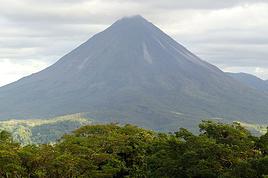
Friday, February 20: Arenal Volcano National Park, Termalistas del Arenal hot springs, and night tour
Saturday, February 21: Return to San Jose, flight to Paris via Atlanta
Sunday, February 22: Arrival in Paris and flight to Marseille.
That gives us a solid 9 days in the country.
Budget breakdown:
Costa Rica is an expensive country, but no more so than France. However, almost all hikes and waterfalls are paid entry, which can really add up.
For meals, sodas (6–10 €) are cheaper than restaurants (10–20 € per dish).
Flights:
We chose Delta Airlines for the price: Marseille to San Jose was 740 € per person (modifiable, with checked baggage and seat selection included).
Other direct flights from Europe were priced between 1200 € and 1600 € with more restrictive conditions.
That’s 2220 € for the family.
Accommodations:
Alajuela, first night: 139 € (1 night) at Rodeo Estancia Boutique Hotel, with personalized airport pickup, transfer to the hotel, and a briefing from Vert Costa Rica agency the next day.
Poas: 66 € (1 night) at Cabañas Tierra Fértil (entire apartment).
Manuel Antonio: 394 € (3 nights) at La Palapa Ecolodge (hotel in the jungle).
Monte Verde: Chalet Aloha Monteverde Cloud Forest (2 bedrooms): 125 € (2 nights).
La Fortuna: Arenal Dream Garden (1 bedroom): 217 € (3 nights).
Total: 941 €.
Car rental:
I went through Vert Costa Rica agency (Vincent is a French expat who set up the agency in Costa Rica and makes great YouTube videos with useful tips).
I rented a 4x4 that was delivered to the hotel the day after arrival and returned at the airport before the flight. The total was 772 €, including full insurance (zero deductible), a child seat, and a phone with a Costa Rican SIM and WhatsApp. The rental company was Poas Rent a Car. The vehicle was well-maintained—no complaints.
Gas: 100 € for the whole trip (3 fill-ups).
Activities:
To get discounts, I bought the pass offered by Vincent, which paid for itself after just one activity. It cost me 30 € (promo since I rented the car through him).
Prices are for 3 people. I’ve added stars to rate them:
La Paz Waterfall Gardens ****: 112 €
Poas Volcano National Park *: 33 €
Manuel Antonio National Park ****: 35 €
Nauyaca Waterfall ***: 25 €
Santa Elena Reserve **: 45 €
El Tigre Waterfall Reserve ****: 141 € (with meal)
Treetopia (ziplining, suspension bridges) **: 250 €
Guided tour of Monte Verde Reserve ***: 113 €
Sloth guided tour (with breakfast) ***: 115 €
Arenal Observatory Lodge (with meal) ****: 102 €
Arenal Volcano National Park *: 34 €
Termalistas del Arenal ****: 20 €
Night tour ***: 116 €
Total: 1171 €.
Meals: 600 €
My favorite restaurants:
Poas: Food court Mercaditas in Fraijanes
Manuel Antonio (near La Palapa): La Langosta and also El Patio
Near Nauyaca Waterfall: Ricar2 el Avión
Between Manuel Antonio and Monte Verde: Soda D’Calle
Santa Elena: HG’s Food
Guadalupe (between Monte Verde and La Fortuna): Soda Río Piedras
Arenal Observatory Lodge restaurant
Arenal Oasis Ecolodge restaurant
Other expenses: 300 € (groceries for breakfast, drinks, ice cream, souvenirs, etc.)
Total overall: 6065 € (about 2020 € per person).
Now, here’s the day-by-day account of this beautiful trip.
Really disappointed with Costa Rica! Pura vida? The scam of the century!
(Costa Rica pure emptiness).
The country where animals are free and people are in cages.
3 weeks in December in this country and never again. Imagine the trailer of a movie that seems interesting, and when you go see it, you realize it’s a flop and the best moments were in the trailer.
Well, that’s exactly how we felt with Costa Rica pure emptiness.
My wife and I have traveled quite a bit and didn’t expect to be so wrong about a place.
On the main routes, we visited:
San José
Alajuela
Limón, Cahuita, Puerto Viejo, Manzanillo (Caribbean side)
Jaco, Quepos, Manuel Antonio (Pacific side)
And a few short stops in intermediate towns.
Our dissatisfaction grew gradually like this:
When we arrived at the hotel, the taxi dropped us off on a small street in front of a white metal gate with ground-floor windows barred. We looked at it skeptically, but the sign matched.
He approached the gate, rang the bell, the buzzer sounded, and the door opened slightly. The hotel wasn’t bad for the price, a 10-minute walk from downtown, but with a "Fleury-Mérogis" vibe guaranteed.
So far, so good.
After showering and regaining our bearings, we headed downtown.
What started to unsettle us on the way was seeing houses with bars on the ground-floor windows and even on the second floor.
At first, we thought the hotel’s neighborhood wasn’t great.
Downtown San José:
It’s a generic city, not very exotic, with a pedestrian street and a small mercado where you can eat local food without frills. Very few tourists—if any—which let you blend in with the locals. We had lunch and struggled to make ourselves understood because, aside from one or two shops, English wasn’t spoken.
On the way back to the hotel, we took a different route, and while chatting and strolling, my wife pointed out a beautiful two-story white house completely barricaded like Fort Knox.
From that moment, we started noticing the facades of houses and buildings, and wow, it was creepy—most looked like prisons, some even with barbed wire.
Though put off, we told ourselves it was probably a big-city thing and the rest of the country couldn’t be like this.
So far, so good.
We relaxed at the hotel and had a drink at the bar. Night falls early, around 5:30 PM. By 7:30 PM, we headed back downtown for dinner. A bit unsettling for a capital—downtown was almost deserted, and aside from fast-food chains, very few restaurants were open, with hardly anyone on the streets.
Bars with security guards out front.
I won’t say we felt unsafe that night, but once it got dark, we realized the bars on the windows weren’t for nothing. First day in, and our impression was already mixed.
The next day, we explored the city and surroundings, and our feelings didn’t change.
So far, so good.
Off to Cahuita by bus—4 hours of travel.
The landscapes are very green but quickly become monotonous. The road runs alongside the forest and passes through a few towns and villages, and even in the countryside, there were just as many prison-like houses.
The bus dropped us off at Cahuita’s terminal station—only four of us got off. It’s a village, or rather, a small town. Cahuita is basically one straight road and a perpendicular one, and honestly, doubt started to creep in.
A few restaurants that add 13% tax and 10% service charge—so 23% extra. We dropped our stuff at the hotel and went to explore. In 20 minutes, we’d seen it all. We had lunch and planned to check out the famous park.
Entry is by donation—well, the "entry" is a joke. There’s a path along the forest by the sea, and that’s it.
Nothing’s going right anymore.
We thought it was a total scam, but since we hadn’t gone far, we decided to come back the next day to explore further.
We returned to the hotel, relaxed, and around 8:00 PM, we went out for dinner. Only two restaurants were open, and the streets were deserted.
Creepy!
The next day, we explored the so-called park more thoroughly and really got it.
A path along the forest by the sea—2 hours there and 2 hours back, where you see animals that feel like showing their faces.
A total joke—"all that for this?"
The beach was full of wood debris and coconut husks. We wondered if the photos online were edited because the sea, very rough, wasn’t the azure blue we’d seen in pictures.
But calling this a park is a joke—it’s like a new concept.
When we thought about the reviews online, we started to suspect that professionals with interests in the country were monitoring and countering any negative feedback that could harm their business.
Too bad we didn’t check the negative reviews beforehand—we did while we were there, and it helped. We wondered if we’d become too demanding after all our travels, but no—when something’s bad, it’s bad.
Manuel Antonio’s park is even more ridiculous—there’s a short path along the sea for about 500 meters, and then nothing. You have to climb through mud and hack your way through the forest. We ended up barefoot because the mud was up to our calves. All that to see a raccoon and a few parrots flying overhead.
We didn’t expect Noah’s Ark, but we’ve seen more animals in Bali, Mexico, and Thailand while visiting temples or just walking around than in these so-called parks!
Puerto Viejo, not far from Cahuita and supposedly livelier—well, it couldn’t be worse!
According to Lonely Planet, it had a Caribbean vibe and wild nights, but maybe that was a long time ago. The good reggae music playing everywhere isn’t enough.
In the evening, Puerto Viejo was a bit livelier than Cahuita, but that’s not saying much. Very few tourists—if any—no night market, just two or three shops open selling $20 T-shirts. Same vibe as San José.
No big deal—we enjoyed the beach and the sun, which was reliable.
Our itinerary was supposed to include Tortuguero Park, but after talking to other travelers who’d just been, we changed our minds, knowing we’d be visiting Manuel Antonio Park on the Pacific side.
To get back to the Pacific side, you have to take the bus and go through San José again—5 hours this time—then switch bus terminals and another 4.5 hours to Quepos.
A stopover town to get to Manuel Antonio’s beach and park!
A town just like the others we’d seen—deserted as soon as the sun sets, and not exactly bustling during the day either. (Where are all the tourists?)
Still as many bars on the windows and that feeling of being in the wrong place.
7 km later: Manuel Antonio beach and park.
The beach is very beautiful and quite large, but don’t expect turquoise blue water—the waves stir up the sand, giving the water a brownish color.
Along the beach, shops and restaurants for about 300 meters, and then nothing. At night, after sunset, the town shuts down too.
Manuel Antonio Park is highly praised for its wildlife, so we were eager to see it. When you express dissatisfaction with Cahuita or Manzanillo parks, the response is always, "But you should’ve gone to Monteverde or Manuel Antonio!" No matter what you do or say, they’ll tell you, "You should’ve gone there or here."
Back to our famous park—entry was about $16, and contrary to what we’d heard, it wasn’t crowded!
Guides at the entrance with spotting scopes offered their services for about $30.
The park: a mix of boardwalk and dirt paths through the forest, sometimes running alongside beautiful coves and beaches.
As soon as we entered, a crowd was taking photos of a deer eating leaves.
A little further on, a guide with a group of five stopped. The guide raised his arm and set up his spotting scope! He showed them, about 100 meters away, a hummingbird perched on a branch. Some, looking through the scope, exclaimed, "Oh my God! Amazing! Incredible!"
For a moment, we thought they’d discovered a unicorn or were in Jurassic Park and had just crossed paths with a T-Rex!
The concept is comical—looking at a bird or another animal through a spotting scope because it’s too far away. Isn’t that what TV is for?
For our part, we saw monkeys, ants, an armadillo, an iguana, and the backside of a sloth climbing a tree. Amazing, incredible!
We stayed a few days in Manuel Antonio to enjoy the beach, changing hotels often because prices varied wildly from one day to the next for shameful services. On top of that, they’d quote a price in dollars and convert it at their discretion—thieves!
Alajuela, a city near the airport, has a two-story mall and a local market downtown! No interest except its proximity to the airport.
What we liked:
The climate and, in hindsight, San José—the most authentic city we visited.
What we didn’t like, in addition to what we’ve already mentioned:
Costa Ricans aren’t very friendly or communicative. English is barely spoken, not even by doctors at Quepos Hospital, where my wife ended up with food poisoning (thanks, Google Translate). The widespread obesity among Costa Ricans, who eat like Americans. The insecurity. The eco-hipsters who leave their $150 lodges in minivans with guides to visit parks and other sites, then return to barricade themselves in their fortresses at nightfall (oh my God, amazing, incredible). The blue signs at the entrance of towns that accept this payment method: "We accept American Express." Parking lots that become paid just because a guy is watching your car. Prices displayed in dollars. The cost of living (hotels, restaurants, taxes). Landscapes that are too green and not flowery enough. Beaches—nothing exceptional. Pollution in cities where big American trucks rule. Sewage dumped directly into the sea. Aside from the jungle, there’s nothing to visit—no ruins, monuments, or anything worth seeing.
In short, my wife and I think the hype about this supposedly eco-friendly country is overrated. It’s just the trendy destination of the moment. There are much better, cheaper, and more authentic places.
In hindsight, we keep the good memories and our beautiful photos, but if we had to do it over...
Before signing off, a little message to those who don’t like hearing opinions different from theirs:
Well, some things aren’t up for debate. And to those who’d have us believe that in 3 weeks, we don’t have the right to criticize a country or express our feelings—how can you praise it in so little time? What a scam. Costa Rica is a money pit. Pura vida? Pure cosmic emptiness.
If you like spending your evenings barricaded in your cozy hotel after dark, this country is for you.
For everyone else: run!
We’re a retired couple in our 70s looking to spend six weeks in Costa Rica between mid-January and mid-March 2026. We’d like to stay in comfortable bungalows (2x3 weeks) and rent a car for the entire period. We enjoy light hiking and some beach time, but we also love relaxing on a shaded veranda, reading, and unwinding. Which places would suit these preferences? We have a lot of experience with this kind of stay in the French West Indies or Indian Ocean islands but have never been to Central America. Does anyone have good tips?
Hi everyone,
I’m so happy 🙂 to be traveling again after 5 years without a trip. I’m heading back to Costa Rica for 18 days from December 12th to 30th with a friend. We’re doing San José-Sarapiquí (2 nights), then Sarapiquí-Tortuguero (3 nights), then from Tortuguero heading to the Cahuita and Puerto Viejo area. We’ll spend about ten days in that region, then make a 2-day stop somewhere before flying back out of San José.
From what I’ve read on this blog, Puerto Viejo seems like the "rasta," party-friendly spot, which is honestly the kind of place I tend to avoid—too touristy. I’m looking for places surrounded by beautiful nature. I’ve already spent several weeks in Drake Bay (in 2019 and 10 years before that) and loved it. My friend also wants to visit the Bri Bri.
Could you recommend some authentic spots in this southern Caribbean area? Your favorite places—whether it’s sights to see, accommodations, or even your favorite little restaurants 😛?
What’s the most authentic way to visit the Bri Bri? What’s your take on that?
And finally, what beautiful stop would you recommend before heading back to San José?
A huge thank you to everyone!
Have a great day,
Zineb
Planned arrival on Sunday evening, November 16, 2025, in San José. Staying 3 nights, then taking a bus to Tortuguero for 2 nights. Looking for a shared shuttle to La Fortuna for 2 nights, then a van-boat-van combo to Santa Elena for 2 or 3 nights. Heading to Quepos for 4 nights for day trips using local buses—Jaco, San Antonio, Uvita. After that, a full-day bus ride to Cahuita. I’m booking hotels as I go, which gives me the flexibility to stay longer in places I like. I’m looking for accommodations in city centers near restaurants and not too far from the bus station. Budget: 50 € for a room with a private bathroom (if you’ve got any great tips!). For my finale, I’ll cross the land border to Panama City for 4 days. Thanks for your suggestions! 😉
Hi, can you tell me if there’s a bus or shuttle from Alajuela to the Nicaragua border via Los Chiles? I’d like to avoid going through San José.
Thanks for your help!
Hi everyone,
We’d like to know if it’s realistic to go to Costa Rica (Playa Carrillo) in late September/early October. Is it too rainy? Does it rain all day, or just for an hour or so? We’ll be traveling with two kids—6 months and 2.5 years old. Do you have any suggestions for places to go? Is Playa Carrillo a good option with young children?
Thanks so much for your help, and have a great day! 😊
Hi there,
I’ve started looking into getting dental implants, possibly in Costa Rica or Mexico.
Do you have any clinics to recommend or ones I should avoid?
For the next steps, I need to choose between Cuba Medika or Medigo—these are agencies that help with medical procedures. Do you have any info on either of them?
I joined my friend in Uvita a week ago, and we're heading out in a few days to explore the country.
We rented a 4x4 to make sure we can get around more easily.
I'm starting to plan an itinerary, but since I’ve never set foot in the country before, I’d love to get some advice from experienced travelers!
We’re starting from Uvita, and I was thinking of doing things in this order:
* Corcovado (I’ve read that you need to buy tickets at least a month in advance? Is it impossible to buy them online or on-site?)
* Caribbean Coast (I’m not sure which spots are worth it?)
* Tortuguero
* La Fortuna
* Tamarindo or Samara, or another nice spot in that area?
* Returning to the airport on May 19th to catch my flight, while he heads back to Uvita.
For accommodations, we have camping gear, and he’d like to do some wild camping, but I have no idea what the laws are about that here—or about the wildlife, to be honest. It kind of freaks me out
We’d also like to stay in guesthouses, youth hostels, or even regular campgrounds.
We both love meeting people, chatting with locals and other travelers alike.
We’re roughly planning the stops, but we haven’t booked anything anywhere. The idea is to leave some room for adventure and live day by day.
I think my post reflects what’s going on in my head—total chaos ^^
We just got back from a nearly 3-week trip to Costa Rica in March. For the occasion, we used EVANEOS to plan our trip based on our preferences.
After some setbacks with ADOBE RENT-A-CAR—they refused the Visa Premier card and forced us to pay for extra insurance (which is usually covered by the Visa Premier)—we finally set off to explore the country.
Observation: Apart from nature, wildlife, and flora, there isn’t much else to see, but it’s so beautiful! Some people criticize the country as insignificant, with bland food and unwelcoming locals. I think those people didn’t really explore—maybe they stayed in their hotel near the beach (UVITA?) without venturing out. Otherwise, there wouldn’t be so many Europeans living in Costa Rica who don’t even consider going back to their home countries.
For our part, we found Costa Ricans very kind and welcoming. It’s often said they’re thieves, but personally, we left a small suitcase in a restaurant. When we returned after driving 20 km round trip, the staff were trying to find our phone number to contact us. I think it’s like anywhere—even in France, I’d tell tourists not to leave anything in their car to avoid… well, you know.
Food: Traditional dishes, fish plates (tilapia was excellent), and especially ceviche (around 15 € per person)—really good—and lobster (around 30 to 35 € per person), all served with fruit batidos (around 3 € per person).
Car: We had a 2-wheel-drive vehicle, which kept us from visiting some sites that require a 4x4, like Boruca, the town of artisan masks. Some lodges are also only accessible via rough, rocky trails that are tough to navigate in a regular car. Don’t hesitate to insist on a 4x4.
Keep in mind that driving fast in Costa Rica isn’t possible. Some roads are in poor condition, and there are often unmarked speed bumps that are much worse than the ones in France. You’ll average about 50 to 60 km/h on a leg of the trip.
I also recommend bringing a road map to cross-check the routes suggested by Waze or Google Maps. Sometimes, these apps will send you down completely wrecked roads to save time! A paper map will help you verify the road type. It’s better to drive an extra 20 km than to get stuck on a rocky path.
- San José to Barra de Pacuare (much less crowded than Tortuguero). Sea turtles are still rare this time of year. Via the canals, we spotted howler monkeys, sloths, and birds, and on land, we saw venomous spiders, poisonous frogs, and a leatherback turtle conservation site.
Explored a primary tropical forest with its many species of flora and fauna (monkeys, snakes, sloths, toucans, raccoons, etc.).
- Barra de Pacuare to Cahuita: Explored Cahuita National Park (howler monkeys, capuchin monkeys, raccoons, sloths, blue crabs, leaf-cutter ants, etc.) and walked along the trail by Puerto Viejo’s beach.
- Cahuita to Bambú: Visited the Bribri tribe and their customs. This isn’t a tourist trap—it’s a deep immersion into a community living almost self-sufficiently. To get there, you take a motorized canoe for over an hour. But be warned:
1 - The restroom cleanliness leaves a lot to be desired
2 - There’s no hot water
3 - A waterfall hike is offered. The first two-thirds are fine, but the last third is very dangerous, especially if it’s rained, even with sneakers. You need sturdy shoes. Our guide turned back halfway…
- Bambú to Sarapiquí:
- La Fortuna: Explored the Mistico Park tropical forest. A 3+ km trail lets you discover animals and lush vegetation. Sixteen suspension bridges, some up to 45 meters high, offer stunning views of the canopy.
Walked around Arenal Volcano: Big disappointment for seeing lava flows. After 2 km, a viewpoint shows vegetation that’s taken over—only a few volcanic rocks hint at the 1968 eruption.
- La Fortuna to Carara: Spotted crocodiles at the Tarcoles Bridge.
- Carara to Uvita: Relaxed. Uvita is a small tourist town with nothing particularly original, but it’s the place to try CEVICHE, a typical dish of raw fish “cooked” in lime juice. Delicious! We recommend Mestizo for very affordable prices.
- Osa to Corcovado National Park: This park is gorgeous. You’ll see all four monkey species, tapirs, scarlet macaws, etc.
From Drake Bay, it takes about 1 hour 15 to 1 hour 30 to cross to the park. After navigating the mangroves, the boat heads into open sea until reaching the beach, where you’ll wade ashore (water up to your thighs—bring shoes for the slippery rocks).
National Geographic called the park a "jewel of humanity" that must be preserved at all costs due to its incredible biodiversity. The park represents 3% of the world’s biodiversity. You can observe countless monkeys (all four species are present), crocodiles, tapirs, and scarlet macaws.
Our guided hike with a French-speaking guide lasted 4 hours before returning by boat to the lodge.
WARNING: There’s strict control at the park entrance:
- No plastic bottles
- No knives
- No plastic items
- No bare feet. Closed-toe shoes are required (in addition to a pair for the boat)
- Osa to Zona de los Santos: This is the coffee region and home to the quetzal, a stunning but hard-to-spot bird that’s also Guatemala’s symbol. Paraíso Quetzal Lodge has a platform with a spotting scope to try to see the bird in the forest. CAUTION: This beautiful lodge is at 2,650 meters altitude. The rooms have incredible forest views, but it’s VERY VERY cold!
- Zona de los Santos to San José: Detour to Irazú Volcano. WARNING: Buy tickets before arriving. The staff kindly bought them for us via their phone. Small disappointment: The crater lake hasn’t existed for years! The ads are misleading about this.
- San José: A city we found uninteresting.
Hello,
We just spent nearly 3 weeks in Costa Rica and had rented a car from ADOBE RENT-A-CAR. For the occasion, I had provided a document from my bank confirming that my VISA Premier card (gold card) covered—by far—the additional CDW insurance that this rental company strongly recommends. On-site, when it came time to pay the mandatory third-party insurance, my card was declined (luckily, we had another basic debit card that worked without any issues). The reason given by the rental company: my card was invalid or I had a banking problem. The same result and comments occurred at a second ADOBE agency. After contacting my bank and their customer service, they confirmed there was no issue! What’s more, throughout the trip, we used this same card to pay for various purchases (gas, restaurants, attractions, etc.) without any problems...
After expressing my dissatisfaction to this rental company on Trustpilot (you can check the site), ADOBE refused to address the issue but admitted that this mandatory insurance is required...
In reality, it’s clear that this rental company refuses this card so that tourists will purchase their additional insurance.
The travel agency we booked through has requested a meeting with ADOBE for clarification. I’m waiting for their conclusions.
Additionally, I noticed on certain sites like tripadvisor.ca or itinego.com/fr/costarica/guide/43/location-voiture-suv-4x4 that this card is no longer accepted...
So, BE CAREFUL:
Before leaving, make sure to check with the rental company you’re using to confirm that your card is accepted
Always have another bank card as a backup
Hi everyone, we’re planning a road trip this summer (in August). I have a question:
is it possible and common to see turtles (nesting or otherwise) around Cahuita? We’ve planned a stop in Tortuguero (but if there’s a chance to see them in Cahuita, it’d save us a detour—which is probably worth it anyway).
We’re planning a trip to Central America and South America, but we’re still unsure about the destination.
It’s for a trip in July 2025, so weather is definitely a factor.
For Ecuador, the weather seems favorable, but my wife knows an Ecuadorian woman who told her that the security situation has really deteriorated, especially on the west side (beaches, etc.).
Has anyone traveled to Ecuador recently (in 2025) and could share their experience? (security situation, recommended itineraries)
In terms of things to see (typical villages, landscapes), weather, and prices, Ecuador seems more appealing to us than Costa Rica or Panama, which we’re also considering.
Hi there, we're looking into Costa Rica for a short trip in July (10 days).
From what we've read here and there:
- Most travelers head to the Pacific coast.
- For a July trip, the Caribbean coast is less prone to heavy rains.
Is that correct?
Question: When it comes to beaches, parks, and driving distances, is the Caribbean coast worth it compared to the Pacific coast?
Especially for the beaches—I’ve seen tons of blogs and sites with photos of Caribbean beaches vs. Pacific ones, and it seems like the Pacific side is way more paradise-like. Is that accurate? (It looks like, regardless of season or weather, the sea on the Caribbean side is darker and choppier.)
Thanks in advance if anyone can share their experience (Caribbean vs. Pacific, pros, cons, etc.)
I’m looking into renting a 4x4 for Costa Rica, and like many, I’m a bit lost...
I know there can be differences between what’s booked and the sales pressure at the airport to sell you mandatory insurance.
On the Booking site, I found an option for a vehicle at 642 € (with a Genius discount—I’ve attached the rate details, it’s unbeatable) for 16 days, plus a 126 € option that claims to cover everything.
Total: 756 €.
But how can I be sure it *really* covers everything? I can’t find any info, and there are no other insurance options at checkout.
And what amount should I expect if they try to add some random insurance on the spot?
Hi there, do you know any affordable places to do yoga in this area? I found some, but they cost between $12 and $20 USD! For a Canadian who wants to practice every day, that adds up quickly... Thanks!
Hi there! I’m a 43-year-old woman planning to travel solo in early March. I’m not into commercial resorts, so I’m looking for places like youth hostels or *casas particulares* where I can meet other travelers. I’d love to do a mix of activities—ideally snorkeling, hiking, Latin dance, group tours, biking, etc. Mostly, I want to meet people (not necessarily a man, just folks in general!). My dream spot would be somewhere I can do Latin dance almost every night, but I’m open to other suggestions. Thanks!
Hi everyone,
I’m planning to spend 15 days on the beaches of the Nicoya Peninsula but I’m having trouble picturing the villages and the vibe.
Since I don’t want to rent a car and would rather base myself somewhere and get around by bus, I think I’ll need to stay a bit in the center of a village. I could also move around—spend a week in two different villages.
I don’t surf but I’m not opposed to trying it, and otherwise, I’m really into yoga and horses.
Any other must-sees in Costa Rica?
I’m thinking of visiting a volcano and a national park; I’ll be there for a total of 3 weeks.
I’m looking for a ferry or Ro-Ro passage for my vehicle and two passengers from Mexico to Costa Rica.
I haven’t found anything online. If you know of any regular routes, I’d love to hear about them!
Hi there,
We’re heading to Costa Rica in March 2025 for a road trip from north to south. What type of vehicle would be best? And, based on your experience, which rental company would you recommend doing business with?
Thanks!
Denis, from Quebec
A brand-new project has just come up: spending 15 days in Costa Rica. If you have any recommendations for a French-speaking agency or guide, I’d love to hear them. I’m thinking of leaving in late February or early March. There’ll be two of us women on this trip. What are the most beautiful spots to explore? Preferably hiking spots.
Véronique
Exploring Costa Rica’s national parks is a must-do experience for any traveler looking to immerse themselves in the natural beauty of this tropical country.
As a local travel agency, Vacaciones en Costa Rica offers practical tips to help you organize your visits and ensure a smooth, enriching experience during your trip.
Options for Booking Your Tickets
1. Online Booking: Simplicity and Time-Saving
Name of the national park.
Date and time of your visit.
Type and number of tickets based on your profile (adult, child, foreigner).
First and last name, passport number, and country of residence for each participant.
Complete your online payment.
Receive a confirmation email with your entry tickets.
The following parks are available for online booking:
Poás Volcano National Park
Manuel Antonio National Park
Chirripó National Park (sectors: San Gerardo, San Jerónimo, Herradura)
Irazú Volcano National Park (sectors: Prusia and Craters)
Tortuguero National Park (sectors: Cuatro Esquinas and Cerro Tortuguero)
And many more!
2. Manual Booking: Parks Requiring a Specific Procedure
Some national parks require booking by email or phone:
Corcovado and Isla del Caño: Book by email (minimum 30 days in advance) at reservaciones.pnc@sinac.go.cr
Turrialba: Book by email (minimum 7 days in advance) at the same address.
Barra Honda: Book by phone at +506 2659-1551.
3. On-Site Purchase: Flexibility for Spontaneous Decisions
Some parks allow you to buy tickets directly at the entrance.
Make sure to have local currency, as not all parks accept credit cards. However, this option can be risky during high season, as popular parks often reach maximum capacity.
Essential Tips for Your Trip to Costa Rica
Plan ahead: Early bookings are recommended, especially for highly visited parks like Manuel Antonio or Tortuguero.
Check specific policies: Each park may have different requirements, particularly regarding booking deadlines.
Be mindful of connectivity: Some areas of Costa Rica, especially remote regions, have limited internet access.
Dive into the heart of nature, admire breathtaking landscapes, and create unforgettable memories in Costa Rica’s national parks.
Hi there,
We’re planning to cross the land border between Costa Rica and Panama along the Pacific coast. Has anyone got any info? I’m not finding much online. From which city in Costa Rica can we catch a bus?
Thanks in advance.
Hi everyone, I’m restarting my travel reports with my 2023 trip that took me from Costa Rica to Suriname over a month and a half.
First stop: Costa Rica. I arrived in late September in San José, a city I know well and never linger in. As soon as I got off the early-morning flight, I headed to the domestic airport—just a 5-minute walk away—to catch a 45-minute flight to Puerto Limón on the Caribbean coast.
The 40-minute flight in a small Cessna was fun, especially since we landed on a tiny airstrip right by the sea—it felt like landing on the beach, which immediately set the mood. Plus, I wasn’t keen on enduring the 4–5-hour bus ride to Cahuita, especially since large sections of the road were under renovation.
In Cahuita (where I’ve been going every year since 2015), I stayed at Kenaki Lodge on Playa Grande. It’s a great lodge, about a 45-minute walk from Cahuita’s center, but you’re just 50 meters from the beach and usually have it all to yourself. The lodge is run by Béa, a Frenchwoman, and depending on the season, you can help release baby turtles on the beach. The room was 55 €, very spacious, and you can use the outdoor kitchen. I’d recommend it for anyone looking for peace and quiet and a private beach.
After 5 days there, I flew to Cartagena but didn’t stay overnight. Instead, I headed straight to Rincón del Mar, a 3-hour bus ride from CTG.
I’d mostly heard about it from a friend who lives there and runs El Ché, a beachfront restaurant. Rincón del Mar is a tiny seaside village, very peaceful, with a pretty nice beach. There are lots of small hotels and restaurants, and it’s a spot that’s likely to grow quickly in the coming years.
Note: there’s no ATM there, so you’ll need to withdraw cash in San Onofre, about 30 minutes away by moto-taxi. The round trip costs around 25,000 COP.
That’s also where you catch the bus to Cartagena.
For accommodations, rooms were roughly 70,000–90,000 COP, with a so-so value for the price.
As for things to do, I’d recommend the tour that takes you to watch the sunset in front of Bird Island, followed by a swim in a lagoon with bioluminescent plankton. The excursion (if I remember correctly) cost around 90,000 COP.
After a week in Rincón del Mar, I headed back to Cartagena and decided to fly to Yopal to visit the Río Meta.
In Yopal, you’ll need to go to the bus terminal (10 minutes by taxi from the airport). From there, I took a bus to Orocué (50,000 COP) for about a 4-hour trip—it felt endless because the road was in terrible condition.
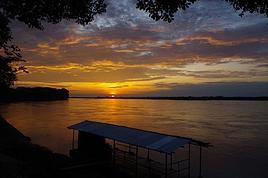
Orocué is a tiny town on the banks of the Río Meta, but it has all the essentials (hotels, restaurants, ATMs). It’s lovely to stroll along the river at sunset. There are a few small bars, the area is very natural, the sunsets are stunning, and when there are distant storms, it’s just breathtaking.
For lodging, I stayed at Hotel Brisas de San Miguel. It wasn’t bad—fan-cooled room for 70,000 COP. There were quite a few mosquitoes.
I spent 3 days in Orocué. If you want to swim, head to the bridge (the only one), Cano San Miguel, and on the right, there’s a swimming spot. With the heat, it’s a great way to cool off.
From Orocué, I took a fast *lancha* (boat) up the Río Meta to Puerto Carreño, in the Vichada department at the far end of Colombia. This brings you to the majestic Orinoco River, right across from Venezuela.
The boat ride is long—10 hours—and costs about 60 €. We left around 6 AM, with a few stops for bathroom breaks and meals along the way. But you *must* book your spot 1–2 days in advance. To do that, go to the small square above the dock—there’s a "navigation office" there.
The trip was long but enjoyable. I never get tired of river journeys.
I was happy to finally arrive in Puerto Carreño, a small border town with Venezuela. No surprise that half the population was Venezuelan.
In Puerto Carreño, I stayed at Hotel Delfines del Orinoco. The room was 80,000 COP, decent, with A/C, and the best part was the pool.
I spent 2 nights there.
One thing you *must* do—morning and evening—is hike to the top of Cerro de la Bandera (the *cerros* are huge rock formations typical of the Orinoco region, and there are many in the area). From the summit, you get amazing 360° views of the savanna and jungle. Sunrise is especially incredible. The trail is well-marked—from downtown Puerto Carreño, it takes about 20 minutes.
Next, I spent 3 nights at Rancho Barú. About an hour by boat from Puerto Carreño, you get off at Casuarito, and someone from the lodge picks you up by motorcycle for a 30-minute ride. The ranch is in the middle of the savanna, with a river/rapids beach just a 5-minute walk away. You can also fish—bites come quickly.
For the lodge, one night (room or hammock) with shared bathrooms, three meals included, one excursion, plus the round-trip motorcycle ride costs 245,000 COP. An extra night without an excursion is around 100,000 COP, but you need to let the lodge know in advance so they can prepare enough food—there’s absolutely nothing for miles around.
After those 3 great days at the ranch, I took a canoe to cross into Venezuela, since Casuarito is right across from Puerto Ayacucho.
The crossing costs 10,000 COP, but I got shaken down by Venezuelan immigration, who invented a violation and made me pay $40 USD.
Puerto Ayacucho didn’t inspire me much. The city felt sketchy, with many hotels closed. Dealing with currency exchange was the hardest part—you *must* bring cash (USD or Colombian pesos), know the exchange rate, and find someone with enough money to exchange with you. It took me at least 2 hours.
I stayed in a decent hotel downtown for $20 USD a night, but I’ll admit that going out at night—even in Puerto Ayacucho—felt pretty dodgy. All the buildings have bars on the windows, and there weren’t many people outside.
I didn’t linger and found my plans to continue south too complicated. The next day, I took a bus across the country to the Brazilian border at Santa Elena de Uairén. The trip took a day and a night, with countless military checkpoints where they made everyone get off, unload all the luggage, etc. Not exactly a fun ride.
Photos:
- 2 sunrises near the Orocué dock
- Storm over the savanna at Rancho Barú
- View of the savanna and Orinoco near Casuarito
- Photo taken during the Río Meta boat trip