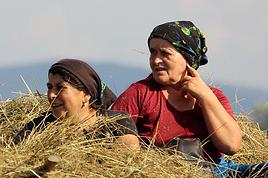
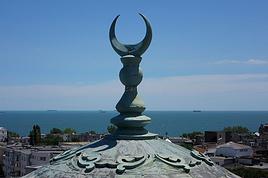
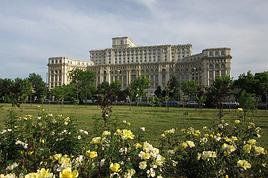
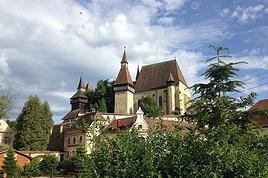
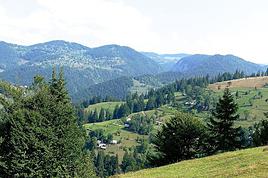
Lors de la petite promenade que nous avons faite en Europe de l’est (voir les premiers chapitres du livre Improvisation Nomade sur ce site), il s’est vraiment passé quelque chose de différent en Roumanie. Comme ci, après avoir traversé des pays étrangers, nous arrivions enfin en famille chez de proches cousins. Cousins où la vie serait restée celle d’entant avec la solidarité familiale et villageoise, avec l’alcool de prune à toutes les occasions, les animaux de la ferme dans toutes les cours, le foin ramassé à la main etc. Comme revenu chez mes grands-parents étant petit, les odeurs et les souvenirs me sont revenus aussitôt.
Mais la Roumanie n’est pas simplement ce que j’en ai vu ou ressenti et comme je n’ai pas pris le temps d’y retourner ainsi que je me l’étais promis, j’ai quand même fait quelques recherches sur ces lointains cousins.
Les Roumains sont originaires d’un peuple indo-européen venu 2000 avant JC : les thraces. Ceux qui resteront entre Carpates et Danube, en future Roumanie s’appelleront les Daces. D’où d’ailleurs la fameuse marque automobile Dacia. Les daces sont un peuple dont Hérodote, Historien grec, disait qu’ils étaient très puissants et qu’ils pourraient être craint s’ils ne se querellaient pas sans cesse entre eux. Les daces parlent dace, une langue presque totalement disparue et qui n’était pas écrite, peut-être pour se protéger de ses trop grands voisins. Mais ils étaient plutôt évolués puisqu’ils avaient un haut niveau de médecine, d’astrologie etc., et d’ailleurs étaient directement influencé par les Grecs.
A l’époque Romaine, les daces ne purent résister à l’empereur Trajan qui les vaincu et fit de la Dacie une province romaine (vers 150 ap JC). Ceux d’entres eux qui n’étaient pas contents s’en sont retournés dans les plus hautes montagnes jusqu’en 256 avant que l’envahisseur ne parte. Quand les Daces romanisés (avec la langue mais aussi avec quelques chromosomes) et ceux restés dans les montagnes se retrouvèrent, ils créèrent le roumain, une langue à forte inclinaison latine mêlée d’ancien dace.
Enfin, il faut savoir que l’un des plus grands empereurs romains nommé Galère était Dace. C’est d’ailleurs à ce moment que la capitale de l’empire romain devint Byzance (Istanbul) à défaut de Rome. L’empereur Constantin qui la rebaptisa juste après en son nom Constantinople fit de cette partie du monde le cœur de l’empire mais aussi, puisque entre temps était apparu le christianisme, le cœur de la chrétienté. C’est donc simplement que les Roumains devinrent chrétiens de rite byzantin, cad. Orthodoxes et ce jusqu’à nos jours.
Pendant de nombreux siècles, les Roumains vécurent parfaitement au sein de l’empire byzantin et aidèrent à son maintien en affrontant les peuples venus du nord et de l’est tels que les Goths ou les Huns… Pourtant, ce fut les Magyars et les Saxons, installés en Hongrie qui grignotèrent de plus en plus du côté de la Transylvanie puis enfin les Ottomans qui réduirent Constantinople en 1453 et ne tardèrent pas à prendre l’autre partie de la Roumanie, cad la Valachie et la Moldavie. D’ailleurs si l’on regarde la carte de Roumanie, l’on s’aperçoit que le cœur du pays, les montagnes des Carpates, a une partie de ses eaux qui descend vers l’Occident et l’autre vers l’Orient et la mer Noire. Une frontière qui perdura bon grès mal grès pendant 400 ans, jusqu’à l’indépendance de la Roumanie en 1878.
Pendant cette période de domination ottomane d’un côté et austro-hongroise de l’autre, de grands princes roumains résistants virent le jour. Ils sont encore très connus, notamment Dracula dont voici la petite histoire : La famille Dracul est une très vieille famille roumaine de sang royal dont le nom qui veut dire dragon vient du symbole Dace qui était représenté sur leur drapeau. Celui dont l’histoire deviendra un mythe était un prince venu à la tête de la Valachie et qui ne se laissa pas faire par l’occupant. Il était particulièrement cruel avec ses ennemis et n’hésitait pas à les faire découper, bouillir, enterrer vifs… mais surtout empaler ! Une fois que Mehmet 2 en eut marre de ce prince qui ne lui payait pas tribut, vint avec son armé et après de longues batailles contre le prince Dracul finit par laisser tomber devant le spectacle de 20 000 de ses soldats empalés au bord d’une forteresse et laissés là jusqu’à décomposition. La fin de l’histoire est moins drôle puisque Dracula fut prisonnier et tué par les austro-hongrois après une entente avec les Ottomans…
Avant d’aller plus loin, je suis obligé de dire un petit mot sur une partie de la population du pays qui n’est pas roumaine. Il s’agit des Roms. Ce peuple indo-européen est arrivé bien plus tard (autour du XIV siècle) et a était pris en esclavage lors de son passage à travers les pays européens, notamment une bonne partie en Roumanie. Malheureusement pour les Roumains ou par punition divine, ils s’appellent Roms et sont souvent confondus avec eux ce qui leur donnent la réputation que vous savez en France. D’ailleurs les deux populations se détestent la plupart du temps…
L’histoire du XX ème siècle est plus connue. Une fois la Roumanie plus ou moins libérée du joug ottoman, de petits princes se disputèrent pour prendre le pouvoir. Comme le risque était grand que le pays ne soit jamais réuni mais partagé entre ses grands voisins, la population décida que le futur roi serait un étranger et les protégerait ainsi de part ses liens familiaux. Comme la France avait de très bonnes relations avec les Roumains (la Roumanie s’est rapprochée de la France depuis la révolution… et aussi parceque tous les gens cultivés d’europe et même de Russie parlaient le français), Napoléon III conseilla à ses amis roumains de prendre comme roi un jeune prince Allemand dont la grand-mère était apparanté à Napolèon. Aussi le jeune prince devint le premier roi roumain et pris le nom de Carol Ier. Il s’associat à la Russie contre les Ottomans, ce fut un succès, enfin la Roumanie devint autonome et son roi servit bien ses habitants.
Carol Ier mourut en 1914 sans laisser d’héritier direct mais il avait depuis longtemps jeté son dévolu sur une autre jeune Prince Allemand, fils d’un de ses frères et depuis longtemps en Roumanie. Il fut donc accepté par la population. Marié avec Marie d’Edimbourg, petite fille de la reine Victoria d’Angleterre par son père et du Tsar Alexandre II par sa mère, ils avaient déjà deux enfants ensemble dont Carol II, qui serait succéseur à la couronne. Ferdinand dès le début de son règne dut prendre la descision de sa vie, à savoir s’il devait se battre avec ses frères allemands ou avec la France, dont les Roumains se sentaient beaucoup plus proches. Ils décidât par honeur à son rang de se battre du côté des alliés contre son pays d’origine. Il a bien fait d’ailleurs puisque les alliés sortent vainqueurs et que son fils deviendra bien roi après lui.
Après la guerre, la Roumanie connaît la période la plus faste de son existence. Bucarest est appelé « petit Paris », on y fait la fête et des affaires. Tout va bien jusqu’à la seconde guerre mondiale ou encore une fois, la Roumanie choisit le camp des alliés mais cette fois est envahi par l’Allemagne nasie puis à la fin de la guerre par l’URSS « libératrice. »
La Roumanie passera alors sous le joug de l’URSS pendant 40 ans et connaîtra une période très néfaste ou Caousescu et la Securitate exerceront une dictature intrétable avec les pires exactions.
C’est seulement une année après la chute du mur de Berlin qu’une soit disant révolution renverse et supprime Caousescu et met au pouvoir un de ses proche : Lliescu avec 85 % des voix. Un vrai coup d’état organisé ainsi que de fausses élections car rien ne changera vraiment en Roumanie avant 10 ans lors d’autres élections. Heureusement aujourd’hui, l’Europe a exigée de la justice et des affaires économiques du pays une plus grande clarté, cad moins de corruption pour rentrer au sein de l’Union Européene. Quand je suis passé en Roumanie en 2004, j’avais l’impression de rentrer dans un pays en guerre ou du moins qui avait connu la guerre et dont rien n’avait bougé depuis. Néamoins, j’avais senti une grande ambition de la part de ses jeunes, une grande envie de travailler et de réussir. Il ne m’étonnerai pas que la Roumanie devienne un grand pays d’ici peu de temps !
Merci d'apprécier ce travail personnel (que j'aime bien faire)
Cependant je ne suis pas historien et il faut se méfier de ce que j'écris
c'est certainement cousu de fautes et d'inepties
en plus d'apporter mes propres réflexions / préjugés.
Bref, à recouper si vous voulez en savoir plus
puis moi, je veux bien en apprendre encore et encore.
Salut Nico,
bravo pour ta petite histoire. j'ai decouvert la Roumanie il y a maintenant 1 an , par le travail. Mes collegues Roumains sont devenus rapidement des amis et la roumanie sera pour moi le lieu de mes vacances au mois d'aout.
Je connais la region de Brasov pour y travailler. Pour les vacances , nous partons à 3 copains vers les monts apuseni et le maramures.Nous profiterons de ces 3 semaines pour aller en pension chez des paysans.
As -tu des adresses?
buna seara,
ddrom
(voir les premiers chapitres du livre Improvisation Nomade sur ce site)
Bonjour,
J'avais beaucoup aimé ton texte Improvisation Nomade.
Il s'agit donc d'un livre ? Edité et en vente dans le commerce ?
Je lirai bien la suite en tous cas !
Non malheureusement, je n'ai pas d'adresse à te proposer.
j'avais rencontré des étudiants quand j'y suis allé mais je n'ai pas de nouvelle.
ça veut dire quoi "aller en pension chez des paysans" ?
Et qu'est ce que tu fais comme travail à Brasov ?
tout d'abord merci pour ta reponse, hier soir comme lecture j'ai lu ta petite histoire..Comme je te l'ai ecrit, nous partons 3 semaines en roumanie, la premiere est destinée à visiter Bucarest et les alentours de Brasov.
La 2em decouverte des monts apuseni et la 3 em le maramures. j'ai trouver un gite site : ursita.ro qui me parait pas mal . Nous preferons les relations avec les locaux que de nous retrouver en hotel, je pense que l'on doit pouvoir trouver des logements chez l'habitant et peut etre chez des paysans..??
Pour le travail je me suis occupé de la gestion d'ouverture d'un site de production en roumanie.J'y vais environ 1 fois tous les 2 mois
la sté est installée à Prejmer, 15 kil de brasov.
Le site du gîte à l'air vraiment sympa.
très nature et tradition mais en même temps très pro.
Pour se faire accueillir chez les gens, c'est possible certainement
mais je pense qu'il faut leur inspirer la nécessité, arriver à pieds, être en rando ou paumé
surtout si vous êtes plusieurs
je ne vois pourquoi vous iriez dormir chez des gens si il y a un gîte dans le coin
mais enfin je dis peut-être une connerie (J'irez dormir chez vous😎)
et en même temps, vu le gîte comme il est classe, je ne sais pas qui a financé ???
Pour ton travail, je me permets d'insister
c'est un site de production d'une société française ?
je ne sais pas si on peut savoir c qui et qu'est ce qu'ils font 😉
Non, ça m'intéresse vraiment dans le cadre du développement de la Roumanie.
J'aimerai bien même en savoir encore plus !
salut Nicodilo,
je pourrais t'en dire plus sur ma société, mais dans un cadre plus discret ! comme je te disais cela fait un an pratiquement jour pour jour que je vais en Roumanie et que depuis, j'en suis tombé un peu gaga.
Les roumains que je connais sont vraiment sympas... je passerai donc 3 semaines au mois d'aout .
Le gite que je t'ai presenté est tenu par une Belge?? je l'ai eue au tel et elle me deconseille une semaine au mois d'aout , parcequ'il y a un grouped'allemands et ils risquent de faire un peu de bruit.. donc à suivre...
j'ai trouvé d'autres gites peut etre moins sympa et des hebergements chez l'habitant.
Pour ce qui concerne j'irai coucher chez vous, je suis un peu comme cela avec en retour la reciprocité chez moi..j'habite le 72 les pieds dans l'eau en plein centre d'une ville qui se nomme la petite venise de l'ouest.
voila pour la reponse,
ddrom
Je voudrais savoir les horaires des boutiques physiques entre l'allemagne et l'autriche et entre l'autriche et la slovénie qui vends les vignettes PAPIER AUTOCOLLANT qui existe encore pour l'année 2026, non digitales, je pense qu'elle n'est pas ouverte 24h/24 et je trouve nulle part l'info
Merci
Hi there,
We’re planning a 3-week trip in late September with our camper van to explore Bulgaria and Romania.
What routes would you recommend, starting from the South?
Is there an option to take a ferry in Italy, and is it worth it?
Thanks for all your tips!😊
Bonjour je recherche un guide local à Bourgas en Bulgarie qui parle français et qui peut nous proposer des excursions sympas? Pour 3 personnes du 8 au 14 juillet 2026
Bonjour, nous sommes un jeune couple et nous aimerions allez au blue eye syri i kalter entre aujourd’hui 26/06/26 et demain 27/06/26.
Dst ce que quelqu’un y vas et pourrait nous emmener ? On est super sympa !
Merci beaucoup !
Bonjour,
après avoir réserver un Airbnb en janvier dernier pour les vacances de cet été à Sarajevo... Mon "hôte" à annuler sans raison notre réservation, cela ne m'était jamais arrivé.
Forcément maintenant impossible de trouver une location à prix "normal" à Sarajevo avec parking ...
On se rabat sur la capitale de la République Serbe de Bosnie, Banja luka qui me trottait déjà dans un coin de la tête avant de réserver Sarajevo.
J'ai déjà pas mal d'idées en tête, sans avoir trop fouiner sur la région.
Mais si certains ce sont déjà rendus sur place et on des idées ? Même pour la restauration je suis preneur !
et même si ce n'est pas à côté, je pense passer une journée à Sarajevo !
We’re two forty-something friends spending two weeks in the Baltic countries. Between Lithuania and Estonia, we’d love to swing by Minsk.
From what I’ve read on this forum and other sites, I think I’ve got it right: from Vilnius, by bus, you need an up-to-date passport, travel insurance, and Belarusian rubles.
A couple more questions—what about euros if we’re carrying a few hundred?
And which sites are reliable for finding accommodation or a hotel for 3–4 days in Minsk? With the usual sites (Airbnb and Booking, for example) being blocked, the alternatives seem to be less familiar or pricier (like hotels.com). There are other sites, but it’s never easy to know how trustworthy they are.
What should we look for in Minsk if we’re used to Airbnb or Booking?
One last question—has anyone here tried crossing via Daugavpils?
We're back. It's still a bit tough to get precise info, so here's a quick trip report!
A good starting point is Shkoder, a really pleasant city. You can easily explore Shkoder itself in a day or two.
Two accessible spots: Valbona and Theth.
In both cases, local travel agencies in Shkoder or online offer round-trip or one-way access packages. Super handy, especially for Valbona.
Valbona and Theth are both very steep! There aren’t many easy hikes for less sporty folks (like me!).
Valbona: The highlight is the amazing 2.5-hour boat ride across Lake Koman. There are day trips from Shkoder, but you’ll only get a short tour of the lake. The best option is to do the full crossing—so spend a night in Valbona (or two if you want to hike in the valley) and return.
Theth is deeply nestled in the mountains. The village at the end of the valley, which is a dead end, has lots of hotels, but they’re pricey. Other hostels are scattered along the mountainside road, but it’s a steep climb down to the village or to the start of the two easy hikes (waterfalls and the Blue Eye). For us, it was a one-hour descent (and ascent!). It’s fine if you have a car; otherwise, keep an eye out for a taxi (cheap) or try hitchhiking—it works really well.
Access from Shkoder to Theth is through an agency. The road is in great condition, and you can also rent a car for 2-3 days in Shkoder. If we did it again, that’s the option we’d choose.
We didn’t do the trek and returned to Shkoder each time. I can’t speak to its difficulty, but we were there in late May, and even experienced hikers had given up because of heavy rain and snow.
Hope this helps! It’s a stunning region you shouldn’t miss.
We’re a Canadian couple, both 77, and we’re already planning our vacation for fall 2027.
Timeframe: mid-September to mid-October... dates are flexible, and we might stay even longer.
Initially, I had planned this itinerary:
Athens (3), Naxos (4), Paros (4), Santorini (4), then a flight to Istanbul (7–10 days!!). This would let us maximize our flights and experience another culture.
That’s a lot of ferries, though... I’ve already cut out Milos.
Our second option would be to stay 2 x 15 days on two different islands, but I’d still keep Istanbul as our next destination... or maybe 30 days on one island that offers the chance to take day trips to other islands where the ferry ride is no more than 2 to 2.5 hours. For example, Naxos to Paros only takes 30 minutes. We could return the same evening or stay overnight.
Naxos seems like the best option!!!
For Istanbul, of course we want to do a day cruise on the Bosphorus and see Hagia Sophia. If we stay 6–7 days, what would be the other main attractions? Are there any points of interest we can reach by local bus?
Hi there!
We bought our tickets to Greece at the end of November 2025, and let’s just say the geopolitical climate has really taken a turn since then with the war started by the United States against Iran. Not to mention all the other conflicts happening around the world 😕... Anyway!
Our flight from Montreal is on May 1st, and I was wondering how things are currently being experienced in Greece.
We were planning to rent a car and had already booked accommodations on three Cyclades islands!!
The oil shortage is also worrying us...
If you could share some insights on this, that would be great!
A little trip report from an 11-day journey to Albania at the end of April 2026, with two friends in their early sixties and beyond...
Our route: Berat, Gjirokastër, Himarë, Tirana
Here are some opinions, tips, and great deals to share:
Flight Round-trip Beauvais-Tirana: Ryanair, 260 € with checked baggage (20 kg) and seat selection. Flight was fine and on time. 2h 30min flight.
Exchange: 1 € was worth 95 lek in April 2026. We were advised to exchange in the airport hall at the Illiria counter (98 lek outside the security zone), saying we wouldn’t find a better rate. However, the exchange rate was 93 lek for 1 euro, while in the city it was 95...
Car rental at Tirana airport for 9 days via Booking.com: 144 € (56 € for the car rental and 88 € for optional full insurance deductible waiver).
Wheego agency: the car was fine, but be careful when signing the contract—they tried to convince us that the insurance taken through Booking didn’t cover everything and insisted we take their own insurance for 250 €... We refused.
After reading about driving in Tirana, instead of starting our trip by visiting the capital, we decided to head straight to Berat upon arrival and return the car at the end of the trip to explore the city on foot. This turned out to be a great choice!
Accommodations: All our stays were booked via Booking.com. Everyone prefers to be paid in euros and in cash—they mention this when booking.
Berat: 2-hour drive from the airport.
Accommodation: Vila Arben Elezi: 135 € for 3 nights with breakfast and private parking. The room was decent and clean but a bit dark, located slightly below ground level near the parking. However, the breakfast on the rooftop was excellent, especially with the stunning view of the "city of a thousand windows." Great location.
Berat was our favorite—there are lovely walks through the different neighborhoods on both sides of the river, each with a very different vibe. The citadel visit is also fascinating, as it’s like a small town within the fortress.
The walk along the river is pleasant, with plenty of restaurant choices. Other restaurants in the old town are also very nice. The White House Restaurant, on the first floor along the road, is good and offers a great view of the Gorica district.
Gjirokastër:
Accommodation: Te Ajdini Guest House: 120 € for 3 nights with breakfast. A private home stay. There’s free parking just before entering the city, a 5-minute walk from the accommodation, which is very convenient since the cobblestone streets are narrow and parking is tricky. Yes, it’s a climb to get to the place, but everything in this city is uphill... The room was bright and clean. Breakfast was very good, hearty, and served in the courtyard with a view of the castle. The guesthouse is a 5-minute walk from the city center (the bazaar) but in a quiet area.
Restaurants: Rrapi and Kujtimi—good and affordable with their little pergolas.
The old town of Gjirokastër is charming but very touristy, with streets packed with souvenir shops and restaurant tables and chairs. Lots of people.
-The bunker visit (near the tourist office) is very interesting: Cold War Tunnel.
The castle offers a beautiful view of the city.
-Visit to the Ottoman house Skenduli: very well done. Don’t forget to climb the ladder facing a trapdoor in the ceiling to see the roof’s framework—it’s like a forest of beams: impressive!
-The bridge Ura e Ali Pasha: A steep 45-minute climb from the city to the site is worth it, but once you reach the viewpoint (which is stunning), you have to go back down a path to reach the bridge. You can drive to the viewpoint, but parking is very tricky.
Around Gjirokastër:
-Just outside the city: Lake Liqeni i Viroit: a nice, ordinary-looking lake, but at the end, there’s a natural spring making the water crystal clear and a brilliant blue—really spectacular, like photos of Blue Eye near Sarandë.
-Drive to Përmet along the gorges: beautiful viewpoints along the way and lovely countryside.
Himarë:
Accommodation: Vila Kosteli: 120 € for 2 nights with breakfast—slightly overpriced for this type of place but very close to a small beach and not far from the promenade with all the restaurants. Private parking, but very tight (4 cars on a tiny lot along the road). The "sea view" room is a bit obstructed by the building across the street. However, the rooftop breakfast view is beautiful. Friendly staff.
Himarë is a pleasant seaside resort, quite calm (but it was April...). There’s a cute promenade with restaurants along the beach. The castle on the heights of Himarë is worth a visit.
Around Himarë:
-Qeparo is worth a quick stop, but Qeparo village is really worth the detour: a village lost in the heights after a scenic drive up from the coastal road—narrow but well-maintained. Beautiful view from the top and a charming village.
-The Big Bunker and Llogora Panorama: take a right turn several kilometers after Dhermi—a road that climbs steeply from the start... A breathtaking winding road that reaches 900 meters in altitude. The view is stunning.
-Several small villages between Dhermi and Himarë are worth a quick stop.
-Porto Palermo Castle is somewhat disappointing.
Tirana:
Taxi from Tirana airport to the city center: 15 € with electric taxis (Green Taxi, Bee Taxi, Do Taxi).
Accommodation: Hotel Nevi Apartment: 63 € for 2 nights. A private apartment in an older building but very clean and well-equipped, with a kitchen and small enclosed balcony.
Great welcome and contact—the owner even booked a taxi for our departure. Very well located, close to the main square, shops, and restaurants. A small supermarket nearby is perfect for stocking up on breakfast supplies.
The city is lively and dynamic, with plenty of green spaces and promenades. Buildings are popping up everywhere, often with surprising architecture—like a building shaped like a face, a huge golden cube, and many others under construction.
-Sky Tower: at the top, a rotating bar offers a 360° view of the city and its buildings. Drinks are a bit pricier than usual, but it’s totally worth it (6 € for a beer or a glass of white wine, 3 € for coffee). We were there for sunset, and it was amazing! A must-do. Arrive early, as it fills up quickly.
-The House of Leaves: a house used for secret surveillance and interrogations during the dictatorship... A great way to learn about the surveillance systems of that era.
-Bunk’Art 2: a bunker in the heart of the city—very interesting, covering the dictatorship period and its system...
-The Pazari i Ri Bazaar: the new bazaar district. The large hall is worth a visit, but souvenir prices are often higher than elsewhere... The area is nice.
Restaurant: Kastrati Restaurant—a bit like a canteen with lots of traditional dishes. It’s on the first floor of a building. Excellent value for money, and the waitress explains the dishes in French.
That’s a little overview of our trip and my personal impressions!
Albania is a beautiful and pleasant country to visit.
If you have any questions, feel free to ask!
Hi everyone,
We’re thinking of spending 3 weeks in Crete between mid-August and early September, renting a car, quickly exploring a few spots in the east, and focusing on the west, southwest, and south.
I’m worried about the heavy tourist crowds. Is it really more noticeable than elsewhere in Greece? Is there a way to avoid the crowds without missing out on the iconic places, which I imagine are stunning in Crete? Thanks for your thoughts and experiences!
Hi,
I'm heading to Greece via Albania soon. Does anyone have info on transportation from Gjirokastër to Ioannina?
Which company, fares, and schedules—it's not very clear with Google.
I’m just passing through Bratislava quickly (one afternoon, one night, one morning) and I’d love to see the highlights of the city.
I’ve put together a little itinerary—feel free to let me know what you think!
Start at the castle and its beautiful viewpoint
Visit the Baroque gardens
St. Martin’s Cathedral, quick visit
National Theatre
Discover the Cumil statues
Primatial Palace via Hlavné Namestie
Michael’s Gate
Grassalkovich Palace via Obchodna
Walk across Namesti Slobody to head back to the upside-down pyramid
Head down to the Blue Church
Cross the Danube to see Sad Janka Krala, then return via the UFO Bridge
There you go—10 km and a packed day!
What do you think?
Hi there,
we’re heading to Crete from May 8th to 15th, staying at a hotel in Agia Pelagia, 20 km from Heraklion, on half-board, so we’ll be back every evening. What daily itinerary would you recommend? We love hiking and discovering local cultures...
Thanks in advance!!
Hello,
We’re heading to Prague with so much excitement from June 10th to 20th. I’ve got three main questions for those who live there or have visited:
- What are your thoughts on what to pack clothing-wise? What’s the weather usually like at this time of year? We’re a bit sensitive to the cold—we live way down in southern Andalusia and are used to the *calor* 😎... Should we pack rain gear? Are we likely to get a lot of rain (which we’re dreading a little, but we couldn’t choose other dates)?
- I’ve seen there are "passes" for various attractions, museums, and sites, including one that’s valid for 10 days but costs a whopping 160 € per person—that’s an average of 16 € per day. Do you think it’s really worth it? We won’t be spending our days rushing between every indoor site; we also love wandering the streets and discovering things a bit "at random." If we do two paid visits a day, that’ll probably be the max... Can we make it worth the cost with that? Of course, we want to visit the castle and take a boat trip as a minimum. Are the sites included in these passes iconic, or are they more "minor" attractions? Does having the pass help us skip long lines?
- Finally, a question about communication: I speak French, obviously, plus Spanish and English fluently, but very little German (haven’t practiced in ages), and no Russian or Czech at all. My husband knows a few words of Russian, but it’s "Cuban" Russian—about the same level as my current German 🙂 !! Can we still get by without too much trouble? We don’t want to spend 10 days not saying a word to anyone and communicating only with gestures!!
Thanks for your valuable tips and opinions.
Hi there!
We’re heading to Crete (Heraklion) as a couple and I’d like to rent a car.
1) Do we need an international driver’s permit?
2) Are rentals super expensive?
Thanks everyone!
I’d like to know how much a meal costs on average in zloty in Poland (Warsaw, Kraków, Częstochowa, Wadowice), and also the price of souvenirs like postcards and magnets—so I don’t end up with too many zlotys left after my 5-day trip to Poland?
I’m just passing through the city very quickly (one afternoon, one night, one morning) and I’d love to see as many must-see spots as possible.
I’ve put together a little itinerary—let me know what you think!
Visit to Varosliget Park
Heroes’ Square
Quick stop in the southern part of Margitsziget (for the photo with the Budapest sign!!!)
Gül Baba Mausoleum and Rose Garden
Fisherman’s Bastion
Church of the Assumption of Our Lady of Budavár
Tóth Árpád stny promenade
Budavar Palace
Freedom Square
Parliament
This is just a first draft.
I still have a few months to tweak it.
hello
I’m looking for advice for a last-minute trip—about 3 weeks (half Montenegro, half Croatia).
I’m traveling solo, backpacker style (low budget, hostels). I’m 40 and love exploring cool spots—cities, beaches, mountains, sports activities, you name it.
I’m torn between renting a car or just going with the flow using buses once I’m there. A car would definitely be more convenient, but it might be pricier—plus, parking (is it paid?) and having to return it to the same place. My plan is to start in Montenegro (flying into Podgorica or Albania) and finish in Croatia, so I’d either need to do short-term rentals per country or one-way.
In Montenegro, here are the spots I’ve noted:
- Ulcinj and Velika Plaža beach
- A side trip to Lake Skadar and Virpazar
- Budva, Sveti Stefan, and Petrovac
- Cetinje and Lovćen National Park
- Kotor / Perast
- Žabljak and Durmitor National Park + rafting in the Tara Canyon
Is 8–10 days enough?
And in Croatia, I’ve got:
- Dubrovnik
- Korčula
- Hvar
- Split + Trogir and Krka National Park
- Zadar
- Plitvice Lakes National Park
- Croatian Istria / Rovinj / Pula
- Zagreb
Around 10–12 days.
Any tips on the stops (adding or cutting some from my list) or transportation options?
I’m heading to Pelion with my partner and then to Chalkidiki around mid-September (from September 12th to 26th). I arrive in Thessaloniki on Saturday evening and plan to spend a day there to check out the market (though it’s marked as temporarily closed on Google??) and, most importantly, enjoy the local food scene.
After that, I’ll head toward Meteora (Sunday evening/Monday), spend a week in Pelion, and then head up to Nikiti to finish the trip (5 days in Vourvourou) and explore the beaches of Sithonia. We’ll also make a trip to Afytos since I think it’s worth the detour.
About Pelion, I’m really not sure where to stay because the distances between Volos and Afissos aren’t straightforward.
I’m looking for a quiet spot but with a little evening activity—like strolling through a village or by the sea. I’ve seen a few suggestions via ChatGPT, but I’m not convinced about the vibe (Milies, Makrinitsa).
Volos is big… but kind of ugly.
We love hiking, spending time in picturesque/typical villages, and, like everyone else, tasting local specialties. As for balancing the trip, I’m open to changes or adjustments if you’ve got any tips—I’d love to hear them, along with any other ideas.
Hi! We’d like to go away for 10 days around May 15th, either to Menorca or Crete—we don’t know either place. We love hiking, unspoiled nature, good food, swimming, and, if possible, avoiding crowds. We enjoy getting off the beaten track. Menorca seems ideal because it’s not far by plane from Lyon, but if Crete is really wilder and more beautiful in terms of landscapes, we can add an extra hour of flight time. Can you help us out? Thanks!
I'm on my way to Slovakia, where I'll be spending about ten days on vacation in the High Tatras. I've decided to stop in Prague for 24 hours with my two teens (arriving around noon, leaving the next day). We don’t know the city at all.
I know a single day is way too short to discover everything, so I’d like to plan a small circuit to see the must-see spots.
Here’s what I’ve planned:
Walk through Nový Svět street
Visit the castle, St. Vitus Cathedral, and Golden Lane
Quick stop at Vojanovy Sady gardens
Malá Strana Square
Maltese Square
Kampa Island
Then the iconic Charles Bridge and a short tour of the Jewish Quarter
We’ll head back down to visit Old Town Square (Malé Náměstí, St. Nicholas Church, and the Church of Our Lady before Týn)
Head to Wenceslas Square and the Church of Our Lady of the Snows
Then to the Church of Saints Cyril and Methodius and the Dancing House
And finally, back to the starting point.
Estimated distance: 10 km
I was thinking of a little evening stroll up Petřín Hill... what do you think?
Are there things that aren’t really worth it, or other spots that are must-sees?
It’s decided—next summer, it’s Cyprus! A region we don’t know yet, with nature, culture, beach time, and diving the Zenobia 😎
We’re thinking of a 2-week trip.
After flipping through the LP guide, I’m still unsure about the best bases—I can’t quite picture the distances...
Option 1: Stay near Larnaca for 1 week and Paphos for the other.
But from Larnaca, Cape Greco is doable. Wouldn’t it be better to stay near Cape Greco (Protaras?) instead? What about getting to Lefkara?
Same from Paphos—easy to explore as far as Kourion.
Option 2: A single, more central base somewhere between Limassol and Larnaca.
I’d like to book tickets for a visit to the Acropolis at the end of April. The official site is down. What do you think of agencies like Get Your Guide? Are they reliable? It’s a lot more expensive. The audio guide option is tempting, but is that reliable too? We’re a bit older and like to take our time...
Do the other museums (National Archaeological Museum and Museum of Cycladic Art) also require reservations? We visited Athens 50 years ago, and it seems like things have changed a lot.
I just booked a flight and hotel (Mövenpick in Durrës) for my husband and me for late May.
We’re thinking of spending (I haven’t really decided yet) one day in Tirana, one day around Berat, and one day around Gjirokastër and the Albanian Riviera.
We were planning to hire a private driver for the day. I asked the hotel if they could find one for me... they brushed me off! Yet I usually do this for all my trips.
Would you have a name, a company, or someone I could contact?
Otherwise, is it "dangerous"—road conditions and Albanian driving—to rent a car?
We’ve only been to Crete in Greece before, so this trip is new to us—but planning the itinerary isn’t easy because we have to make choices. We’d love to hear from those in the know about the following plan:
Day 1: flight to Athens, then flight to Milos
3 days in Milos,
4 days in Sifnos,
3 days in Paros,
Final 3 days in Athens.
Should we book ferry tickets between the islands in March in advance, or can we wait until the last minute?
Same question for accommodations on these different islands.
Finally, on the 3 islands we’ve chosen, is renting a car essential, or are the buses enough?
Thanks for your help!