Summer 2022 left me with a sense of unfinished business, so here I am back in Swedish Lapland for summer 2024, ready to attempt the Sarek crossing again—and this time, tackle part of the Kungsleden too.
After much hesitation, my partner Jean Marie and I decided to start with the Kungsleden, which is, from what we’ve read, stunning but very busy (and it really is!!), and finish with the wilder option: SAREK! This park is known as Europe’s last true wilderness—sounds like a dream, right?!
The downside of this plan is that there’s no way to resupply in Sarek, and the Kungsleden isn’t exactly set up for long-distance trekking either, so we’ll have to carry a lot of food for the first part of the trip with Sarek in mind. Oh well, we’re motivated!
Our plan is to start in Abisko (the classic route), head to Vakkotavare (also classic, but with some variations to avoid the official trail and the crowds), then continue the Kungsleden from Saltoluokta. Before reaching Aktse, we’ll set off on an east-to-west crossing of Sarek (weather-dependent, since aside from the Skarja hut in the center of the park, there’s no shelter if conditions turn bad).
At least we’ll be on the right side of the park to climb Skierfe and enjoy the jaw-dropping view of Rappaladen if we have to bail on Sarek.
All in all, that’s 17 days of trekking, including 1 rest day and 1 buffer day for weather delays.
So if you’re interested, I invite you to follow our fully packed backpacks!
08/03 - Abisko – 5km before Abiskojaure
Some info (guides we used for prep, SFT map, sending food to Saltoluokta)
08/04 – 5km before Abiskojaure - on the east shore of Lake Alisjavri
08/05 – East shore of Lake Alisjavri – just before Tjaktja
08/06 – Just before Tjaktja – above the Salka hut via Nallo
08/07 - Salka – just past Singi + side trip to Djalson Lake
08/08 - Singi – Teusajaure
08/09 - Teusajaure - Vakkotavare (end of the first section of the Kungsleden)
08/10 – rest day in Saltoluokta + round trip to the Sámi village of Pietjaure
08/11 – Saltoluokta – Sitojaure
08/12 - Sitojaure - Skierfe - Sarek or no Sarek?
08/13 – Skierfe – somewhere above Rapadalen
08/14 – Somewhere above Rapadalen – above the Skarki hut
08/15 – Above the Skarki hut - Skarja
08/16 – Camping at Skarja
08/17 – Ruohtesvagge
08/18 – Ruohtesvagge - Padjelantaleden
08/19 – Padjelantaleden - Ritsem – End of the trek
08/20–24 - End of the trip (Lullea - Stockholm)
And of course, the recap
Western Europe · Suède
Allemagne, Belgique, Danemark, Espagne, France, Grèce, Hollande, Irlande, Italie, Norvège, Portugal, Suisse, Turquie...
Showing 1–30 of 962 discussions.
Many threads here are in French, the community’s main language. English translations are added over time.
Kattegat isn’t just the name of the village in the TV series *Vikings*—it’s also the stretch of water separating Denmark from Sweden... the sea, basically! And further north, you’ve got Norway and its fjords!
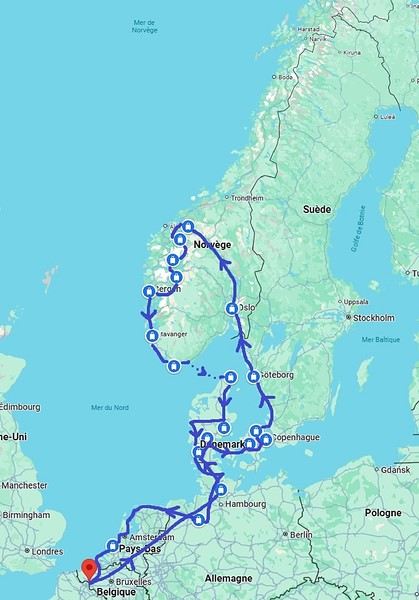
Originally, I’d planned to just do a loop around Kattegat, with the *Under* restaurant in Lindesnes as our anniversary treat... but along the way, we thought, why not "push" a little further north, keeping an eye on the budget since we’d chosen to travel by car in June 2025 through Scandinavia.

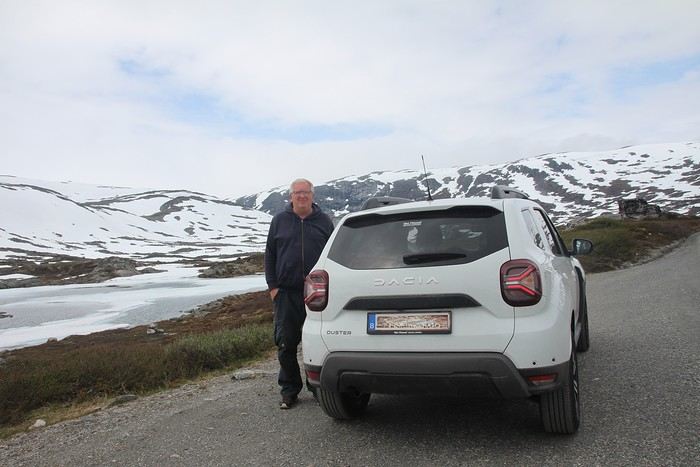
Why by car when most travelers opt for a camper van, while others prefer the comfort of cruises? Well, because we don’t own a camper van, renting one is pricey, and then you’ve got to add fuel costs (those things guzzle gas!), ferry fees, and other "tolls." All things considered, we went for mostly rentals—especially since there were four of us at the start of the trip. We spent the first week in Denmark with our daughter and son-in-law. Then they flew back to Belgium, and we continued our adventure as a couple. For accommodation, we mainly booked Airbnb apartments, which helped keep costs down and, most importantly, let us prepare our own meals (diet, diet!). In this travel journal, you’ll discover (or rediscover, for those who followed my older ones) our unbridled love for theme parks, museums, unique experiences, and—especially in Denmark—Legos! Unfortunately, we didn’t do any hikes this year because the unpredictable weather had made the trails slippery, and since I’d already taken three tumbles during the trip, I didn’t want to risk another! In the end, we traveled for 32 days, covered 6,200 km, and most importantly, discovered the charming country of Denmark, marveled at Norway’s breathtaking fjords—all without suffering the heatwave that hit France and Belgium that June! If you’ve got any questions, don’t hesitate to ask!

Why by car when most travelers opt for a camper van, while others prefer the comfort of cruises? Well, because we don’t own a camper van, renting one is pricey, and then you’ve got to add fuel costs (those things guzzle gas!), ferry fees, and other "tolls." All things considered, we went for mostly rentals—especially since there were four of us at the start of the trip. We spent the first week in Denmark with our daughter and son-in-law. Then they flew back to Belgium, and we continued our adventure as a couple. For accommodation, we mainly booked Airbnb apartments, which helped keep costs down and, most importantly, let us prepare our own meals (diet, diet!). In this travel journal, you’ll discover (or rediscover, for those who followed my older ones) our unbridled love for theme parks, museums, unique experiences, and—especially in Denmark—Legos! Unfortunately, we didn’t do any hikes this year because the unpredictable weather had made the trails slippery, and since I’d already taken three tumbles during the trip, I didn’t want to risk another! In the end, we traveled for 32 days, covered 6,200 km, and most importantly, discovered the charming country of Denmark, marveled at Norway’s breathtaking fjords—all without suffering the heatwave that hit France and Belgium that June! If you’ve got any questions, don’t hesitate to ask!

Hi! I’m planning to visit the Stockholm Archipelago by bike in early April.
Do you know if the boats will be running between the different islands at that time of year? For those who’ve already been, all your tips and recommendations are welcome—accommodation, etc. Also, do you know where I can rent a bike in Stockholm? Thanks so much in advance for your help!
Hello,
I’m looking for a trek itinerary for two people in Sweden—something authentic, varied, and spectacular (transport from Stockholm). My partner and I have experience in Norway (Dovrefjell and Jotunheimen) and would love to explore Sweden’s landscapes. Naturally, I’ve been considering the Sarek / Padjelanta / Stora Sjöfallet area. I haven’t decided on a specific destination yet, so I have a few questions and would love input from experienced travelers.
- Which region of Sweden should be a priority if we love mountains?
- Starting in mid-July, which summits in the Sarek / Padjelanta / Stora area are interesting and accessible without gear (crampons, rope, ice axe)? We have solid mountaineering experience and want to gain elevation without overloading our packs. Ideally, summits without crevassed glacier crossings and minimal technical climbing (easy scrambling).
- How many days does it take to complete the north-to-south traverse of Sarek?
Thanks for your tips and ideas! :)
I’m looking for a trek itinerary for two people in Sweden—something authentic, varied, and spectacular (transport from Stockholm). My partner and I have experience in Norway (Dovrefjell and Jotunheimen) and would love to explore Sweden’s landscapes. Naturally, I’ve been considering the Sarek / Padjelanta / Stora Sjöfallet area. I haven’t decided on a specific destination yet, so I have a few questions and would love input from experienced travelers.
- Which region of Sweden should be a priority if we love mountains?
- Starting in mid-July, which summits in the Sarek / Padjelanta / Stora area are interesting and accessible without gear (crampons, rope, ice axe)? We have solid mountaineering experience and want to gain elevation without overloading our packs. Ideally, summits without crevassed glacier crossings and minimal technical climbing (easy scrambling).
- How many days does it take to complete the north-to-south traverse of Sarek?
Thanks for your tips and ideas! :)
Hi there,
We’re planning to tour Scandinavia by camper van—Denmark, Sweden, Finland, and Norway (in that order)—for 5 weeks from late May to late June 2026.
I’ve done it before, but that was way back in 1980 😎 and by hitchhiking!
We’d love to hear from anyone who’s done this trip about the best routes, great tips, must-know advice, and what to do or avoid (ferries, campsites, etc.).
Thanks in advance!
Hello fellow cycle-tourers!
First post on this site for our first big family cycling adventure with our two teens (12 and 16 years old) over 2 months. We're preparing to leave in June/July from Erdeven by bike, then take the train from Auray to Paris, followed by a FlixBus from Paris to Copenhagen with our 4 bikes. After that, we're looking to refine our route: Should we go to Sweden via Helsingborg and then head up to Stockholm along the west or east coast? Maybe passing through the Gotland islands, then via the Åland Islands, why not Turku? Then off to Estonia to Tallinn, ride a bit along the coast, and return by bus if we can find one that takes 4 bikes. :))
Could you share any tips on routes in Sweden: west coast or east coast to prioritize in the south? We’ve heard it’s a shame not to go up to Norway, but we’re worried about the elevation and don’t see how to make a loop work in our 2 months / 1500 km. Any ideas? And the southern Finnish coast: should we go all the way to Helsinki or not? Maybe at the expense of Estonia?
In short, we know choosing means giving something up, but if we can do it with advice from fellow cyclists, that would be amazing! Thanks in advance for your tips! Anne-Sophie and the whole Breton family: David, Axel, and Maude
Could you share any tips on routes in Sweden: west coast or east coast to prioritize in the south? We’ve heard it’s a shame not to go up to Norway, but we’re worried about the elevation and don’t see how to make a loop work in our 2 months / 1500 km. Any ideas? And the southern Finnish coast: should we go all the way to Helsinki or not? Maybe at the expense of Estonia?
In short, we know choosing means giving something up, but if we can do it with advice from fellow cyclists, that would be amazing! Thanks in advance for your tips! Anne-Sophie and the whole Breton family: David, Axel, and Maude
EDITOR’S NOTE: As with every travel journal I publish, I won’t force anyone to agree with my comments—they’re my own, I share my feelings, and that’s it. Your comments are, of course, welcome, but I’ll refrain from responding to any hint of controversy, as has happened in the past.
For the summer holidays of 2018, we decided to take a break from long-haul, transcontinental trips. They’re expensive and exhausting, and this year, we also had to consider our young student’s limited vacation days. So, it was a short 14-day circuit in Scandinavia. Very quickly, I had to abandon the unrealistic idea of driving door-to-door with our personal car (unlike last year—see my "Balkan Stroll" story). Too many kilometers and stops. Still, crossing Poland, Lithuania, Estonia, and Latvia before taking a ferry from Tallinn to Helsinki and Finland was tempting—what a shame.
As usual, I planned ahead and started booking in early February for a mid-July departure, typically the best time weather-wise for this destination. Browsing tour operator catalogs didn’t offer much insight—just the usual circuits. Most aim for the North Cape, but we didn’t have time for that. First, via Expedia, we booked our flight tickets: Paris to Stockholm, Helsinki to Paris for the return (880 euros for three), plus a domestic flight from Oulu to Helsinki in Finland (220 euros). The unanimous advice was that there’s not much to see between the two cities, so this saved us a night’s accommodation and a day of car rental. However, the "drop-off" fees (not returning the car to the country of origin) were unavoidable. Out of 1,100 euros for 12 days of rental, this fee was significant—I say this from memory because I never received a detailed document or even the contract itself after picking up the car, despite my complaints. That said, Holiday Autos offered the best rates at the time with Hertz. Plus, I think we were unknowingly upgraded to a Volvo XC 40 T5 automatic, packed with electronics and an incredibly efficient GPS (so I lugged around my updated TomTom for nothing). I wasn’t used to it, and I’ll come back to that. For 50 euros, I also booked one of the many mandatory ferry crossings in Norway—unless you want to drive kilometers around the countless fjords. Specifically, the Bognes-Lødingen route to reach the Lofoten Islands, a must-see in Norway (though not necessarily the best choice I made—I’ll come back to that). Then, gradually via Booking.com, I reserved hotel accommodations, which wasn’t easy at reasonable prices. For three people, it’s nearly impossible to find a room with three real beds—often a sofa bed or even two separate rooms!!!! Norway isn’t a budget-friendly destination for us, yet French tourists are everywhere—groups or families traveling independently. Okay, you’re probably wondering when I’ll get started—I’m getting there... First up, Stockholm, a two-hour flight from Paris. A first for us: we’d gotten used to online check-in within 30 hours of the flight and sometimes printing our boarding passes. But, as progress never stops, at Roissy, we now also print our baggage tags at a kiosk, then place them on the conveyor belt ourselves, scan the barcode with the handheld scanner, and watch the luggage disappear—hoping it doesn’t get misrouted. With all this reduced staff, I hope ticket prices will drop. What? Huh? I’m naive... Okay, fine! Plus, during the flight, don’t expect any snacks—everything’s paid for now, except for water and coffee. I didn’t think I was on a low-cost flight!!! Picking up the car at Arlanda Airport went smoothly, except the contract signed on a tablet (progress, right?) was never emailed to me as promised—too bad... The Volvo SUV packed with electronics: as usual, aside from adjusting the mirrors and seat, I didn’t bother learning all the features and accessories for better handling. So, from the start, I felt jerky movements in the steering, independent of my control. The white-line detection was activated and corrected my direction whenever I got too close... And that’s not all—there’s also driving assistance. Besides the speed limiter, the car accelerates or brakes on its own based on the distance from the vehicle ahead. You still have to keep your hands on the wheel, though—too bad, we could’ve played cards and let it drive itself. When you slow down, if you signal to overtake and turn the wheel, it accelerates to pass. Soon, we won’t even need a driver’s license... Not to mention the little light in the side mirror to signal vehicles in the "blind spot"—very useful. But given the excessively strict speed limits in these parts, it’s still handy. I’ll unfortunately come back to this later!!!!!! In the end, we covered 4,700 km in 8 days of actual travel—no small feat!!!!!! Stockholm: still loyal to the hop-on-hop-off sightseeing buses (or the reverse), I booked our tickets online with a discount. It remains (for us) one of the best ways to visit and get around big cities. The tourist attractions aren’t that numerous. Forty kilometers from the airport, we reached our hotel, Clarion Amaranten. At reception, we were told our reservation was for four days, not two. I insisted, and they told me to call Booking.com to fix it—they couldn’t do anything themselves. Luckily, a nice blonde understood the situation and asked where we were from to lighten the mood. For me, it worked... After a few minutes of back-and-forth, we realized a namesake had booked at the same time. I think the intern got mixed up—oh well. We finally dropped off our bags and headed out under the sun for the included boat tour. It’s beautiful and relaxing under 26°C. We glided past massive cruise ships, very common in these Nordic countries, especially for fjord tours.
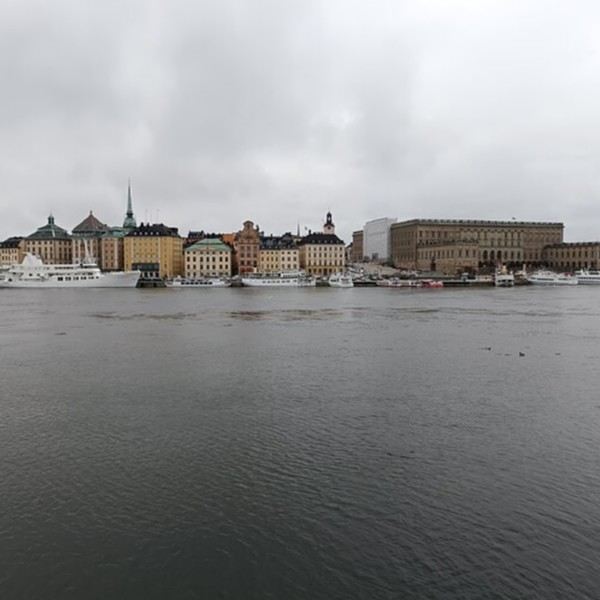
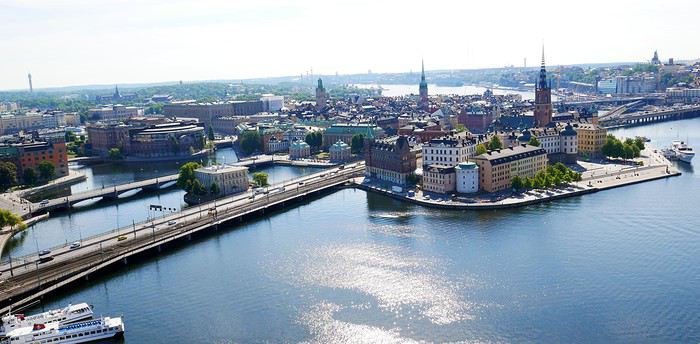
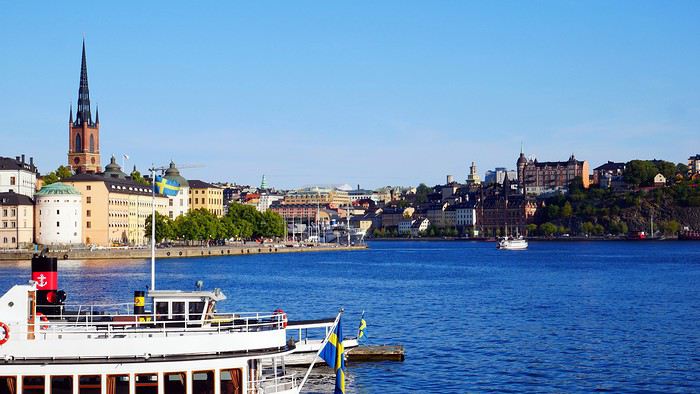
We passed Djurgården, one of the city’s 14 islands, home to the Tivoli amusement park and several museums, including the ABBA Museum and the Vasa Museum. I’m not talking about the crispy sandwiches sold since 1919 but the infamous warship that sank in the harbor on its maiden voyage in 1628 after sailing just a few hundred meters. Its intact hull was salvaged in 1961, and since then, it’s one of Sweden’s most visited museums. The country is a quarter smaller than France and has 10 million inhabitants, mostly in the three big cities (Stockholm, Gothenburg, Malmö). The rest is empty, filled with lakes and forests. The currency is the krona, with 1 euro worth about 10 SEK. Dinner in the Old Town consisted of a so-called Viking burger (more like a kebab) and meatballs—the famous Swedish meatballs with potatoes, just like at IKEA... I have to say, here, it seems the Vikings have long been just blond heads—I get it... It still cost us 550 SEK. A beer alone costs at least 9 euros!!!!
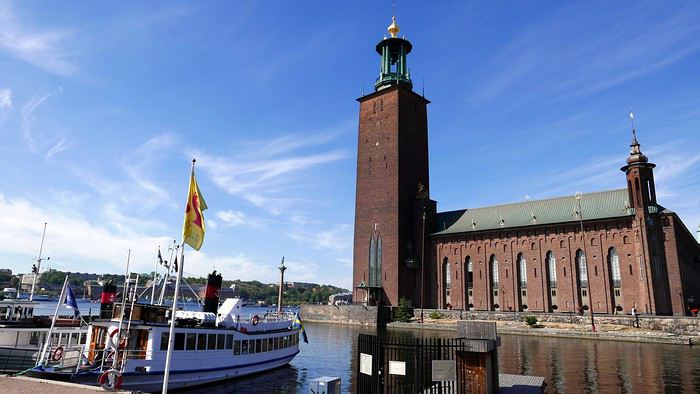
DAY 2. Sunny skies. After a hearty buffet breakfast with salmon, herring in all forms, eggs, cold cuts, bread, and pastries (don’t worry, the classics are there), we started the day by visiting the City Hall tower, famous for hosting the Nobel Prizes (except the Peace Prize, awarded in Oslo). At 106 meters tall, with 365 steps and 9 clocks, it weighs twice as much as the Eiffel Tower. Access is at fixed times in small groups for safety. You can climb up to 73 meters for a 360° view of the city. Next, we visited the Royal Palace, still the official residence of the King of Sweden, and its Treasury (entry: 160 SEK). We skipped the 12:15 PM changing of the guard—three-quarters of an hour before, dozens of onlookers were already crowding the front rows in the sun.
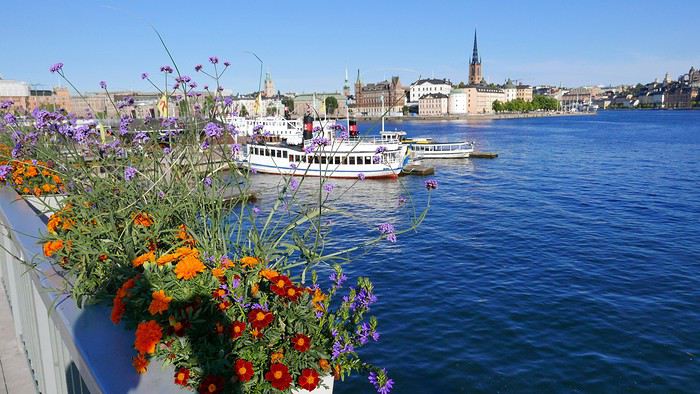
So, we took our favorite bus to rest a bit and tour the city. We also took the subway to see several "decorated" stations—love it or hate it, but it’s original. In the late afternoon, we returned to the Old Town and its Gamla Stan to find some souvenirs, even if it feels more like Bollywood than Viking country, complete with music in the shops—a nice sign of integration... One of the first things that surprised us was the very light car traffic—no traffic jams in this capital. But there are tons of electric and regular bikes, skateboards, and scooters. Also, lots of roadwork and housing construction—apparently a big need. For dinner (our only meal of the day), we treated ourselves to something local at Borgmästaren (Stora Nygatan 35). DECIDEDLY, I’M TELLING YOU EVERYTHING...
DAYS 3 & 4. Contrary to what I was told upon arrival, the hotel parking (700 SEK for 2 nights) didn’t open at 7:00 AM but at 9:00 AM on Saturday. After having to call myself (the French-speaking African receptionist couldn’t do it for me, especially after I told him I thought Croatia would win against France in the World Cup final), the kind parking attendant (partnered with the hotel—there’s the catch) arrived early and let us leave at 8:30 AM to start our east-to-west route to Norway and Oslo, 530 km away, finally beginning our summer adventure. At the border, absolutely no checks, and on the road, aside from lakes and forests, not much to see. However, tolls are very common—don’t overlook this in your budget. In Sweden, everything’s covered by the rental company, but not in other countries. In Norway, there are many automatic toll sections—cameras film your license plate and send you the bill later. So, you must register online at www.epcplc.com/rental, with or without your credit card details, and wait for the final bill. As of now, I haven’t received it, but after noting almost all of them, it should easily reach 200 euros. Roads, tunnels, and bridges are often toll-based to fund maintenance or new constructions. We reached the Norwegian capital at 3:00 PM and checked into our room. Small hiccup: the hotel parking, not reservable, was full on Saturday. Parking meters only take coins for a max of 2 hours. Luckily, tomorrow’s Sunday—free parking from 8:00 PM until Monday morning. After circling the neighborhood, I finally found a spot for my little car—even if it’s not mine, I still care about it...
The Thon Slottsparken Hotel is slightly off-center, but a little walking won’t hurt. The nearby Hertz agency was closed—too bad, I would’ve liked to complain about still not receiving my rental contract by email... With the nice weather, we started with a walking tour of the main sights: the palace, Karl Johans gate (the main street), and some souvenir shopping to fill the display cases back home—if there’s space. We also visited the deserted Akershus Fortress, where two poor young soldiers stood guard in the scorching sun. Below it, the World Cup final fan zone was being set up. Dinner was at Rorbua for 90 euros—ouch. Hard to find, tucked away from the harbor pier. We skipped the paid ascent of the city’s only "tower" with a panoramic view—tickets had to be paid by credit card, and given the fees my bank charges, I’d had enough. Note that card payments are widely accepted here, even for small amounts. When I tried to get change in cash for a 50-euro equivalent bill, some café owners were embarrassed.
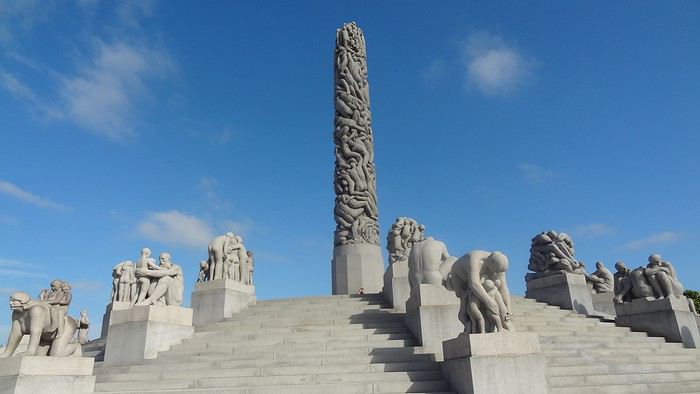
DAY 4. After discussion, we planned the day: first up, one of Oslo’s must-sees, the Vigeland Sculpture Park, featuring bronze, granite, and cast-iron works by Gustav Vigeland (1869–1943). Given the distance, we took the tram—some cars still had their old-school charm!!!! Despite the early hour, hordes of Asian tourists were already there, making photo-taking a nightmare—same everywhere they go. The park is a matter of taste... The 17-meter monolith with 121 intertwined bodies is remarkable, and rightly so. Lazy, we took the tram again to save time—same name, tight schedule. I stopped by the Hertz agency, where the overwhelmed employee promised to try to help. Given his enthusiasm, I doubted it. From the start, I’ve really felt the welcome here, at least for French visitors, isn’t great. Remember my previous reports—it’s becoming a habit. Tourist brochures aren’t available in French here either—strange... Anyway, we took a relaxing fjord cruise. Besides the quirky opera house, the beautiful summer homes on the islands were really tempting. Next, with another paid boat, we headed to the Bygdøy peninsula and its museums. We skipped the Viking Ship Museum in favor of the Norwegian Folk Museum. It features different buildings from across the country, by era and region. Unfortunately, few actors in period costumes—common in this type of tourist attraction. Its real highlight is the stave church, very beautiful. On this late Sunday afternoon, bars and restaurants competed to become World Cup 2018 fan zones—crowds everywhere. So, we decided to head back to rest and catch a glimpse of the African French team against Croatia. It’ll go down in history: a 4-2 victory, with a beautiful goal by Lloris... Go "Les Bleus"—I get it...
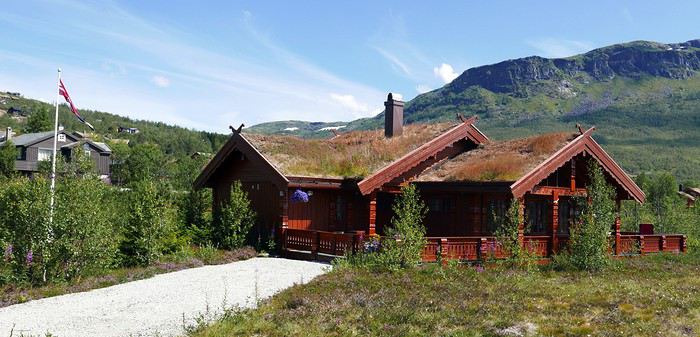
DAY 5. Oslo to Bergen: 450 km, but with detours, it was nearly 550. The real journey begins. Departure at 7:00 AM after sleeping in and a mediocre breakfast. Arrival at 5:00 PM—yes, driving’s slow... More tolls, but under 26°C, the real beauty starts around Geilo. First real fjord—it’s stunning. Then those houses with vegetated roofs blending perfectly into the landscape, sometimes nearly invisible... (Not bad, right? And it’s all me!!!)
We also discovered tunnels with "indoor roundabouts" and underground roads crossing—never seen that before!! We followed the shores of Lake Tyrifjord and the Hallingdal valleys. After Geilo, views of the Hardangerjøkulen glacier (achoo!) and the Vøringfossen waterfall (Norway’s highest at 163 meters) and Steinsdalsfossen in the Hardangerfjord (the country’s second-longest). Bergen, Norway’s second city, is built between seven mountains. Aside from the colorful old docks along the wharf, there’s not much to see. At the market, stalls of fresh fish, jars of various fish eggs (all called "caviar" here), and cold cuts made from reindeer, moose, and whale.
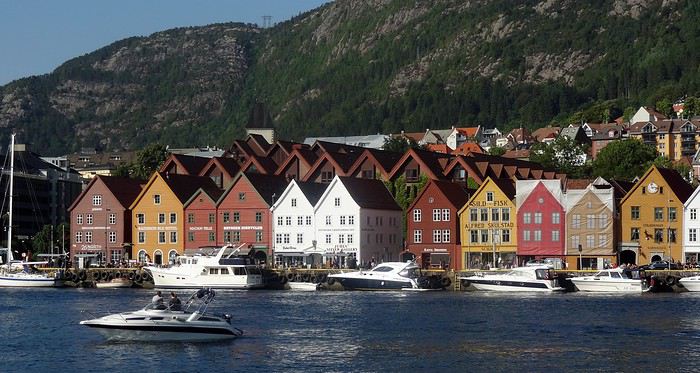
For 10 euros per person, we queued for the steep funicular for a great view of the city. Dinner was at "Fish Me," very busy. The salmon looked appetizing, and my first whale steak for 27 euros was... interesting. Our hotel, Augustin, is near the center. They charged me 150 NOK to park in the nearby public lot...
DAY 6. Bøverdalen, our evening stop, was less than 300 km away, but along the way, we had our first two scenic routes and first ferry crossing. When I got back in the car, I noticed the seagulls—rightful tenants of the harbor—had turned it into a Picasso painting overnight... First stop in Voss to peek inside its Vangskyrkja church (for a fee). The mural icons all have a marked squint, making the angels on the ceiling smile—quite the original touch. In 1277, it shocked people.
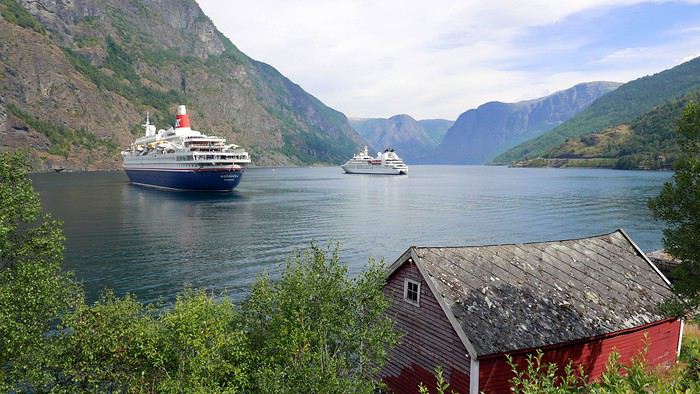
Gudvangen at the end of the Nærøyfjord offers beautiful views and a waterfall. An 11 km tunnel took us to Aurland and the Sognefjord, the king of fjords at 180 km long. Then we took Route 243 to Lærdal instead of a second long tunnel. A 47 km very narrow road with no passing except in designated spots. Buses, RVs, and trailers were in the mix—between backing up and moving forward, how do you expect me to... pass? At some spots, I had to "burn some oil" (non-edible). The beautiful viewpoints along Jotunheimen Park and its high peaks were hard-earned.
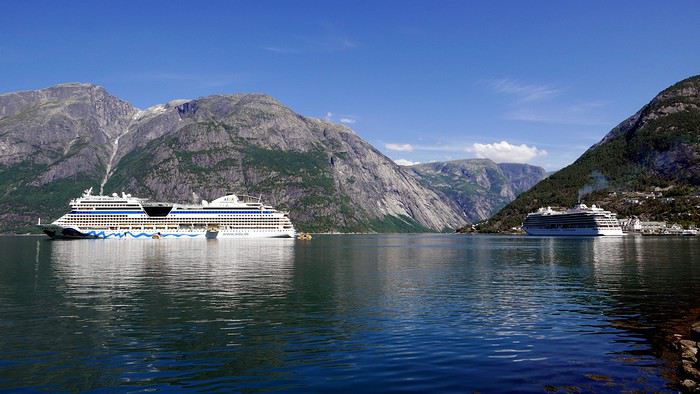
By midday, the 26°C of previous days gave way to 11°C with downpours and gusts. To reach Kaupanger, its stave church, and Route 55 (108 km), we took the Fodnes-Mannheller ferry for 119 kr (about 13 euros) for a 20-minute crossing. For these short trips, rotations are frequent, and wait times are short. The Sognefjellet route took us along lakes and snow-capped peaks—too bad the weather wasn’t cooperating. In Bøverdalen, in the middle of nowhere, we reached the Elveseter Hotel, the only one in the area, and it was packed. Luckily, it’s big. Recent reviews had us a bit worried, but personally, all the well-maintained wooden buildings gave the place charm. Our two small, simple rooms had character, and the common areas’ decor was interesting—a pile of antiques... Unless you dine on-site (reservations required for one of two sittings), the only option is to drive 20 km to Lom to see its beautiful stave church—but we didn’t go in (7 euros per person, and that’s enough). Dinner was three pizzas for 70 euros—yes, it’s expensive here.
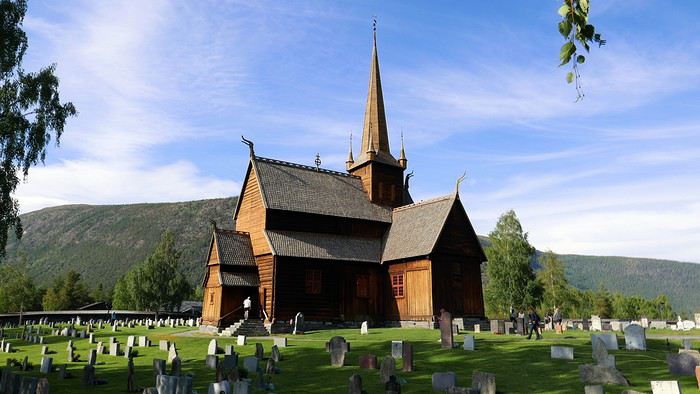
Note that in most establishments, bars, or restaurants, you have to order and pay at the counter yourself. A *stavkirke* or *stavkyrkje* (in Norwegian Bokmål and Nynorsk) is a medieval wooden church typical of Norway, though excavations suggest similar churches may have existed elsewhere in Northern Europe. About 1,300 medieval churches were recorded, with 28 preserved in Norway. In French, they’re called "églises en bois debout" (standing wood churches) because masts or posts support the roof and nave elevation, as well as the walls. The stave church is one of the most elaborate and technically advanced types of wooden construction in Northwestern Europe during the Middle Ages. This technique is represented by the Urnes Stave Church (a UNESCO World Heritage Site), Borgund (the best-preserved in its medieval form), and 25 others—from the largest, Heddal, to the smallest, Undredal, in the stunning Sognefjord, plus a few others in Northwestern Europe.
DAY 7. Heading to Trondheim—supposedly 320 km, but with detours, it was nearly 550. Unpredictable weather until about 1:00 PM, but it’s better because it’s the day of the "triples": 3 scenic routes, 3 ferries, and 3 "underwater" tunnels. No rush—here, there’s no need to "hurry to arrive before night" because as you head north, the sun lingers and sets less and less, eventually not setting at all. First, in Grotli, we took the 27 km of Route 258, *Gamle Strynefjellsvegen* (achoo), also very narrow and unpaved in the first section. Luckily, campers and RVs aren’t early risers—otherwise, I’d have had to make not just oil but olives this time. We only passed four other users. However, despite the early hour, local road workers were already on the job, and we had to ask the excavators to move several times to let us pass. At Langvatnet, we joined Route 63, called the Eagle Road here—mediocre, except for Geiranger at the end of the narrowest fjord in the country. A cruise ship had just unloaded its passengers, who rushed into the few shops. After the Eidsdal-Linge ferry (10 minutes) and Gudbrandsjuvet with its waterfalls, we tackled the famous Trollstigen (Troll’s Path), winding and very touristy. Coming from the south, we descended it. Mandatory photo stop at the tourist center and its impressive walkway. The descent into the valley was tough—the bus driver ahead of us must’ve been disabled, blind, and quadriplegic, taking two tries at every hairpin turn, causing a traffic jam behind and for those "going up" waiting at passing spots!!!
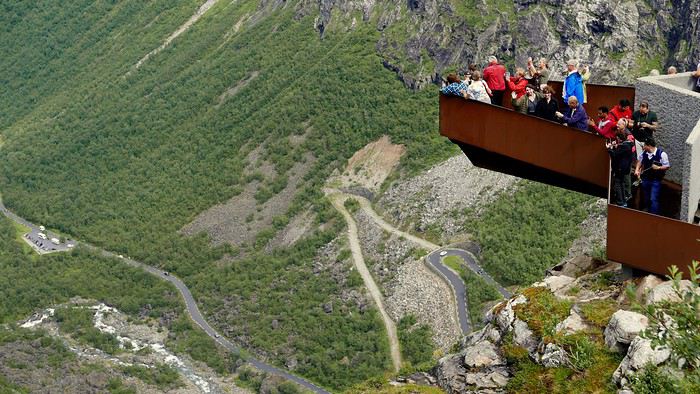
On Route 64, we took the Åfarnes-Solnes ferry instead of the initially planned 660 because my young passenger insisted on part of the "Atlantic Road." From what we’d read on blogs, only the last 11 km are spectacular, with arched bridges connecting islets. So, in Molde, we headed to Eide, then Vevang—beautiful but nothing more. The rain spoiled the scenery. Quick photo stop in Kristiansund, then a long underwater tunnel and the Kanestraum-Halsa ferry (7 km, 20 minutes) to reach the E39 toward Trondheim.
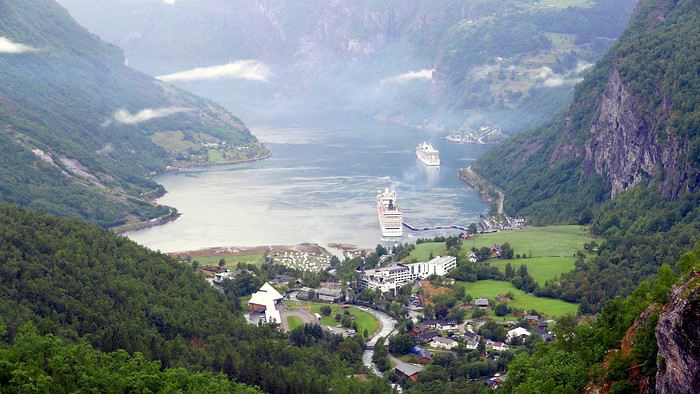
We all agreed that all these wooden houses and churches reminded us of the U.S. in their architecture—especially since, like there, a flagpole with the national flag often stands in front of homes. Trondheim, Norway’s third city, doesn’t have much to see. A university town in the country’s center, aside from its Nidaros Cathedral (closed when we arrived late), its wooden bridge, and colorful old docks on pilings—nothing else. Even finding food was complicated. As for accommodation, Booking.com had forgotten to mention that the Nidaros Pilgrimsgard is a "pilgrim hostel" on the Camino de Santiago. Monastic atmosphere and spartan rooms for reflection—same for the frugal breakfast in silence... Anyway... Luckily, the night before, in a kitschy place run by hip youngsters, I’d stocked up on a hearty assortment of marinated herring with aquavit that burned the rest of my esophagus. (BAKLANDET SKYDSSTATION) I’m really doing all the work for you...
DAY 8. Heading to Mo i Rana—633 km actually covered instead of the planned 480 through Nord-Trøndelag!!! After Steinkjer and its fjord, we decided to take Route 763, parallel to the E6, for less traffic and to see pretty mountain villages. We also stopped in Bola to see a petroglyph (Stone Age rock carving) of a reindeer. After Medja, we skipped Kjerringfoss and Europe’s largest salmon ladder (paid access). Instead, via the Holm-Vennesund ferry, we took a bit of the scenic Route 17 before reaching Mosjøen and Mo i Rana (too many ferries if you do the whole route). Along the way, we saw reindeer and moose relaxing on the road several times. Mo i Rana is small. The Ole Tobias Hotel was packed, and parking was complicated. For dinner, we crossed the street to "No. 3," the only option. Two spicy bacalao and a whale steak cost us 90 euros... At this rate, I had to find an ATM to finish the Norwegian stay properly. The 2,000 euros exchanged before leaving (at 9.28) were already partially gone. Cigarettes cost 13 euros a pack here—twice as much as in Sweden—while unleaded gas is 1.85 euros per liter.
DAY 9. Heading to the main event of the trip: the Lofoten Islands. First programming mistake: not studying the subject well, I preferred a shorter ferry crossing from further north on the mainland. But that also meant arriving further north on the islands.
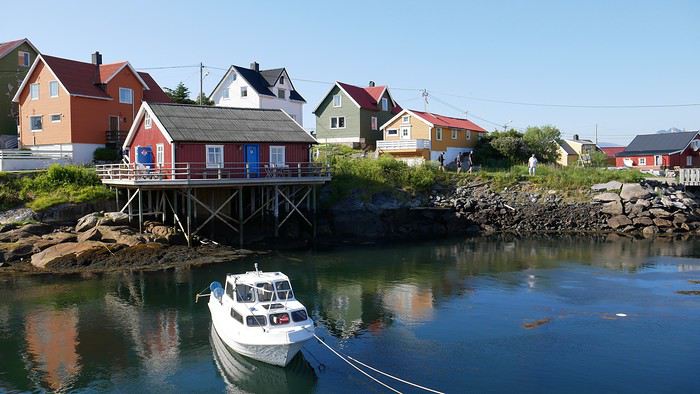
I booked for 50 euros (vehicle, driver, and two passengers included on the official Torghatten Nord site) for Bognes-Lødingen—a one-hour crossing. I should’ve left from Bodø to Leknes or better yet Moskenes and the town of Å for three hours—it would’ve saved time by avoiding the drive north and crossing to the south before heading back up the islands. Luckily, we still managed two different routes. Fortunately, the great weather returned, and I have to say, IT’S REALLY, REALLY, REALLY... BEAUTIFUL... Memory cards are melting—not just from the heat.
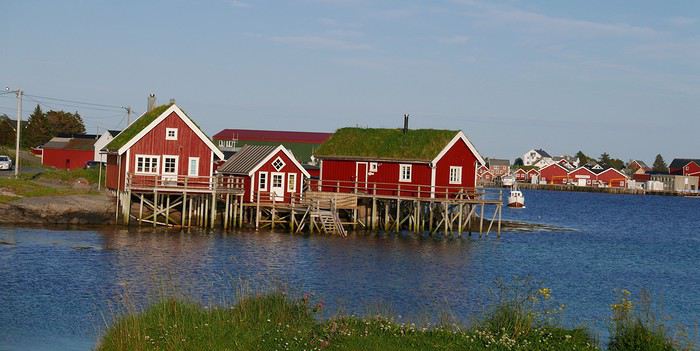
Two things worked in our favor, if I may say so, and countered my little blunder: first, I’d booked the 2:30 PM ferry, but arriving at the departure at noon, we easily took the earlier one—two hours saved. With the longer crossings, rotations with only two boats are much less frequent (8 to 12 per day depending on the season, vs. 6 to 8 for the southern route). Second, after Mo i Rana, we crossed the Arctic Circle, and today, the sun only "sets" from 12:20 AM to 1:50 AM. What luck! With a 7:40 AM departure (after sleeping in), I could drive until 11:00 PM easy!!!!!! And cover only 740 km!!!!!! Here, winters don’t drop below zero, but from early November to late January, it’s night almost all the time, with a supposed daylight clarity from 10:00 AM to 2:00 PM like a rainy day back home. But apparently, the northern lights and reflections on the snow also provide light!! I’d love to see that, but I’ll have to come back... We crisscrossed everything humanly possible, sometimes stopping abruptly in the middle of the road for photos—much to the locals’ dismay, but they’re used to the madness of temporary invaders enchanted by the place... These steep mountains "falling" into the water with all those colorful "rorbu" villages are magnificent. Rorbu are traditional fishermen’s cabins on stilts by the water, which over time have become the must-stay accommodation here—many have never housed any fishermen!!! The villages follow one after another, each more beautiful than the last. In Nusfjord, in season, pedestrians are even charged an access fee between 10:00 AM and 6:00 PM. At 7:00 PM, the booth was closed—lucky us, no crowd. The ochre wooden facades are beautiful, but don’t get too close—the seagulls nest there and see any approach as aggression. The result? Bomb-like droppings that can leave unpleasant memories. Go peek inside the grocery store—it’s kept its old-world charm. With the season, the many cod drying racks are empty. The hour turned, and our southward journey stopped in Reine—too bad for Å, not far, but fatigue got the better of me. We had to "go back up" to Kabelvåg for our rorbu at Nyvågar. We’d stocked up on groceries to eat quietly in this cozy little place (very small single beds upstairs).
DAY 10. We headed back north on the islands to reach Tromsø (grandiosely nicknamed the "Paris of the North"), with a late 7:50 AM departure despite 450 km to cover—things are getting lax at the end of the trip!!! However, this stop didn’t reveal much of interest—it’s the lake region, but meh. Tour operators include it as the last stop toward the far north. Aside from the Målselvfossen waterfall and its (paid) salmon ladder, nothing to report. We arrived at 3:00 PM, and the second room in our Quality Saga Hotel wasn’t ready yet. Plus, the parking we’d requested wasn’t accessible—the eight spots were taken. Even in this small town, free and easy parking is rare. Two souvenir shops and a main street (Storgata)—that’s it. Not to mention a nice storm that cooled things down. The only curiosity is the church, but it’s closed and under renovation—the exterior scaffolding ruins the only photo opportunity here. Otherwise, the Arctic Cathedral is visible from afar—that’s enough for us. The sun only sets for 20 minutes, from 12:40 AM to 1:00 AM!!!!! Last note before leaving this country: every morning at the breakfast buffet with all those eggs, I asked for a Norwegian omelet. Believe it or not, they don’t know the recipe for a Norwegian omelet!!!! 😏😛😉
DAY 11. Heading to Finland (with an extra hour time difference) and Rovaniemi, self-proclaimed official Santa Claus Village—it’s not nice to play on kids’ heartstrings for money!!!! On the 400 km of road (that or avoiding the Lofoten), nothing to see except two sad "Sami" shops. But there’s also AND ESPECIALLY: The run-in with a police radar mounted on the dashboard to welcome me to this country: alone, on a straight, flat road in the middle of the forest, I had this privilege—especially at a spot limited to 80 km/h instead of 100 as I thought. Of course, most well-meaning readers will think: serves him right... Only here’s the thing: in Finland, for years, speeding fines depend on the "Päiväsakko," meaning based on your income and number of children, a subtle calculation of average daily money is made and multiplied proportionally to the estimated severity of the offense... Ignorant of this, I naively but honestly answered the questions. The result? The fine was enormous—I won’t say the amount out of shame, but especially out of hatred for this country that ruined my vacation. Others like me, potential murderers, have been fined up to 170,000 euros (I wrote ONE HUNDRED SEVENTY THOUSAND EUROS) for a 40 km/h speeding offense!!!! I hope the clowns running France quickly adopt this particularly SOCIAL measure. Let the lazy and parasites of the country freely enjoy the road in their BMWs and MERCs!!! Let me tell you, I’ll spend my savings elsewhere in the future. So, a tip: be as dishonest as these conscientious police—say you’re unemployed with five kids, and maybe they’ll give you money!!!!! I’m really disgusted. No wonder in this nothing-to-see town, drivers sheepishly drive in a "little train" at 40 behind an RV without anyone daring to overtake. I think sometimes human stupidity should have limits, and the word freedom should regain its meaning!!! To those who understand, cheers. And as written at the start: trolls, abstain. I stand by what I said and sign it. After this brutal introduction to Finnish discriminatory laws, you can imagine Rovaniemi and its two-bit Santa Claus—I couldn’t care less. Even under the storm, at 6:00 PM on Sunday, even in summer, the scammer shops and profiteers of the Santa Claus Village (conveniently located on the Arctic Circle...) were already closed. Good riddance!!! The Arctic City Hotel is fine. I struggled to swallow my Tex-Mex at Pancho Villa (local chain).
DAY 12. Toward Oulu via Tornio, 200 km, and again, nothing to see in this land of lakes and forests. Detour and only photo stop in Tervola for a wooden church—my vacation is officially ruined... The Cumulus City Hotel is fine in this pleasant but empty and dull city, though it’s a university and tech hub. To cheer myself up, we splurged on a supposedly Viking meal at Harald—don’t know if the recipes are authentic, but my "Viking" knowledge stops at Vik, the animated boobs... Anyway, it’s good, unusual, and hearty.
DAY 13. After struggling to fill the tank (no station open with cash payment, only cards), we returned the chariot at the airport. The offices weren’t open yet at this early hour (8:35 AM flight), so I left the key in a mailbox without any inspection—I didn’t like that at all. I thought we’d get a propeller plane, but it was a well-filled Airbus. One-hour flight to Helsinki, the capital. Impossible to get clear information on buses to the city center, 40 km away. So, for 37 euros, we took a taxi with a trunk big enough for our three suitcases and three "cabin" bags. I’m not counting the cost anymore. At 10:00 AM, we could finally check into our large triple room at the Cumulus City Hotel on Hakaniemi Square—again, despite the size, with a fold-out armchair bed. Off to visit our last city, with the obvious purchase—you guessed it—a 24-hour bus ticket with a 1.5-hour mini-cruise for 43 euros per person...
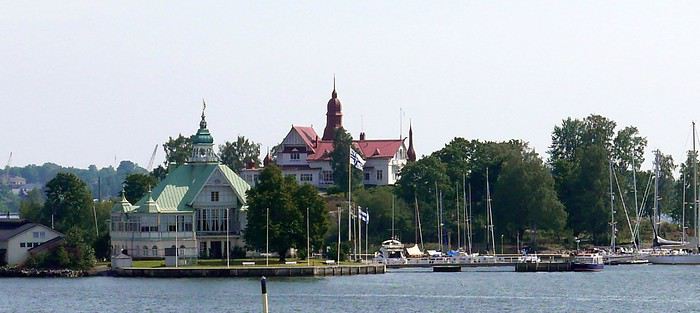
The boat tour showed that the standard of living seems high here too—summer homes (or not) on the islands are very beautiful. A small canal was even dug to save these lucky owners time on maritime transport. Apartments sell for a fortune. Back at Market Square, we grabbed a snack at the market—a reindeer kebab with dried reindeer, cheese, and a mini cracker—simple but delicious. No time to waste—ours is limited. Even if there’s not much to see tourist-wise. Four churches compete: the very busy and beautiful Helsinki Cathedral (better outside than in), its direct rival the Orthodox Uspenski Cathedral (same), the Rock Church (Temppeliaukio) and the Wooden Church (Kampin)—both as beautiful inside as out!!! Here too, very little car traffic, but tons of people—tourists or not—and joggers. In the evening, a bit tired, we headed to the off-center hotel to try the Scandinavian Hesburger chain. For connoisseurs and 29 euros, decent fries and burgers resembling Burger King’s—while the other American giant is left behind. Personal taste, I guess. The next day, we took the bus tour again, passing the Parliament and the controversial Sibelius Monument—a 24-ton pile of clanging iron pipes. Then, to kill time, we headed to Linnanmäki amusement park, on a hill overlooking the city. Rides are packed together, and a new one appears every year. Mostly family-oriented, but two or three thrill rides were packed. Despite my advancing age, I gave it a try—obviously regretted it afterward... Europe’s oldest wooden roller coaster (1950) shows the genius of its creators, with a brakeman at the back—worth the detour and passes the time. We ate (if you can call it that) on-site for 19 euros. Back "in town," classic shopping centers are numerous, but souvenir shops can be counted on one hand. No matter—we had to pack because tomorrow’s the return. We ate burgers again near the hotel and Hes... but served at the table for 67 euros. The next morning, to kill time before the 4:00 PM flight, we went to the port and its tourist market, where I splurged 15 euros on a cap to add to (or clutter) my already well-stocked collection. We finally learned that bus 615 goes to the airport, with a stop in front of our hotel where the luggage was left in storage after checking out. Still, count 40 minutes with this indirect route. Via an Air France flight operated by Finnair, after 3 hours, we returned to Roissy CDG—our vacation is truly over!!!!!!
CONCLUSION (if I may) Among the three capitals we visited, our unanimous ranking is: Oslo, Helsinki, and Stockholm—period. Despite a few imperfections in my itinerary, I’d say the Lofoten Islands are really worth it—two days on-site is a minimum. Finland, and not just because of the radars, is way below—nothing to see tourist-wise. I didn’t say nothing to do for those with time—nuance... Norwegian fjords, even if once you’ve seen one, you’ve seen them all, are really beautiful, though this destination is quite expensive for us. Norway, thanks to its oil and gas, is very wealthy, near full employment, with an annual GDP per capita of 70,000 euros!!! A pack of cigarettes at 13 euros and beer at 10 euros doesn’t make this a dream destination for an addict like me. We were very lucky with the weather—only two and a half days of rain over 14, unlike many bloggers whose stories I read before leaving. The welcome wasn’t always what we expected. Despite the massive French presence, we’re not always as welcome as Asian conquerors, to whom the West, racing to its doom, continues to roll out the red carpet—literally! I don’t regret our choice—it’s worth seeing once, but only once. At least now we know what we’re talking about!!!!! Finally, as always, here’s the link to my public slideshow on YouTube. For the private one, some spicy scenes (especially with Santa and a troll) could cause me more problems—I’ve had enough!!! www.youtube.com/...zbIgZC6Pk&t=165s See you soon, maybe for new adventures and getaways. DJ93.

For the summer holidays of 2018, we decided to take a break from long-haul, transcontinental trips. They’re expensive and exhausting, and this year, we also had to consider our young student’s limited vacation days. So, it was a short 14-day circuit in Scandinavia. Very quickly, I had to abandon the unrealistic idea of driving door-to-door with our personal car (unlike last year—see my "Balkan Stroll" story). Too many kilometers and stops. Still, crossing Poland, Lithuania, Estonia, and Latvia before taking a ferry from Tallinn to Helsinki and Finland was tempting—what a shame.

As usual, I planned ahead and started booking in early February for a mid-July departure, typically the best time weather-wise for this destination. Browsing tour operator catalogs didn’t offer much insight—just the usual circuits. Most aim for the North Cape, but we didn’t have time for that. First, via Expedia, we booked our flight tickets: Paris to Stockholm, Helsinki to Paris for the return (880 euros for three), plus a domestic flight from Oulu to Helsinki in Finland (220 euros). The unanimous advice was that there’s not much to see between the two cities, so this saved us a night’s accommodation and a day of car rental. However, the "drop-off" fees (not returning the car to the country of origin) were unavoidable. Out of 1,100 euros for 12 days of rental, this fee was significant—I say this from memory because I never received a detailed document or even the contract itself after picking up the car, despite my complaints. That said, Holiday Autos offered the best rates at the time with Hertz. Plus, I think we were unknowingly upgraded to a Volvo XC 40 T5 automatic, packed with electronics and an incredibly efficient GPS (so I lugged around my updated TomTom for nothing). I wasn’t used to it, and I’ll come back to that. For 50 euros, I also booked one of the many mandatory ferry crossings in Norway—unless you want to drive kilometers around the countless fjords. Specifically, the Bognes-Lødingen route to reach the Lofoten Islands, a must-see in Norway (though not necessarily the best choice I made—I’ll come back to that). Then, gradually via Booking.com, I reserved hotel accommodations, which wasn’t easy at reasonable prices. For three people, it’s nearly impossible to find a room with three real beds—often a sofa bed or even two separate rooms!!!! Norway isn’t a budget-friendly destination for us, yet French tourists are everywhere—groups or families traveling independently. Okay, you’re probably wondering when I’ll get started—I’m getting there... First up, Stockholm, a two-hour flight from Paris. A first for us: we’d gotten used to online check-in within 30 hours of the flight and sometimes printing our boarding passes. But, as progress never stops, at Roissy, we now also print our baggage tags at a kiosk, then place them on the conveyor belt ourselves, scan the barcode with the handheld scanner, and watch the luggage disappear—hoping it doesn’t get misrouted. With all this reduced staff, I hope ticket prices will drop. What? Huh? I’m naive... Okay, fine! Plus, during the flight, don’t expect any snacks—everything’s paid for now, except for water and coffee. I didn’t think I was on a low-cost flight!!! Picking up the car at Arlanda Airport went smoothly, except the contract signed on a tablet (progress, right?) was never emailed to me as promised—too bad... The Volvo SUV packed with electronics: as usual, aside from adjusting the mirrors and seat, I didn’t bother learning all the features and accessories for better handling. So, from the start, I felt jerky movements in the steering, independent of my control. The white-line detection was activated and corrected my direction whenever I got too close... And that’s not all—there’s also driving assistance. Besides the speed limiter, the car accelerates or brakes on its own based on the distance from the vehicle ahead. You still have to keep your hands on the wheel, though—too bad, we could’ve played cards and let it drive itself. When you slow down, if you signal to overtake and turn the wheel, it accelerates to pass. Soon, we won’t even need a driver’s license... Not to mention the little light in the side mirror to signal vehicles in the "blind spot"—very useful. But given the excessively strict speed limits in these parts, it’s still handy. I’ll unfortunately come back to this later!!!!!! In the end, we covered 4,700 km in 8 days of actual travel—no small feat!!!!!! Stockholm: still loyal to the hop-on-hop-off sightseeing buses (or the reverse), I booked our tickets online with a discount. It remains (for us) one of the best ways to visit and get around big cities. The tourist attractions aren’t that numerous. Forty kilometers from the airport, we reached our hotel, Clarion Amaranten. At reception, we were told our reservation was for four days, not two. I insisted, and they told me to call Booking.com to fix it—they couldn’t do anything themselves. Luckily, a nice blonde understood the situation and asked where we were from to lighten the mood. For me, it worked... After a few minutes of back-and-forth, we realized a namesake had booked at the same time. I think the intern got mixed up—oh well. We finally dropped off our bags and headed out under the sun for the included boat tour. It’s beautiful and relaxing under 26°C. We glided past massive cruise ships, very common in these Nordic countries, especially for fjord tours.

We passed Djurgården, one of the city’s 14 islands, home to the Tivoli amusement park and several museums, including the ABBA Museum and the Vasa Museum. I’m not talking about the crispy sandwiches sold since 1919 but the infamous warship that sank in the harbor on its maiden voyage in 1628 after sailing just a few hundred meters. Its intact hull was salvaged in 1961, and since then, it’s one of Sweden’s most visited museums. The country is a quarter smaller than France and has 10 million inhabitants, mostly in the three big cities (Stockholm, Gothenburg, Malmö). The rest is empty, filled with lakes and forests. The currency is the krona, with 1 euro worth about 10 SEK. Dinner in the Old Town consisted of a so-called Viking burger (more like a kebab) and meatballs—the famous Swedish meatballs with potatoes, just like at IKEA... I have to say, here, it seems the Vikings have long been just blond heads—I get it... It still cost us 550 SEK. A beer alone costs at least 9 euros!!!!
DAY 2. Sunny skies. After a hearty buffet breakfast with salmon, herring in all forms, eggs, cold cuts, bread, and pastries (don’t worry, the classics are there), we started the day by visiting the City Hall tower, famous for hosting the Nobel Prizes (except the Peace Prize, awarded in Oslo). At 106 meters tall, with 365 steps and 9 clocks, it weighs twice as much as the Eiffel Tower. Access is at fixed times in small groups for safety. You can climb up to 73 meters for a 360° view of the city. Next, we visited the Royal Palace, still the official residence of the King of Sweden, and its Treasury (entry: 160 SEK). We skipped the 12:15 PM changing of the guard—three-quarters of an hour before, dozens of onlookers were already crowding the front rows in the sun.

So, we took our favorite bus to rest a bit and tour the city. We also took the subway to see several "decorated" stations—love it or hate it, but it’s original. In the late afternoon, we returned to the Old Town and its Gamla Stan to find some souvenirs, even if it feels more like Bollywood than Viking country, complete with music in the shops—a nice sign of integration... One of the first things that surprised us was the very light car traffic—no traffic jams in this capital. But there are tons of electric and regular bikes, skateboards, and scooters. Also, lots of roadwork and housing construction—apparently a big need. For dinner (our only meal of the day), we treated ourselves to something local at Borgmästaren (Stora Nygatan 35). DECIDEDLY, I’M TELLING YOU EVERYTHING...
DAYS 3 & 4. Contrary to what I was told upon arrival, the hotel parking (700 SEK for 2 nights) didn’t open at 7:00 AM but at 9:00 AM on Saturday. After having to call myself (the French-speaking African receptionist couldn’t do it for me, especially after I told him I thought Croatia would win against France in the World Cup final), the kind parking attendant (partnered with the hotel—there’s the catch) arrived early and let us leave at 8:30 AM to start our east-to-west route to Norway and Oslo, 530 km away, finally beginning our summer adventure. At the border, absolutely no checks, and on the road, aside from lakes and forests, not much to see. However, tolls are very common—don’t overlook this in your budget. In Sweden, everything’s covered by the rental company, but not in other countries. In Norway, there are many automatic toll sections—cameras film your license plate and send you the bill later. So, you must register online at www.epcplc.com/rental, with or without your credit card details, and wait for the final bill. As of now, I haven’t received it, but after noting almost all of them, it should easily reach 200 euros. Roads, tunnels, and bridges are often toll-based to fund maintenance or new constructions. We reached the Norwegian capital at 3:00 PM and checked into our room. Small hiccup: the hotel parking, not reservable, was full on Saturday. Parking meters only take coins for a max of 2 hours. Luckily, tomorrow’s Sunday—free parking from 8:00 PM until Monday morning. After circling the neighborhood, I finally found a spot for my little car—even if it’s not mine, I still care about it...

The Thon Slottsparken Hotel is slightly off-center, but a little walking won’t hurt. The nearby Hertz agency was closed—too bad, I would’ve liked to complain about still not receiving my rental contract by email... With the nice weather, we started with a walking tour of the main sights: the palace, Karl Johans gate (the main street), and some souvenir shopping to fill the display cases back home—if there’s space. We also visited the deserted Akershus Fortress, where two poor young soldiers stood guard in the scorching sun. Below it, the World Cup final fan zone was being set up. Dinner was at Rorbua for 90 euros—ouch. Hard to find, tucked away from the harbor pier. We skipped the paid ascent of the city’s only "tower" with a panoramic view—tickets had to be paid by credit card, and given the fees my bank charges, I’d had enough. Note that card payments are widely accepted here, even for small amounts. When I tried to get change in cash for a 50-euro equivalent bill, some café owners were embarrassed.
DAY 4. After discussion, we planned the day: first up, one of Oslo’s must-sees, the Vigeland Sculpture Park, featuring bronze, granite, and cast-iron works by Gustav Vigeland (1869–1943). Given the distance, we took the tram—some cars still had their old-school charm!!!! Despite the early hour, hordes of Asian tourists were already there, making photo-taking a nightmare—same everywhere they go. The park is a matter of taste... The 17-meter monolith with 121 intertwined bodies is remarkable, and rightly so. Lazy, we took the tram again to save time—same name, tight schedule. I stopped by the Hertz agency, where the overwhelmed employee promised to try to help. Given his enthusiasm, I doubted it. From the start, I’ve really felt the welcome here, at least for French visitors, isn’t great. Remember my previous reports—it’s becoming a habit. Tourist brochures aren’t available in French here either—strange... Anyway, we took a relaxing fjord cruise. Besides the quirky opera house, the beautiful summer homes on the islands were really tempting. Next, with another paid boat, we headed to the Bygdøy peninsula and its museums. We skipped the Viking Ship Museum in favor of the Norwegian Folk Museum. It features different buildings from across the country, by era and region. Unfortunately, few actors in period costumes—common in this type of tourist attraction. Its real highlight is the stave church, very beautiful. On this late Sunday afternoon, bars and restaurants competed to become World Cup 2018 fan zones—crowds everywhere. So, we decided to head back to rest and catch a glimpse of the African French team against Croatia. It’ll go down in history: a 4-2 victory, with a beautiful goal by Lloris... Go "Les Bleus"—I get it...
DAY 5. Oslo to Bergen: 450 km, but with detours, it was nearly 550. The real journey begins. Departure at 7:00 AM after sleeping in and a mediocre breakfast. Arrival at 5:00 PM—yes, driving’s slow... More tolls, but under 26°C, the real beauty starts around Geilo. First real fjord—it’s stunning. Then those houses with vegetated roofs blending perfectly into the landscape, sometimes nearly invisible... (Not bad, right? And it’s all me!!!)

We also discovered tunnels with "indoor roundabouts" and underground roads crossing—never seen that before!! We followed the shores of Lake Tyrifjord and the Hallingdal valleys. After Geilo, views of the Hardangerjøkulen glacier (achoo!) and the Vøringfossen waterfall (Norway’s highest at 163 meters) and Steinsdalsfossen in the Hardangerfjord (the country’s second-longest). Bergen, Norway’s second city, is built between seven mountains. Aside from the colorful old docks along the wharf, there’s not much to see. At the market, stalls of fresh fish, jars of various fish eggs (all called "caviar" here), and cold cuts made from reindeer, moose, and whale.

For 10 euros per person, we queued for the steep funicular for a great view of the city. Dinner was at "Fish Me," very busy. The salmon looked appetizing, and my first whale steak for 27 euros was... interesting. Our hotel, Augustin, is near the center. They charged me 150 NOK to park in the nearby public lot...
DAY 6. Bøverdalen, our evening stop, was less than 300 km away, but along the way, we had our first two scenic routes and first ferry crossing. When I got back in the car, I noticed the seagulls—rightful tenants of the harbor—had turned it into a Picasso painting overnight... First stop in Voss to peek inside its Vangskyrkja church (for a fee). The mural icons all have a marked squint, making the angels on the ceiling smile—quite the original touch. In 1277, it shocked people.

Gudvangen at the end of the Nærøyfjord offers beautiful views and a waterfall. An 11 km tunnel took us to Aurland and the Sognefjord, the king of fjords at 180 km long. Then we took Route 243 to Lærdal instead of a second long tunnel. A 47 km very narrow road with no passing except in designated spots. Buses, RVs, and trailers were in the mix—between backing up and moving forward, how do you expect me to... pass? At some spots, I had to "burn some oil" (non-edible). The beautiful viewpoints along Jotunheimen Park and its high peaks were hard-earned.

By midday, the 26°C of previous days gave way to 11°C with downpours and gusts. To reach Kaupanger, its stave church, and Route 55 (108 km), we took the Fodnes-Mannheller ferry for 119 kr (about 13 euros) for a 20-minute crossing. For these short trips, rotations are frequent, and wait times are short. The Sognefjellet route took us along lakes and snow-capped peaks—too bad the weather wasn’t cooperating. In Bøverdalen, in the middle of nowhere, we reached the Elveseter Hotel, the only one in the area, and it was packed. Luckily, it’s big. Recent reviews had us a bit worried, but personally, all the well-maintained wooden buildings gave the place charm. Our two small, simple rooms had character, and the common areas’ decor was interesting—a pile of antiques... Unless you dine on-site (reservations required for one of two sittings), the only option is to drive 20 km to Lom to see its beautiful stave church—but we didn’t go in (7 euros per person, and that’s enough). Dinner was three pizzas for 70 euros—yes, it’s expensive here.

Note that in most establishments, bars, or restaurants, you have to order and pay at the counter yourself. A *stavkirke* or *stavkyrkje* (in Norwegian Bokmål and Nynorsk) is a medieval wooden church typical of Norway, though excavations suggest similar churches may have existed elsewhere in Northern Europe. About 1,300 medieval churches were recorded, with 28 preserved in Norway. In French, they’re called "églises en bois debout" (standing wood churches) because masts or posts support the roof and nave elevation, as well as the walls. The stave church is one of the most elaborate and technically advanced types of wooden construction in Northwestern Europe during the Middle Ages. This technique is represented by the Urnes Stave Church (a UNESCO World Heritage Site), Borgund (the best-preserved in its medieval form), and 25 others—from the largest, Heddal, to the smallest, Undredal, in the stunning Sognefjord, plus a few others in Northwestern Europe.
DAY 7. Heading to Trondheim—supposedly 320 km, but with detours, it was nearly 550. Unpredictable weather until about 1:00 PM, but it’s better because it’s the day of the "triples": 3 scenic routes, 3 ferries, and 3 "underwater" tunnels. No rush—here, there’s no need to "hurry to arrive before night" because as you head north, the sun lingers and sets less and less, eventually not setting at all. First, in Grotli, we took the 27 km of Route 258, *Gamle Strynefjellsvegen* (achoo), also very narrow and unpaved in the first section. Luckily, campers and RVs aren’t early risers—otherwise, I’d have had to make not just oil but olives this time. We only passed four other users. However, despite the early hour, local road workers were already on the job, and we had to ask the excavators to move several times to let us pass. At Langvatnet, we joined Route 63, called the Eagle Road here—mediocre, except for Geiranger at the end of the narrowest fjord in the country. A cruise ship had just unloaded its passengers, who rushed into the few shops. After the Eidsdal-Linge ferry (10 minutes) and Gudbrandsjuvet with its waterfalls, we tackled the famous Trollstigen (Troll’s Path), winding and very touristy. Coming from the south, we descended it. Mandatory photo stop at the tourist center and its impressive walkway. The descent into the valley was tough—the bus driver ahead of us must’ve been disabled, blind, and quadriplegic, taking two tries at every hairpin turn, causing a traffic jam behind and for those "going up" waiting at passing spots!!!

On Route 64, we took the Åfarnes-Solnes ferry instead of the initially planned 660 because my young passenger insisted on part of the "Atlantic Road." From what we’d read on blogs, only the last 11 km are spectacular, with arched bridges connecting islets. So, in Molde, we headed to Eide, then Vevang—beautiful but nothing more. The rain spoiled the scenery. Quick photo stop in Kristiansund, then a long underwater tunnel and the Kanestraum-Halsa ferry (7 km, 20 minutes) to reach the E39 toward Trondheim.

We all agreed that all these wooden houses and churches reminded us of the U.S. in their architecture—especially since, like there, a flagpole with the national flag often stands in front of homes. Trondheim, Norway’s third city, doesn’t have much to see. A university town in the country’s center, aside from its Nidaros Cathedral (closed when we arrived late), its wooden bridge, and colorful old docks on pilings—nothing else. Even finding food was complicated. As for accommodation, Booking.com had forgotten to mention that the Nidaros Pilgrimsgard is a "pilgrim hostel" on the Camino de Santiago. Monastic atmosphere and spartan rooms for reflection—same for the frugal breakfast in silence... Anyway... Luckily, the night before, in a kitschy place run by hip youngsters, I’d stocked up on a hearty assortment of marinated herring with aquavit that burned the rest of my esophagus. (BAKLANDET SKYDSSTATION) I’m really doing all the work for you...
DAY 8. Heading to Mo i Rana—633 km actually covered instead of the planned 480 through Nord-Trøndelag!!! After Steinkjer and its fjord, we decided to take Route 763, parallel to the E6, for less traffic and to see pretty mountain villages. We also stopped in Bola to see a petroglyph (Stone Age rock carving) of a reindeer. After Medja, we skipped Kjerringfoss and Europe’s largest salmon ladder (paid access). Instead, via the Holm-Vennesund ferry, we took a bit of the scenic Route 17 before reaching Mosjøen and Mo i Rana (too many ferries if you do the whole route). Along the way, we saw reindeer and moose relaxing on the road several times. Mo i Rana is small. The Ole Tobias Hotel was packed, and parking was complicated. For dinner, we crossed the street to "No. 3," the only option. Two spicy bacalao and a whale steak cost us 90 euros... At this rate, I had to find an ATM to finish the Norwegian stay properly. The 2,000 euros exchanged before leaving (at 9.28) were already partially gone. Cigarettes cost 13 euros a pack here—twice as much as in Sweden—while unleaded gas is 1.85 euros per liter.
DAY 9. Heading to the main event of the trip: the Lofoten Islands. First programming mistake: not studying the subject well, I preferred a shorter ferry crossing from further north on the mainland. But that also meant arriving further north on the islands.

I booked for 50 euros (vehicle, driver, and two passengers included on the official Torghatten Nord site) for Bognes-Lødingen—a one-hour crossing. I should’ve left from Bodø to Leknes or better yet Moskenes and the town of Å for three hours—it would’ve saved time by avoiding the drive north and crossing to the south before heading back up the islands. Luckily, we still managed two different routes. Fortunately, the great weather returned, and I have to say, IT’S REALLY, REALLY, REALLY... BEAUTIFUL... Memory cards are melting—not just from the heat.

Two things worked in our favor, if I may say so, and countered my little blunder: first, I’d booked the 2:30 PM ferry, but arriving at the departure at noon, we easily took the earlier one—two hours saved. With the longer crossings, rotations with only two boats are much less frequent (8 to 12 per day depending on the season, vs. 6 to 8 for the southern route). Second, after Mo i Rana, we crossed the Arctic Circle, and today, the sun only "sets" from 12:20 AM to 1:50 AM. What luck! With a 7:40 AM departure (after sleeping in), I could drive until 11:00 PM easy!!!!!! And cover only 740 km!!!!!! Here, winters don’t drop below zero, but from early November to late January, it’s night almost all the time, with a supposed daylight clarity from 10:00 AM to 2:00 PM like a rainy day back home. But apparently, the northern lights and reflections on the snow also provide light!! I’d love to see that, but I’ll have to come back... We crisscrossed everything humanly possible, sometimes stopping abruptly in the middle of the road for photos—much to the locals’ dismay, but they’re used to the madness of temporary invaders enchanted by the place... These steep mountains "falling" into the water with all those colorful "rorbu" villages are magnificent. Rorbu are traditional fishermen’s cabins on stilts by the water, which over time have become the must-stay accommodation here—many have never housed any fishermen!!! The villages follow one after another, each more beautiful than the last. In Nusfjord, in season, pedestrians are even charged an access fee between 10:00 AM and 6:00 PM. At 7:00 PM, the booth was closed—lucky us, no crowd. The ochre wooden facades are beautiful, but don’t get too close—the seagulls nest there and see any approach as aggression. The result? Bomb-like droppings that can leave unpleasant memories. Go peek inside the grocery store—it’s kept its old-world charm. With the season, the many cod drying racks are empty. The hour turned, and our southward journey stopped in Reine—too bad for Å, not far, but fatigue got the better of me. We had to "go back up" to Kabelvåg for our rorbu at Nyvågar. We’d stocked up on groceries to eat quietly in this cozy little place (very small single beds upstairs).
DAY 10. We headed back north on the islands to reach Tromsø (grandiosely nicknamed the "Paris of the North"), with a late 7:50 AM departure despite 450 km to cover—things are getting lax at the end of the trip!!! However, this stop didn’t reveal much of interest—it’s the lake region, but meh. Tour operators include it as the last stop toward the far north. Aside from the Målselvfossen waterfall and its (paid) salmon ladder, nothing to report. We arrived at 3:00 PM, and the second room in our Quality Saga Hotel wasn’t ready yet. Plus, the parking we’d requested wasn’t accessible—the eight spots were taken. Even in this small town, free and easy parking is rare. Two souvenir shops and a main street (Storgata)—that’s it. Not to mention a nice storm that cooled things down. The only curiosity is the church, but it’s closed and under renovation—the exterior scaffolding ruins the only photo opportunity here. Otherwise, the Arctic Cathedral is visible from afar—that’s enough for us. The sun only sets for 20 minutes, from 12:40 AM to 1:00 AM!!!!! Last note before leaving this country: every morning at the breakfast buffet with all those eggs, I asked for a Norwegian omelet. Believe it or not, they don’t know the recipe for a Norwegian omelet!!!! 😏😛😉
DAY 11. Heading to Finland (with an extra hour time difference) and Rovaniemi, self-proclaimed official Santa Claus Village—it’s not nice to play on kids’ heartstrings for money!!!! On the 400 km of road (that or avoiding the Lofoten), nothing to see except two sad "Sami" shops. But there’s also AND ESPECIALLY: The run-in with a police radar mounted on the dashboard to welcome me to this country: alone, on a straight, flat road in the middle of the forest, I had this privilege—especially at a spot limited to 80 km/h instead of 100 as I thought. Of course, most well-meaning readers will think: serves him right... Only here’s the thing: in Finland, for years, speeding fines depend on the "Päiväsakko," meaning based on your income and number of children, a subtle calculation of average daily money is made and multiplied proportionally to the estimated severity of the offense... Ignorant of this, I naively but honestly answered the questions. The result? The fine was enormous—I won’t say the amount out of shame, but especially out of hatred for this country that ruined my vacation. Others like me, potential murderers, have been fined up to 170,000 euros (I wrote ONE HUNDRED SEVENTY THOUSAND EUROS) for a 40 km/h speeding offense!!!! I hope the clowns running France quickly adopt this particularly SOCIAL measure. Let the lazy and parasites of the country freely enjoy the road in their BMWs and MERCs!!! Let me tell you, I’ll spend my savings elsewhere in the future. So, a tip: be as dishonest as these conscientious police—say you’re unemployed with five kids, and maybe they’ll give you money!!!!! I’m really disgusted. No wonder in this nothing-to-see town, drivers sheepishly drive in a "little train" at 40 behind an RV without anyone daring to overtake. I think sometimes human stupidity should have limits, and the word freedom should regain its meaning!!! To those who understand, cheers. And as written at the start: trolls, abstain. I stand by what I said and sign it. After this brutal introduction to Finnish discriminatory laws, you can imagine Rovaniemi and its two-bit Santa Claus—I couldn’t care less. Even under the storm, at 6:00 PM on Sunday, even in summer, the scammer shops and profiteers of the Santa Claus Village (conveniently located on the Arctic Circle...) were already closed. Good riddance!!! The Arctic City Hotel is fine. I struggled to swallow my Tex-Mex at Pancho Villa (local chain).
DAY 12. Toward Oulu via Tornio, 200 km, and again, nothing to see in this land of lakes and forests. Detour and only photo stop in Tervola for a wooden church—my vacation is officially ruined... The Cumulus City Hotel is fine in this pleasant but empty and dull city, though it’s a university and tech hub. To cheer myself up, we splurged on a supposedly Viking meal at Harald—don’t know if the recipes are authentic, but my "Viking" knowledge stops at Vik, the animated boobs... Anyway, it’s good, unusual, and hearty.
DAY 13. After struggling to fill the tank (no station open with cash payment, only cards), we returned the chariot at the airport. The offices weren’t open yet at this early hour (8:35 AM flight), so I left the key in a mailbox without any inspection—I didn’t like that at all. I thought we’d get a propeller plane, but it was a well-filled Airbus. One-hour flight to Helsinki, the capital. Impossible to get clear information on buses to the city center, 40 km away. So, for 37 euros, we took a taxi with a trunk big enough for our three suitcases and three "cabin" bags. I’m not counting the cost anymore. At 10:00 AM, we could finally check into our large triple room at the Cumulus City Hotel on Hakaniemi Square—again, despite the size, with a fold-out armchair bed. Off to visit our last city, with the obvious purchase—you guessed it—a 24-hour bus ticket with a 1.5-hour mini-cruise for 43 euros per person...

The boat tour showed that the standard of living seems high here too—summer homes (or not) on the islands are very beautiful. A small canal was even dug to save these lucky owners time on maritime transport. Apartments sell for a fortune. Back at Market Square, we grabbed a snack at the market—a reindeer kebab with dried reindeer, cheese, and a mini cracker—simple but delicious. No time to waste—ours is limited. Even if there’s not much to see tourist-wise. Four churches compete: the very busy and beautiful Helsinki Cathedral (better outside than in), its direct rival the Orthodox Uspenski Cathedral (same), the Rock Church (Temppeliaukio) and the Wooden Church (Kampin)—both as beautiful inside as out!!! Here too, very little car traffic, but tons of people—tourists or not—and joggers. In the evening, a bit tired, we headed to the off-center hotel to try the Scandinavian Hesburger chain. For connoisseurs and 29 euros, decent fries and burgers resembling Burger King’s—while the other American giant is left behind. Personal taste, I guess. The next day, we took the bus tour again, passing the Parliament and the controversial Sibelius Monument—a 24-ton pile of clanging iron pipes. Then, to kill time, we headed to Linnanmäki amusement park, on a hill overlooking the city. Rides are packed together, and a new one appears every year. Mostly family-oriented, but two or three thrill rides were packed. Despite my advancing age, I gave it a try—obviously regretted it afterward... Europe’s oldest wooden roller coaster (1950) shows the genius of its creators, with a brakeman at the back—worth the detour and passes the time. We ate (if you can call it that) on-site for 19 euros. Back "in town," classic shopping centers are numerous, but souvenir shops can be counted on one hand. No matter—we had to pack because tomorrow’s the return. We ate burgers again near the hotel and Hes... but served at the table for 67 euros. The next morning, to kill time before the 4:00 PM flight, we went to the port and its tourist market, where I splurged 15 euros on a cap to add to (or clutter) my already well-stocked collection. We finally learned that bus 615 goes to the airport, with a stop in front of our hotel where the luggage was left in storage after checking out. Still, count 40 minutes with this indirect route. Via an Air France flight operated by Finnair, after 3 hours, we returned to Roissy CDG—our vacation is truly over!!!!!!
CONCLUSION (if I may) Among the three capitals we visited, our unanimous ranking is: Oslo, Helsinki, and Stockholm—period. Despite a few imperfections in my itinerary, I’d say the Lofoten Islands are really worth it—two days on-site is a minimum. Finland, and not just because of the radars, is way below—nothing to see tourist-wise. I didn’t say nothing to do for those with time—nuance... Norwegian fjords, even if once you’ve seen one, you’ve seen them all, are really beautiful, though this destination is quite expensive for us. Norway, thanks to its oil and gas, is very wealthy, near full employment, with an annual GDP per capita of 70,000 euros!!! A pack of cigarettes at 13 euros and beer at 10 euros doesn’t make this a dream destination for an addict like me. We were very lucky with the weather—only two and a half days of rain over 14, unlike many bloggers whose stories I read before leaving. The welcome wasn’t always what we expected. Despite the massive French presence, we’re not always as welcome as Asian conquerors, to whom the West, racing to its doom, continues to roll out the red carpet—literally! I don’t regret our choice—it’s worth seeing once, but only once. At least now we know what we’re talking about!!!!! Finally, as always, here’s the link to my public slideshow on YouTube. For the private one, some spicy scenes (especially with Santa and a troll) could cause me more problems—I’ve had enough!!! www.youtube.com/...zbIgZC6Pk&t=165s See you soon, maybe for new adventures and getaways. DJ93.

A travel journal—it’s been a while!
I must say, my personal situation has "changed a bit" since my last journals (my 3 kids are grown up + a divorce finalized in early 2021). So, no more long-haul family trips; now I’m focusing on multi-day hikes for my vacations. I found a hiking buddy in 2021 to join me on the Laugavegur trek in Iceland, but this year, no one was available.
That’s how the idea of a solo trek in Lapland took root—a region I’ve been dreaming about ever since I read Marie Lefevre’s 2012 journal on the topic.
Marie, who I hiked with for the first time in 2015 during my very first multi-day trek, and whom I can never thank enough for sharing her knowledge and saving me so much time.
To build my confidence for this solo trek, I hiked around Cantal in May (okay, I’m capable of spending nights alone in the middle of nowhere without being overly terrified) and camped in the Mercantour in July, where a massive storm made me realize I still had room for improvement in managing wet conditions...
After some research, I bought 2 Nylofume bags—large, ultra-lightweight ones to protect my gear in my backpack—and a set of 4 Aloksak bags in different sizes for my passport, camera, battery, etc. (and I’m so glad I did!!)
Well, I think I’m all set...
My 16/08 - Day 1 - Ritsem – Gisuris (well, almost) Wed 17/08 – Day 2 - Partly in the tent + minimal progress toward Gisuris Thu 18/08 – Day 3 - Gisuris – Laddejakha (23 km) Fri 19/08 – Day 4 – Laddejakha – Arasluokta (13 km) Sat 20/08 - Day 5 - Arasluokta – Staloluokta (12 km) Sun 21/08 – Day 6 - Staloluokta – Duottar (18 km) Mon 22/08 Day 7 - Duottar – Dareluoppal (10 km) Sammarlappa (15.3 km) Tue 23/08 - Day 8 - Sammarlappa – Tarrekaise (12 km) + halfway to Tarrekaise-Nunjes (approx. 3 km) Wed 24/08 – Day 9 – Finish Tarrekaise-Nunjes (approx. 4 km) Kvikkjokk (12.6 km) Thu 25/08 and Fri 26/08 – Around Kvikkjokk Food and gear summary
I must say, my personal situation has "changed a bit" since my last journals (my 3 kids are grown up + a divorce finalized in early 2021). So, no more long-haul family trips; now I’m focusing on multi-day hikes for my vacations. I found a hiking buddy in 2021 to join me on the Laugavegur trek in Iceland, but this year, no one was available.
That’s how the idea of a solo trek in Lapland took root—a region I’ve been dreaming about ever since I read Marie Lefevre’s 2012 journal on the topic.
Marie, who I hiked with for the first time in 2015 during my very first multi-day trek, and whom I can never thank enough for sharing her knowledge and saving me so much time.
To build my confidence for this solo trek, I hiked around Cantal in May (okay, I’m capable of spending nights alone in the middle of nowhere without being overly terrified) and camped in the Mercantour in July, where a massive storm made me realize I still had room for improvement in managing wet conditions...
After some research, I bought 2 Nylofume bags—large, ultra-lightweight ones to protect my gear in my backpack—and a set of 4 Aloksak bags in different sizes for my passport, camera, battery, etc. (and I’m so glad I did!!)
Well, I think I’m all set...
My 16/08 - Day 1 - Ritsem – Gisuris (well, almost) Wed 17/08 – Day 2 - Partly in the tent + minimal progress toward Gisuris Thu 18/08 – Day 3 - Gisuris – Laddejakha (23 km) Fri 19/08 – Day 4 – Laddejakha – Arasluokta (13 km) Sat 20/08 - Day 5 - Arasluokta – Staloluokta (12 km) Sun 21/08 – Day 6 - Staloluokta – Duottar (18 km) Mon 22/08 Day 7 - Duottar – Dareluoppal (10 km) Sammarlappa (15.3 km) Tue 23/08 - Day 8 - Sammarlappa – Tarrekaise (12 km) + halfway to Tarrekaise-Nunjes (approx. 3 km) Wed 24/08 – Day 9 – Finish Tarrekaise-Nunjes (approx. 4 km) Kvikkjokk (12.6 km) Thu 25/08 and Fri 26/08 – Around Kvikkjokk Food and gear summary
Hi,
How do you prepare for a trip in Northern European countries when you own a 2000-model motorhome?
Hi everyone,
I’m planning to spend about 9 days in Sweden (round trip to Stockholm) in July (without a car, most likely). We’d like to spend 4 or 5 days in Stockholm to really enjoy it. For the rest of the trip, I’m struggling to find good ideas. I’ve seen the Gullmar Fjord or small towns like Kjallbacka or Lysekil, or even the Bohuslän cliffs, but on various travel sites, they don’t mention whether it’s easy to get around, if there are excursions, or what transport options are available. Do you have any suggestions for where to stay for 3 days (outside a big city) with easy transport? Thanks for your help.
Dominique
Hi everyone,
I’m planning a camper van trip from the Hautes-Alpes to Sweden in mid-July for three to four weeks.
My first question is about the route—specifically, which ferry to take? Bridges? Do I need to book in advance? Is it better to go via Denmark or take a ferry from Germany? And which cities should I leave from and arrive in?
Are there any toll passes or electronic toll systems I should get for road crossings?
My plan is to visit only southern Sweden…
Thanks in advance for your tips and experiences!
Best regards,
I’m planning a camper van trip from the Hautes-Alpes to Sweden in mid-July for three to four weeks.
My first question is about the route—specifically, which ferry to take? Bridges? Do I need to book in advance? Is it better to go via Denmark or take a ferry from Germany? And which cities should I leave from and arrive in?
Are there any toll passes or electronic toll systems I should get for road crossings?
My plan is to visit only southern Sweden…
Thanks in advance for your tips and experiences!
Best regards,
Hello everyone,
I’m trying to take the time to share one or two travel journals I wrote elsewhere (the forum wasn’t accessible when I was writing them...).
My partner and I went to Stockholm from February 27th to March 1st, 2024.
It was a pretty short trip, shaped by the usual factors: time, budget, and the kids.
We live not far from Luxembourg City (about an hour away), and when we can, we fly with Luxair. It’s a quality airline, but it’s a bit pricey.
This trip was originally planned for 2022, but it was canceled by the airline a few weeks before departure. Since the flight was on a De Havilland Q-400 with a max of 76 passengers, I think there just weren’t enough people booked.
So, we booked a flight with checked baggage and seat selection (2 + 2 seating) for around 400 € round trip.
For the hotel, I chose the **Radisson Blu Waterfront** through Booking.com for just under 600 €, including breakfast.
PS: I had to grab photos from the web and adjust their resolution, so they’re not amazing—sorry about that!

I’m trying to take the time to share one or two travel journals I wrote elsewhere (the forum wasn’t accessible when I was writing them...).
My partner and I went to Stockholm from February 27th to March 1st, 2024.
It was a pretty short trip, shaped by the usual factors: time, budget, and the kids.
We live not far from Luxembourg City (about an hour away), and when we can, we fly with Luxair. It’s a quality airline, but it’s a bit pricey.
This trip was originally planned for 2022, but it was canceled by the airline a few weeks before departure. Since the flight was on a De Havilland Q-400 with a max of 76 passengers, I think there just weren’t enough people booked.
So, we booked a flight with checked baggage and seat selection (2 + 2 seating) for around 400 € round trip.
For the hotel, I chose the **Radisson Blu Waterfront** through Booking.com for just under 600 €, including breakfast.
PS: I had to grab photos from the web and adjust their resolution, so they’re not amazing—sorry about that!

Hello,
I’m starting to plan our summer 2025 trip. We’ll be traveling as a family (2 adults and 2 teens), most likely in mid-July. Here’s a first draft of our itinerary. I’d love to hear your thoughts on whether this 15-day route is doable. We’ll be renting a car in Rovaniemi.
- Rovaniemi (2 nights) - Jokkmokk (1 night) - Kiruna (1 or 2 nights???) - Narvik (1 night) - Lofoten Islands (3 or 4 nights???) - Bodø (2 nights) - Return through Sweden, but where to stay between Bodø and Luleå to break up the drive????? (1 night) - Luleå (1 or 2 nights???) - Return to Rovaniemi (1 night)
What do you think of this route? I’m open to all suggestions—whether there are places to add, remove, or adjust. Thanks in advance for your help!
I’m starting to plan our summer 2025 trip. We’ll be traveling as a family (2 adults and 2 teens), most likely in mid-July. Here’s a first draft of our itinerary. I’d love to hear your thoughts on whether this 15-day route is doable. We’ll be renting a car in Rovaniemi.
- Rovaniemi (2 nights) - Jokkmokk (1 night) - Kiruna (1 or 2 nights???) - Narvik (1 night) - Lofoten Islands (3 or 4 nights???) - Bodø (2 nights) - Return through Sweden, but where to stay between Bodø and Luleå to break up the drive????? (1 night) - Luleå (1 or 2 nights???) - Return to Rovaniemi (1 night)
What do you think of this route? I’m open to all suggestions—whether there are places to add, remove, or adjust. Thanks in advance for your help!
Hi everyone,
I’m looking for a destination for a 3-4 day trip with my older kids on Nov 11. Every year we go away together in Europe for a few days, usually in the spring, but this year it wasn’t possible. In past years we’ve been to London, Amsterdam, Prague, Rome, and Lisbon. They know Spain well. I’m struggling a bit to find something since some cities aren’t (or are poorly) served by airlines at this time of year.
I just found out there are direct flights from Paris to Stockholm that aren’t too expensive, so I was wondering if it’s a destination worth the cost at this time of year?
Thanks so much for your feedback!
Caroline
I’m looking for a destination for a 3-4 day trip with my older kids on Nov 11. Every year we go away together in Europe for a few days, usually in the spring, but this year it wasn’t possible. In past years we’ve been to London, Amsterdam, Prague, Rome, and Lisbon. They know Spain well. I’m struggling a bit to find something since some cities aren’t (or are poorly) served by airlines at this time of year.
I just found out there are direct flights from Paris to Stockholm that aren’t too expensive, so I was wondering if it’s a destination worth the cost at this time of year?
Thanks so much for your feedback!
Caroline
Hi there,
I’m planning to spend a week in Lapland from January 4th to 11th, 2025.
It’s one of my dreams that I’ll finally get to fulfill—I’ve only been to the mountains once before, at Les 2 Alpes when I was 19.
I’ll admit, I’m usually more drawn to warmth, the sea, and islands, but I have this crazy desire to discover this incredible region.
For those of you who’ve been lucky enough to go, could you please share lots of tips so I can make the most of my trip? What clothes should I pack, what local dishes should I try, and what souvenirs should I bring back? Thanks in advance!
Bonjour, je suis heureux de vous accueillir à bord de ce nouveau carnet de voyage.
2020 est décidément une année bien compliquée et ce voyage est à 1000 lieux de ce qui était prévu à la base pour cette année.

A la base, un voyage était prévu début septembre, dans le Wyoming. Il a été reporté à 2021. Un voyage qui avait été annulé en mai en Slovénie a donc été placé à ces dates. Hélas, une semaine avant le départ, la Slovénie a imposé une quarantaine aux français et un test covid à réaliser dans les 36 avant le départ, donc : report à mai 2021.

Je cherchais donc une nouvelle destination… Danemark, Pologne, Suisse ? Ces 3 pays ont restreint également la venue des français. Il me restait donc la Suède, pays qui a eu une ligne et une stratégie stable face à la crise du covid.

J’ai donc acheté 3 billets flexibles sur Air France 3 jours avant le départ en cas de report de dernière minute. Seule la 1ere nuit a été réservée. Les autres l'ont été au fur et à mesure.

Nous avons décidé de nous concentrer sur le nord, plus sauvage. Notre besoin de grands espaces vierges nous avait poussés à réserver le Wyoming. La Suède nous offrira-t-elle la même chose ?

Voici donc le road trip effectué : Samedi 29 août : Marseille-Amsterdam-Stockholm Dimanche 30 août : Stockholm Lundi 31 août : Stockholm et train de nuit pour Lulea Mardi 1er septembre : Lulea, Gammelstad Mercredi 2 septembre : Lulea-chutes de Storforsen-Jokkmokk Jeudi 3 septembre : Le parc national de Muddus Vendredi 4 septembre : Jokkmokk-Kiruna Samedi 5 septembre : Le parc national d’Abisko Dimanche 6 septembre : Jukkajärvi et le massif du Kebnekaise Lundi 7 septembre : Kiruna-Arvidsjaur Mardi 8 septembre : Arjeplog Mercredi 9 septembre : Arvidsjaur-Umea Jeudi 10 septembre : Umea-Lulea et train de nuit pour Stochkolm Vendredi 11 septembre : Ile de Vaxholm Samedi 12 septembre : Stockholm-Marseille via Paris.


Au niveau du budget : Nous sommes partis à 2 avec un bébé de 22 mois. Les vols : 760€ A/R pour toute la famille Train de nuit SJ A/R : 483€ à 2 Location de voiture Europcar via carigami.fr : 405€ pour 9 jours à Lulea. Hébergements : réservés via booking.com · Stockholm : 2 nuits au Best Western Plus 4* : 160€ (pt dej inclus) · Lulea : 1 nuit au First Arctic camp (cabane) : 80€ · Jokkmokk : 2 nuits à l’hôtel Akerlund : 300€ (pt dej inclus) · Kiruna : 3 nuits au Ripan Camp 4* : 450€ (pt dej inclus) · Arvidsjaur : 2 nuits au camp Gielas : 160€ · Umea : 1 nuit à l’hôtel Aveny : 80€ (pt dej inclus) · Stockholm : 1 nuit au SAS Radisson Blu Waterfront : 89€


A la base, un voyage était prévu début septembre, dans le Wyoming. Il a été reporté à 2021. Un voyage qui avait été annulé en mai en Slovénie a donc été placé à ces dates. Hélas, une semaine avant le départ, la Slovénie a imposé une quarantaine aux français et un test covid à réaliser dans les 36 avant le départ, donc : report à mai 2021.

Je cherchais donc une nouvelle destination… Danemark, Pologne, Suisse ? Ces 3 pays ont restreint également la venue des français. Il me restait donc la Suède, pays qui a eu une ligne et une stratégie stable face à la crise du covid.

J’ai donc acheté 3 billets flexibles sur Air France 3 jours avant le départ en cas de report de dernière minute. Seule la 1ere nuit a été réservée. Les autres l'ont été au fur et à mesure.

Nous avons décidé de nous concentrer sur le nord, plus sauvage. Notre besoin de grands espaces vierges nous avait poussés à réserver le Wyoming. La Suède nous offrira-t-elle la même chose ?

Voici donc le road trip effectué : Samedi 29 août : Marseille-Amsterdam-Stockholm Dimanche 30 août : Stockholm Lundi 31 août : Stockholm et train de nuit pour Lulea Mardi 1er septembre : Lulea, Gammelstad Mercredi 2 septembre : Lulea-chutes de Storforsen-Jokkmokk Jeudi 3 septembre : Le parc national de Muddus Vendredi 4 septembre : Jokkmokk-Kiruna Samedi 5 septembre : Le parc national d’Abisko Dimanche 6 septembre : Jukkajärvi et le massif du Kebnekaise Lundi 7 septembre : Kiruna-Arvidsjaur Mardi 8 septembre : Arjeplog Mercredi 9 septembre : Arvidsjaur-Umea Jeudi 10 septembre : Umea-Lulea et train de nuit pour Stochkolm Vendredi 11 septembre : Ile de Vaxholm Samedi 12 septembre : Stockholm-Marseille via Paris.


Au niveau du budget : Nous sommes partis à 2 avec un bébé de 22 mois. Les vols : 760€ A/R pour toute la famille Train de nuit SJ A/R : 483€ à 2 Location de voiture Europcar via carigami.fr : 405€ pour 9 jours à Lulea. Hébergements : réservés via booking.com · Stockholm : 2 nuits au Best Western Plus 4* : 160€ (pt dej inclus) · Lulea : 1 nuit au First Arctic camp (cabane) : 80€ · Jokkmokk : 2 nuits à l’hôtel Akerlund : 300€ (pt dej inclus) · Kiruna : 3 nuits au Ripan Camp 4* : 450€ (pt dej inclus) · Arvidsjaur : 2 nuits au camp Gielas : 160€ · Umea : 1 nuit à l’hôtel Aveny : 80€ (pt dej inclus) · Stockholm : 1 nuit au SAS Radisson Blu Waterfront : 89€

Bonjour à tous,
Nous désirons partir en Aout 2021 pour un road-trip au Danemark et en Suède. Nous partons du sud-ouest de la France en voiture et sommes une famille de trois (papa, maman et un petit garçon de 5ans). Je souhaiterai avoir vos avis concernant notre planning… il est encore en construction, bien sur :-)
J+1 : départ de notre maison pour la lorraine (famille) J+2 : Trajet vers Hambourg - nuit sur place J+3 : trajet vers Naestved - Arrêt à Odense pour visite - Nuit à Naestved J+4 : Campadventure avec la tour forest à Ronnede + balade au alentour - Nuit à Naestved J+5 : Trajet vers copenhague en passant par Roskilde - Nuit Copenhague J+6 : Copenhague J+7 : Copenhague J+8 : Riviera Danoise - Nuit Copenhague J+9 : Trajet vers goteberg visite - nuit à Kungsbacka J+10 : Fjallbacka + tanum + balade cote J+11 : excursion sur une des iles de Goteberg J+12 : Jour off - en réflexion - une journée tranquille ... J+13 : Trajet vers Mols Bjerge via ferry - Nuit Mols Bjerge J+14 : Aarhus visite - nuit Mols Bjerge J+15 : Trajet vers Ribe - sur le chemin, journée à Legoland J+16 et J+17 : Farniente + plage + balade cote J+18 : retour vers Hanovre J+19 : retour en lorraine
Qu'en pensez-vous ? est-ce trop intense ? Notre fils supporte très bien les longs trajets et aime la nature, la plage et les jeux :-)
Dans l'attente de vos remarques et suggestions, n'hésitez surtout pas si nos choix ne vous semble pas judicieux ou si nous ratons des lieux essentiels!! Concernant nos étapes si vous avez des bonnes adresses de choses à faire avec un enfant, je pense notamment à Copenhague ou Aarhus... nous sommes preneurs ;).
D'avance Merci, Cordialement,
Nous désirons partir en Aout 2021 pour un road-trip au Danemark et en Suède. Nous partons du sud-ouest de la France en voiture et sommes une famille de trois (papa, maman et un petit garçon de 5ans). Je souhaiterai avoir vos avis concernant notre planning… il est encore en construction, bien sur :-)
J+1 : départ de notre maison pour la lorraine (famille) J+2 : Trajet vers Hambourg - nuit sur place J+3 : trajet vers Naestved - Arrêt à Odense pour visite - Nuit à Naestved J+4 : Campadventure avec la tour forest à Ronnede + balade au alentour - Nuit à Naestved J+5 : Trajet vers copenhague en passant par Roskilde - Nuit Copenhague J+6 : Copenhague J+7 : Copenhague J+8 : Riviera Danoise - Nuit Copenhague J+9 : Trajet vers goteberg visite - nuit à Kungsbacka J+10 : Fjallbacka + tanum + balade cote J+11 : excursion sur une des iles de Goteberg J+12 : Jour off - en réflexion - une journée tranquille ... J+13 : Trajet vers Mols Bjerge via ferry - Nuit Mols Bjerge J+14 : Aarhus visite - nuit Mols Bjerge J+15 : Trajet vers Ribe - sur le chemin, journée à Legoland J+16 et J+17 : Farniente + plage + balade cote J+18 : retour vers Hanovre J+19 : retour en lorraine
Qu'en pensez-vous ? est-ce trop intense ? Notre fils supporte très bien les longs trajets et aime la nature, la plage et les jeux :-)
Dans l'attente de vos remarques et suggestions, n'hésitez surtout pas si nos choix ne vous semble pas judicieux ou si nous ratons des lieux essentiels!! Concernant nos étapes si vous avez des bonnes adresses de choses à faire avec un enfant, je pense notamment à Copenhague ou Aarhus... nous sommes preneurs ;).
D'avance Merci, Cordialement,
Hello,
Pour une semaine en suède, j'ai évidement Stockholm (2 jours) puis je recherche ce qui est faisable sachant qu'une semaine ça passe vite. Je cherche des avis sur Kiruna notamment pour les aurores boréales. J'envisage d'arriver un début d'après-midi depuis Stockholm, faire un trip photo dans la soirée. Ensuite, je m'interroge à rester le lendemain ou repartir directement.
Je cherche tout avis, sachant que je devrais partir le 30 août et retour entre le 4 et 6 septembre. J'ai la semaine pour m'organiser.
Merci Yvan
Pour une semaine en suède, j'ai évidement Stockholm (2 jours) puis je recherche ce qui est faisable sachant qu'une semaine ça passe vite. Je cherche des avis sur Kiruna notamment pour les aurores boréales. J'envisage d'arriver un début d'après-midi depuis Stockholm, faire un trip photo dans la soirée. Ensuite, je m'interroge à rester le lendemain ou repartir directement.
Je cherche tout avis, sachant que je devrais partir le 30 août et retour entre le 4 et 6 septembre. J'ai la semaine pour m'organiser.
Merci Yvan
Bonsoir,
Après un projet de voyage au Canada, puis en Norvège... Nous avons finalement prit nos billets pour la Suède pour un départ la semaine prochaine.
Nous serons 19 jours sur place et nous ne connaissons absolument rien de ce pays hormis le fait qu'il n'y a pas de quatorzaine et qu'il y a des animaux en liberté. 🙂
Nous pensions louer une sorte de campervan pour notre séjour. Auriez vous des conseils d'agence de location ? Des immanquables à ne pas rater ou tout autre conseil ? Merci beaucoup !
Après un projet de voyage au Canada, puis en Norvège... Nous avons finalement prit nos billets pour la Suède pour un départ la semaine prochaine.
Nous serons 19 jours sur place et nous ne connaissons absolument rien de ce pays hormis le fait qu'il n'y a pas de quatorzaine et qu'il y a des animaux en liberté. 🙂
Nous pensions louer une sorte de campervan pour notre séjour. Auriez vous des conseils d'agence de location ? Des immanquables à ne pas rater ou tout autre conseil ? Merci beaucoup !
Bonjour à tous,
J’ouvre cette discussion en espérant que certain pourront m’aider .
A partir de mai 2021 , je pars faire un tour d’Europe d’environ 9 mois :)
Mais faire l’itinéraire n’est pas simple .. il faut considérer plusieurs facteurs, et c’est la que j’ai besoin de votre aide :)
Le problème est que ça nous fait arriver dans les pays du Nord ( Finlande suede norvege ) en décembre ( ou en novembre si on fait quelques changements)
A la base c’est ce qu’on voulait pour fêter noël en Laponie . Mais on se rend compte que c’est peut être pas la meilleure idée avec un camping car à cause des températures ... que le ciel est pas très dégagé en décembre ( aurores boréals..) , et que la nuit dure toute la journée ...
je veux absolument pas gâcher cette partie du voyage qui je pense est magnifique.
Certain d’entre vous ont ils été amené à y être à cette période également ? En camping car ? Que me conseiller vous
Merci beaucoup
Certain d’entre vous ont ils été amené à y être à cette période également ? En camping car ? Que me conseiller vous
Merci beaucoup
hello
je dispose d'un mois pour faire un trip en vélo en août prochain. Mon idée serait de partir au Nord, Hollande, Danemark Suède J'habite le Doubs Avez-vous des idées de parcours sympa et pas trop fréquenté par les autos ? Je peux faire entre 100 et 150 km par jour merci
Bonsoir à tous,
Voilà, le projet d'achat de notre maison en Suède est entrain de se concrétiser, je vais devoir monter seule en juillet ou août pour signer et récupérer les clés, assurer la maison et ouvrir l'électricité. Mon mari ne pourra pas m'accompagner nous procéderons par procuration. Je vais arriver en avion à Stockholm et je vais devoir louer une voiture pour me rendre à Kalmar (où est l'agence) puis à Torsas où se situe la maison. J'aimerais savoir s'il serait possible de discuter avec des français qui vivent sur Kalmar? Je me débrouille bien en anglais mais j'ai tout de même peur qu'en ne parlant pas encore suédois je galère un peu pour les détails. Ce serait pour avoir un soutien physique ou par téléphone ou visio. De plus, je pense dormir une nuit sur Kalmar puis une nuit sur Arlanda (que je connais bien). Pour Kalmar auriez vous un hôtel sympa à me recommander avec pdj inclus? Merci d'avance 😉
Bonjour, je cherche un magasin de sport pas cher à Stockholm (et dans les environs proches) où je pourrais trouver un bâton de marche, une cartouche de gaz à vis, des piquets de tente et un couteau, merci d'avance pour les réponses.
Bonjour,
Je suis en train de réfléchir à mes prochaines vacances d'été 2020, et je souhaite partir dans le Grand Nord, entre la Norvège et la Suède.
Nous serons 17 nuits sur place pour 18 jours au total, du 28.07.2020 au 14.08.2020 (date prévisionnelle, pas de réservation faite pour le moment).
Nous sommes deux trentenaires et un enfant qui aura 2 ans et demi.
Voici ce que j'avais pensé : - J1 : Arrivée à Lulea à 16h30. Départ vers Jokkmokk dans la foulée. 2 nuits sur place (visite du musée et rando dans le parc Muddus) - J3 : Départ pour le parc d'Abbisko pour 2 nuits (rando à Abisko + visite mine de Kiruna) - J5 : Départ vers la Norvège et l’île de Langoya pour 3 nuits (Queen’s Road Dronningruta (La Route de la Reine), Bleik Matind) - J8 : Départ pour les Lofoten pour 6 nuits (musée Viking, rando Helvete, Munkebu – Hermannsdaltinden, Værøy, Geitgallien..) - J14 : Prise du ferry vers Bodo puis arrivée à Mo i Rena pendant 2 nuits pour une rando sur le glacier Svartisen. - J16 : Longue route de retour vers Lulea pour 2 nuits - J18 : Retour en avion depuis Lulea.
On a un total de 2000 km en deux semaines et demi. Location de voiture à Lulea (beaucoup moins chère)
Qu'en pensez vous ?
Merci,
Je suis en train de réfléchir à mes prochaines vacances d'été 2020, et je souhaite partir dans le Grand Nord, entre la Norvège et la Suède.
Nous serons 17 nuits sur place pour 18 jours au total, du 28.07.2020 au 14.08.2020 (date prévisionnelle, pas de réservation faite pour le moment).
Nous sommes deux trentenaires et un enfant qui aura 2 ans et demi.
Voici ce que j'avais pensé : - J1 : Arrivée à Lulea à 16h30. Départ vers Jokkmokk dans la foulée. 2 nuits sur place (visite du musée et rando dans le parc Muddus) - J3 : Départ pour le parc d'Abbisko pour 2 nuits (rando à Abisko + visite mine de Kiruna) - J5 : Départ vers la Norvège et l’île de Langoya pour 3 nuits (Queen’s Road Dronningruta (La Route de la Reine), Bleik Matind) - J8 : Départ pour les Lofoten pour 6 nuits (musée Viking, rando Helvete, Munkebu – Hermannsdaltinden, Værøy, Geitgallien..) - J14 : Prise du ferry vers Bodo puis arrivée à Mo i Rena pendant 2 nuits pour une rando sur le glacier Svartisen. - J16 : Longue route de retour vers Lulea pour 2 nuits - J18 : Retour en avion depuis Lulea.
On a un total de 2000 km en deux semaines et demi. Location de voiture à Lulea (beaucoup moins chère)
Qu'en pensez vous ?
Merci,
Bonjour,
Habitué aux randonnées, j'aimerais savoir si la Kungsleden est appropriée pour le carrix ?
Merci pour vos réponses.
Laurent
Habitué aux randonnées, j'aimerais savoir si la Kungsleden est appropriée pour le carrix ?
Merci pour vos réponses.
Laurent
Bonjour, pouvez-vous me dire s'il est possible de s'approcher de la Suède ou de la Norvège, pays que nous souhaitons visiter, en mettant notre moto sur le train et ainsi éviter de traverser l'Europe.
Même question pour le sud du Portugal.
Merci pour vos réponses
Martine
Martine
Bonjour,
Nous sommes en train de débuter nos préparatifs de voyage pour l'été et je trouve, à mon grand étonnement, assez peu d'informations sur la Suède. Notre projet est de réaliser un voyage en train (2 adultes et 2 enfants 6-9ans) depuis Paris grâce au pass Interrail, avec la Suède pour destination finale. Nous arriverons à Malmö où nous comptons passer 2-3 jours et avons pour "contrainte" le souhait d'effectuer le retour en avion, donc depuis une grande ville. Entre Malmö et le retour, nous disposons de 8 à 10 jours et devant l'éventail de possibilités et de paysages magnifiques nous sommes perdus.
Nous aimerions passer par Stockholm, au moins 1 ou 2 journées mais sans le souhait d'y rester forcément plus longtemps. Avant ou après Stockholm, nous souhaiterions surtout voir la Suède et vivre " à la suédoise" en nous posant à un endroit pour faire du tourisme tranquille. Il nous semble que l'idéal serait de nous arrêter sur une petite zone où nous pourrions rayonner (en train toujours, ou éventuellement avec une voiture louée) quelques jours, les îles sont aussi une belle tentation mais il y en a tellement!
Amateurs de Suède, auriez-vous des conseils?
Merci!
Mitouls
Nous sommes en train de débuter nos préparatifs de voyage pour l'été et je trouve, à mon grand étonnement, assez peu d'informations sur la Suède. Notre projet est de réaliser un voyage en train (2 adultes et 2 enfants 6-9ans) depuis Paris grâce au pass Interrail, avec la Suède pour destination finale. Nous arriverons à Malmö où nous comptons passer 2-3 jours et avons pour "contrainte" le souhait d'effectuer le retour en avion, donc depuis une grande ville. Entre Malmö et le retour, nous disposons de 8 à 10 jours et devant l'éventail de possibilités et de paysages magnifiques nous sommes perdus.
Nous aimerions passer par Stockholm, au moins 1 ou 2 journées mais sans le souhait d'y rester forcément plus longtemps. Avant ou après Stockholm, nous souhaiterions surtout voir la Suède et vivre " à la suédoise" en nous posant à un endroit pour faire du tourisme tranquille. Il nous semble que l'idéal serait de nous arrêter sur une petite zone où nous pourrions rayonner (en train toujours, ou éventuellement avec une voiture louée) quelques jours, les îles sont aussi une belle tentation mais il y en a tellement!
Amateurs de Suède, auriez-vous des conseils?
Merci!
Mitouls
Bonjour,
Après la lecture de quelques carnets de voyage dans les derniers jours, je me suis enfin décidé à écrire mon propre carnet de voyage et ce même si le voyage en question à eu lieu il y a près de 2 ans.
C’est après beaucoup d’hésitation dû au nombre incalculable de possibilité de destination que mon choix c’est arrêté pour mon premier voyage en sol européen sur la Suède, le Danemark et l’Allemagne.
Voici un résumé de mon voyage :
Durée : 12 jours (9 au 21 septembre 2018) environ 2 nuits par ville
Villes visitées: Stockholm, Malmö, Copenhague, Hambourg, Berlin
Vol : Départ de l’aéroport de Montréal vers l’aéroport de Stockholm-Arlanda avec une escale à l’aéroport de Reykjavík avec la compagnie aérienne Wow air. Le billet aller-retour a coûté entre 800-900 $ cad.
Budget : 2500$ voyage solo en auberge jeunesse Hébergement : 455 $ Nourriture : 300 $ Activités : 200 $ Transport (inclus avion, métro, autobus, train) : 1100 $ Autres (Souvenirs, …) : 100 $
Le déroulement du voyage suivra sous peu
Après la lecture de quelques carnets de voyage dans les derniers jours, je me suis enfin décidé à écrire mon propre carnet de voyage et ce même si le voyage en question à eu lieu il y a près de 2 ans.
C’est après beaucoup d’hésitation dû au nombre incalculable de possibilité de destination que mon choix c’est arrêté pour mon premier voyage en sol européen sur la Suède, le Danemark et l’Allemagne.
Voici un résumé de mon voyage :
Durée : 12 jours (9 au 21 septembre 2018) environ 2 nuits par ville
Villes visitées: Stockholm, Malmö, Copenhague, Hambourg, Berlin
Vol : Départ de l’aéroport de Montréal vers l’aéroport de Stockholm-Arlanda avec une escale à l’aéroport de Reykjavík avec la compagnie aérienne Wow air. Le billet aller-retour a coûté entre 800-900 $ cad.
Budget : 2500$ voyage solo en auberge jeunesse Hébergement : 455 $ Nourriture : 300 $ Activités : 200 $ Transport (inclus avion, métro, autobus, train) : 1100 $ Autres (Souvenirs, …) : 100 $
Le déroulement du voyage suivra sous peu
Bonjour à Tous,
Je voulais partager ma composition (étant musicien) & mon voyage à vélo de 3 mois & demie entre la France et la Norvège.
https://www.youtube.com/watch?v=p9aq6URgqhc
Bon visionnage ! :)
Je voulais partager ma composition (étant musicien) & mon voyage à vélo de 3 mois & demie entre la France et la Norvège.
https://www.youtube.com/watch?v=p9aq6URgqhc
Bon visionnage ! :)
Bonjour,
Je prépare un périple qui doit me conduire de Paris à Saint Petersbourg en Mai/Juin prochain.
J'aimerais obtenir des informations sur :
l'intérêt et la qualité de la route cotière de Malmö à Stockholm,
puis de l'étape finlandaise de Turku/Helsinki à la frontière Finlando Russe,
et enfin des quelques kilometres en Russie.
Merci d'avance.
Marc
Recommended for you
Scandinavian Road Trip, July 2018
Swedish Lapland - Padjelantaledden solo trek
Deux semaines en famille en Suède et au DanemarkFR
Road trip 15 jours de Stockholm au grand nordFR
Back to Swedish Lapland: Trekking the Kungsleden and Crossing Sarek
D'Oslo à Hambourg, un vélo au pays du véloFR
Kattegat Tour and Norway’s Majestic Fjords – 32 Days (Denmark, Sweden, Norway)