last edited Apr 1, 2026
Money, Budget, and Shopping in Cambodia
Location Map of Cambodia
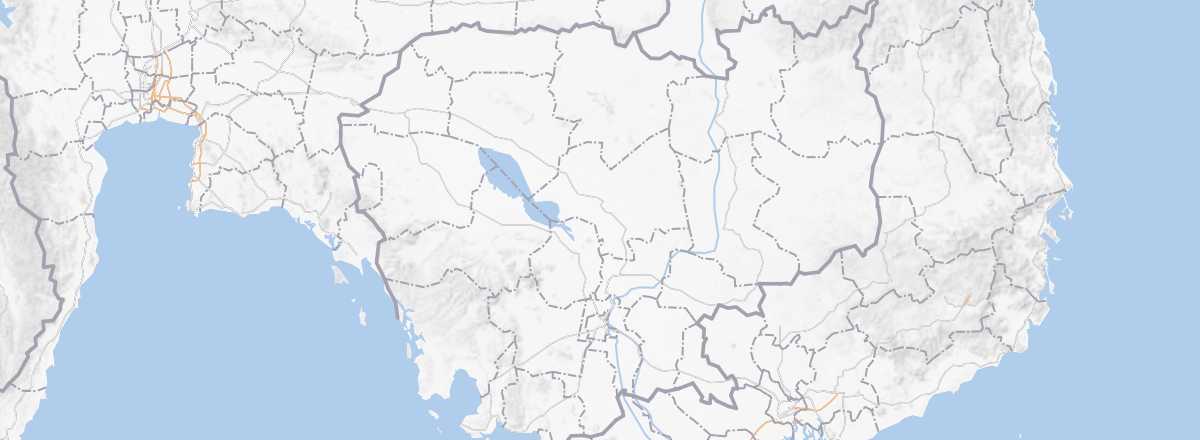 Cambodia
Open the interactive map
Money
Currency
- Devise: the riel.
- Bills: 100, 500, 1,000, 2,000, 5,000, 10,000, 20,000, 50,000, and (quite rare) 100,000 riels.
- Coins: although some still exist (50, 100, 200, and 500 riels), coins are no longer really in circulation in Cambodia.
- Exchange:
Exchange
Generally, in Cambodian cities and tourist areas, it’s quite easy to exchange money at banks and exchange bureaus. Especially since there are also ATMs where you can withdraw money, often with high withdrawal limits, though they come with fees that can add up if you’re not careful.
That said, these ATMs offer both riels and US dollars. Because in Cambodia, alongside the riel, the US dollar serves as a "parallel" currency, if not a second official one. This means you’ll constantly switch between the two—riels for small purchases and dollars for larger sums or tourist services. The exchange rate is more or less fixed at 1 US $ = 4,000 riels.
Which currency to bring
If you’re coming from the eurozone, the best option is to bring euros along with dollars, either obtained before departure or from ATMs once you arrive. While the euro exchanges well, you’ll still need US dollars. In any case, make sure your bills are in good condition, especially the dollars, or they may be refused.
Payment methods
While card payments are accepted in tourist areas and upscale establishments, Cambodia remains a cash-based country. So, it’s wise to carry a good amount of cash (euros, dollars, riels), particularly dollars, which will be useful everywhere.
Now, there’s also something called "Bakong", which is revolutionizing Cambodia’s payment system. It’s a highly developed and popular mobile payment method that has recently adapted to tourist needs. As a visitor, you just need to download the official "Bakong Tourists" app, create an account with your passport, and link it to your Visa or Mastercard. Then, you can pay for everything by scanning QR codes for products and services, and even withdraw cash from certain ATMs or kiosks.
Returning home
Since the riel has no value outside the country, it’s best to spend it all or settle your final expenses in dollars.
Budget
Although prices have risen recently, Cambodia remains a relatively affordable destination for travelers. While it’s more expensive than neighboring Laos, you can still get by on a budget of 40 to 50 € (for two people) if you travel like a backpacker. For a bit more comfort or convenience, 60 to 80 € is often enough—though visiting Angkor does come with a cost that can impact your budget. Overall, Cambodia is still an affordable country where you can travel without (too many) sacrifices.
What can be expensive
- The Angkor site, which is usually the most costly visit for most people. But it’s worth it!
- Imported products, including alcohol, or services with Western standards.
- Private transport, like a car with a driver.
- Fees from frequent ATM withdrawals.
- The high season, from November to February, when prices rise slightly, especially for accommodations.
What can be inexpensive
- Most things, either in terms of cost or value for money.
Price range
- Budget double room: less than a dozen euros for a dorm or small guesthouse.
- Mid-range double room: for 35 to 50 €, you’ll find a good selection of quality establishments.
- Snacks or local meals: 2 or 3 € at markets, street stalls, or local eateries.
- Tourist restaurant meals: 12 to 15 € for a full meal in a restaurant used to tourists.
- Car rental with driver: budget between 60 and 100 € per day, depending on the route and vehicle.
- Two-wheeler rental: around 5 or 6 € per day for a bicycle and 8–12 € for a scooter.
- 100 km by local bus or shared vehicle: roughly 3 € per segment.
- 100 km by express/comfort bus: nearly double the price of standard buses.
- Tuk-tuk: 2 or 3 € per ride in the city or outskirts.
Bargaining and tipping
Bargaining in Cambodia is common in local markets, for souvenirs, textiles, or even with tuk-tuk drivers, often saving you 20 to 30% off the initial price.
As for tipping, while it’s not a local custom, it has become common in tourist areas. In tourist restaurants, you can add 10% to the bill, give around 1 € to hotel staff used to visitors, or 5 or 6 € to private guides and drivers.
Shopping and souvenirs
You’ll find textiles like the checkered scarf called krama, worn by all Cambodians, as well as silks and other "typical" Khmer handicrafts. You can also buy silver jewelry or pieces made from recycled materials, Buddha statues, or lacquered wooden crafts. Everything is available in markets and cooperatives—just remember to negotiate!