last edited Aug 27, 2020
Who to go trekking or hiking with?
Location Map of Destinations
 Destinations
Open the interactive map
Choices
Obviously, several options are available depending on destinations, difficulty levels, and personal preferences. You can choose: a fully organised trip from home, travelling independently and organising everything yourself or through a local agency, walking alone, in a group, or with family.
Going alone (off the beaten track)
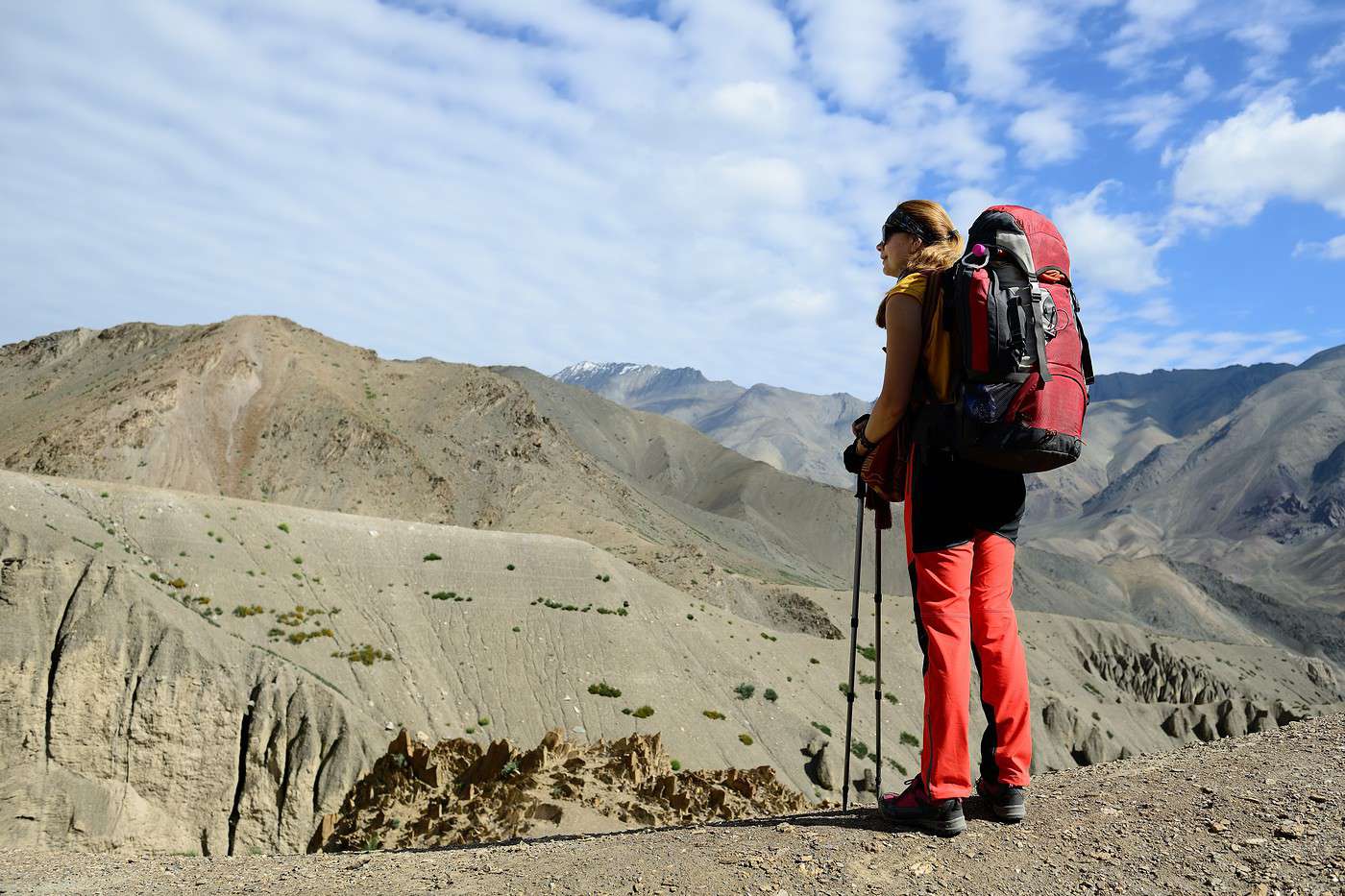
This means without supervision. While this poses no problem for many hikes, easy treks, well-marked trails, or routes with infrastructure at each stage, the same cannot be said once you venture slightly off the beaten track (and beyond). Because while total freedom is appealing, it’s important not to overlook the constraints that come with it—lest things turn into a struggle or even a disaster.
Self-sufficiency
In short, in this context, you’ll need to be self-sufficient. This means being able to handle several key responsibilities: resupplying and finding accommodation, carrying your equipment, communicating with locals, and—most importantly—navigating and avoiding dangers.
Finding accommodation is usually the easiest part—just bring a tent or plan a route that passes through mountain huts or villages.
For food, difficulties arise in the most remote or under-resourced areas. In such cases, bring your own (energy-rich) food, basic cooking gear, and even fuel for desert environments. As a safety measure, pack at least one to three extra days’ worth of food, depending on how long you’ll be between resupply points.
Of course, the issue of transporting all this—and more—quickly arises. Once you exceed around fifteen kilograms per person in challenging terrain or conditions, don’t expect to manage the load yourself.
Communication is another challenge. Beyond casual conversations with people you meet, it can be useful—even vital—to ask for directions and, crucially, understand the answers. This highlights the biggest risk of travelling alone or without someone who knows the area. Whether in deserts, mountains, or jungles, this isn’t something you can improvise. Off the most frequented paths, you risk getting lost quickly, not to mention unpredictable weather and other hazards or accidents you won’t know how to anticipate.
So, stay realistic and aware of the challenges (and your own abilities), even if it means adjusting or modifying your plans. Only set off alone for trips and/or in conditions that offer a minimum of safety—even for the shortest durations...
Organising your own trek
Organising your own trek means hiring guides and porters to accompany you on hikes in isolated or difficult conditions.
While the experience can be fascinating, it’s best to be resourceful, a good negotiator, and have at least a basic grasp of English or the local language—otherwise, you risk major disappointments. Also, be careful not to end up paying more than you would by using a local or international agency. First, get an idea of the prices these agencies charge for a similar itinerary, as well as the wages and other gratuities you’ll need to pay your team.
Who to contact and where?
Hiring a team is entirely possible in many places, whether for desert, jungle, or—especially—mountain treks, such as in the Himalayas. In India or Nepal, for example, you’ll have no trouble finding guides with donkeys or porters ready to accompany you. The best approach is to arrive in the starting town or village and ask locals if they know reliable people (or check other travellers’ experiences on the matter). In any case, plan to be self-sufficient with your own gear (tent, sleeping bag, etc.) and, depending on the situation, your own food.
Once you’ve made contact, you’ll need to agree on your itinerary, the number of days, and the financial terms—including, crucially, any taxes or entry fees for certain areas (in short, clarify who pays what). Be realistic: don’t plan stages that are too demanding for your fitness level or preferences, and leave room for changes due to weather or other unforeseen circumstances. Once decisions are made, stick to them!
Porters, guide, and cook
Porters (and cook)
For those unaccustomed to walking for hours with a backpack over days or weeks—especially in difficult conditions—it’s advisable to hire a porter to avoid ruining your trip. Even if you don’t have much gear, consider hiring someone to carry your belongings. The maximum load for a porter is 30 kg.
In any case, if you’ll be facing extreme conditions (temperature, altitude, etc.), ensure your porters and guides are properly equipped. You’re responsible for the people you hire! On this topic, see "Porters' rights", which raises important questions about the rights of porters and other sherpas.
An alternative to porters is pack animals (donkeys, mules, horses, camels), which can carry luggage and are usually managed by one person for several animals. On average, each can carry around fifty kilograms.
Another team member is the cook. Generally, they’re only responsible for carrying cooking-related gear and won’t carry your backpack.
Guide
The guide is by far the most important person. For longer or more difficult treks, choosing the right one is crucial—otherwise, you risk running into trouble or even danger if they’re inexperienced. In all cases, this is the first person you should hire, and with whom you’ll discuss the trek and its details. So, make sure they speak at least English—or at least a language you can communicate in. Almost always, they’ll handle recruiting the rest of the team and organising logistics, so avoid "imposing" someone they might not get along with. While agreeing on the team’s composition beforehand, clearly avoid interfering with their choices or "management" of the team during the trek.
Lastly, just because someone is from the country doesn’t mean they’ll necessarily be a good, experienced, or competent guide—or even porter. The growth of tourism in some regions has turned almost anyone into a potential guide.
The team and their equipment
The team
Guide, cook, porters, and/or pack animals—this is the basis of your team. But first, ask yourself whether hiring all these people is even necessary. Local agency packages might be more appealing and/or far simpler to arrange, or you might realise you can complete the trek alone without supervision.
Next, hire or have the right number of people employed. There’s no point in having a crowd of porters or animals carrying almost nothing. Similarly, if your trek only passes through villages where resupply is possible, a cook and their gear may be far less useful. In some cases, a single guide may suffice.
In short, tailor your team to your trek, its duration, and its conditions—even if your guides may sometimes overestimate (for various reasons) the number of people needed.
Equipment
Be clear about what you and the team will need and the associated costs. As mentioned, be at least self-sufficient in terms of sleeping arrangements and, if necessary, food. For the rest, trust your guide while occasionally checking the quality and quantities required. In principle, you’ll only need to worry about what directly concerns you (so not the team’s food or other equipment), though you should ensure your "staff" have the minimum safety gear for the most difficult sections or extreme conditions.
Prices
Fair pricing
This is the crucial question. Do your research beforehand—especially with other travellers—and use the prices offered by local agencies for identical services as a "ceiling" reference.
In all cases, negotiate firmly—even haggle—with your main contact, usually your guide. Agree on the itinerary and cost breakdown (the most important part). Avoid intermediaries if you don’t want prices to rise. Often, your guide will collect the entire budget and then distribute wages and other expenses. For extra security, some travellers only pay part of the sum before departure and the balance upon arrival. Others sign a "contract", though this rarely helps much in case of problems. So, it’s up to you to decide based on the situation.
Remuneration
Wages vary by country, trek type, conditions or difficulty, and people’s skills. For example, in the Himalayas, a porter earns an average of 6 or 7 €/day for "classic" treks and 10 to 12 € in more difficult conditions. The same roughly applies to a cook or a muleteer with their animal. For guides, it’s more variable: from 10 to 15 €/day for a porter-guide, 20 to 25 € if they manage a team or for long treks, and over 50 €/day for very difficult treks or extreme conditions.
Don’t forget—including if you use an agency—to add a tip for each team member at the end of the trip. As a guideline, you can base it on 10 or 15% of each person’s daily wage, and you can always add some useful gifts.
Going with an organised group

The offerings from "international" and local agencies, with their pros and cons. Hence the importance of making the right choice...
Fully organised by an agency
In short, opting for a "fully organised" trip from home by contacting trekking or hiking specialists. Typically, European tour operators work with local agencies ("inbound operators") that provide logistics, guides, and all necessary staff (while the tour operator only provides an escort—and sometimes not even that).
Advantages and disadvantages
This remains a good solution if you don’t want to handle anything, have little time, or simply don’t want to manage the trip/trek yourself. Another advantage is that you’ll generally be with people who share your motivation and skill level (and speak the same language) in a structure that can sometimes adapt to your preferences. Plus, in principle, there won’t be any nasty surprises. Downsides: a price that logically includes the tour operator’s and their providers’ margins, and often a fairly inflexible schedule.
As for purists who say that travelling in a group harms the environment or local interactions, one could argue that "organised" doesn’t necessarily mean "herd" (you sometimes see herds of backpackers too), and the rest is primarily a matter of individual choice and selecting competent, responsible providers...
Local agencies
This is an option chosen for various reasons: travelling to the destination and contacting a local agency. Indeed, nothing stops you from planning the framework of your trip yourself and then supplementing it locally with agency proposals for the hiking part.
In most countries, you’ll easily find local providers offering set itineraries or custom treks. A small detail: through these local agencies, you might sometimes encounter groups organised by European tour operators. Also note that in capital cities or towns outside trekking areas, many providers will already offer hiking packages. While this can be interesting, it’s often better to wait until you’re actually on-site to make your choice.
The choice
Concretely, it’s good to know what’s available beforehand—so research online and, above all, learn from others’ experiences (one of VoyageForum’s goals).
On-site, spend roughly half a day seeing what’s available and comparing the services and skills of different providers (in addition to what you’ve already found online). And do this even if, upon arrival, you’re harassed by crowds of touts (who, to help you decide, will "offer" you a ride to your hotel or a "free" city tour), your hotelier, or just about anyone you meet. And, of course, talk to other travellers who’ve just returned. Finally, once the deal is done, don’t hesitate to put what was agreed in writing, including prices, and keep a copy of the contract to avoid any disputes.
Meanwhile, it’s clear that using a provider will always make your life easier and might even save you a bit of money on gear you don’t have (tent, cooking equipment, etc.). It also allows you to go to places you wouldn’t visit alone and discover things these agencies have known and practised for a long time. Downside: you won’t necessarily be with French speakers (group, guides), and a basic knowledge of English is often necessary to communicate.
Hiking with family

For those who want to hike with family, it’s entirely possible to take children from the age of 4 or 5 on short walks of a few kilometres. From age 8, they can generally cover 8 to 15 km/day. Of course, avoid choosing circuits that are too difficult, with steep elevation gains, high-altitude climbs, or harsh temperature conditions.
Practically speaking, beyond adapting the group’s pace to the youngest, you can always hire a porter or an animal to carry the child. And, of course, keep your children engaged by suggesting games or discoveries along the way—show them the landscapes, flora, and fauna...