last edited Aug 17, 2020
Getting Around Canada
Location Map of Canada
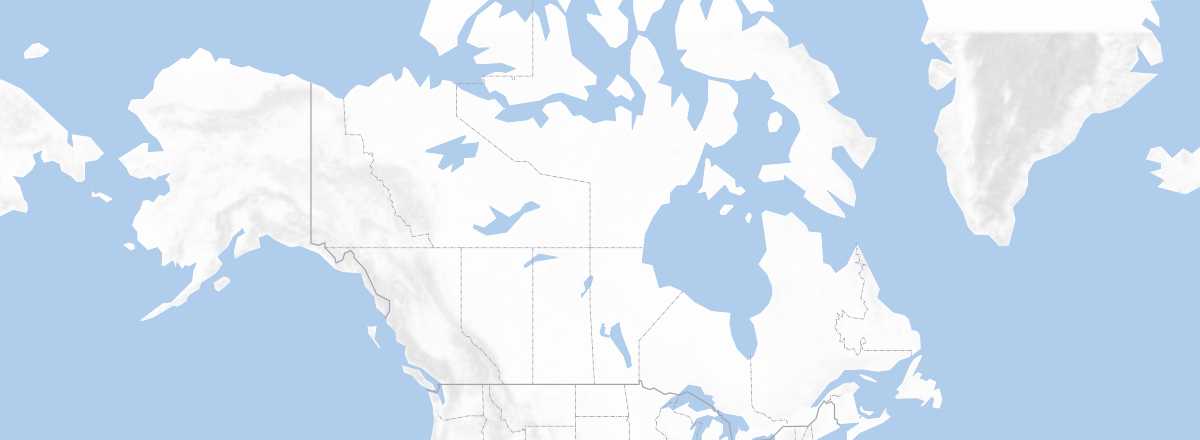 Canada
Open the interactive map
Canada
Open the interactive map
Road Network, Traffic
Specific Driving Rules
Like every other country, Canada has its own driving and road rules, which may vary slightly from one province to another.
Driving is on the right side of the road, and seat belts are mandatory for all vehicle passengers. Using a handheld mobile phone while driving is prohibited. Littering from a vehicle is also punishable by a fine. As for alcohol, the legal limit is 80 mg of alcohol per 100 ml of blood.
Speed limits vary. Signs are posted on each road to indicate the maximum permitted speed. In school zones, it is 30 km/h. In urban areas, it is 50 km/h (70 km/h on major arteries). On secondary roads, it generally ranges from 70 to 90 km/h. On highways, the minimum and maximum speeds are 60 km/h and 100 km/h, respectively. In some provinces (Alberta, Manitoba, New Brunswick, Nova Scotia, Saskatchewan), the maximum limit is 110 km/h, while in British Columbia, it is 120 km/h. It is important to respect speed limits, as checks are frequent and fines are steep.
Vehicles following a yellow school bus—and even those coming from the opposite direction—must stop when the bus’s flashing lights are on. Additionally, when an emergency vehicle or tow truck is stationary on the road, it is crucial to slow down and move as far away as possible from the vehicle to avoid a severe fine.
In cities, traffic lights are located on the far side of the road. Unless otherwise indicated ("no right turn on red"), you may turn right on a red light if the lane is clear. When a green light is flashing, you have priority over vehicles coming from all directions. In some urban areas, lanes are reserved exclusively for buses and taxis, as indicated by signs. Some intersections may have four stop signs; in this case, the first vehicle to arrive is the first to proceed.
Parking is prohibited near fire hydrants, and you must never park against the flow of traffic. To avoid a ticket, always check the posted parking hours, which may vary.
In winter, driving conditions change significantly. It is recommended to reduce your speed and leave a greater distance between your vehicle and the one ahead. Before driving, check traffic conditions and the weather forecast by dialing 511. Additionally, parking may be prohibited on certain streets during snow removal operations—always check the signs.
In case of an accident, do not leave the scene, as this is a serious offense. Dial 911, the emergency number.
Police and Fines
Car, RV
Rental
Many agencies, both local and international, offer vehicle rentals. Several factors can influence rental prices: region, season, promotions, etc. It is essential to compare prices before renting and to check if unlimited mileage is included. Sometimes, combining car rental with accommodation, flights, or all three can be more advantageous.
Make sure to ask for the rental agency’s phone number and the type of fuel the vehicle uses.
Requirements and Documents
The minimum age to rent a car in Canada is 21, and the driver must have at least one year of driving experience and hold a valid driver’s license. An international permit is not required. A credit card is necessary for payment, and the cardholder’s name must match the driver’s name.
Note that drivers aged 21 to 24 face stricter conditions. For insurance reasons, a higher security deposit is required, and rentals are limited to subcompact, compact, and standard cars. Larger vehicles (minivans, 4x4s, etc.) are not available for rent.
Various Options
In addition to vehicle type and optional insurance, other (paid) options are usually offered: additional driver, drop-off fees if returning the vehicle in a different city, GPS, baby car seat, etc.
Rent Before Departure or On-Site?
Renting an RV
The network is well-established, and many rental options are available in major tourist cities across Canada, including Calgary, Edmonton, Montreal, Quebec City, Toronto, Vancouver, and Whitehorse.
If you decide to rent an RV, consider where you will sleep. Campgrounds are the only authorized places to stay overnight with an RV. It is not permitted to spend the night in rest areas—a maximum parking time of four hours is allowed. Additionally, overnight parking is prohibited in shopping center lots, except at Walmart stores, where it may be allowed with prior permission from the store manager.
Bus
For long-distance travel, buses can be a good alternative. The four largest companies in the country are Coach Canada, Greyhound, Intercar, Megabus, and Orléans Express. There are, of course, several other bus companies that serve areas not covered by these major carriers, requiring transfers.
Major Companies
- Coach Canada: Serves southeastern Ontario and southern Quebec. However, connections to New York and other major U.S. cities must be made with other carriers.
- Greyhound Canada: Originally, the company covered all of Canada, but since 2018, its western network (Alberta, BC, Saskatchewan, Manitoba) has been discontinued. Direct routes to New York, Detroit, and other cities in U.S. states bordering Canada are still available. For regions not served by Greyhound, transfers to other bus lines with Greyhound agreements may be possible.
- Intercar: The second-largest intercity carrier in Quebec. It connects Quebec City to the Saguenay-Lac-Saint-Jean, Charlevoix, and Côte-Nord regions.
- Megabus: Offers daily low-cost bus service between Montreal, Kingston, and Toronto, as well as a route to Buffalo, New York, from several Ontario cities.
- Orléans Express: The largest bus company operating in Quebec. It connects the province’s major cities.
Two Wheels
Motorcycle
Bike
Hitchhiking and Carpooling
Hitchhiking
Carpooling
Carpooling exists in Canada. Several online platforms offer this service, including Allostop, Amigoexpress, Covoiturage.ca, and Le Pouceux.
Trains
Trains are not the ideal way to travel across Canada. Connections are limited, and trains are relatively slow. Several comfort categories are available, and snacks are provided during the journey. Trains are non-smoking.
Via Rail
Via Rail Canada is the only passenger rail company in Canada, offering connections between the country’s major cities.
Passes are available. The Canrailpass offers the Corridor Travel Card, allowing travel in Ontario and Quebec for 21 consecutive days. This card includes three options: 7 or 10 one-way trips or unlimited travel. The Network Card is valid for 60 consecutive days and allows travel across Canada, with the same options as above. For reference, the Corridor Travel Card costs between $299 and $699 for an adult, while the Network Card ranges from $699 to $1299. These prices do not include taxes.
Boats
Domestic Flights
In the City
Taxis
Other Means
Subway and tram:
Urban bus:
On foot:
What to Choose for Getting Around?
Distances Between Cities
Distances (km) between major cities in the country:
| Charlottetown | Edmonton | Fredericton | Halifax | Quebec City | Toronto | Vancouver | Winnipeg | |
|---|---|---|---|---|---|---|---|---|
| Charlottetown | 4748 | 340 | 325 | 904 | 1696 | 5699 | 3403 | |
| Edmonton | 4748 | 4417 | 4849 | 3858 | 3379 | 1160 | 1348 | |
| Fredericton | 340 | 4417 | 440 | 591 | 1365 | 5367 | 3071 | |
| Halifax | 325 | 4849 | 440 | 1024 | 1796 | 5800 | 3500 | |
| Quebec City | 904 | 3858 | 591 | 1024 | 808 | 4809 | 2505 | |
| Toronto | 1696 | 3379 | 1365 | 1796 | 808 | 4468 | 2043 | |
| Vancouver | 5699 | 1160 | 5367 | 5800 | 4809 | 4468 | 2313 | |
| Winnipeg | 3403 | 1348 | 3071 | 3500 | 2505 | 2043 | 2313 |