last edited Dec 11, 2019
Getting Around in Aquitaine
Location Map of Aquitaine
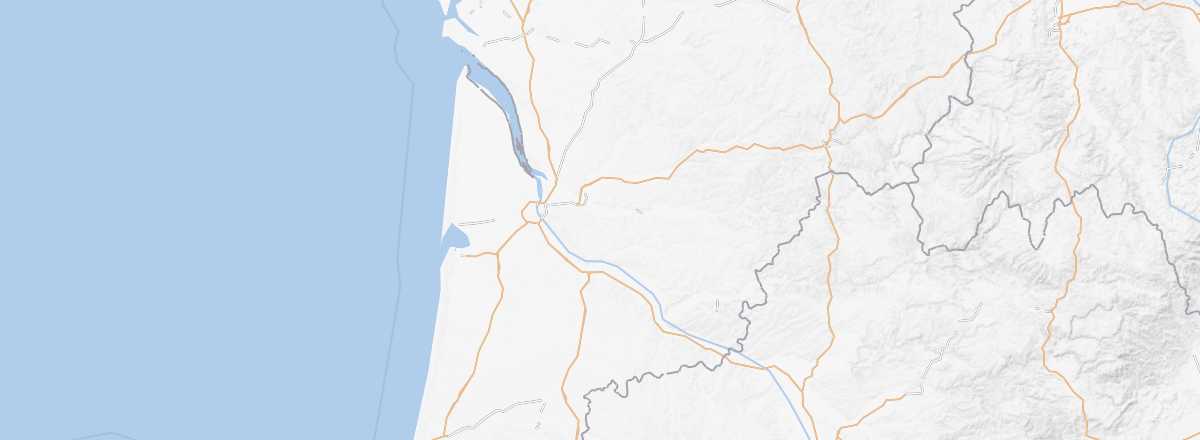 Aquitaine
Open the interactive map
Aquitaine
Open the interactive map
Road Network, Traffic
Logically, Bordeaux remains the convergence point of the region's motorway network, which also regularly causes major slowdowns on the Bordeaux ring road. Five motorways serve the regional capital: the A10 to Paris, the A62 to Toulouse, the A63 to Biarritz and Spain, the A65 to Pau, and the A89 to Clermont-Ferrand and Lyon. There is also a motorway, the A64, linking Bayonne to Toulouse.
Outside the motorways, the Aquitaine road network is good but locally very congested, such as when arriving in Bordeaux (often), accessing Spain (sometimes), or roads leading to beaches (in season).[Traffic Forecasts: Bison Futé traffic forecasts.]
Vehicle Rental
Buses
Two Wheels
Motorcycle
Bike
Aquitaine can be easily explored by bike. There are several hundred kilometres of cycle paths, and the Aquitaine coastline, the Basque Country, or the Dordogne department offer pleasant routes.
Hitchhiking
Trains
Main Lines
For SNCF trains, only cities in Aquitaine on TGV lines or the Bordeaux-Toulouse axis have truly good connections between them.
Secondary Lines
As is often the case, while the main-line network is useful, secondary lines (TER Aquitaine) are much less so. Many services have very limited frequencies, with a targeted network, slow trains, and not always economical fares. Some train lines have also been replaced by buses. In short, outside major cities, don’t expect to explore the region by train...
Note that there are also several small tourist train lines in Aquitaine (Petit train d'Artouste, de la Rhune, etc.).
In Town
Taxis
Other Means
Which Transport to Choose?
Even though there are regional train lines and sometimes local buses, the connections, frequencies, and fares of these public transport options make them of very limited use for visitors. In short, it’s best to be independent for free movement in Aquitaine and have your own vehicle or a rental.