last edited Jan 5, 2020
History of Mexico
Location Map of Mexico
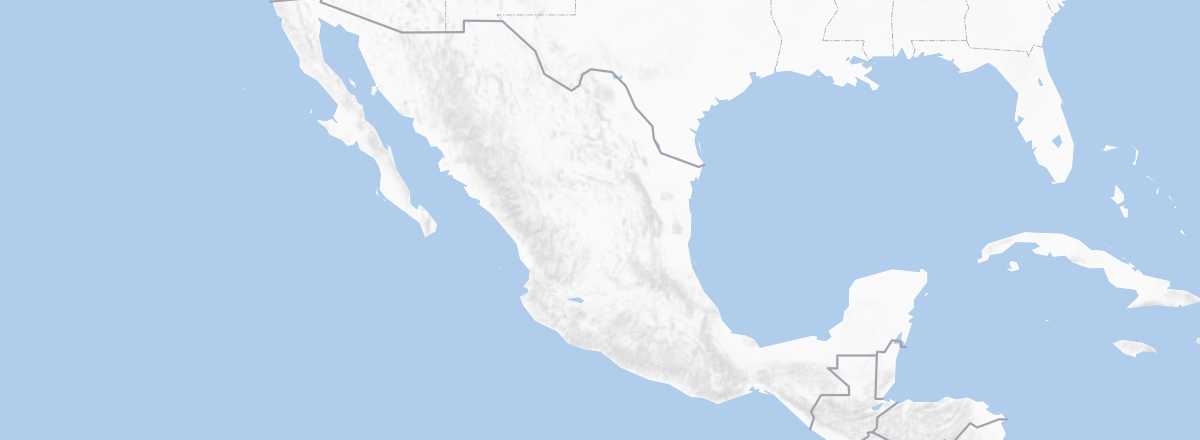 Mexico
Open the interactive map
History of Mexico

Key Dates
- 50,000 BC: The earliest traces of settlements in the country date back to this period, particularly in Baja California.
- 1st century BC: Development of pre-Columbian civilizations such as the Maya and Toltec, based on city-states.
- 14th century: The Aztecs, arriving from the north, unify the country and establish their empire in central Mexico with Mexico City as its capital. Around 25 million indigenous people then populate Mexico.
- 1517-1521: After an initial reconnaissance of the Atlantic coast, the Spanish, led by Hernán Cortés, land near present-day Veracruz in 1519. Cortés destroys the Aztec Empire in 1521 by seizing its capital.
- 1521: Establishment of the Viceroyalty of New Spain, which, encompassing nearly all of Central America and part of present-day USA, lasts until Mexico's independence, with Mexico City as its capital.
- Late 16th century: The Spanish gradually colonize the country by force and begin exploiting numerous gold and silver mines, using indigenous people as slaves.
- 1810-1821: After nearly three centuries of colonization, Mexico experiences a strong desire for independence led by "Spanish Creoles," resulting in eleven years of civil war. Independence is proclaimed in 1821, followed by the establishment of a republic in 1824.
- 1836: Texas, then a Mexican territory, declares its independence before being annexed by the United States in 1845.
- 1846-1848: During the Mexican-American War, Mexico loses California and all its territories north of the Rio Grande, amounting to 40% of its land area.
- 1862-1867: Following a civil war and the suspension of debt payments, among other issues to France, the latter undertakes an expedition aimed at establishing a regime favorable to French interests. The operation ends in disaster, leading to the execution of Emperor Maximilian of Austria, who had been placed in power.
- 1876-1911: After a coup, Porfirio Díaz seizes power and establishes a "progressive and authoritarian" dictatorship, which nonetheless leads to economic and commercial development in the country.
- 1910-1920: The Mexican Revolution of 1910 is a series of coups and civil wars involving, among others, the "famous" Zapata and Pancho Villa.
- 1929: Amid ongoing turmoil, the PRI is founded, holding power for many decades.
- 1930-1940: Land reform and nationalization of oil occur, though this does not prevent growing inequality and the PRI's authoritarian drift in the following decades.
- 1992: Signing of NAFTA (North American Free Trade Agreement) with the USA and Canada. Despite this, the country continues to face major socio-economic problems, culminating in the "Mexican peso crisis" of 1994-95.
- 2000: With the election of Vicente Fox, the PRI loses the presidential power it had held for three-quarters of a century.
- 2012: The PRI returns to power with the election of Enrique Peña Nieto as head of state.
- 2015: The state of Quintana Roo (Cancún) chooses to align with GMT-5, meaning the country now spans four time zones instead of three.
- 2018: Amid violence and cartel wars, the left comes to power with López Obrador winning the presidential election.