last edited May 15, 2020
History of Cuba
Location Map of Cuba
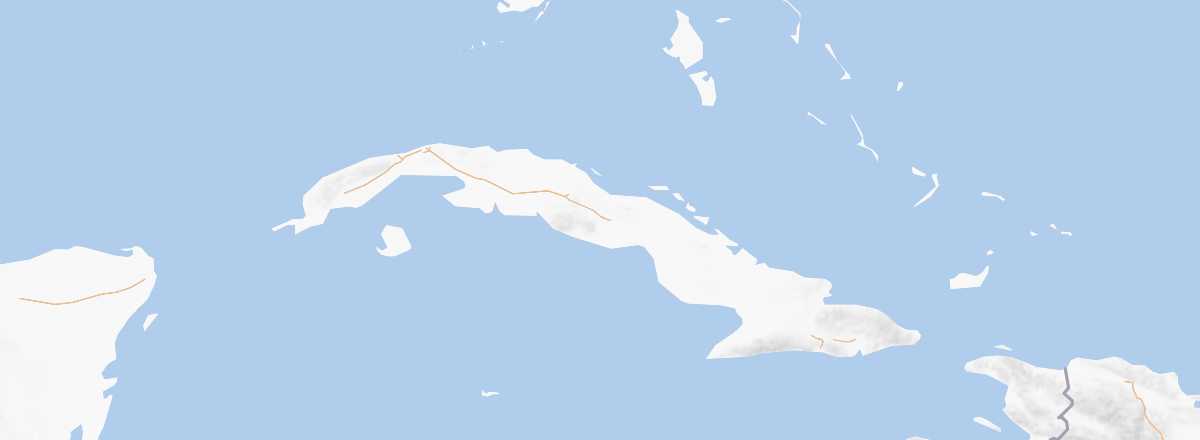 Cuba
Open the interactive map
History of Cuba

Key Dates
- 1492: Christopher Columbus discovers the island, then inhabited by the indigenous Taíno and Karib peoples.
- 1510-1520: Beginning of Spanish colonization by Diego Velazquez, marked by the plundering of land and gold, and the enslavement of the indigenous population. Founding of the first "cities": Baracoa (1512), Santiago de Cuba (1514), which became the capital for a few decades, and Havana (1515).
- 18th century: With gold mines depleted, the Spanish develop sugar cane, tobacco, and coffee plantations on the island. This period also sees the massive arrival of African slaves to work the plantations, replacing the decimated indigenous population.
- 1791-1809: Cuba sees an influx of French planters and their slaves fleeing the Haitian Revolution of 1791. They boost the local economy until the anti-French riots and expulsions of 1809, following Napoleon Bonaparte’s invasion of Spain.
- Early 19th century: Economic development of the island, driven by coffee and then sugar, leads to an increase in the slave population and overall population, which exceeds one million by 1840.
- 1868: The first general uprising against Spanish rule, the "Ten Years' War", grants the island a degree of autonomy starting in 1878.
- 1886: Effective abolition of slavery in Cuba.
- 1895-1898: Another popular uprising ("War of '95"), led by José Martí, is met with brutal repression by the Spanish.
- 1898: Under the pretext of "defending their interests," the Americans land in Santiago. Following the Spanish-American War, Spain relinquishes the island, which becomes the Republic of Cuba in 1902.
- 1899-1919: The U.S. takes control of the island, dominating its economy and intervening militarily four times.
- Interwar period: The country experiences a severe economic crisis and intense socio-political tensions.
- 1934-1959: The Batista era. Twice president, notably from 1952 to 1959, he establishes a military dictatorship backed and heavily influenced by the U.S. Inequality deepens in a society riddled with corruption and organized crime.
- 1956: After three years in exile in Mexico following an attack on a barracks near Santiago in 1953, Fidel Castro, accompanied by Che Guevara, lands in Cuba to overthrow Batista’s dictatorship.
- 1959: After more than two years of armed struggle, the Castroist revolution triumphs, forcing Batista to flee.
- 1961: Freezing of relations with the United States and the failure of the anti-Castro "Bay of Pigs" invasion.
- 1962: The Cuban Missile Crisis between the U.S. and the USSR creates extreme tension. The effective start of the U.S. embargo.
- 1960s: The Castroist revolution quickly takes a dictatorial turn, sparking heated debates among intellectuals worldwide about support for Cuba.
- 1967: Death of Che Guevara in Bolivia.
- 1975-1989: Cuban interventions in several African countries, primarily Angola (1975-79).
- 1976: Relaxation of the regime following the 1976 Constitution.
- 1980: A temporary opening of borders leads to the exodus of over one hundred thousand Cubans to Florida and the rest of the U.S.
- 1989: The gradual end of Soviet aid, which began in 1960, brings new hardships for the population.
- 1990-1995: Tourism is designated a priority for the country.
- 1994: Economic exodus of tens of thousands of balseros, fleeing the island on rafts for Florida.
- 1997: Thirty years after his death, Che Guevara is buried in Santa Clara, where nearly 300,000 Cubans pay tribute to him.
- Late 1990s: While Fidel Castro is "re-elected" in 1998, the country seeks new allies, notably Venezuela under Hugo Chávez. The turn of the 21st century also marks new relations with the U.S. (easing of the U.S. embargo, visit by former President Jimmy Carter...), despite recurring tensions between Cubans in Miami and Havana.
- 2003: New crackdown by the Castroist dictatorship on Cuban dissidents on the island ("Black Spring").
- 2005: Cuba and Venezuela create the Bolivarian Alliance for the Americas, which today includes a dozen Latin American and Caribbean countries at the political and economic level.
- 2006: Ill, Fidel Castro temporarily cedes power to his brother Raúl.
- 2008: Fidel Castro officially retires from political life in favor of his brother, who is elected President of the National Assembly and gradually relaxes and modernizes the regime.
- 2014: In December, U.S. President Obama and Raúl Castro announce a "rapprochement" between the two countries, including the opening of embassies and the end of the U.S. embargo, allowing American tourists to visit Cuba.
- 2016: Death of Fidel Castro on November 25.
- 2018: With Raúl Castro’s withdrawal from power in favor of Miguel Díaz-Canel, the island is no longer led by a Castro for the first time in nearly 60 years.
- 2019: As the country slowly returns to "normal," new U.S. sanctions, particularly on tourism, mark a setback and raise concerns about further challenges for the island and its people.