last edited Dec 11, 2019
Introduction to Dominica
Location Map of Dominica
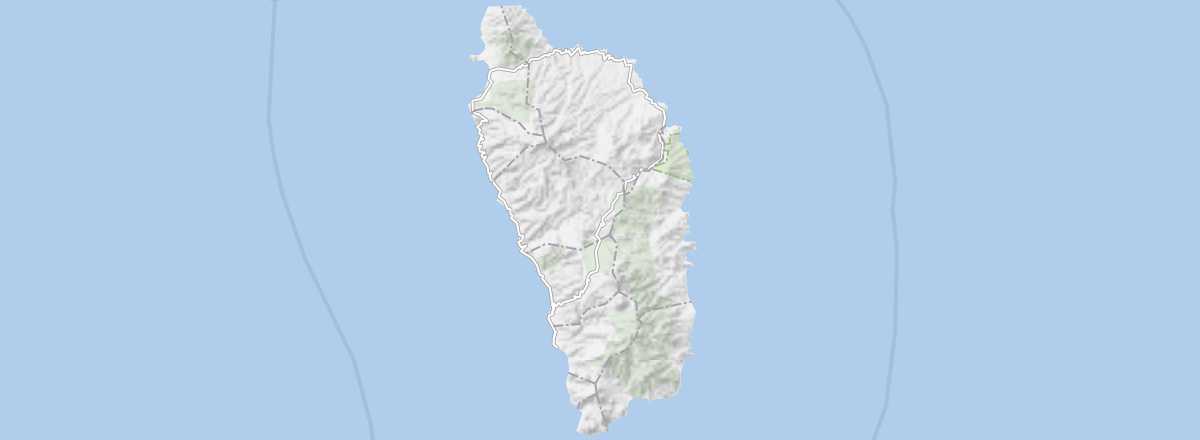 Dominica
Open the interactive map
Dominica
Open the interactive map
Quick Overview
Between Martinique and Guadeloupe, this former British territory is part of the Windward Islands in the Lesser Antilles. Administratively, it is also one of the nine members of the Organisation of Eastern Caribbean States, whose headquarters is in Saint Lucia.
Of volcanic origin, the island offers stunning "mountainous" and wild landscapes among the most beautiful in the Caribbean. You’ll find rugged coastlines surrounded by cliffs, as well as around thirty waterfalls, hot springs, and countless small rivers hidden in its tropical forest.
The island’s economy relies on tourism (much more focused on ecotourism than beach holidays) and agriculture, primarily banana production. To these resources, Dominica is now trying to add offshore financial services and "flag of convenience" registrations, as practiced by other islands. The goal is also to stem the significant exodus of its inhabitants to other countries in the region, North America, or England. Dominica’s population is largely Catholic and over 80% of African descent, with the last—and only—indigenous Amerindian community in the Caribbean, making up about 3% of Dominicans.
Key Facts
- Type de lieu: country.
- Localisation: in the Caribbean, between Guadeloupe and Martinique.
- Latitude/longitude: 15.25 N, 61.20 W.
- Heure locale:
- Capitale: Roseau
- Nature de l'état: parliamentary democracy and Commonwealth member.
- Langue officielle: while English is the official language, Creole is also widely spoken.
- Monnaie: Eastern Caribbean dollar.
- Population: 74,027 inhabitants (2018).
- Superficie: 751 km².
- Densité: 98.5 inhabitants/km².
- Point le plus haut: Morne Diablotins (1,447 m).
- Point le plus bas: sea level.
- Littoral: 148 km.
- Conduite: on the left.
Tourism
Despite its natural wealth ideal for ecotourism, Dominica remains one of the least visited destinations in the Caribbean. Only 63,000 people traveled to the island in 2018, with over a third coming from the French Antilles. However, limited infrastructure, few beach holiday options, and especially the island’s expensive and limited air connections play a role. The upside: fewer crowds and a glimpse of what other islands in the region were like a few years ago...
Travel Essentials
- Destination: for beginner travelers.
- By air: France-Dominica for 700 to 1,000 € round trip.
- Entry requirements: passport.
- Currency to bring: US dollars (and some euros).
- Taux de change:
- Daily "backpacker" budget: from 45 to 65 € per person.
- Accommodation: guesthouses and lodges.
- Getting around: shared minibuses.
- Risks: low health risks and relatively low security risks.
- Best time (climate/crowds/prices): April-May, and secondarily late November to early December.
- Intérêts (out of ): Nature ; Adventure ; Culture ; Relaxation/Holidays
Addresses in France
- Tourist Office: 01 53 25 03 55.
Addresses in Belgium, Switzerland, and Quebec
Socio-Economic Statistics
- "Quality of life": 103/188 (2018 ranking)
- GDP per capita: $11,000 (2017)
- Average monthly income:
- Inflation: +0.6% (2017)
- Official unemployment rate:
- Population below poverty line: 29% (2011)
- Life expectancy: 77.4 years (2018)
- Migration rate per 1,000 inhabitants: -5.4 (2017)
- Population growth: +0.17% (2018)
- Literacy rate: 94% (2011)
- Urban population: 70.5% (2018)
- Press freedom: 35/180 (2018 ranking)
- Political regime:
Sources: World Bank, Human Development Indicators, RSF, The Economist, The World Factbook