last edited Dec 11, 2019
Introduction to Estonia
Location Map of Estonia
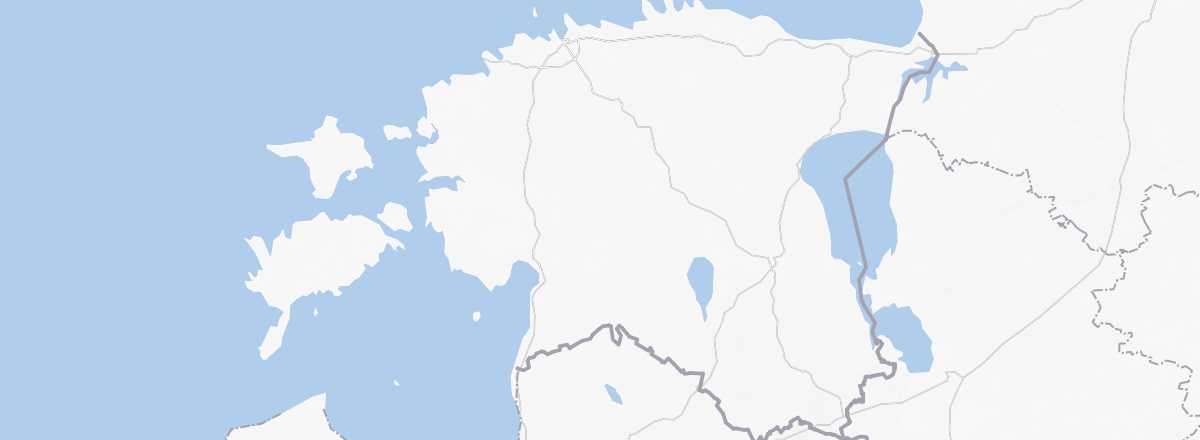 Estonia
Open the interactive map
Estonia
Open the interactive map
Quick Overview
Of the three Baltic republics, Estonia is the smallest and least populated. Bordering Latvia to the south and Russia to the east, it is separated from Finland by the Gulf of Finland. Like everywhere in the region, the terrain is relatively flat. Although the country is quite urbanised, it still offers large areas of forests, lakes, or marshes, plus, in the west, islands (Hiiumaa, Saaremaa) with landscapes that remain quite wild.
Key Facts
- Type of place: country.
- Location: the northernmost of the Baltic States, facing Finland.
- Latitude/longitude: 59°26' N, 24°45' E.
- Local time:
- Capital: Tallinn
- Nature of the state: parliamentary republic.
- Official language: Estonian.
- Currency: euro.
- Population: 1,244,288 inhabitants (2018).
- Area: 45,339 km².
- Density: 27.5 inhabitants/km²
- Highest point: Suur Munamägi (318 m)
- Lowest point: sea level.
- Coastline:
- Driving: on the right.
Tourism
A capital, Tallinn, whose heart is a UNESCO World Heritage site, historical remains, cultural heritage, numerous lakes and rivers, forests, and above all the charm of the Baltic with its rugged coasts and offshore islands are the main attractions of the destination. In short, enough to draw visitors and make Estonia the most visited of the three Baltic States, with 3.234 million tourists in 2018, many of them Finns, Russians, Swedes, and Germans.
Travel Essentials
- Destination: for beginner travellers.
- By air: France-Tallinn.
- Entry requirements: passport or ID card.
- Currency to bring: euros.
- Exchange rate:
- Daily "backpacker" budget:
- Best for accommodation:
- Best for getting around:
- Risks:
- Best period for climate/crowds/prices:
- Interests (out of ): Nature ; Adventure ; Culture ; Relaxation-holidays .
Useful Addresses
Socio-Economic Statistics
- "Quality of life": 30/188 (rank in 2018)
- GDP per capita: $31,700 (2017)
- Average monthly income: ()
- Inflation: +3.7% (2018)
- "Official" unemployment: 5.8% (2017)
- Population below the poverty line: 21.3% (2015)
- Life expectancy: 77 years (2018)
- Migration rate per 1,000 inhabitants: -3.2 (2017)
- Population growth: -0.6% (2018)
- Literacy rate: 99.8% (2015)
- Urban population: 68.9% (2018)
- Press freedom: 12/180 (rank in 2018)
- Political regime: flawed democracy (23/167 in 2018)
Sources: World Bank, Human Development Indicators, RSF, The Economist, The World Factbook