last edited Dec 11, 2019
Introduction to Georgia
Location Map of Georgia
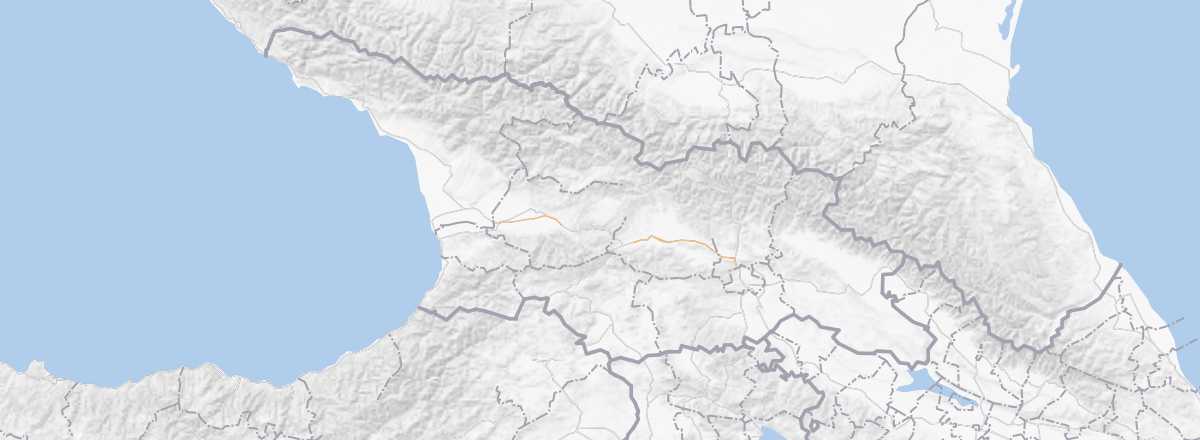 Georgia
Open the interactive map
Georgia
Open the interactive map
Quick Overview
Georgia is a country on the Black Sea in the Caucasus. It is situated at a crossroads between Europe and Asia in many respects, particularly culturally.
Key Facts
- Type of place: country.
- Latitude/longitude: 41°42' N, 44°47' E.
- Local time:
- Capital: Tbilisi.
- State nature: republic.
- Official language: Georgian.
- Currency: lari.
- Population: 4,926,087 inhabitants (2018).
- Area: 69,700 km².
- Density: 70 inhabitants/km².
- Highest point: Mount Shkhara (5,193 m).
- Lowest point: sea level.
- Coastline: 310 km.
- Driving: on the right.
Tourism
Georgia is a charming country in the Caucasus. It is ideal for nature lovers and those interested in local cultures, with numerous monasteries and old castles, as well as the Black Sea coast for beachgoers.
Like the rest of the region—and perhaps even more so—the country has seen a surge in popularity in recent years. In less than a decade, visitor numbers have quadrupled, reaching 4.757 million entries in 2018. However, most visitors still come from the surrounding region (Armenia, Azerbaijan, Turkey, Russia, Ukraine...), as well as from Israel, Poland, and Germany. In 2015, 14,000 French travelers visited Georgia.
Travel Essentials
- Destination: beginner/somewhat experienced traveler.
- By air: France-Tbilisi.
- Entry requirements: passport.
- Currency to bring: euros.
- Exchange rate:
- Daily "backpacker" budget:
- Best for accommodation:
- Best for getting around:
- Risks:
- Best time for climate/crowds/prices:
- Interests (out of ): Nature: ; Adventure: ; Culture: ; Relaxation/holidays: /
Useful Addresses
Socio-Economic Statistics
- "Quality of life": 70/188 (rank in 2018)
- GDP per capita: $10,700 (2017)
- Average monthly income: ()
- Inflation: +6% (2017)
- "Official" unemployment: 11.8% (2016)
- Population below poverty line: 9.2% (2011)
- Life expectancy: 76.6 years (2018)
- Migration rate per 1,000 inhabitants: -1.6 (2017)
- Population growth: +0.01% (2018)
- Literacy rate: 99.8% (2016)
- Urban population: 58.6% (2018)
- Press freedom: 61/180 (rank in 2018)
- Political regime: hybrid regime (89/167 in 2018)
Sources: World Bank, Human Development Indicators, RSF, The Economist, The World Factbook