last edited Dec 11, 2019
Introduction to Mauritania
Location Map of Mauritania
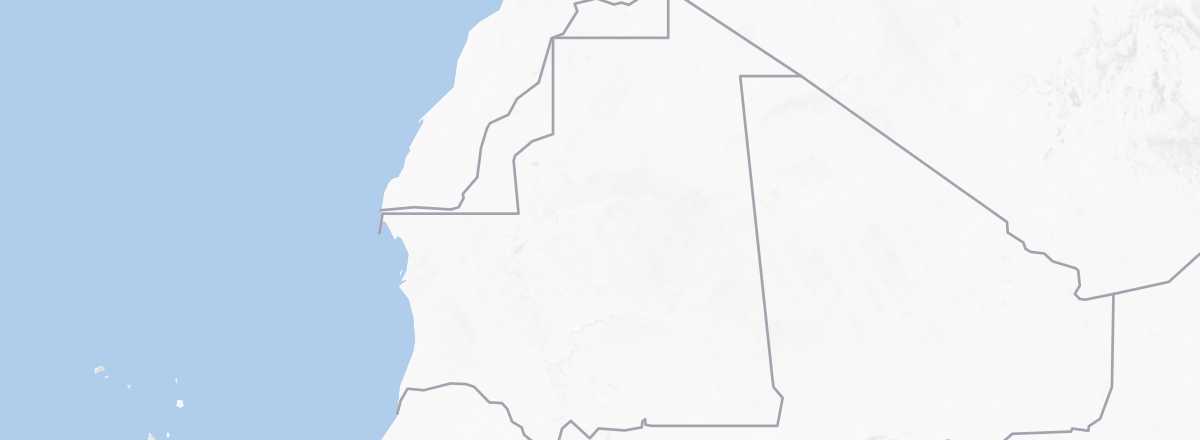 Mauritania
Open the interactive map
Mauritania
Open the interactive map
Quick Overview
Mauritania is a transition point between North Africa and sub-Saharan Africa, making it a culturally diverse, multi-ethnic country.
Key Facts
- Type of place: country.
- Latitude/longitude: 18°05' N, 15°58' W.
- Local time:
- Capital: Nouakchott.
- Nature of the state: Islamic republic.
- Official language: Arabic.
- Currency: ouguiya.
- Population: 3,840,429 inhabitants (2018).
- Area: 1,030,700 km².
- Density: 3.7 inhabitants/km².
- Highest point:
- Lowest point: sea level.
- Coastline: 750 km.
- Driving: on the right.
Tourism
A land of transition and a crossroads of cultures between the Maghreb and sub-Saharan Africa, Mauritania has always attracted desert and adventure lovers. Unfortunately, the insecurity affecting much of the country means tourism is now extremely limited (though it has improved slightly), with barely tens of thousands of visitors each year.
Travel Essentials
- Destination: for slightly experienced/confirmed travelers.
- By air: France-Nouakchott.
- Entry requirements: passport valid for at least 6 months after the planned return date + visa.
- Currency to bring: euros.
- Exchange rate:
- Daily "backpacker" budget:
- Best for accommodation:
- Best for getting around:
- Risks:
- Best time for climate/crowds/prices:
- Interests (out of ): Nature ; Adventure ; Culture ; Relaxation/holidays
Useful Addresses
Socio-Economic Statistics
- "Quality of life": 159/188 (rank in 2018)
- GDP per capita: $4,500 (2017)
- Average monthly income: ()
- Inflation: +2.3% (2017)
- "Official" unemployment: 10.2% (2017)
- Population below the poverty line: 31% (2014)
- Life expectancy: 63.8 years (2018)
- Migration rate per 1,000 inhabitants: -0.8 (2017)
- Population growth: +2.14% (2018)
- Literacy rate: 52.1% (2015)
- Urban population: 53.7% (2018)
- Press freedom: 72/180 (rank in 2018)
- Political regime: authoritarian regime (119/167 in 2018)
Sources: World Bank, Human Development Indicators, RSF, The Economist, The World Factbook