last edited Dec 11, 2019
Introduction to Mongolia
Location Map of Mongolia
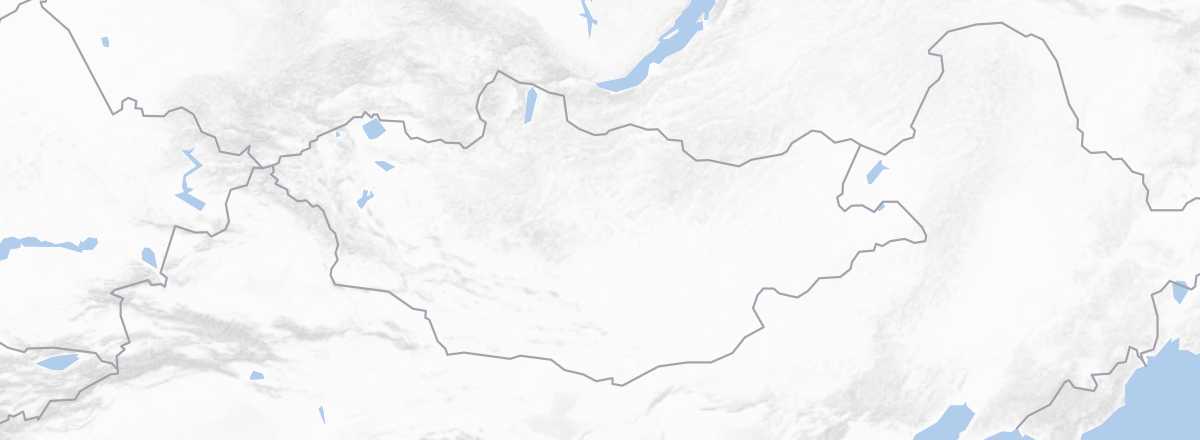 Mongolia
Open the interactive map
Mongolia
Open the interactive map
Quick Overview
Landlocked between Russia and China, Mongolia is renowned for the vastness of its steppes.
Key Facts
- Type of place: country.
- Latitude/longitude: 47°55' N, 106°55' E.
- Local time:
- Capital: Ulaanbaatar.
- Nature of the state: semi-presidential republic.
- Official language: Mongolian.
- Currency: tögrög.
- Population: 3,103,428 inhabitants (2018).
- Area: 1,564,116 km².
- Density: 2 inhabitants/km².
- Highest point: Khüiten Peak (4,374 m).
- Lowest point: Höh Nuur (518 m).
- Coastline: 0 km; no maritime access.
- Driving: on the right.
Tourism
Forests and endless steppes set against a backdrop of mountains—Mongolia and its vast desert landscapes will delight nature lovers and adventurers looking to experience off-the-beaten-path travel.
While Mongolia is a dream destination, it doesn’t attract crowds and caters to a specific audience, with around 500,000 visitors per year (529,000 in 2018). Unsurprisingly, the majority of tourists come from neighboring countries, with China leading (nearly 40% of arrivals), followed by Russia, South Korea, Japan, and Kazakhstan. Western visitors are far fewer, with around 15,000 Americans and 8,000–10,000 Germans or French annually.
Travel Essentials
- Destination: for somewhat experienced travelers.
- By air: France–Ulaanbaatar.
- Entry requirements: passport valid for at least 6 months after entry date + visa.
- Currency to bring:
- Exchange rate:
- Daily "backpacker" budget:
- Best for accommodation:
- Best for getting around:
- Risks:
- Best time for climate/crowds/prices:
- Interests (out of ): Nature ; Adventure ; Culture ; Relaxation/Holidays
Useful Addresses
Socio-Economic Statistics
- "Quality of life": 92/188 (rank in 2018)
- GDP per capita: $13,000 (2017)
- Average monthly income: ()
- Inflation: +4.6% (2017)
- "Official" unemployment: 8% (2017)
- Population below poverty line: 29.6% (2016)
- Life expectancy: 70.2 years (2018)
- Migration rate per 1,000 inhabitants: -0.8 (2017)
- Population growth: +1.11% (2018)
- Literacy rate: 98.4% (2015)
- Urban population: 68.4% (2018)
- Press freedom: 71/180 (rank in 2018)
- Political regime: flawed democracy (62/167 in 2018)
Sources: World Bank, Human Development Indicators, RSF, The Economist, The World Factbook