last edited Dec 11, 2019
Introduction to Tajikistan
Location Map of Tajikistan
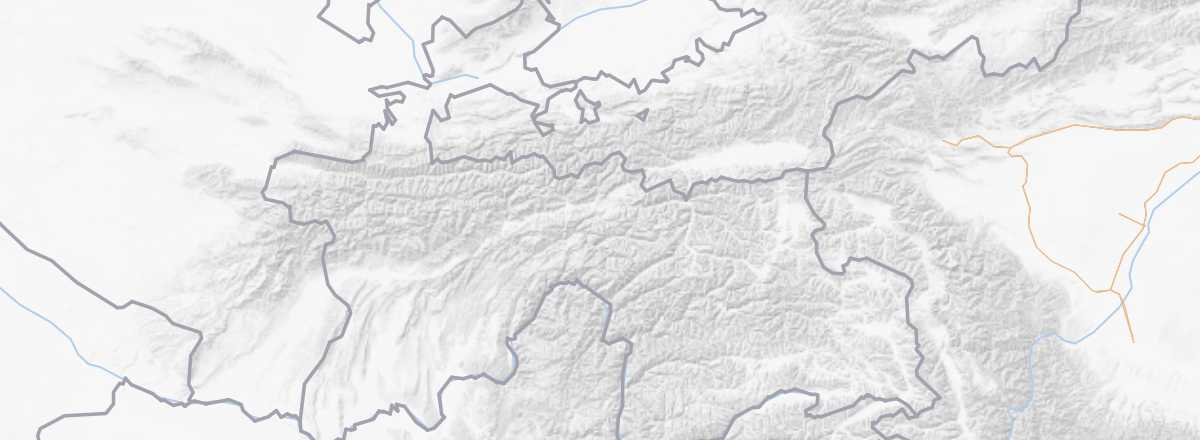 Tajikistan
Open the interactive map
Tajikistan
Open the interactive map
Quick Overview
Spanning its centre and east over the Pamir mountain range and its foothills, this 90% mountainous country is punctuated by a few basins in the south and north, which host fruit tree and cotton crops. It is also where the majority of the population is concentrated.
Key Facts
- Type of place: country.
- Location: at the heart of Central Asia, sandwiched between Uzbekistan and China.
- Latitude/longitude: 38°33' N, 68°48' E.
- Local time:
- Capital: Dushanbe.
- Nature of the state:
- Official language: Tajik (with Russian as an inter-ethnic communication language).
- Currency: Somoni.
- Population: 8,604,882 inhabitants (2018).
- Area: 143,100 km².
- Density: 60 inhabitants/km².
- Highest point: Ismail Samani Peak (7,495 m).
- Lowest point: Syr Darya (300 m).
- Coastline: 0 km; no maritime access.
- Driving: on the right.
Tourism
Completely off the beaten track, Tajikistan remains a top destination for trekking, mountaineering, adventure, and vast open spaces in this part of the world. Sparsely populated, 90% of its territory consists of mountains, half of which lie above 3,000 m. Currently, the country welcomes around 400,000 visitors per year (431,000 in 2017), many of whom come from Russia or neighbouring countries.
Travel Essentials
- Destination: for slightly experienced travellers.
- By air: France-Dushanbe.
- Entry requirements: passport + visa.
- Currency to bring:
- Exchange rate:
- Daily "backpacker" budget:
- Best for accommodation:
- Best for getting around:
- Risks:
- Best time for climate/crowds/prices:
- Interests (out of ): Nature ; Adventure ; Culture ; Relaxation/holidays
Useful Addresses
Socio-Economic Statistics
- "Quality of life": 127/188 (rank in 2018)
- GDP per capita: $3,200 (2017)
- Average monthly income: ()
- Inflation: +7.3% (2017)
- "Official" unemployment: 2.4% (2016)
- Population below the poverty line: 31.5% (2016)
- Life expectancy: 68.4 years (2018)
- Migration rate per 1,000 inhabitants: -1.1 (2017)
- Population growth: +1.58% (2018)
- Literacy rate: 99.8% (2016)
- Urban population: 27.1% (2017)
- Press freedom: 149/180 (rank in 2018)
- Political regime: authoritarian regime (159/167 in 2018)
Sources: World Bank, Human Development Indicators, RSF, The Economist, The World Factbook