last edited Dec 26, 2019
Introduction to the Dominican Republic
Location Map of Dominican Republic
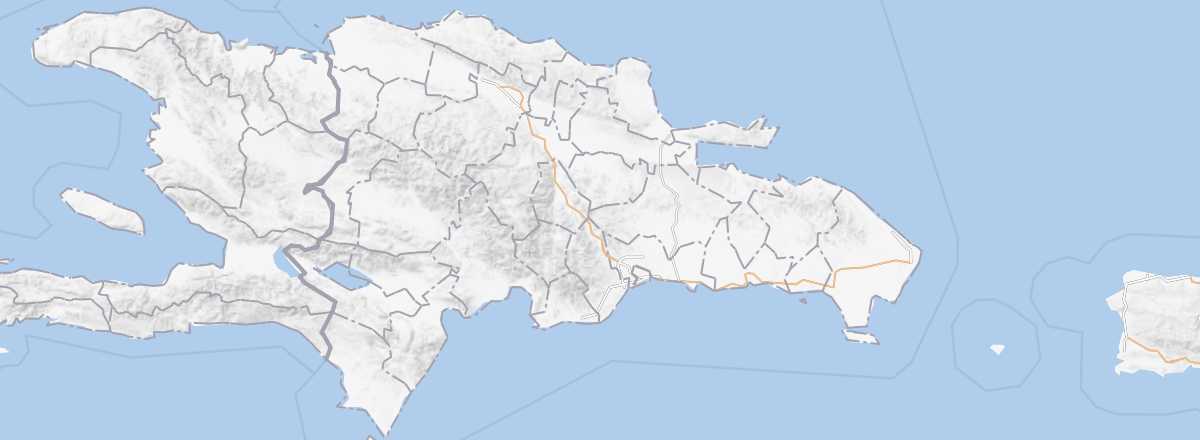 Dominican Republic
Open the interactive map
Quick Overview
The Dominican Republic, also called Santo Domingo or "DR," occupies two-thirds of the island of Hispaniola alongside Haiti. It is the second-largest country in the Caribbean by area after Cuba. Its territory, bordered by nearly 1,300 km of stunning coastline, boasts the highest relief in the Antilles, with Pico Duarte reaching 3,175 m.
With its tropical vegetation and beaches, the country has become the archetype of a relaxation-holiday destination for millions of Europeans and North Americans who stay in all-inclusive resorts. Today, tourism and its related activities account for nearly two-thirds of the Dominican Republic's resources, ahead of traditional agricultural products like tobacco, sugarcane, and coffee. Additionally, regular remittances from thousands of Dominican expatriates, primarily residing in the United States, contribute significantly.
Key Facts
- Type of place: country.
- Location: in the heart of the Greater Antilles, between Cuba and Puerto Rico, on the island of Hispaniola, which it shares with Haiti.
- Latitude/longitude: 19.00' N, 70.40' W.
- Local time:
- Capital: Santo Domingo (de Guzmán)
- Nature of the state: presidential democracy.
- Official language: Spanish.
- Currency: Dominican peso.
- Population: 10,298,756 inhabitants (2018).
- Area: 48,670 km².
- Density: 210 inhabitants/km².
- Highest point: Pico Duarte (3,098 m).
- Lowest point: Lake Enriquillo (-46 m).
- Coastline: 1,288 km.
- Driving: on the right.
Tourism
If there is one destination that has thrived on tourism for several decades, it is the Dominican Republic. The country remains the most visited in the Caribbean (6.569 million entries in 2018) and the one generating the most revenue from it ($7.5 billion in 2018). It is also one of the world's main all-inclusive activity hubs, though authorities are now considering diversifying the offering with ecotourism and cultural stays. In short, tourism is booming, with the long-term goal of further increasing visitor numbers (which have already risen by 50% since 2010), thanks in particular to an excellent value-for-money ratio in the "beach-holiday relaxation" category and an offering that aligns well with visitors' expectations.\n
While the destination attracts visitors from across the Americas and Europe, Americans and Canadians (58% of arrivals) are the most numerous, followed by the French (221,000 in 2018), Russians, Germans, and Italians. The vast majority of visitors come for all-inclusive packages (primarily in Punta Cana), followed by cruises and independent travel. While the north and east coasts welcome the most visitors and match the image one might have of the DR, there is another side to the country that most people overlook: the southwest coast, between the capital and Haiti, and the mountainous center of Santo Domingo.
Travel Essentials
- Destination: for beginner travelers.
- By air: France-Punta Cana (or other) for 550 to 900 € round trip.
- Entry requirements: passport + tourist card on arrival.
- Currency to bring: euro (and some US dollars).
- Exchange rate:
- Backpacker daily budget: 40 to 60 € per person.
- Accommodation: all-inclusive for beach stays, local small hotels when traveling.
- Getting around: buses and minibuses (guaguas), occasionally car rental.
- Risks: relatively low in terms of health and safety.
- Best time for climate/crowds/prices: November to early December and late March to late April.
- Interests (on ): Nature ; Adventure ; Culture ; Relaxation-holidays .
Addresses in France
Tourist Office: 22 rue du 4 septembre, 75002 Paris. Tel.: 01 43 12 91 91.
Addresses in Belgium, Switzerland, and Quebec
- Belgium
Tourist Office: 10 av. Lloyd George, 1000 Brussels. Tel.: 02 646 1300.
- Switzerland
No Dominican Republic Tourist Office in Switzerland; the French-speaking region is covered by the French office.
- Canada
There are two Tourist Offices:
-- Montreal: 2055 Peel Street, Suite 550, Montreal, Quebec, H3A 1V4. Tel.: (514) 499 1918.
-- Toronto: 26 Wellington Street East, Suite 201, Toronto, Ontario, M5E 1S2. Tel.: (416) 361 2126.
Socio-Economic Statistics
- "Quality of life": 94/188 (rank in 2018)
- GDP per capita: $17,000 (2017)
- Average monthly income: $460 (2012)
- Inflation: +3.3% (2017)
- "Official" unemployment: 5.1% (2017)
- Population below the poverty line: 30.5% (2016)
- Life expectancy: 71.3 years (2018)
- Migration rate per 1,000 inhabitants: -1.9 (2017)
- Population growth: +0.99% (2018)
- Literacy rate: 91.8% (2015)
- Urban population: 81.1% (2018)
- Press freedom: 59/180 (rank in 2018)
- Political regime: flawed democracy (61/167 in 2018)
Sources: World Bank, Human Development Indicators, RSF, The Economist, The World Factbook