last edited Dec 11, 2019
Introduction to The Gambia
Location Map of Gambia
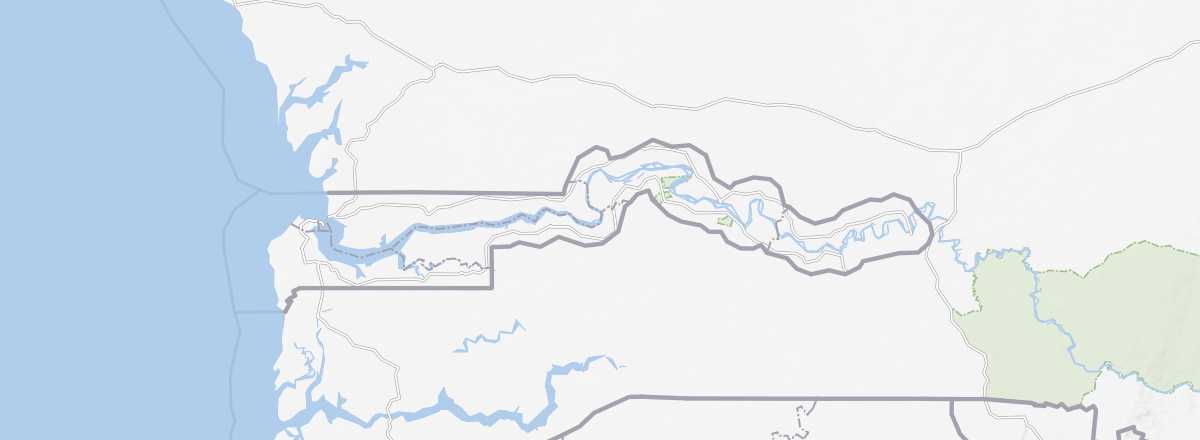 Gambia
Open the interactive map
Gambia
Open the interactive map
Quick Overview
Little known to the general public and completely landlocked within its Senegalese neighbour, The Gambia is the smallest country in West Africa.
Key Facts
- Type of place: country.
- Location: on the Atlantic coast, completely landlocked within Senegal.
- Latitude/longitude: 13°28' N, 16°36' W.
- Local time:
- Capital: Banjul.
- Nature of the state: presidential Islamic republic with a "dominant party".
- Official language: English.
- Currency: dalasi.
- Population: 2,092,731 inhabitants (2018).
- Area: 10,689 km².
- Density: 190 inhabitants/km².
- Highest point:
- Lowest point: sea level.
- Coastline:
- Driving: on the right.
Tourism
With around 150,000 visitors per year (162,000 in 2017), mostly from the UK, the Netherlands, or Scandinavia, the smallest country in West Africa is not particularly touristy, though it does have beautiful beaches, some colonial-era landmarks, and several relatively interesting natural sites. However, The Gambia has long been associated with sex tourism, particularly involving European women, an image it is keen to shake off.
Travel Essentials
- Destination: for beginner travellers.
- By air: France-Banjul.
- Entry requirements: passport valid for at least 6 months after the planned departure date + visa (available on arrival) + yellow fever vaccination.
- Currency to bring: euros.
- Exchange rate:
- Daily "backpacker" budget:
- Best for accommodation:
- Best for getting around:
- Risks:
- Best time for climate/crowds/prices:
- Interests (out of ): Nature / ; Adventure ; Culture ; Relaxation/holidays /
Useful Addresses
Socio-Economic Statistics
- "Quality of life": 174/188 (2018 ranking)
- GDP per capita: $2,600 (2018)
- Average monthly income: ()
- Inflation: +8% (2017)
- "Official" unemployment: ()
- Population below the poverty line: 48.4% (2011)
- Life expectancy: 65.4 years (2018)
- Migration rate per 1,000 inhabitants: -1.9 (2017)
- Population growth: +1.99% (2018)
- Literacy rate: 55.5% (2015)
- Urban population: 61.3% (2018)
- Press freedom: 122/180 (2018 ranking)
- Political regime: hybrid regime (111/167 in 2018)
Sources: World Bank, Human Development Indicators, RSF, The Economist, The World Factbook