last edited Feb 17, 2026
Money, Budget, and Shopping for Senegal
Location Map of Senegal
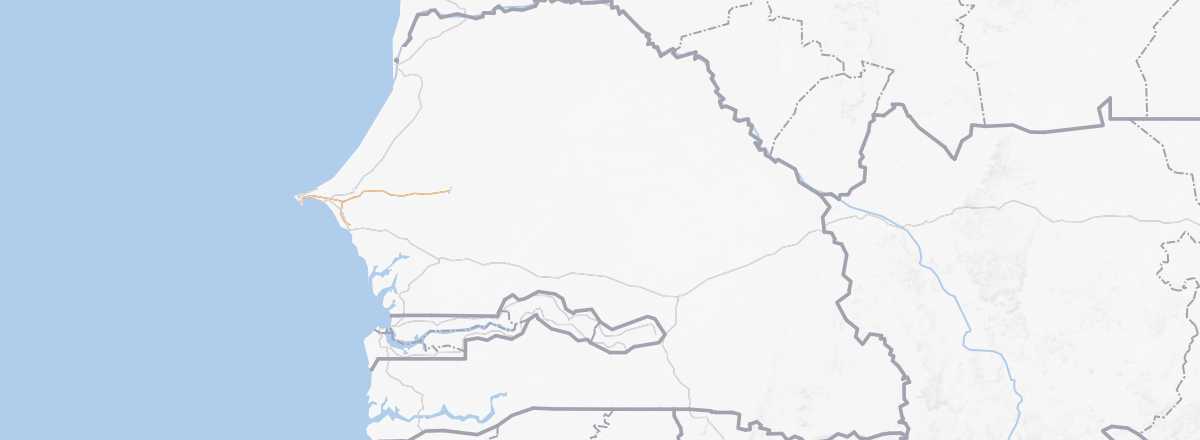 Senegal
Open the interactive map
Money
Currency
- Currency: West African CFA franc
- Banknotes: 500, 1,000, 2,000, 5,000, and 10,000 FCFA.
- Coins: 5, 10, 25, 50, 100, 200, and 500 FCFA.
- Exchange:
The West African CFA franc is used by 14 countries in West and Central Africa. There is a fixed parity between the CFA franc and the euro (100 FCFA = 0.15 €).
Exchange
It is easy to exchange money in major cities and tourist areas at exchange bureaus, many banks, and some large hotels. ATMs are also increasingly available across the country, with most major banks offering them.
Which currency to bring
Bring euros for your trip, including small denominations. These can often be used as a means of payment in many situations once you arrive. Otherwise, other major foreign currencies are also easily exchanged in Senegal.
Payment methods
Generally, it is best to always carry cash and small change to cover daily expenses and small purchases. This is even more important when venturing off the beaten path. Card payments, however, can be used for (large) hotels, vehicle rentals, and in many shops in tourist areas. Mobile payments are also becoming more common in the country.
Note that in tourist areas, it is often possible to pay directly in euros. This can be a convenient option, especially if you have little FCFA left.
Returning home
Since the CFA franc is rarely exchanged outside its zone, it is wise to manage your exchange needs as you go or finish your trip with euros to avoid ending up with excess FCFA.
Budget
In terms of budget, Senegal remains a relatively affordable country for those traveling "local-style." In this case, budget around 35 € to 45 € per day (for two people). However, if you seek a bit more comfort or convenience, especially in transportation, prices can rise quickly, and it is better to plan for at least 50 € per day.
Overall, excursions will be your biggest expense. For private transport, guides, and purchases, always check prices beforehand and bargain firmly if necessary.
What can be expensive
- Forgetting to or poorly negotiating prices, especially for purchases.
- Excursions and staying too long in coastal tourist areas.
- Car rental, as an additional cost.
What can be inexpensive
- Meals when eating local.
- Local hotels and camps.
- Public transportation.
Price range
- Budget double room: around 20 €.
- Mid-range double room: 40 € to 50 € for a (good) first choice.
- Snacks or local restaurant meals: about 5 € to 8 €.
- Tourist restaurant meals: expect at least 20 € for a full meal.
- Budget car rental: 40 € to 50 €, and double that for a 4x4.
- 100 km by local bus: 3 € or 4 €, and at least double for express/comfort.
- 100 km by shared taxi: roughly the same as local buses.
Bargaining and tipping
Bargaining is part of local culture in Senegal. You will have many opportunities to negotiate prices during your stay, which will directly impact your budget.
However, not everything is negotiable. Bargaining mainly applies to purchases in markets and shops. You can also negotiate hotel rates in budget establishments, vehicle rentals, guides, or taxi fares. On the other hand, meals, public transport (though it’s still good to check fares), and site or monument entry fees are not negotiable.
To bargain well, first determine the maximum amount you want to spend and research the prices of items that interest you. In shops, only start negotiating if you are truly interested, and don’t haggle over the equivalent of a few cents. For the first price quoted (avoid stating yours first), you can usually offer half, aiming to settle at 60% or 70% of the initial price. In any case, bargaining takes time but should remain enjoyable and a form of "mutual exchange" between both parties.
As for tipping, while not mandatory, it is often expected in restaurants, hotels, by taxi drivers, and especially by tour guides.
Shopping and souvenirs
Senegal offers plenty of souvenirs for those interested. Generally, Dakar is the best place for good deals, unlike the coastal tourist areas. However, in any case, it is the art of negotiation and bargaining that will always make the difference...
What to bring back
Among the items you can bring back are fabrics, batiks, boubous, traditional jewelry, basketry, pottery, sand paintings, masks, carved wood, and various musical instruments (djembe, balafon, koras...), as well as other African art pieces. All of these can be found and bargained for in shops and especially in markets.