last edited Dec 11, 2019
Other practical information for Florida
Location Map of Florida
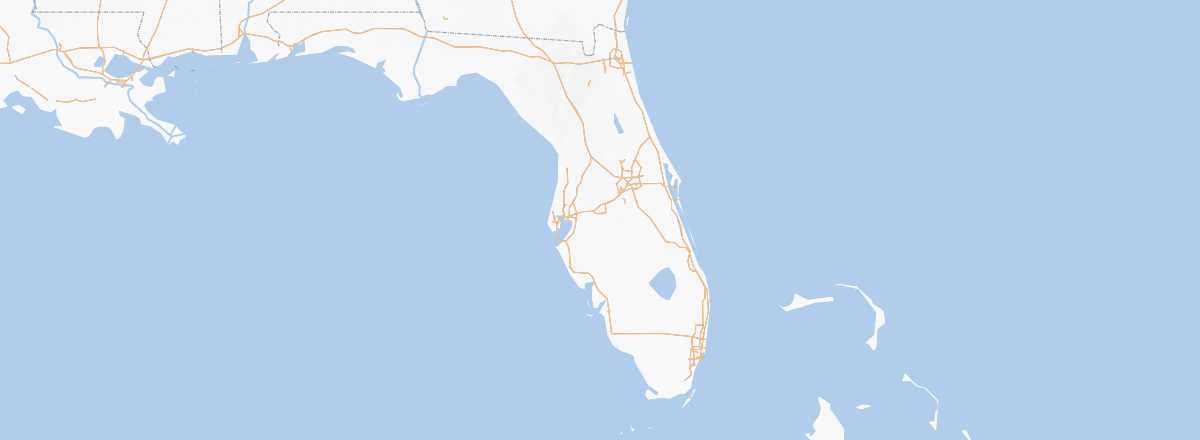 Florida
Open the interactive map
Florida
Open the interactive map
Baggage and equipment to bring
If staying in central or southern Florida, plan lightweight clothing and a sweater for evenings or air conditioning at all times. For the north, a warmer garment may be useful around January when it can occasionally get a bit cold. Otherwise, think about sun and rain protection, mosquito repellent, and good shoes if you plan to hike.
Budget
Highly tourist-oriented, with a peak season (late November to March) that sees prices rise significantly, Florida requires a slightly higher budget than the rest of the USA. Additionally, the many temptations—starting with theme parks, museums, boat trips, diving, or exploring the Everglades—are all things that cost money.
Precautions
Despite the Everglades and other swampy areas, Florida does not present major health risks. While mosquitoes are numerous in some places during summer (bring good repellent), they are not disease carriers.
As for safety, the basic advice is the same here as elsewhere in the country. In urban areas, certain neighborhoods in Miami are best avoided.
Consulates
Among the few countries with consular representations in Florida that can assist in case of problems are France and Canada.
- Canada: Consulate General, 200 South Biscayne Blvd, Ste. 1600, Miami. Tel.: (305) 579 1600.
- France: Consulate General, Espirito Santo Plaza, 1395 Brickell Ave., Ste. 1050, Miami. Tel.: (305) 403 4150.
Time difference
Local time: .
Like the entire Atlantic coast (or Montreal), Florida is on "Eastern Time." This means GMT-5, which is a 6-hour difference from France in both summer and winter.
Note, however, that the far western part of the state (the Pensacola region) does not follow the same time zone as the rest of the territory. The area is aligned with "Central Time" (GMT-6), like its neighbors in Alabama or New Orleans, to which it is much closer in every way than to Miami.