last edited Dec 11, 2019
Overview of Côte d'Ivoire
Location Map of Ivory Coast
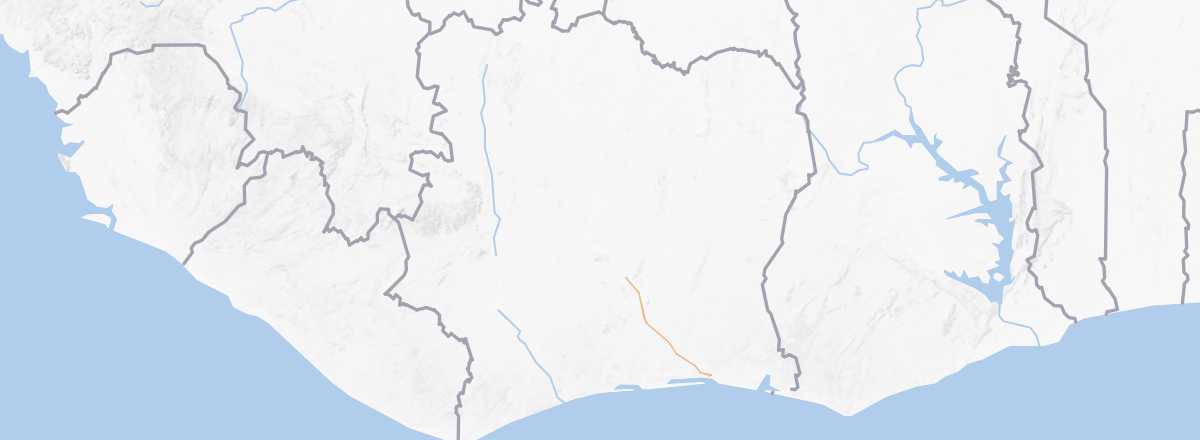 Ivory Coast
Open the interactive map
Quick Overview
Located in the western part of the Gulf of Guinea, the country is characterized by low-lying terrain consisting mostly of plateaus and plains. However, the western part of the country is more mountainous, with some areas exceeding one thousand meters.
Key Facts
- Type of place: country.
- Location: on the western coast of Africa, in the Gulf of Guinea and south of Mali.
- Latitude/longitude: 6°51' N, 5°18' W.
- Local time:
- Capital: Yamoussoukro (and Abidjan as the economic capital).
- Nature of the state: constitutional republic.
- Official language: French.
- Currency: West African CFA franc.
- Population: 26,260,582 inhabitants (2018).
- Area: 322,462 km².
- Density: 82 inhabitants/km².
- Highest point: Mount Nimba (1,752 m).
- Lowest point: sea level.
- Coastline: 520 km.
- Driving: on the right.
Tourism
Rich in nature, wildlife, culture, and even beach activities, the country has everything to offer. The only downside: a political situation that, depending on the period, ranges from unstable to fragile and has somewhat hindered the tourism sector in the past. That said, tourism has now regained some momentum, and Côte d'Ivoire welcomed 1.965 million visitors in 2018.
Travel Essentials
- Destination: for slightly experienced travelers.
- By air: France-Abidjan.
- Entry requirements: passport valid for at least 6 months after the planned return date + visa + yellow fever vaccination + return or onward ticket.
- Currency to bring: euros.
- Exchange rate:
- Daily backpacker budget:
- Best for accommodation:
- Best for getting around:
- Risks:
- Best period for climate/crowds/prices:
- Interests (out of ): Nature ; Adventure ; Culture ; Relaxation/Holidays
Useful Addresses
Socio-Economic Statistics
- "Quality of life": 170/188 (rank in 2018)
- GDP per capita: $3,900 (2017)
- Average monthly income: ()
- Inflation: +0.8% (2018)
- "Official" unemployment: 9.4% (2013)
- Population below poverty line: 46.3% (2015)
- Life expectancy: 60.1 years (2018)
- Migration rate per 1,000 inhabitants: 0 (2017)
- Population growth: +2.3% (2018)
- Literacy rate: 43.1% (2015)
- Urban population: 50.8% (2018)
- Press freedom: 85/180 (rank in 2018)
- Political regime: hybrid regime (113/167 in 2018)
Sources: World Bank, Human Development Indicators, RSF, The Economist, The World Factbook