last edited Dec 11, 2019
Overview of Croatia
Location Map of Croatia
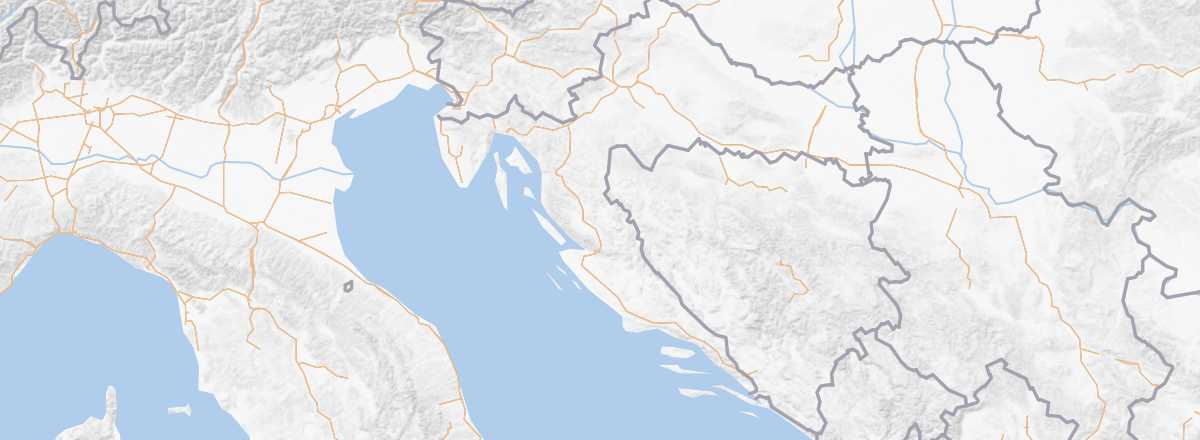 Open the interactive map
Quick Overview
Located in the Balkans, between Slovenia and Bosnia and Herzegovina, Croatia is one of the seven republics that emerged from the former Yugoslavia. Shaped like a crescent, it features a long coastline of 1,800 km, deeply indented and home to numerous islands (1,200!), along the Adriatic Sea. Beyond the narrow coastal plains, the terrain rises quickly (with the Dinaric Alps) before descending into the vast plains of Slavonia. Traditionally, the country has always had an agricultural focus in the north and east, while the coast has long benefited from tourism.
Key Facts
- Type of place: country.
- Location: facing northern Italy, along the Adriatic coast.
- Latitude/longitude: 45.10' N, 15.30' E.
- Local time:
- Capital: Zagreb
- State nature: Parliamentary republic.
- Official language: Croatian.
- Currency: kuna.
- Population: 4,270,480 inhabitants (2018).
- Area: 56,594 km².
- Density: 75.5 inhabitants/km².
- Highest point: Mount Dinara (1,830 m).
- Lowest point: sea level.
- Coastline: 5,835 km (including 1,777 km on the mainland).
- Driving: on the right.
Tourism
Long known for its coastline, as well as some of its natural sites like Plitvice Lakes National Park, Croatia has always attracted visitors—except, of course, during its war years (1991–1995).
Today, Croatian tourism remains a thriving industry, accounting for 20% of the national GDP. Each year brings new attendance records, and in 2018, the country welcomed 16.645 million tourists. The result: crowds, and often too many in peak season, especially along the coast and on the islands. Overall, Germans are by far the most numerous visitors (roughly one in five), followed by Slovenians, Austrians, Italians, and Poles. In 2016, 495,000 French tourists visited Croatia, making France the eighth-largest source of visitors, far ahead of Switzerland (235,000 tourists) and Belgium (183,000).
According to the Croatian Tourist Board, the most visited region is Istria (northern coast), followed by Split and the Dalmatian coast, particularly Dubrovnik. Logically, the country sees the most visitors during the summer holidays (too many!), though the off-season (September–October) is increasingly popular.
Travel Essentials
- Destination: for beginner travelers.
- By plane: France-Zagreb for 150/350 € round trip.
- Entry requirements: ID card or passport.
- Currency to bring: euros.
- Exchange rate:
- Backpacker daily budget: 50 to 70 € per person.
- Accommodation: homestays or camping.
- Getting around: car or bus.
- Risks: low in terms of health and safety.
- Best time for climate/crowds/prices: the shoulder seasons are the most pleasant, from late April to late June and September to early October.
- Interests (out of ): Nature ; Adventure ; Culture ; Relaxation/Holidays .
Addresses in France
Tourist Office: by phone at 01 45 00 99 55 or online.
Addresses in Belgium, Switzerland, and Quebec
Socio-Economic Statistics
- "Quality of life": 46/188 (2018 ranking)
- GDP per capita: $24,700 (2017)
- Average monthly income: $1,100 (2012)
- Inflation: +1.1% (2017)
- "Official" unemployment: 12.4% (2017)
- Population below the poverty line: 19.5% (2015)
- Life expectancy: 76.3 years (2018)
- Migration rate per 1,000 inhabitants: -1.7 (2017)
- Population growth: -0.51% (2018)
- Literacy rate: 99.3% (2015)
- Urban population: 56.9% (2018)
- Press freedom: 69/180 (2018 ranking)
- Political regime: flawed democracy (60/167 in 2018)
Sources: World Bank, Human Development Indicators, RSF, The Economist, The World Factbook