last edited Dec 11, 2019
Overview of Ghana
Location Map of Ghana
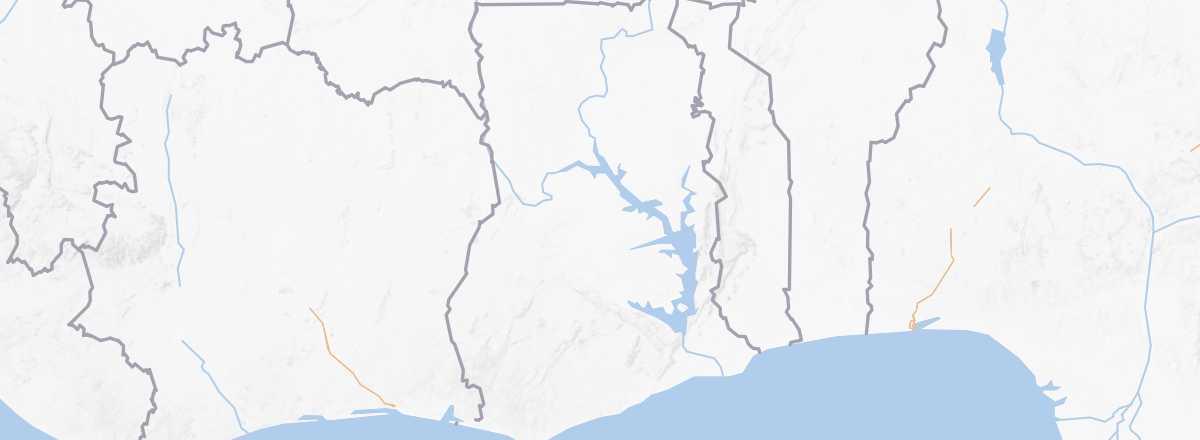 Ghana
Open the interactive map
Ghana
Open the interactive map
Quick Overview
A former British colony surrounded by French-speaking countries, Ghana is a flat country stretching about 1,000 km from the shores of the Gulf of Guinea to the small border highlands of Burkina Faso. The latter area is a savanna region, while the south is lush and covered with dense forests interspersed with numerous cocoa plantations (the country’s primary resource). Ghana is also crisscrossed by many rivers flowing toward the sea and has, in the east, a vast artificial lake (the largest in the world), Lake Volta.
Key Facts
- Type of place: country.
- Location: on the Gulf of Guinea, between Ivory Coast and Togo.
- Latitude/longitude: 5°33' N, 0°15' W.
- Local time:
- Capital: Accra.
- Nature of the state: parliamentary republic.
- Official language: English, plus 9 local languages with "national language" status.
- Currency: cedi.
- Population: 28,102,471 inhabitants (2018).
- Area: 238,540 km².
- Density: 117 inhabitants/km².
- Highest point: Mount Afadjato (885 m).
- Lowest point: sea level.
- Coastline:
- Driving: on the right.
Tourism
With its UNESCO-listed former colonial forts and trading posts along the coast, its beaches, and a few national parks and reserves home to some wildlife, Ghana has found its audience, primarily among English-speaking visitors. Each year, the country welcomes around one million visitors (972,000 in 2017).
Travel Essentials
- Destination:
- By air: France-Accra.
- Entry requirements: passport valid at least 6 months after the planned return date + visa + yellow fever vaccination.
- Currency to bring: euros.
- Exchange rate:
- Daily "backpacker" budget:
- Best for accommodation:
- Best for getting around:
- Risks:
- Best time for climate/crowds/prices:
- Interests (out of ): Nature ; Adventure ; Culture ; Relaxation-holidays /
Useful Addresses
Socio-Economic Statistics
- "Quality of life": 140/188 (rank in 2018)
- GDP per capita: $4,700 (2017)
- Average monthly income: ()
- Inflation: +12.4% (2017)
- "Official" unemployment: 11.9% (2015)
- Population below the poverty line: 24.2% (2013)
- Life expectancy: 67.4 years (2018)
- Migration rate per 1,000 inhabitants: -1.8 (2017)
- Population growth: +2.16% (2018)
- Literacy rate: 76.6% (2016)
- Urban population: 56.1% (2018)
- Press freedom: 23/180 (rank in 2018)
- Political regime: flawed democracy (57/167 in 2018)
Sources: World Bank, Human Development Indicators, RSF, The Economist, The World Factbook