last edited Dec 11, 2019
Overview of Malawi
Location Map of Malawi
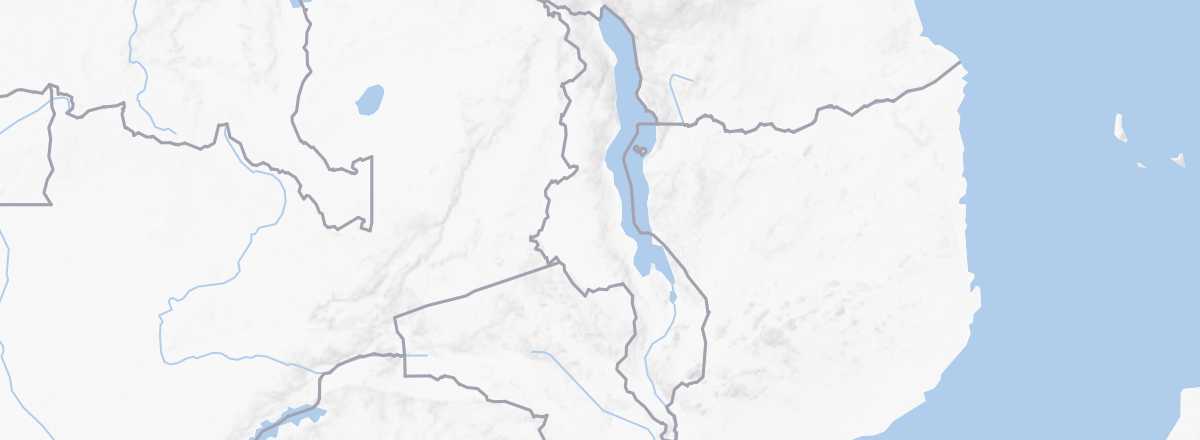 Malawi
Open the interactive map
Malawi
Open the interactive map
Quick Overview
A small, elongated country, Malawi stretches nearly 900 kilometres from south to north but is only a few dozen kilometres wide. Lake Malawi, bordering Mozambique and Tanzania, is among the world's top ten largest lakes. While the lowest point is almost at sea level, the highest reaches 3,000 metres at Mount Sapitwa in the south.
Key Facts
- Type of place: country.
- Location: in south-east Africa between Zambia and Mozambique.
- Latitude/longitude: 13°57' S, 33°42' E.
- Local time:
- Capital: Lilongwe.
- Nature of the state:
- Official language: English (plus Chichewa recognised "nationally").
- Currency: Malawian kwacha.
- Population: 19,842,560 inhabitants (2018).
- Area: 118,844 km².
- Density: 168 inhabitants/km².
- Highest point: Mount Sapitwa (3,002 m).
- Lowest point: Mozambican border (37 m).
- Lakeshore:
- Driving: on the left.
Tourism
Though not a "major tourist destination", with around 800,000 tourists per year (837,000 in 2017), Malawi offers a selection of parks and reserves with abundant wildlife, like most countries in Southern Africa. It also boasts a small beach sector developed around the vast Lake Malawi.
Travel Essentials
- Destination:
- By air: France-Lilongwe.
- Entry requirements: passport + visa on arrival.
- Currency to bring:
- Exchange rate:
- Daily "backpacker" budget:
- Best for accommodation:
- Best for getting around:
- Risks:
- Best time for climate/crowds/prices:
- Interests (out of ): Nature ; Adventure ; Culture ; Relaxation-holidays .
Useful Addresses
Socio-Economic Statistics
- "Quality of life": 171/188 (rank in 2018)
- GDP per capita: $1,200 (2017)
- Average monthly income: ()
- Inflation: +12.2% (2017)
- "Official" unemployment: 20.4% (2013)
- Population below poverty line: 50.7% (2011)
- Life expectancy: 62.2 years (2018)
- Migration rate per 1,000 inhabitants: 0 (2017)
- Population growth: +3.31% (2018)
- Literacy rate: 65.8% (2015)
- Urban population: 16.9% (2018)
- Press freedom: 64/180 (rank in 2018)
- Political regime: hybrid regime (90/167 in 2018)
Sources: World Bank, Human Development Indicators, RSF, The Economist, The World Factbook