last edited Dec 11, 2019
Overview of Montenegro
Location Map of Montenegro
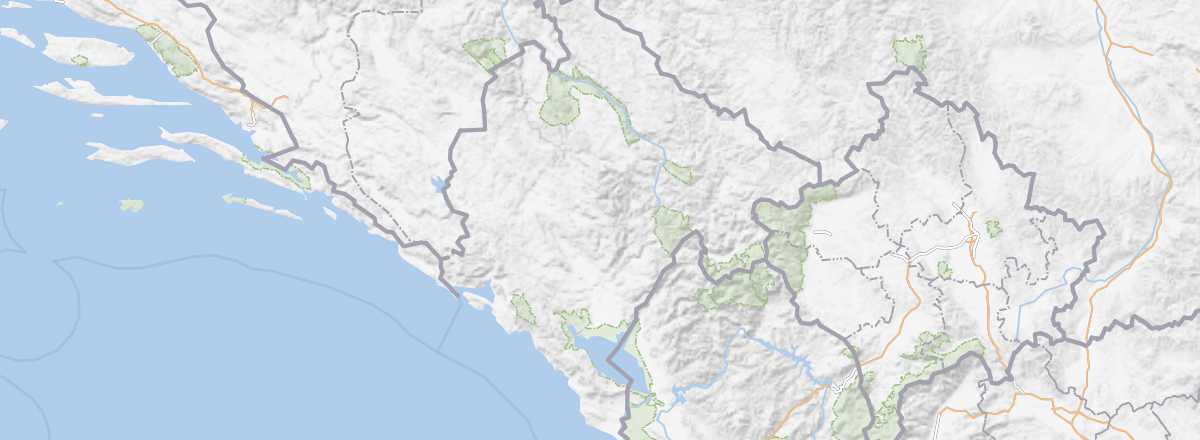 Montenegro
Open the interactive map
Quick Overview
Following on from Croatia, just before Albania, the country is one of Europe's newest, despite having had periods of independence in the past. After the breakup of Yugoslavia, it united with Serbia to form the Federal Republic of Yugoslavia from 1992 to 2003, and later Serbia and Montenegro, before regaining independence in 2006 after separating from the latter.
Key Facts
- Type of place: country.
- Latitude/longitude: 42.30' N, 19.18' E
- Local time:
- Capital: Podgorica.
- Nature of the state: Parliamentary republic.
- Official language: Montenegrin. However, Serbian, Bosnian, Albanian, and Croatian are also officially accepted.
- Currency: euro.
- Population: 614,249 inhabitants (2018).
- Area: 13,812 km².
- Density: 44.5 inhabitants/km².
- Highest point: Zla Kolata Peak (2,534 m).
- Lowest point: sea level.
- Coastline: 293 km.
- Driving: on the right.
Tourism
Following the example of neighboring Croatia, this country, which regained independence in 2006, is increasingly positioning itself as a tourist destination for many Europeans. Its seaside resorts, beautiful mountain landscapes, and especially its famous "Bay of Kotor", easily accessible for a day trip from Dubrovnik (in Croatia), are certainly part of the appeal. Add to this the fact that the region already enjoyed a certain popularity before the breakup of Yugoslavia and the subsequent wars.
Although Montenegro welcomes eight times fewer visitors than Croatia, the numbers are steadily rising, with over 2 million tourists now visiting each year (2.077 million in 2018). Currently, the tourism sector accounts for over 15% of national GDP, with annual revenues of 2 billion euros.
Travel Essentials
- Destination: for beginner travelers.
- By air: France-Podgorica for 180 to 350 € round trip.
- Entry requirements: ID card (for stays under 30 days) or passport.
- Currency to bring: euros.
- Exchange rate:
- Daily "backpacker" budget: 40 to 60 € per person.
- Accommodation: homestays or, alternatively, hotels.
- Getting around: car or bus.
- Risks: low in terms of health and safety.
- Best time for climate/crowds/prices: from late April to late June and September to early October.
- Interests (out of ): Nature ; Adventure ; Culture ; Relaxation-holidays .
Addresses in France
Addresses in Belgium, Switzerland, and Quebec
Socio-Economic Statistics
- "Quality of life": 50/188 (rank in 2018)
- GDP per capita: $17,800 (2018)
- Average monthly income: $578 (2012)
- Inflation: +2.4% (2017)
- "Official" unemployment: 16.1% (2017)
- Population below the poverty line: 8.6% (2013)
- Life expectancy: 73.5 years (2014)
- Migration rate per 1,000 inhabitants: ()
- Population growth: -0.34% (2018)
- Literacy rate: 98.7% (2015)
- Urban population: 66.8% (2018)
- Press freedom: 103/180 (rank in 2018)
- Political regime: hybrid regime (81/167 in 2018)
Sources: World Bank, Human Development Indicators, RSF, The Economist, The World Factbook