last edited Dec 11, 2019
Overview of the Bahamas
Location Map of Bahamas
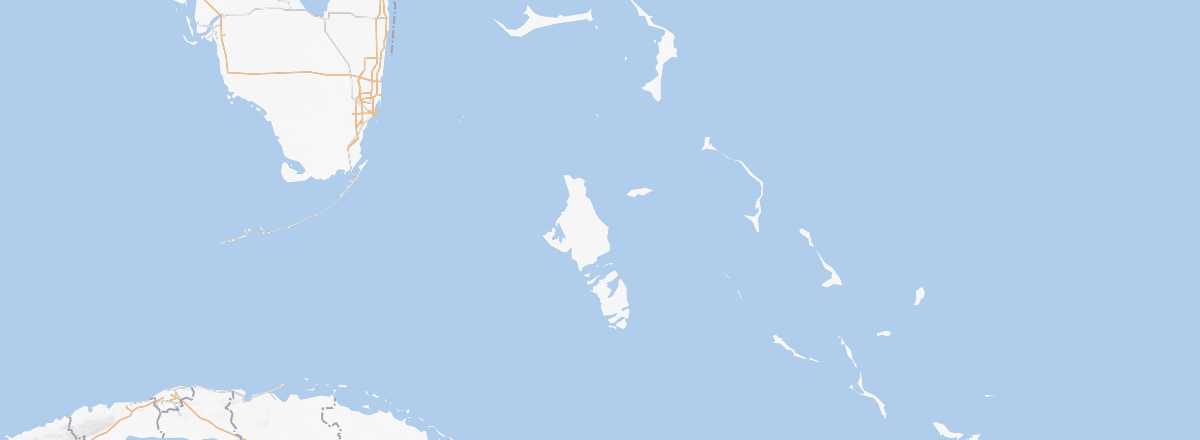 Bahamas
Open the interactive map
Quick Overview
Less than 100 kilometres from the coasts of Florida and Cuba, the Bahamas, with its 700 islands and islets, stretches in an arc over 1,200 kilometres long. This former British territory is part of what is known as the Commonwealth Realm.
The entire group of islands is of coral origin and has very limited relief, with the country's highest point barely reaching 63 metres. While the archipelago has several hundred islands, only about twenty are permanently inhabited, primarily New Providence, which is home to the capital Nassau and 70% of the 330,000 inhabitants.
Economically, the Bahamas has one of the highest standards of living in the Caribbean, with resources coming from tourism (which employs one in two inhabitants and accounts for over 60% of the economy) and offshore financial activities, which make up 20% of the GDP.
Key Facts
- Type de lieu: country.
- Latitude/longitude: 24.15' N, 76.00' W.
- Heure locale:
- Capitale: Nassau
- Nature de l'état: parliamentary democracy and member of the Commonwealth.
- Langue officielle: English.
- Monnaie: Bahamian dollar.
- Population: 332,634 inhabitants (2018).
- Superficie: 13,880 km².
- Densité: 24 inhabitants/km².
- Point le plus haut: Mount Alvernia (63 m) on Cat Island.
- Point le plus bas: sea level.
- Littoral: 3,542 km.
- Conduite: on the left.
Tourism
With over 1.5 million visitors per year (1.627 million in 2018), the Bahamas is one of the Caribbean's top tourist destinations. Tourism accounts for 60% of the archipelago's GDP and is firmly oriented towards luxury, catering to a clientele that is 80% American and cruise-based. As for the French, only a few thousand visit the Bahamas each year (14,000 in 2013), mostly to the Club Med on San Salvador Island, which is also the only island sometimes connected directly to France. In terms of budget, the Bahamas is one of the few destinations in the world where it is more cost-effective to explore through all-inclusive packages or cruises rather than travelling independently.
Travel Essentials
- Destination: for beginner travellers.
- By air: France-Nassau for 650 to 900 €.
- Entry requirements: passport.
- Currency to bring: US dollar.
- Exchange rate:
- Daily "backpacker" budget: 100 to 150 US$/person (90/130 €) or 1,500 to 2,000 US$/week per person (1,350/1,800 €) for all-inclusive packages excluding flights.
- Accommodation: all-inclusive or occasionally guesthouses/B&Bs.
- Getting around: minibuses, scooters, or golf carts, plus inter-island boats.
- Risks: low in terms of health and safety.
- Best time for climate/crowds/prices: late April to August and November to early December.
- Intérêts (out of ): Nature ; Adventure ; Culture ; Relaxation/Holidays .
Addresses in France
Tourist Office: 113-115 rue du Cherche Midi, 75006 Paris. Tel.: +33 1 45 26 62 62.
Addresses in Belgium, Switzerland, and Quebec
The Bahamas Tourist Office in Paris also handles Belgium and French-speaking Switzerland.
Socio-Economic Statistics
- "Quality of life": 54/188 (rank in 2018)
- GDP per capita: 32,400 US$ (2017)
- Average monthly income: 1,770 US$ (2011)
- Inflation: +1.4% (2017)
- "Official" unemployment: 10.1% (2017)
- Population below the poverty line: 9.3% (2011)
- Life expectancy: 72.9 years (2018)
- Migration rate per 1,000 inhabitants: 0 (2017)
- Population growth: +0.79% (2018)
- Literacy rate: 95.6% (2012)
- Urban population: 83% (2018)
Sources: World Bank, Human Development Indicators, RSF, The Economist, The World Factbook