last edited Dec 11, 2019
Introduction to Bosnia and Herzegovina
Quick Overview
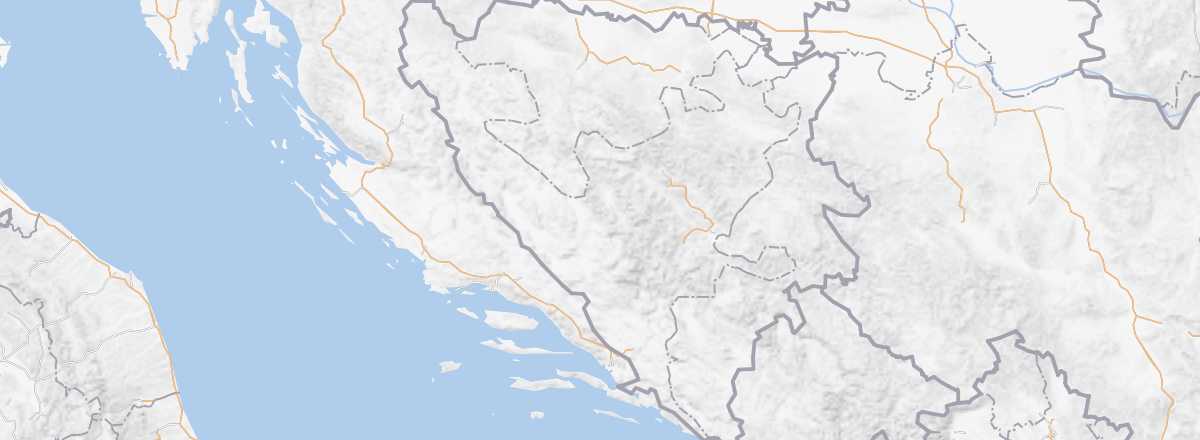
Since 1995, the country has been a unique case in Europe. It is divided into three non-independent territorial components: the Federation of Bosnia and Herzegovina (capital: Sarajevo), the Republika Srpska (capital: Banja Luka), and a third (small) entity, the Brčko District, which is partly managed by the UN.
Key Facts
- Type of place: country.
- Location: in the Balkans, bordering Croatia with a small opening onto the Adriatic.
- Latitude/longitude: 43°50' N, 18°21' E.
- Local time:
- Capital: Sarajevo
- Nature of the state: federal republic.
- Official languages: Bosnian, Serbian, and Croatian.
- Currency: convertible mark.
- Population: 3,849,891 inhabitants (including 1,327,000 in Republika Srpska).
- Area: 51,197 km² (including 24,857 km² for Republika Srpska).
- Density: 75 inhabitants/km².
- Highest point:
- Lowest point: sea level.
- Coastline: 20 km.
- Driving: on the right.
Tourism
This country, whose name is—or has been—associated with the troubled history of the former Yugoslavia in the 1990s, has now become a tourist destination (almost) like any other. Though still less frequented than its neighbors (primarily Croatia), Bosnia offers a rich cultural heritage and a pleasant natural environment.
Currently, around one million visitors travel there each year (1.053 million in 2018), which is three times more than a decade ago. The majority of visitors are Croats, Turks, Serbs, and Slovenians.
Travel Essentials
- Destination:
- By air: France-Sarajevo.
- Entry requirements: passport or ID card.
- Currency to bring: euros.
- Exchange rate:
- Backpacker daily budget:
- Best for accommodation:
- Best for getting around:
- Risks:
- Best time for climate/crowds/prices:
- Interests (on ): Nature / ; Adventure ; Culture ; Relaxation/Holidays .
Useful Addresses
Socio-Economic Statistics
- "Quality of life": 77/188 (2018 ranking)
- GDP per capita: $12,800 (2017)
- Average monthly income: $388 (2012)
- Inflation: +1.2% (2017)
- "Official" unemployment: 20.5% (2017)
- Population below poverty line: 16.9% (2015)
- Life expectancy: 77.1 years (2018)
- Migration rate per 1,000 inhabitants: -0.4 (2017)
- Population growth: -0.17% (2018)
- Literacy rate: 98.5% (2015)
- Urban population: 48.2% (2018)
- Press freedom: 62/180 (2018 ranking)
- Political regime: hybrid regime (101/167 in 2018)
Sources: World Bank, Human Development Indicators, RSF, The Economist, The World Factbook