last edited Dec 11, 2019
Overview of Malaysia
Location Map of Malaysia
 Malaysia
Open the interactive map
Quick Overview
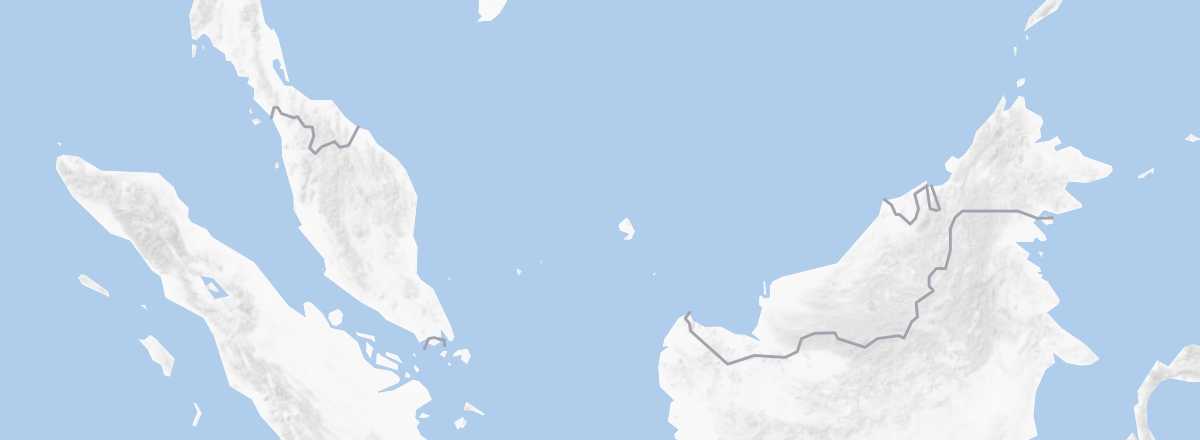
The country consists of two distinct regions: Peninsular Malaysia (also known as the Malay Peninsula) and East Malaysia. The two are separated by the South China Sea.
The Peninsula is divided from north to south by a long mountain range (under 2,190 m) where vast forested areas remain. The west coast is marshy and flat, while the east coast is made up of long sandy beaches. Crops and plantations are primarily located along the coastal plains.
East Malaysia (including the states of Sabah and Sarawak) is home to 15% of the population across an area that accounts for about 60% of the country’s territory. It is largely composed of jungles and highland terrain (Mount Kinabalu: 4,100 m).
Key Facts
- Type of place: country.
- Location: at the tip of Southeast Asia, with Peninsular Malaysia (south of Thailand) on one side and East Malaysia (north of the island of Borneo) on the other.
- Latitude/longitude: 3°05' N, 101°40' E.
- Local time:
- Capital: Kuala Lumpur
- Nature of the state: constitutional and federal monarchy.
- Official language: Malay.
- Currency: ringgit.
- Population: 31,809,660 inhabitants (2018).
- Area: 329,750 km².
- Density: 96 inhabitants/km².
- Highest point: Mount Kinabalu (4,096 m), on Borneo.
- Lowest point: sea level
- Coastline: 4,675 km.
- Driving: on the left.
Tourism
Malaysia is perhaps the most culturally and geographically diverse country in the region, with its modern, dynamic mainland on one side and the wilder, more "adventurous" northern part of Borneo on the other. In short, Malaysia is a complete destination, even if many travelers limit their exploration to the western part.
Each year, the country consistently welcomes around 25 million visitors (25.832 million in 2018), mostly from neighboring countries, China, or India. Among Western visitors, the British remain the most numerous.
Travel Essentials
- Destination: for beginner to somewhat experienced travelers.
- By air: France–Kuala Lumpur.
- Entry requirements: passport valid for at least 6 months after the planned arrival date.
- Currency to bring:
- Exchange rate:
- Daily "backpacker" budget:
- Best for accommodation:
- Best for getting around:
- Risks:
- Best time for climate/crowds/prices:
- Highlights (out of ): Nature ; Adventure ; Culture /; Relaxation/Holidays
Useful Addresses
Socio-Economic Statistics
- "Quality of life": 57/188 (rank in 2018)
- GDP per capita: $29,100 (2018)
- Average monthly income: ()
- Inflation: +3.8% (2017)
- "Official" unemployment: 3.4% (2017)
- Population below the poverty line: ()
- Life expectancy: 75.4 years (2018)
- Migration rate per 1,000 inhabitants: -0.3 (2017)
- Population growth: +1.34% (2018)
- Literacy rate: 94.6% (2015)
- Urban population: 76% (2018)
- Press freedom: 145/180 (rank in 2018)
- Political regime: flawed democracy (52/167 in 2018)
Sources: World Bank, Human Development Indicators, RSF, The Economist, The World Factbook