last edited Dec 11, 2019
Overview of Papua New Guinea
Location Map of Papua New Guinea
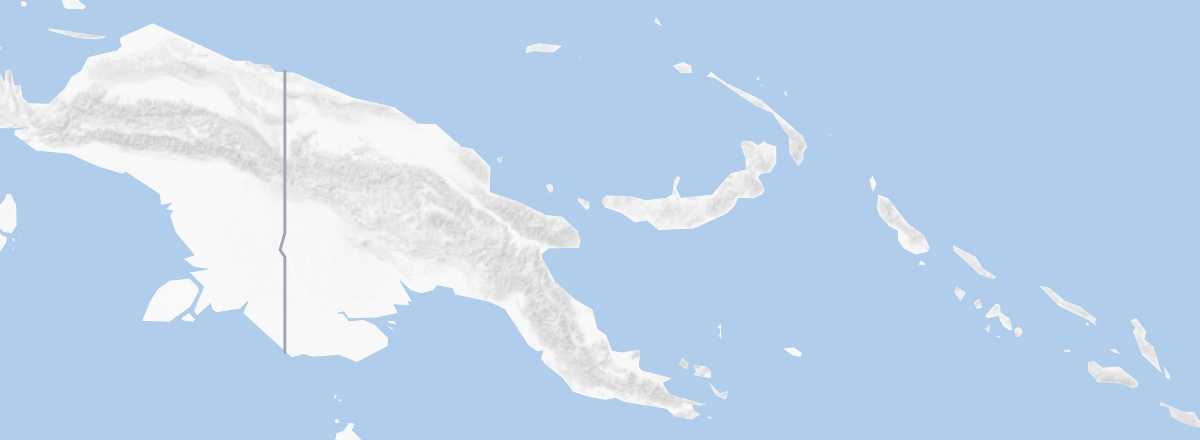 Papua New Guinea
Open the interactive map
Quick Overview
Papua New Guinea (PNG) consists of the eastern part of New Guinea (with the western part, West Papua, belonging to Indonesia) and thousands of islands and islets (the Bismarck Archipelago, Admiralty Islands, New Britain, etc.). New Guinea is the largest island in the world after Greenland. Stretching nearly 2,500 km, this volcanic archipelago forms a barrier between Asia and Australia. In the PNG region, towering mountains with eternal snow, such as Mount Wilhelm at 4,509 m, dominate the center, as do many of the other islands in the archipelago. Highlands (1,500/2,000 m) and vast swamps make up the southern part. Along the coast, jagged shorelines with strong currents are common.
Papua New Guinea is a parliamentary democracy and a member of the Commonwealth, with Christianity as the official religion and the worship of ancestors as the traditional belief. The archipelago is primarily inhabited by Papuans and Melanesians, the vast majority of whom are rural (87%) and live largely in self-sufficiency. Covered by over 90% forest and with a rich subsoil, PNG is one of the last places on Earth where nearly unexplored areas still exist.
Key Facts
- Type de lieu: country.
- Localisation: north of Australia, the eastern half of the island of New Guinea (the other half being Indonesian).
- Latitude/longitude: 9°28' S, 147°12' E.
- Heure locale:
- Capitale: Port Moresby
- Nature de l'état:
- Langues officielles: English, Papua New Guinean Sign Language, tok pisin, and hiri motu are recognized as official languages among over 800 spoken in the country.
- Monnaie: kina.
- Population: 7,027,332 inhabitants (2018).
- Superficie: 462,840 km².
- Densité: 15 inhabitants/km².
- Point le plus haut: Mount Wilhelm (4,509 m).
- Point le plus bas: sea level.
- Littoral: 5,152 km.
- Conduite: on the left.
Tourism
PNG is undoubtedly the least explored land on the planet. It offers visitors a journey back in time through its people and all kinds of adventures in a wild nature perfect for outdoor activities. Though the destination is not easy or budget-friendly, it has found its audience, with 150,000 to 200,000 visitors per year (143,000 in 2017), the majority being Australians and Indonesians.
Travel Essentials
- Destination: for experienced travelers.
- By air: France–Port Moresby.
- Entry requirements: passport + return or onward ticket + visa on arrival.
- Currency to bring:
- Exchange rate:
- Daily "backpacker" budget:
- Best for accommodation:
- Best for getting around:
- Risks:
- Best time for climate/crowds/prices:
- Intérêts (out of ): Nature ; Adventure ; Culture ; Relaxation/holidays
Useful Addresses
Socio-Economic Statistics
- "Quality of life": 153/188 (rank in 2018)
- GDP per capita: $3,700 (2017)
- Average monthly income:
- Inflation: +5.4% (2017)
- "Official" unemployment: 2.5% (2017)
- Population below the poverty line:
- Life expectancy: 67.5 years (2018)
- Migration rate per 1,000 inhabitants: 0 (2017)
- Population growth: +1.67% (2018)
- Literacy rate: 64.2% (2015)
- Urban population: 13.2% (2017)
- Press freedom: 53/180 (rank in 2018)
- Political regime: flawed democracy (75/167 in 2018)
Sources: World Bank, Human Development Indicators, RSF, The Economist, The World Factbook