last edited Dec 11, 2019
Overview of Turks and Caicos
Location Map of Turks and Caicos
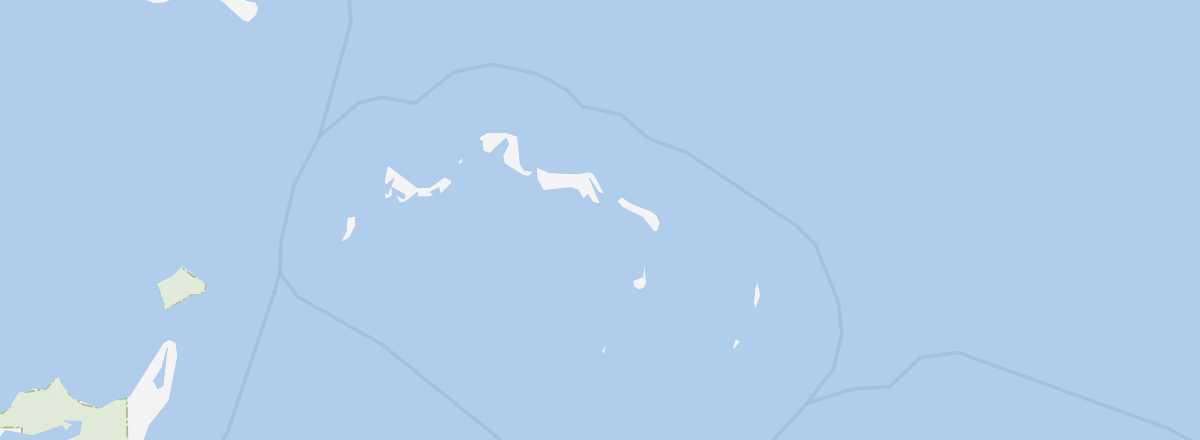 Turks and Caicos
Open the interactive map
Quick Overview
The Turks and Caicos archipelago, also known as Turks & Caicos, is located in the extension of the Bahamas, with which it forms the Lucayan Islands. It consists of around forty islands and "cays", eight of which are inhabited, divided into two groups. The Turks form the easternmost part with two main islands: Salt Cay (7 km²; 200 inhabitants) and Grand Turk, which hosts the capital (Cockburn Town) despite its 18 km² and fewer than 5,000 inhabitants. Just a few kilometers away, the Caicos archipelago is a group of much larger islands separated by small channels. Nevertheless, the vast majority of the population, the international airport, many services, and a large part of the tourist activity are concentrated solely on the island of Providenciales, by far the most "lively" in the entire archipelago.
Economically, fishing, offshore financial services, and especially tourism are the main resources of Turks and Caicos.
Key Facts
- Type of place: territory.
- Location: southeast of the Bahamas and just above Dominican Republic.
- Latitude/longitude: 21.45' N, 71.35' W.
- Local time:
- Capital: Cockburn Town.
- Nature of the state: British Overseas Territory.
- Official language: English.
- Currency: US dollar.
- Population: 53,701 inhabitants (2018).
- Area: 948 km².
- Density: 56 inhabitants/km².
- Highest point: Flamingo Hill (48 m).
- Lowest point: sea level.
- Coastline: 389 km.
- Driving: on the left.
Tourism
Alongside offshore financial services, tourism is the main activity of the archipelago and a priority for local authorities, which have multiplied initiatives and investments in this area for years. Not counting cruise passengers who only make a brief stop, around half a million visitors discover the islands each year (416,000 in 2017). Given the small population of Turks & Caicos, this represents one of the highest tourist-to-resident ratios in the entire Caribbean.
Overall, Americans, Canadians, and Britons are by far the most numerous visitors, while the French barely exceed a thousand per year. While the islands serve as a "refuge" for celebrities and high-contributing visitors, local tourism has also turned toward all-inclusive resorts, particularly popular among Canadians, as well as cruises. For the latter, Grand Turk is a stop for over 250 cruise ships, which bring more than half of the archipelago's visitors for just a few hours.
Travel Essentials
- Destination: for beginner travelers.
- By air: France-Providenciales.
- Entry requirements: passport + return ticket.
- Currency to bring: US dollar.
- Exchange rate:
- Daily backpacker budget: €/person.
- Best for accommodation: all-inclusive if staying at least a week.
- Best for getting around:
- Risks: low in terms of health and safety.
- Best period for climate/crowds/prices: mid-November to early May, though it's best to avoid Christmas-January due to high crowds.
- Interests (out of ): Nature ; Adventure ; Culture ; Relaxation/Holidays / .
Useful Addresses
Tourist Office: online only (in English).
Socio-Economic Statistics
- "Quality of life":
- GDP per capita: $29,100 (2017)
- Average monthly income:
- Inflation: +4% (2017)
- "Official" unemployment:
- Population below poverty line:
- Life expectancy: 80.1 years (2018)
- Migration rate per 1,000 inhabitants: +9.7 (2017)
- Population growth: +2.09% (2018)
- Literacy rate:
- Urban population: 93.1% (2018)
- Press freedom:
- Political regime:
Sources: World Bank, Human Development Indicators, RSF, The Economist, The World Factbook