last edited Jan 8, 2020
Overview of the United Arab Emirates
Location Map of United Arab Emirates
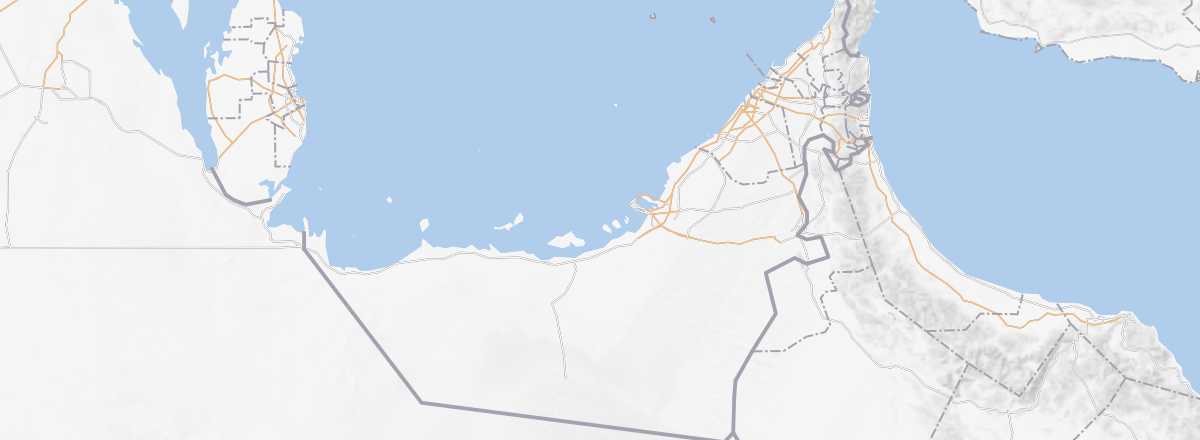 United Arab Emirates
Open the interactive map
Quick Overview
Established in 1971, the United Arab Emirates (UAE) is a federation of seven monarchical emirates: Abu Dhabi, Ajman, Sharjah, Dubai, Fujairah, Ras Al Khaimah, and Umm Al Quwain.
Key Facts
- Type of place: country.
- Location: On the eastern side of the Arabian Peninsula, between the Persian Gulf and the Gulf of Oman.
- Latitude/longitude: 24°28' N, 54°22' E.
- Local time:
- Capital: Abu Dhabi
- Nature of the state: Federation of seven monarchical emirates.
- Official language: Arabic.
- Currency: United Arab Emirates dirham.
- Population: 9,701,315 inhabitants (2018).
- Area: 82,880 km².
- Density: 117 inhabitants/km².
- Highest point:
- Lowest point: Sea level.
- Coastline:
- Driving: On the right.
Tourism
While everyone knows Dubai for its gigantism and some of the most ambitious projects, the UAE is not just about this city (and Abu Dhabi), which has become a major tourist destination in recent years. The UAE also includes six other "territories" that are far less visited but still interesting.
Nevertheless, Dubai attracts around 75% of visitors to the UAE and is the fourth most visited city in the world, with no plans to slow down. Meanwhile, Abu Dhabi (the country’s capital) recorded 4.5 million international arrivals. In short, strong figures, helped by the fact that both cities are key hubs for several regional airlines. Overall, the UAE welcomed 15.920 million tourists in 2018 (double the number in 2010) and aims to grow this figure even further in the coming years.
Travel Essentials
- Destination: For beginner travelers.
- By air: France-Dubai or Abu Dhabi.
- Entry requirements: Passport.
- Currency to bring:
- Exchange rate:
- Daily "backpacker" budget:
- Best for accommodation:
- Best for getting around:
- Risks:
- Best time for climate/crowds/prices:
- Interests (out of ): Nature / ; Adventure ; Culture ; Relaxation/Holidays
Useful Addresses
Socio-Economic Statistics
- "Quality of life": 34/188 (2018 ranking)
- GDP per capita: $68,600 (2018)
- Average monthly income: ()
- Inflation: +2% (2017)
- "Official" unemployment: 1.6% (2016)
- Population below the poverty line: ()
- Life expectancy: 78.7 years (2018)
- Migration rate per 1,000 inhabitants: +10.5 (2017)
- Population growth: +1.44% (2018)
- Literacy rate: 93.8% (2015)
- Urban population: 86.5% (2018)
- Press freedom: 128/180 (2018 ranking)
- Political regime: Authoritarian regime (147/167 in 2018)
Sources: World Bank, Human Development Indicators, RSF, The Economist, The World Factbook