last edited Dec 11, 2019
Overview of Bangladesh
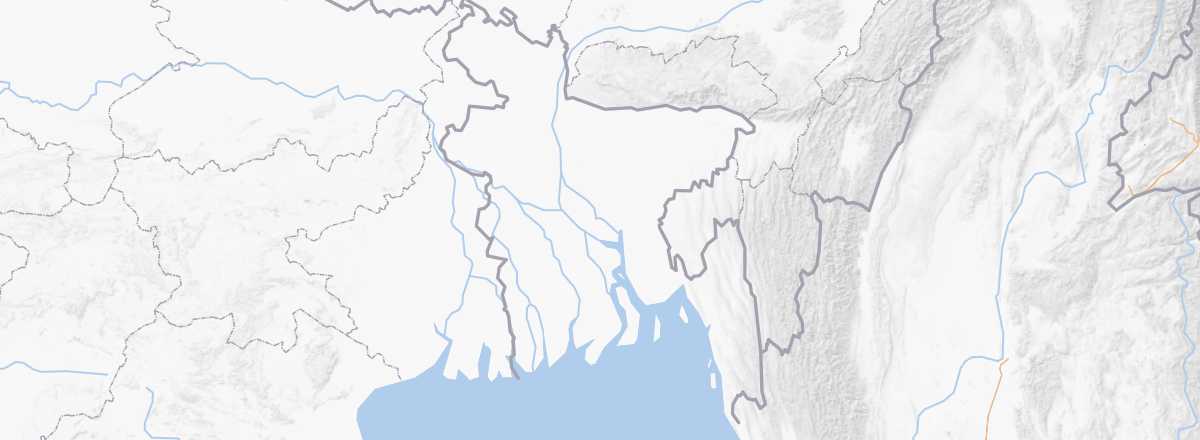
Location Map of Bangladesh
 Bangladesh
Open the interactive map
Quick Overview
Bangladesh is located north of the Bay of Bengal, almost entirely enclosed within India. Most of its territory is occupied by the Ganges Delta, a fertile plain but prone to cyclones and monsoon floods.
Key Facts
- Type of place: country.
- Location: north of the Bay of Bengal, almost entirely enclosed within India.
- Latitude/longitude: 23°43' N, 90°24' E.
- Local time:
- Capital: Dhaka.
- Nature of the state:
- Official language: Bengali.
- Currency: taka.
- Population: 159,453,001 inhabitants (2018).
- Area: 143,998 km².
- Density: 1,107 inhabitants/km².
- Highest point: Mowdok Mual (1,052 m).
- Lowest point: sea level.
- Coastline: 580 km.
- Driving: on the left.
Tourism
Completely off the beaten track and not necessarily the easiest destination in every respect, Bangladesh is a country that rewards effort and serves as a "complement" to India, with which, given its history, it shares many similarities. It’s no surprise, then, that Indians make up the largest group of the 1.026 million visitors who traveled here in 2017.
Travel Essentials
- Destination: for slightly experienced/seasoned travelers.
- By air: France-Dhaka.
- Entry requirements: passport + visa.
- Currency to bring:
- Exchange rate:
- Daily "backpacker" budget:
- Best for accommodation:
- Best for getting around:
- Risks:
- Best time for climate/crowds/prices:
- Interests (out of ): Nature ; Adventure ; Culture ; Relaxation/holidays /
Useful Addresses
Socio-Economic Statistics
- "Quality of life": 136/188 (rank in 2018)
- GDP per capita: $4,200 (2017)
- Average monthly income: ()
- Inflation: +5.6% (2017)
- "Official" unemployment: 4.4% (2017)
- Population below poverty line: 24.3% (2016)
- Life expectancy: 73.7 years (2018)
- Migration rate per 1,000 inhabitants: -3.1 (2017)
- Population growth: +1.02% (2018)
- Literacy rate: 72.8% (2016)
- Urban population: 36.6% (2018)
- Press freedom: 146/180 (rank in 2018)
- Political regime: hybrid regime (88/167 in 2018)
Sources: World Bank, Human Development Indicators, RSF, The Economist, The World Factbook