Covers both the French side (Saint Martin) and the Dutch side (Sint Maarten) of the island.
Travel guide
Covers both the French side (Saint Martin) and the Dutch side (Sint Maarten) of the island.
Though not very large—less than 100 km²—Saint Martin Island is divided into two parts: a French section in the north (Saint Martin) and a Dutch one in the south (Sint Maarten). Together, they attract over 2.5 million visitors annually, making it one of the…
Saint Martin has a mild, dry tropical climate, thanks in large part to the trade winds. Its average annual temperature hovers around 28 to 31°C, with May to October being the hottest period and December to February the coolest—though temperatures never drop below 25°C during the day or 20°C at night.
Like the rest of the Antilles, the island has a dry season (December to April) and a rainy season called the *hivernage* (May to November). However, there’s little variation between the two seasons, as rainfall here is relatively low compared to many other islands in the region. Annual precipitation is under 1,000 mm, with only brief showers. August to November is the wettest period and when hurricanes can occasionally hit the island. By contrast, February to March is the driest.
The climate isn’t a major constraint for visiting Saint Martin, though it’s best to avoid the rainy and hurricane season between late July and mid-November.
| Jan. | Feb. | Mar. | Apr. | May | Jun. | Jul. | Aug. | Sep. | Oct. | Nov. | Dec. | |
|---|---|---|---|---|---|---|---|---|---|---|---|---|
| Climate | / | / |
: very favorable | : favorable | : moderately favorable | : unfavorable.
The water temperature in Saint Martin is consistently pleasant year-round.
| Jan. | Feb. | Mar. | Apr. | May | Jun. | Jul. | Aug. | Sep. | Oct. | Nov. | Dec. | |
|---|---|---|---|---|---|---|---|---|---|---|---|---|
| Saint Martin | 26 | 26 | 26 | 27 | 28 | 28 | 28 | 29 | 29 | 29 | 28 | 27 |
The island, on both the French and Dutch sides, is quite multi-ethnic and multicultural, with a predominance of French and other European nationalities, as well as Haitian, Dominican, and American. While some (Haitians, Dominicans, etc.) arrived in search of work, others (Europeans, Americans) were rather drawn by the tax advantages the island offers to its wealthiest residents...
Although the island isn’t very large, many languages are spoken there. On the Saint Martin side, French is the official language, but English is widely spoken. On the Sint Maarten side, Dutch (primarily used for administrative purposes) and English (spoken by nearly 90% of the population) are the official languages, while French is spoken by no more than 5% of the population in that part of the island. Additionally, around 5% of the island’s population speaks Spanish, and 3–4% use Haitian Creole or Papiamento. In short, the island is quite multilingual, and English generally serves as the common language for most residents.
A few local words and expressions useful for travelers:
January 1: New Year’s Day.
February: Carnival.
March–April: Good Friday.
March–April: Easter Monday.
May: Labor Day.
May 8: Victory Day.
May 27: Abolition of Slavery.
May–June: Ascension Day.
May–June: Whit Monday.
July 14: Bastille Day.
July 21: Schoelcher Day.
August 15: Assumption.
November 1: All Saints’ Day.
November 11: Armistice Day.
December 25: Christmas.
Saint Martin/Sint Maarten has no sites listed as UNESCO World Heritage Sites.
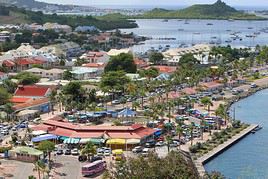
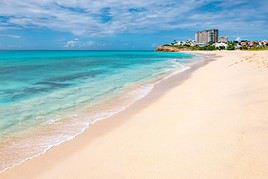
This small town on the west coast, with its typical Caribbean architecture and 18th-century fort, is the capital of the French side of the island of Saint Martin.
Close to Marigot (and the airport), this village on the northwest coast with its wooden houses and beach is renowned for the quality of its restaurants.
This is the highest point on the entire island of Saint Martin (424 m), offering a magnificent panorama.
On the east coast, this spot—despite its urbanization—has the most frequented beach on the French side of Saint Martin.
Of the ten or so islets around Saint Martin, Pinel is the largest and most tourist-friendly, with its three beautiful beaches.
This beach is world-famous for its proximity to Princess Juliana International Airport. During landings, aircraft fly just a few metres above swimmers.
On the border of the French side and close to the airport, this area is home to the island’s most beautiful beaches.
This is the capital of the Dutch side and a major cruise-ship port in the Caribbean. The main draw is duty-free shopping. The town also has beaches, casinos, and the remains of two Dutch forts.
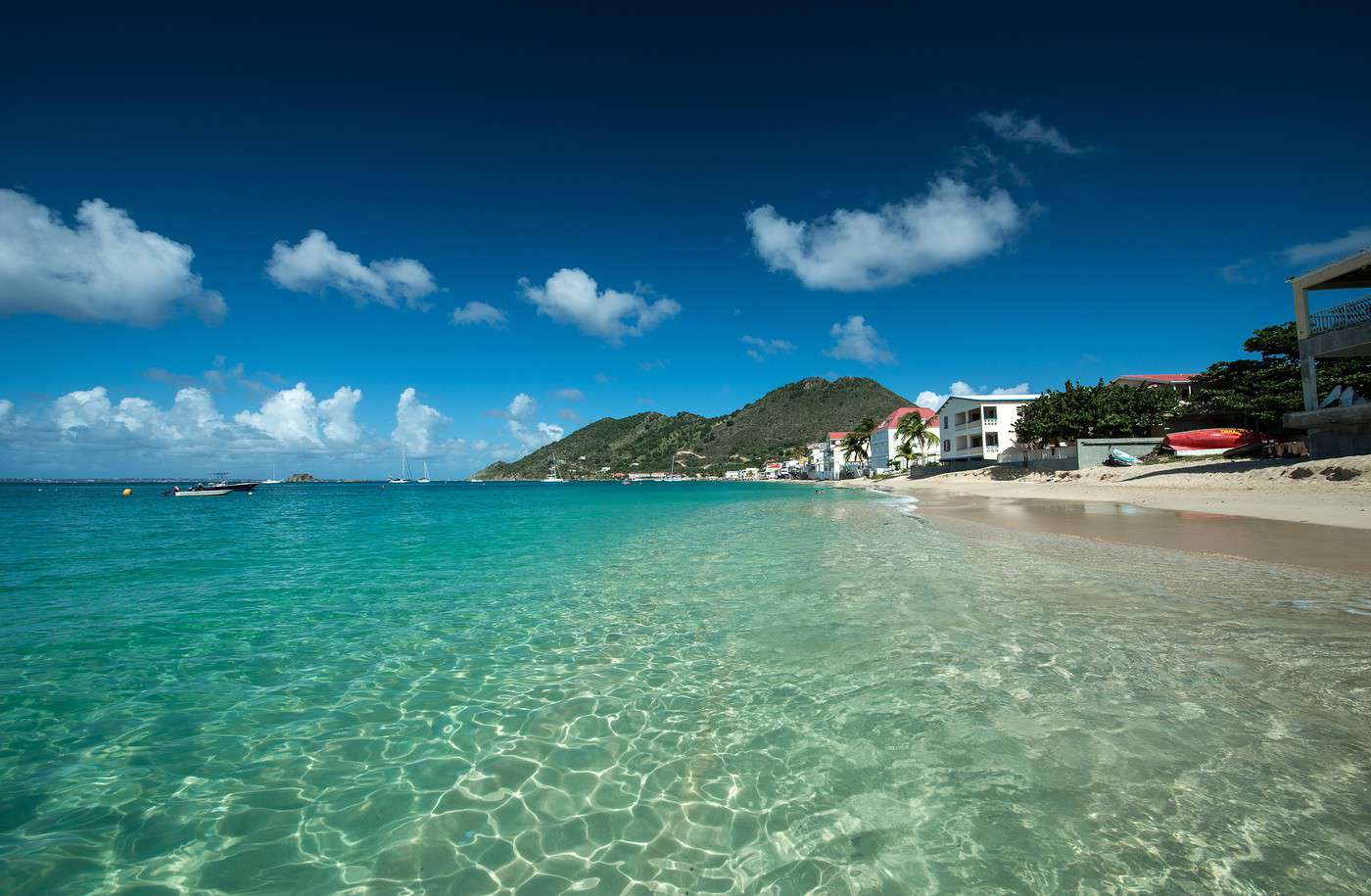
Saint Martin boasts 37 (stunning) beaches, on both the French and Dutch sides. Some are quite busy, while others are much quieter. On the French side: Orient Bay, one of the most popular, plus the islets Pinel and Tintamarre, accessible by boat and loved by visitors. On the Dutch side, Maho Beach is famous for its proximity to Juliana Airport and the planes flying just metres above swimmers. As for Mullet Bays, on the border with the French side, it has the island’s most beautiful beaches.
There are 45 diving and snorkelling sites on the island, suitable for beginners and experienced divers alike. The marine life and flora are particularly interesting, especially around the nature reserve of the Tintamarre and Pinel islets or the coral reef. Alongside diving, you can also explore the seabed on glass-bottom boat tours.
Fishing:
Watersports:
Sailing and Boat Trips:
There are around twenty short hiking trails on the island. Very short, no more than 6 km, they’re more like simple walks than proper hikes.
The whole island is a very easy destination for independent travel, perfect for first-time travellers.
Finding the best time to visit means balancing climate conditions with crowd levels and the most attractive prices for travel and on-site expenses.
The climate isn’t a major constraint for Saint Martin, though it’s best to avoid the rainy and hurricane season from late July to mid-November. However, the tourist rush and higher prices during peak season—from Christmas (especially) to mid-April—can be a bigger concern. The best compromise for exploring the island is April to June and late November to early December.
| Jan. | Feb. | Mar. | Apr. | May | Jun. | Jul. | Aug. | Sep. | Oct. | Nov. | Dec. | |
|---|---|---|---|---|---|---|---|---|---|---|---|---|
| Climate | / | / | ||||||||||
| Avoid crowds | / | |||||||||||
| Low prices | / |
: very favorable | : favorable | : moderately favorable | : unfavorable.
The island has two airports: a very small one on the French side at Grand Case (Grand Case Espérance Airport), which only offers a few flights to/from Anguilla, St. Barths, or Guadeloupe, and Princess Juliana, the international airport on the Dutch side. Most…
Although there is "legally" a border between the two parts of the island, it is not marked, and there are no checks when moving from one side to the other. The island's road network mainly consists of a circular route (the RN7) that loops around it. Given the…
For tourist travel purposes.
There are two airports on the island: a very small one on the French side in Grand-Case, which only offers a few flights to and from other French West Indies islands, and Princess Juliana, the international airport on the Dutch side. Most visitors arrive via the latter. However, for French travelers, the entry requirements differ depending on which side is chosen. Note that neither part of the island is part of the Schengen Zone.
If arriving on the French side (Saint-Martin), there are no special entry requirements regardless of the length or purpose of the stay. A valid ID card or passport is sufficient.
If arriving on the Dutch side (Sint Maarten), a passport along with a return or onward ticket is required for stays of theoretically less than 60 days. An immigration card handed out on the plane must also be filled out, and the address of your accommodation should generally be provided. Note that a French ID card is not sufficient when arriving on the Dutch side. This means that in all cases, a passport is preferable to avoid being unable to leave from the Dutch side, whether by plane or boat, if you initially arrived on the French side.
For citizens of the EU, Switzerland, Canada, and a few other nationalities, a passport and return/onward ticket are required for the Dutch side. On the French side, for EU members or Swiss citizens (but not Canadians), a simple passport is sufficient with no time limit on the stay (compared to a maximum of 60 days in principle on the Dutch side).
In foreign countries, French consulates handle all matters concerning Saint-Martin, while Dutch representations take care of Sint Maarten.
Currency: Saint-Martin: euro (100 centimes). Sint Maarten: Netherlands Antilles guilder (100 cents). Banknotes: Saint-Martin: 5, 10, 20, 50, 100, 200 and 500 €. Sint Maarten: 5, 10, 25, 50, 100 and 250 Fls. Coins: Saint-Martin: 1, 2, 5, 10, 20 and 50 centimes…
In France, both for individuals and professionals, the "travel advice" from the Ministry of Foreign Affairs regarding precautions for each country has legal value. A similar online travel advice system exists in several countries: Foreign Affairs Belgium…
At any time of year, pack light clothing plus a sweater for evenings and air conditioning. Don’t forget mosquito protection, sun protection, and rain gear in season.
International dialing code: (00 +) 590 for the French side and 1-721 for the Dutch side.
A useful detail: calling from one side of the island to the other is considered an international call.
Local time: .
Both sides of the island share the same time, GMT-4. This means 5 hours less in winter and 6 hours less in summer compared to mainland France. In winter, there is a one-hour difference between Quebec (GMT-5) and Saint Martin.
As with some other things, the electrical system differs between the French and Dutch sides.
On the French side, you’ll find 220 volts (60 Hz) with "French" plugs (officially type C or E), which will require an adapter for North American plugs. On the Dutch side, it’s 110 volts (60 Hz) with "American" plugs (officially type A or B), which will require an adapter for French plugs. However, adapters are easy to find everywhere on the island.
French side: There is a Tourist Office located at Route de Sandy Ground, Marigot, 97150 Saint-Martin. Tel.: 0590 87 57 21.
Dutch side: Tourist Office, WG Buncamper Road 33, Philipsburg. Tel.: (1-721) 542 2337.
While French is the official language on the French side of Saint Martin, this is not the case in Sint Maarten, where Dutch and English are the official languages. Moreover, despite the proximity, French is spoken by barely 5% of the population on the Dutch side, making English the common language across the entire island. That said, you won’t have much trouble traveling even if you only speak French, as you’ll always be able to find someone who speaks it more or less fluently, even on the Dutch side.
From the island of Saint Martin to...: Anguilla Guadeloupe Saba St-Barth St-Kitts St Croix Saint-Martin 17 km 280 km 25 km Saint Martin, or more precisely its Dutch side with Port St. Maarten , is a classic stop for cruise ships sailing the region. Over 2…
Something wrong or out of date? Report this page