last edited Dec 11, 2019
Health and Safety in Guadeloupe
Location Map of Guadeloupe
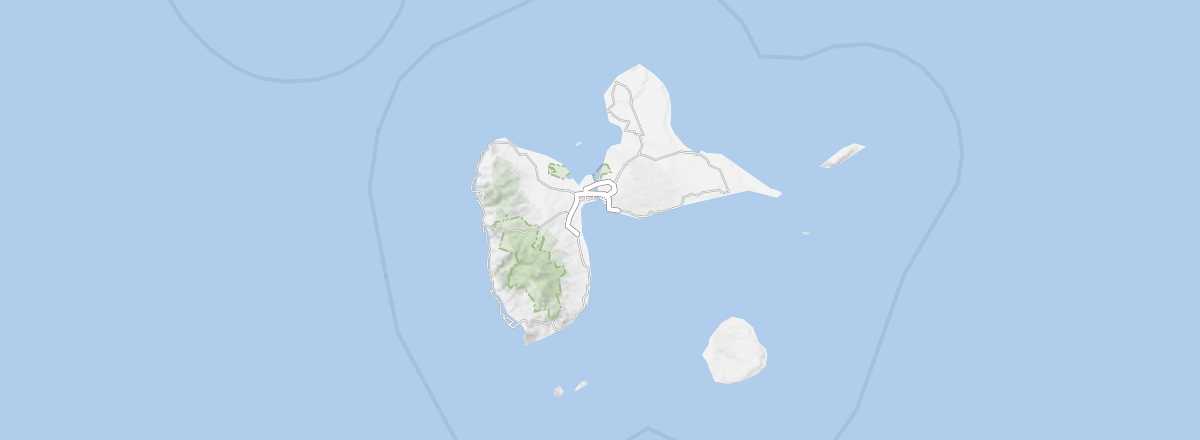 Guadeloupe
Open the interactive map
Official Recommendations
In France, both for individuals and professionals, the "travel advice" from the Ministry of Foreign Affairs regarding precautions for each country has legal value. A similar online travel advice system exists in several countries:
Health
While no vaccinations are mandatory for staying there, it’s still best to be up to date with your "basic vaccinations."
Diseases
Guadeloupe doesn’t pose major health risks, though dengue, chikungunya, and more recently Zika—spread by certain mosquitoes—are present. To protect yourself, the best approach is to use a good repellent, cover your arms and legs at dusk when bites are most frequent, and bring an impregnated mosquito net if sleeping in a place without air conditioning or airflow. This will also help against biting midges that thrive in some areas. For swimming, avoid stagnant water where parasites may be present. On another note, STIs and HIV are also present in the department, so take the usual precautions.
Hygiene
There are no major risks here either, and the water is drinkable everywhere (though local network outages may occur). Just remember to stay hydrated and protect yourself from the sun during the hottest periods.
Healthcare Facilities on Site
Guadeloupe has a very good healthcare system, one of the best in the Antilles. As for how it works—reimbursement for care, etc.—everything functions as it does in mainland France.
Safety
Crime and Delinquency
Like everywhere, there is some crime and delinquency on the island, which has given it a somewhat poor reputation in recent years. That said, incidents—aside from theft and vandalism against vehicles—rarely affect visitors, and there’s no need to "overthink it" as long as you don’t act recklessly and avoid walking alone at night in isolated areas or certain neighborhoods.
Scams and "Tourist" Harassment
Socio-Political Issues and Terrorism
There are no terrorism-related issues on the island. However, while it’s important not to overstate, Guadeloupe’s socio-economic situation does lead to recurring movements, one of the most "well-known" being the "2009 general strike in the French Antilles".
Climate and Nature
Beyond the usual precautions for swimming in the sea, the main natural risk is hurricanes, which are most common between August and October. In any case, authorities do (and do well) what’s necessary to inform and protect the population. More broadly, the archipelago is also located in a seismic zone, and La Soufrière has experienced volcanic eruptions in the recent past.
Animals
In addition to mosquitoes and other biting midges (which require repellent), watch out for centipedes, whose bites are painful. On beaches or near rivers, it’s also advisable to wear shoes or use a towel to avoid contact with sand or soil where parasites may be present.
Foreign Consulates on Site
Around a dozen countries (though not Canada or Switzerland) have consular representations in Guadeloupe, including:
- Belgium: Immeuble Mirabel n° 16, Zone commerciale de D'Orvilles Dalciat, BP 2121, 97122 Baie-Mahault. Tel.: 0 590 32 56 78.
- Dominica: 21 rue Gambetta, 97110 Pointe-à-Pitre. Tel.: 0 590 82 0157.
- Dominican Republic: 35 rue Peynier, 97110 Pointe-à-Pitre. Tel.: 0 590 82 13 87.