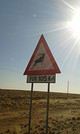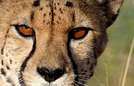

the Audi Camp restaurant (because after seeing so much wildlife, you want to indulge other senses).
Degrowth
Barely into Botswana from Namibia, you leave the Trans Kalahari Highway for a gravel road heading due south. After the first village, a hundred kilometers later, the road turns into a wide scar of multiple tracks in the deep sand of the bush. A few more villages with huts, where enthusiastic greetings are exchanged, and the last Bushman points out the trail that should lead you through the savanna to Kaa, the gateway to Botswana’s Kgalagadi.
Earlier, the track played hopscotch with dunes and was suddenly crowded with the largest gathering of springboks you’ve ever seen, stretching as far as the eye can see. There must be a thousand (five hundred according to the police), elegantly scattering at the last moment (it’s easier to disperse than a protest of elephants!).
As human traces fade, the space seems to widen—and so do your pupils. Small thirsty patches invite a pause.
Tonight, neither dogs nor trucks will disturb your sleep.
Water!
In the painful blue dawn, you thought you wouldn’t see water again until reaching the Boteti River or the Zambezi, but by mid-morning, the sky grew heavily overcast.
This late afternoon, you’re searching for a place to settle, but the campsite marked on your map—the best for the region (Tracks4Africa)—is unknown to the villagers.
You set off again in search of a track leading into the bush, hoping to emerge in a pretty clearing lined with shade, when you spot a pan that seems to shimmer—probably fatigue playing tricks.
A track appears to lead toward it, which you take, half-expecting nothing but trusting anyway, and you arrive at a water pan, a vast lake in the middle of the Kalahari Desert.
By morning, the water is gone—the sand drank it all overnight. What poor planning. Last night, you had to skirt a lake to reach the perfect campsite facing the sunset, and now you’re returning to the village, crossing a pan in the revealed tracks of livestock.
They say you shouldn’t give fish to Africans but teach them to fish: fair enough, but how do you do that with ephemeral lakes?
Oh, you wanted sand!
Even the best guidebook on the country (Bradt, 2007 ed.) doesn’t mention the south of the Central Kalahari Game Reserve, the world’s largest park—so you had to go!
You enter via Khutse, the only southern access, and quickly find yourself on a deep-sand track, though with a hard, bumpy base, enclosed in dense, close bush that scratches the car and blocks visibility. You think this must be a rough patch, that it won’t last, that the Kalahari wouldn’t do this to you.
All morning, near the only waterhole by a village of Bushmen resistant to relocation programs, you see only goats and mules. Fortunately, plenty of birds save the day: varied raptors, Cape vultures, colorful birds, and that astonishing helicopter-bird that takes off vertically and hovers with the sound of a Chinese-made rotor. Plus a leopard tortoise.
Along this single track, a rudimentary campsite—really just an authorized spot with nothing but a fire circle—is offered every four hours (80 kilometers), and the one you reach at noon isn’t inviting for a full day’s stay. You summon your courage, lock the differential with your co-pilot (both agreeing that driving in harmony was the right call), and set off again for what turns into five hours.
The afternoon is like the morning: sandy, bouncy, scratchy, and blind. You collect enough grasshoppers through the windows for evening skewers, and enough kindling to grill them—plus a scratch on your face, revenge from a disturbed branch (now you’ll look like a real adventurer!).
Travel Snippets
According to the owner of Camp Gecko, on a car, what isn’t there can’t break down.
The sounds of the Cape Cross seal colony: bleats, Harley-Davidson revs, a lion’s hoarse roar, foghorn blasts, quacking. And a smell that would make a pigsty seem like a perfumer’s creation.
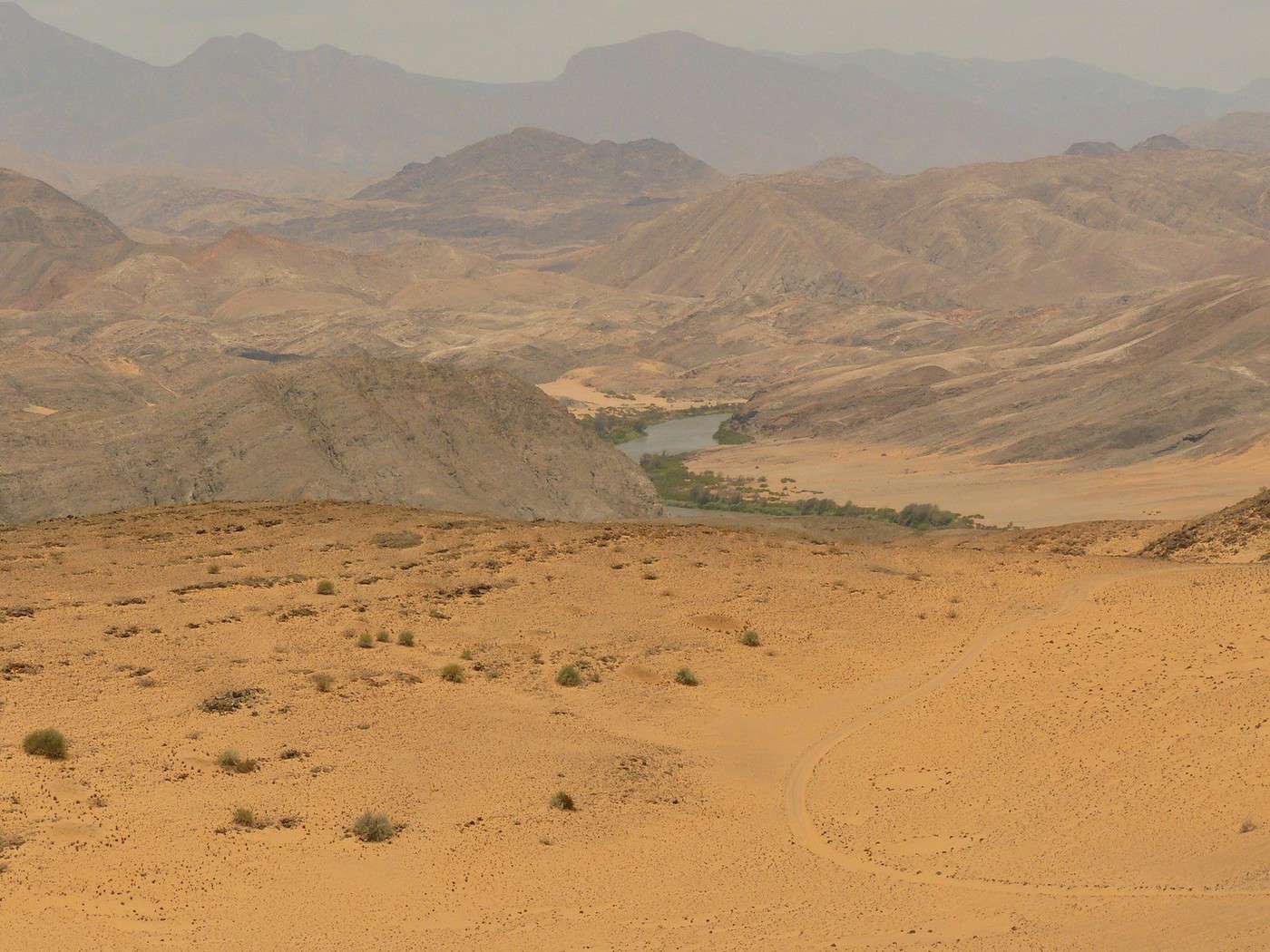
In Kaokoland, driving up a dry riverbed against the current isn’t as easy as it sounds.
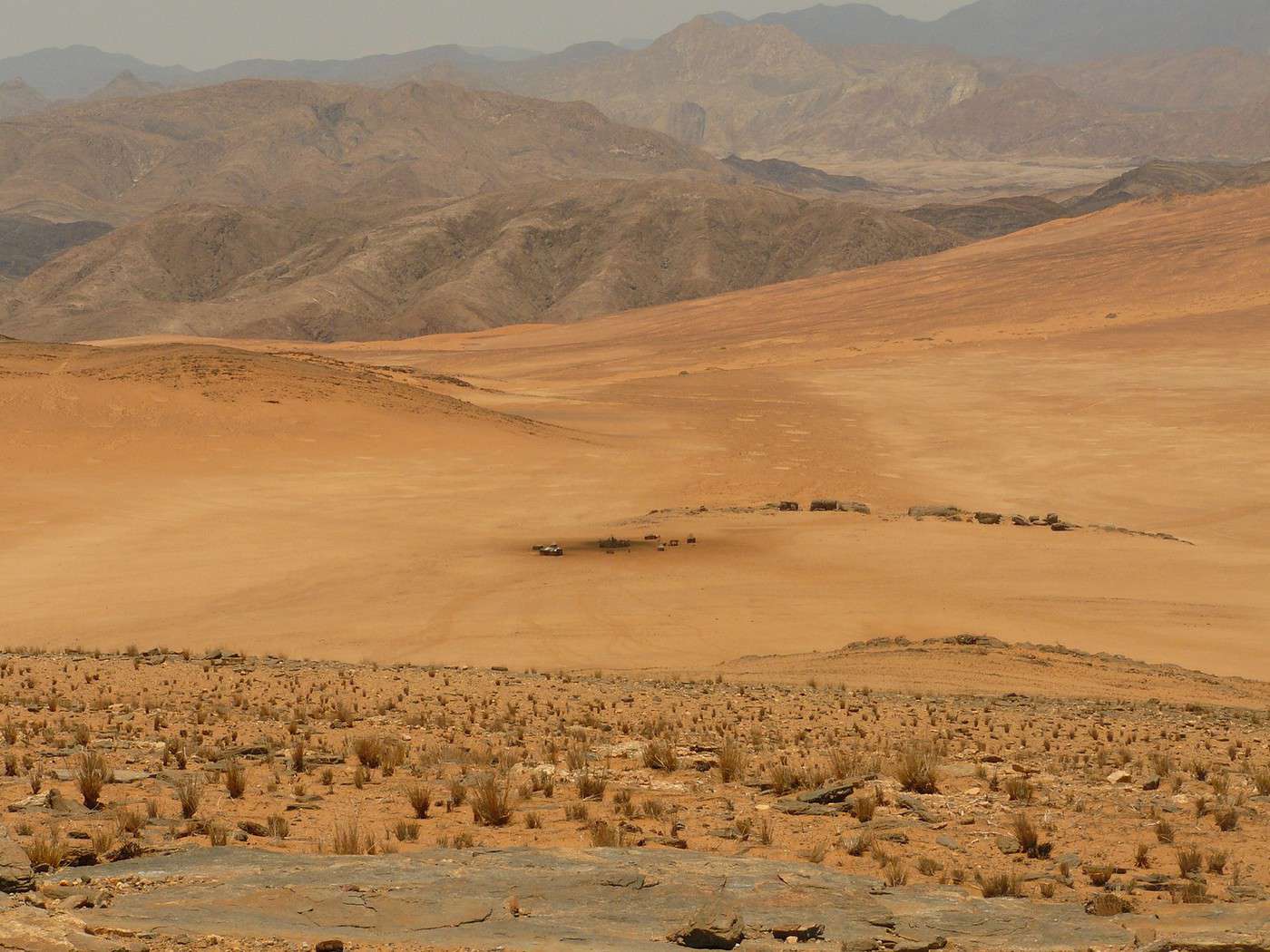
A dream of integrated architecture: in Hartmann Valley, that Himba village of black huts built on sand, extending a basalt outcrop.
The height of Namibian hygiene: in open-air toilets, a strawberries-and-cream air freshener spray (Johnson) with a whipped-cream-and-strawberries illustration.
Under the fence, the warthog roots and flees.
The difference between Paris and the Central Kalahari? You can get eaten there, but not robbed.
That Bushman woman we bought firewood from by the roadside, who threw herself into our arms when we gave her a Coke.
On the main road, tied to poles to mark village tracks: tires, rims, car doors and fenders, a grille, shattered buckets and burst jerrycans, a satellite dish—things they only use as scrap.