
Thatcher used to say)
In the small town of Kang, in the southwest of the Kalahari, the only ATM (cash machine) within a 250-kilometer radius is located in one of the two small supermarkets where you’re more likely to find 25 kg bags of rice than a box of tea.
The machine is exclusively stocked with the store’s cash: no sales, no cash, and no cash, no sales. A sign strongly encourages you to spend your withdrawals on-site if you want to have cash later.
When we arrived, we were preceded by a statuesque Black woman in pink, followed by two young men in white shirts and pastel ties, and two or three more discreet people. The manager explained the situation: the store had just opened that morning and was waiting for enough revenue to feed the machine.
With our pulas in 100-note bills (ten euros each), the head cashier called out to us and asked us to exchange our notes for 200-pula bills: the machine only handles 100-pula notes, and she needed them. I agreed, though she refused my offer of a commission with a laugh.
Savages
Almost deserted when we arrived, the urban camp was packed with white South Africans that evening—a convoy of ten over-equipped 4x4s, twenty overweight men (two tons of PTC), and no women (must be their idea of a vacation). After endless, noisy drinking sessions, the gentle silence of the night was filled with snores loud enough to paralyze a lion.
Add to that the barking like some absurd call-and-response chant, the heartbreaking braying of mules—who can describe the despair of the unloved mule?—and the stubborn cooing of doves before dawn—don’t they know Valentine’s Day is over?—drowning out the melody of rarer birds, and you’ve got a second night in hell.
This morning, we’re heading back into the bush, and by noon, I’ll be hanging my hammock between the acacias.
Into the wild
We crossed from Botswana into Zimbabwe via the tiny border post of Pandamatenga, where seventeen cars have passed in the last three weeks. Just after the post and forty-five minutes of formalities at four counters on the Zimbabwean side, a dirt track begins in a reserve adjacent to Hwange National Park, which we aim to reach without re-entering civilization.
After about an hour, a side track heads south with no signage, but it should lead into Hwange, even though the map shows no entry point there. The idea of being a little outlaw in Mugabe’s country (1) doesn’t bother me.
We keep going—we’ve got enough fuel to turn back—and suddenly, a monumental structure looms in the middle of the track: an official entrance to Hwange. A flawless officer welcomes us, and as I fill out the register, I see that twelve cars have passed through here in the last twenty days. We’re now officially legal.
(1) S.A.S.: His Most Senile Autocrat. Robert Mugabe, an octogenarian president regularly elected thirty years ago, now a dictator and demagogue.
What a mess!
At Robbins Camp in Hwange NP, I’m revising my theories on work organization. The core team for camp maintenance consists of a supervisor in an impeccable brown uniform, a wheelbarrow pusher, two hoe carriers, and a raker.
When the hoe carriers have cleared a small patch, they rest while the raker piles up the grass, which the wheelbarrow pusher collects by hand and dumps at the other end of the camp. The supervisor flits around, borrowing an idle tool here and there for finishing touches. When a spot is cleared, bent over a broom with no handle, one arm behind her back as if supporting her lower back, she twirls and sways in the perfect circle that is her stage—a ballet dancer.
Those not working keep up a cheerful banter, and often those working pause in unison to approve or argue passionately with wild gestures.
The mongooses trot and dig with no respect for the hard work. A vervet monkey, dignified on the concrete table of a campsite, seems to be overseeing operations—or maybe he’s just wondering how to improve productivity.
Forty-eight people work at this camp, which has twenty chalets and as many campsites, and live nearby with their families (about 250 people, according to Kudsie, the chatty receptionist). In the last three weeks, twelve guests have stayed here, bringing in a total revenue of 360 US dollars.
Kennedy’s Lions
Kennedy campsite in Hwange NP (Zimbabwe) is the place to be.
It’s one of the prettiest and best-maintained of the park’s dozen private camps; you spend the night alone with a guard. Tonight, it’s a cheerful guard who’s been working here for thirty consecutive days (which probably explains the camp’s exceptional cleanliness).
A chicken-wire fence, seemingly there to hold back the vegetation, separates you from the bush, and we laugh with our protector as she closes the symbolic gate—you wonder whether the branches or the wire are holding each other up.
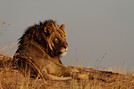
Earlier, you’ve seen elephants, giraffes, zebras, and kudus nearby, and now deep roars drown out the crackling of the fire.
The procedure! What procedure?
Today, on the small road from Hwange to Lake Kariba (Zimbabwe)—a road so narrow and in such poor condition that no French conseiller général would tolerate it in their district—we didn’t pass ten cars in three hours, but we did encounter four police roadblocks.
At the first, we got our first ticket of the season for not wearing a seatbelt; without asking for any documents, they issued us a proper receipt ($5).
At the second, they only asked for our driver’s license. At the third, all they wanted to know was if we had some cold water. At the fourth, the only thing that mattered was whether we could present the vehicle’s temporary import certificate.
The next day, after the dead end at Binga, we had to go back through checkpoint number four: a new team of police, this time assisted by three officials from the Roads Department. The first looked for an infraction, the second wrote the ticket, and the third, the boss, started chatting up my co-pilot. We were missing the mandatory white reflectors on the front bumper: another $10 fine.
During the formalities, a pickup truck passed with about ten people laughing in the back—no seatbelts!
Note that this country, the only one on the continent I know of, charges a $50 carbon tax at the border, proof, if any were needed, that Zimbabwe is an advanced country.