
The Spirit of the Place
Ever since we left Harare, the capital of Zimbabwe, we hadn’t seen a single campsite. As we turned onto a secondary road in the Eastern Highlands, the landscape changed above 1,600 meters—the dense vegetation gave way to rock, and we spotted a rocky outcrop that, once navigated, revealed an ideal esplanade for bivouacking.
There were traces of various fires, which we assumed were left by travelers who had come before us. A full-moon night fell over a damp fire.
Voices and a red dot moved along the edge of the plateau before suddenly heading toward us. A very gentle man, accompanied by a child dressed in a white cape, approached the fire. We chatted for a moment, and he assured us we could stay—that we weren’t disturbing anyone. The red dot he carried was a torch, which he used to light his own fire fifty meters away, where they would spend the night.
Female voices and laughter erupted in the opposite direction, and the torch returned to light a meager fire for them. We paid a courtesy visit to this new campsite, bearing a pack of cookies: three women and three children, all dressed in white from head to toe, were also spending the night there to pray. Why pray here? Because this is exactly where they needed to pray! We suddenly felt like sacrilegious intruders, but they confirmed we could stay. The night was filled with whispers, incantations, or chants—who knows?
At 5:30 AM, nearby voices alerted us: the women and children were there, shivering in the rain, trying to relight our drowned fire. When I stepped out, they said they were hungry. Our emergency supplies, which hadn’t been needed in the desert, finally found their purpose that morning.
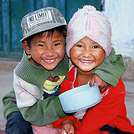
After everyone had eaten their fill—like never before—the mother began washing the three children, who swapped their rags for crumpled school uniforms from a bag. They set off on foot toward a school an hour’s walk away, a chocolate bar in their pocket.
I don’t know what they were hoping for from their prayers or if they felt they’d been even slightly answered. But we, mere heathens who had sensed the spirit of the place, thanked it for this gift from the heavens.
Help!
At Hivu Guest Farm in the Bvumba Mountains, towering 1,700 meters above Mutare, Zimbabwe’s second-largest city, we thought we’d found the holy grail: a tiny campsite below the guesthouse parking lot but overlooking a terraced nursery cascading down to a small lake, with a clear view of the mountains of Mozambique—all for the best price in the country: sixteen dollars.
Then one, then two, then four brand-new white Toyotas bristling with radio antennas and bearing the UNFPA (United Nations Population Fund) logo arrived. A dozen well-dressed, healthy Zimbabweans in suits and ties stepped out. Some greeted us; others ignored us. Together, they filled the lodge.
At dusk, as we nibbled on leftovers by a struggling fire battling the mist, lit only by a flickering candle, one of the Zimbabweans returned to his car and glanced our way.
For a moment, I wondered if he might offer to help.
National Economy
The National Route 1 cuts across and sustains southern Mozambique for over a thousand kilometers. In its northern section, it winds through dense forests, offering visibility no wider than a green tunnel. Except for the few large villages it passes through, there are no side roads—not even a sandy track—just impassable trails.
You can guess what’s happening in the undergrowth by what’s displayed on the roadside—a road that sometimes resembles a chicken coop, given how many nests line it.
At first, the timber trade dominates: bundles of branches of varying sizes, logs chopped with axes, charcoal in plastic bags sealed with woven grass, and cabinetmakers.
Then minerals take over in small piles of gravel, rocks of different sizes, and polished pebbles.
Later, bold kids plant themselves in the middle of the road, forcing you to buy their pineapples, while others wave live chickens at arm’s length.
Regularly, fuel resellers have set up their picturesque stations of jerrycans and bottles.
Note on Weights and Measures: Here, kilos and cubic meters don’t exist. Goods that lend themselves to it are sold in pyramids (tomatoes, stones) or precarious but clever towers (potatoes, bricks).
You might hesitate between a small pyramid of large tomatoes or a large pyramid of small ones.
Other Travel Snippets
On a national road in Botswana, in the rain, these three white cyclists, loaded like pack mules, weave between potholes and dodge cows and mules, laughing all the way.
…/…
In the West, we fence in animals to protect crops. Here, it’s the crops that are fenced in, while animals—from goats to elephants—roam freely.
…/…
Just as the sun dips into the Zambezi, a hippopotamus emerges, glistening, crosses our camp, and goes off to graze without further ado.
…/…
In Mana Pools National Park, I set up my hammock between two trees overlooking the Zambezi. A hippopotamus grumbles on a sandbar twenty meters away, and when it yawns, jaws open at 180 degrees, I estimate that if I placed my feet on its lower canines, I could lean back against its upper incisors. But my guide is adamant: these beasts are herbivores. I consider moving the hammock higher into the trees (my guide is equally adamant: hippos don’t climb trees). I don’t sleep a wink.
…/…
You’re camping in this lovely cove on Lake Kariba (Zimbabwe), which, in the soft morning light, could pass for the French Riviera, with the Zambian foothills as Italy. Suddenly, a hippopotamus leaps out, bellowing, shattering the charm. You abandon the idea of a dip.
…/…
In frenetic Harare, gleaming German limousines vie for space on the avenue with crumbling Japanese minibuses.
… /...
At this large hotel in eastern Zimbabwe, thirty Zimbabweans from a reputable NGO are attending a four-day conference (led by three white facilitators), engaging in role-playing games on the lawn. A night here costs 160 dollars.





 icccccccccccccccccccccccccccccccccccccccccccccccccccccccccc the Bvumba Mountains near MUTARE