
Re: A Southern African Tour in 80 Days
Homeless & jobless
Johan and Theurus, two brothers aged fifty-three and forty-three, have been crisscrossing the country for two years, hitchhiking in search of work. For the past six months, they haven’t found anything and no longer even have enough to buy a loaf of bread. They live on the soup churches serve at midday to people in their situation and pitch their tent along the roads or, like tonight, for free in a campsite when their plea has been heard.
Johan is a carpenter and, as if to prove he’s got the trade in his blood—or as a form of attestation—he shows me his hands. He’s only got nine fingers left but insists that the missing one communicates with its neighbors when he’s working. Theurus is a cook and learned from a French chef (Aaah! The French cui*sine).
They barely knew their father, and their mother was murdered in her car a few years ago during a routine robbery. When he talks about it, Theurus, who stands at six foot three, seems like a child. They have no family left and seem very attentive to each other. Though they still look good for their age, their blue eyes are startled. Even in the camp, they’re on alert and say they’ve been violently attacked twice by gangs. Johan still bears the scars.
Feeling scorned by both Black and white people, who they say shame them, they claim there’s no solidarity among white people like there is among Black people. They confirm the official 30% unemployment rate and the tightly regulated affirmative action policy that leaves them little chance of finding stable work anytime soon. They talk about God, who sustains them. They’re appalled by the omnipresent violence and corruption but still regard Nelson Mandela as a lovely man and president and say, in the past tense, it was a beautiful country.
And in the morning, when these two lanky men, as lean as a Sotho from the mountains, accept enough to buy bread for a week, suddenly overwhelmed by their distress, they struggle to hold back their tears.
These are Africans I wouldn’t have seen smile.
Makkie’s, the Gift of God
Hand-painted sayings on slates, rag dolls, hearts made of fabric, wood, or metal, porcelain coat hooks, weathered clocks, crosses of all sizes in stone, wood, and steel.
That’s just a small part of what Rita sells in her coffee shop in Edenburg, under the sign of Makkie’s, the Gift of God.
The armchairs are halved galvanized wash tubs, and the tables are raised iron bed frames.
She’s framed family mementos with grandeur: letters, glasses, a Bible, a marriage certificate, an embroidered child’s dress, silverware. On a console by the entrance, old meat grinders push aside coffee mills that jostle with irons. And in the garden, succulents thrive in old chamber pots.
Everything seems like an ode to the good old days, a tribute to the voortrekkers, the pioneers. And while it might seem kitsch to a European fond of simplicity, it’s also deeply moving in its sincerity.
Rita, whose family has been in this country for so long she’s lost track, opened this coffee shop two years ago after her sister Makkie—the Gift of God—passed away, as a memorial.
She insists nothing could make her leave this place, confirming in her own way the name given to this village by her ancestors.
I’ll leave without paying for my coffee and be rewarded with a generous hug.
The Madwoman of the Karoo
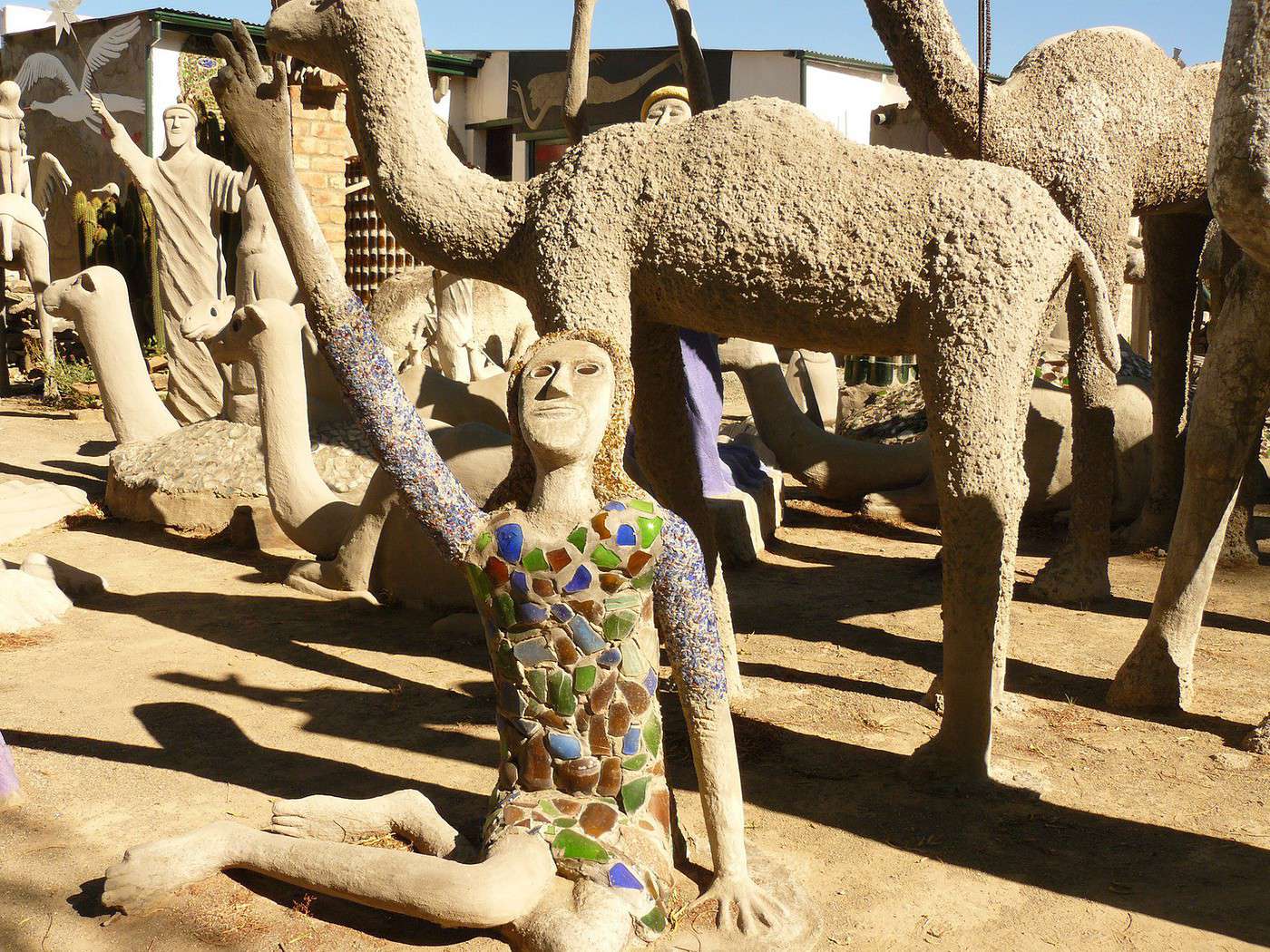
Is it because of its unpronounceable name that Nieu Bethesda nestled in this crater of a high desert plateau in the Karoo? Or because she couldn’t stand her reflection that Miss Helen Martins chose to live a reclusive life there? Or was it the telluric pressure that, at sixty, made this jumble of cement statues burst from her mind?
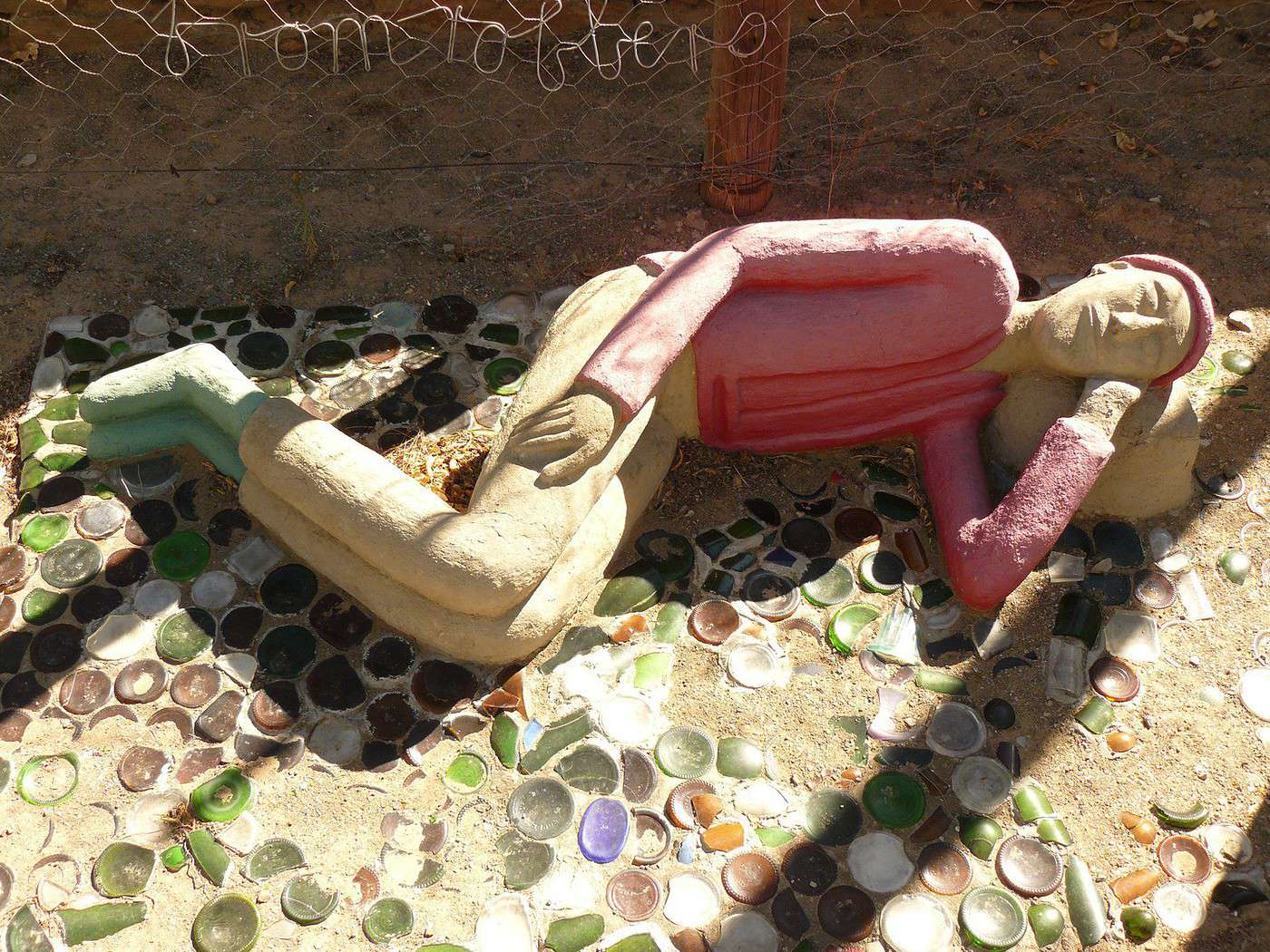
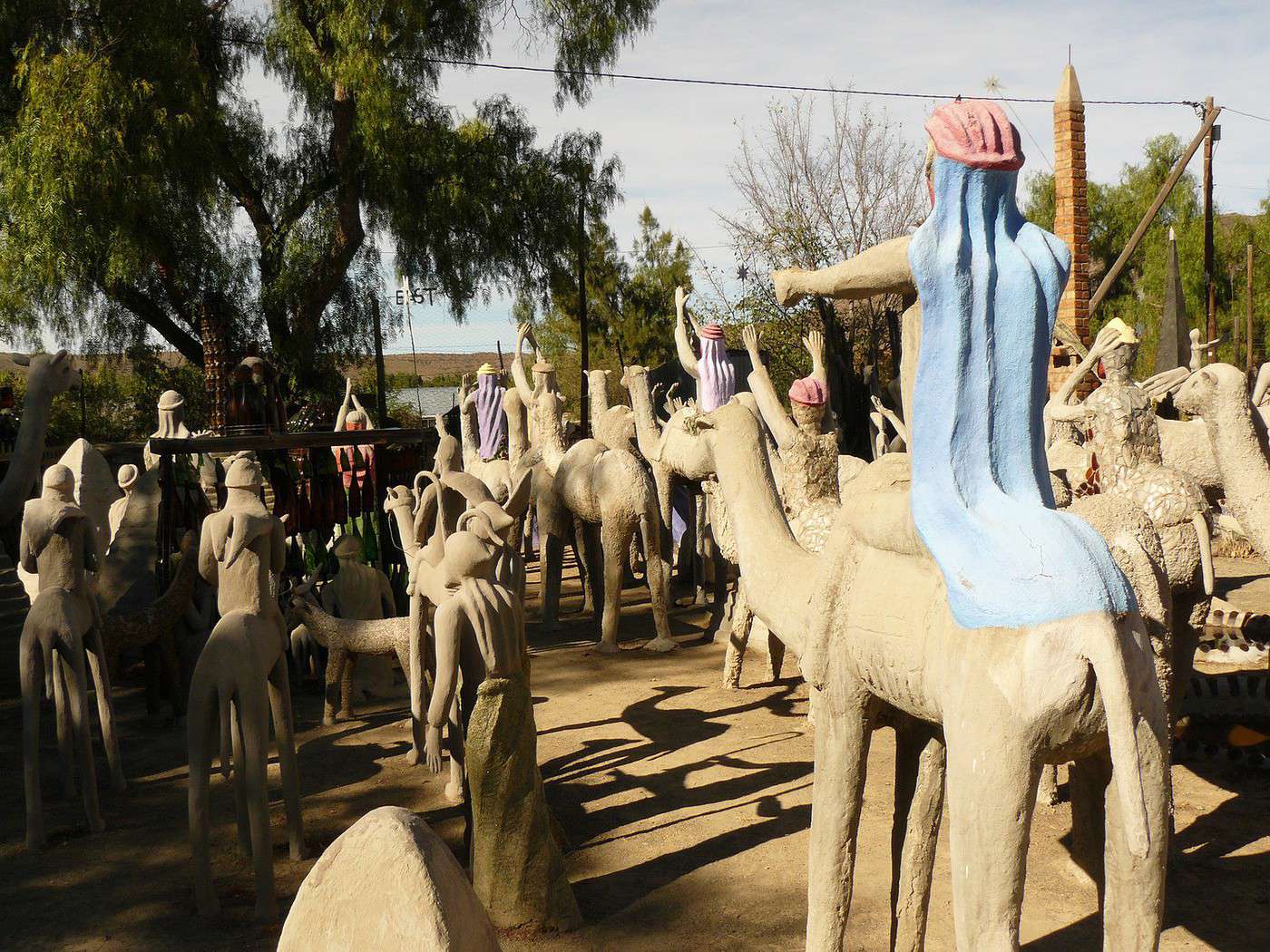
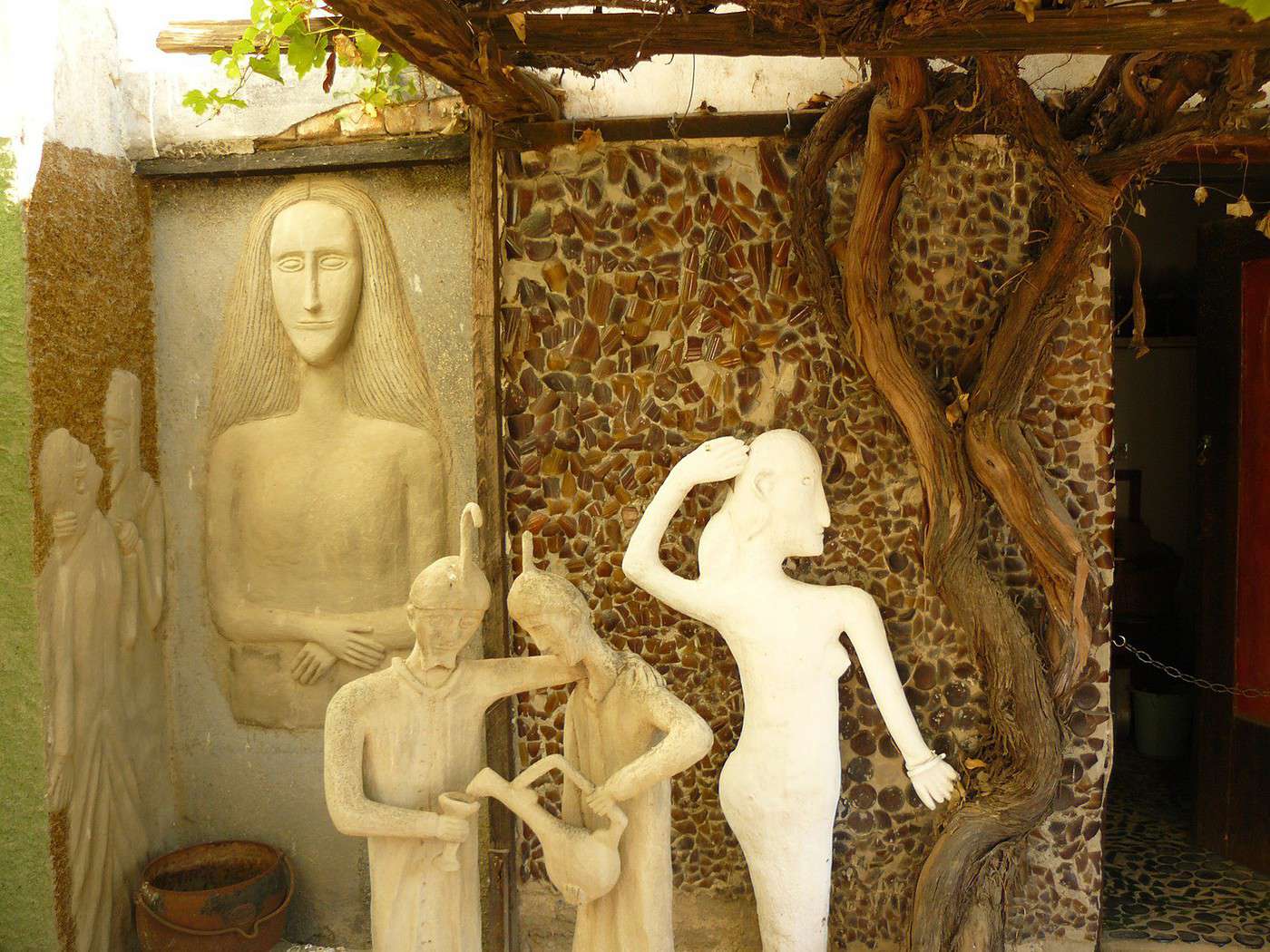
In the garden next to her house, which isn’t even three hundred square meters, three hundred cement statues were sculpted between 1955 and 1976, most at half to double scale, until Miss Helen, nearly blind, ended her earthly existence. Many camels, some ridden, various birds with a preference for owls, men, women—often in pilgrim poses—children, and monuments, pyramids, and churches all jostle in a biblical atmosphere.
The cement is enhanced with crushed glass or shards, creating green eyes or multicolored trails. Some figures wear painted capes. Stricken early with arthritis, Miss Helen held the images to copy in front of a young mixed-race man, Koos Malgars, who sculpted, and it’s the work of this unlikely duo that people now come from all over the world to see.
Helen Martins is a sister to the Facteur Cheval and Robert Tatin.
In the small township next to the town, the houses are made of stone, not much different from the smaller ones in the old white town, though more modest in size, and the gardens are planted with trees. Young people sculpt cement owls to sell to visitors of Miss Helen’s house-museum, worthy children of Koos Malgars.
Or how the legacy of an eccentric, considered mad in her lifetime, sparked the rebirth of a village.
A Wild Goose Chase
In this lovely coffee shop, over a scone and a cup of tea, I learn that fifty kilometers of tarmac plus a hundred of dirt road away, the Karoo Food Festival is taking place. Off I go!
Arriving in Cradock, though well-kept, nothing signals the event—no banners, not even a simple poster. I prowl around, nostrils twitching, but detect no scent of herb-crusted lamb chops, no whiff of sosaties, not even a hint of oxtail stew. And no one in the street has heard of anything.
I have lunch in a nursery-coffee-shop facing Sarah Palin and resume my investigation.
I flag down a police car, which complies. He’s a David Bowie lookalike from his peroxide era, and she’s a Halle Berry double, but they’re clueless. They ask me to follow them. We stop at a restaurant, then a school. I can tell things are coming together—they’ve found someone who knows someone who’s heard of it. Hope returns, along with saliva. I’ve clearly stumbled upon sharp detectives. The net is closing, and we burst into the town’s best hotel, which is supposedly involved in this affair.
I’m handed a festival program, offered a welcome drink, and when I mention I’m French, practically the Victoria suite.
As for the festival itself, I’ll say nothing more than that it’s its first edition… and you can tell.
Oh well! On the way, I crossed the Brankberg Range through a series of passes and valleys and discovered Mountain Zebra NP, home to these stocky mountain zebras that, lacking ground clearance, have lost their belly stripes.
To the Winds of the Karoo
There’s always been a wind here strong enough to straighten a sheep’s wool.
No wolves in the Karoo—the sheep thrive.
The country’s roads are perpetually under construction, and on a secondary road, this man, directing alternating traffic with others, fell asleep in the shade of his stop sign, unable to see the furious waving of his colleagues’ flags urging him to flip the sign and let traffic through. Was it the intensity of my stare? Suddenly, he jumps up, looks around in surprise, and, embarrassed, flips the sign.
In the small towns of the Upper Karoo, you meet many San people, these southern bohemians, nomadic like them but never in the right place.
French collection in Colesberg: the Colesberg Kemper (Quimper in Breton) Museum, featuring an exhibit on nomadic San people moving from farm to farm for sheep shearing, all their possessions loaded onto a cart pulled by two mules; a lovely house called Molene Place; Bordeaux, a century-old restaurant serving local specialties; La Provence, a pale pink B&B.
Incorrigible optimists, the pioneers named this patch of veld “Wheatland,” but I see no miracle, and a little further on, at Leopard’s Valley, there isn’t one either.
Ostriches sometimes seem a bit slow on the uptake—is it because the distance from brain to muscles is so great?