

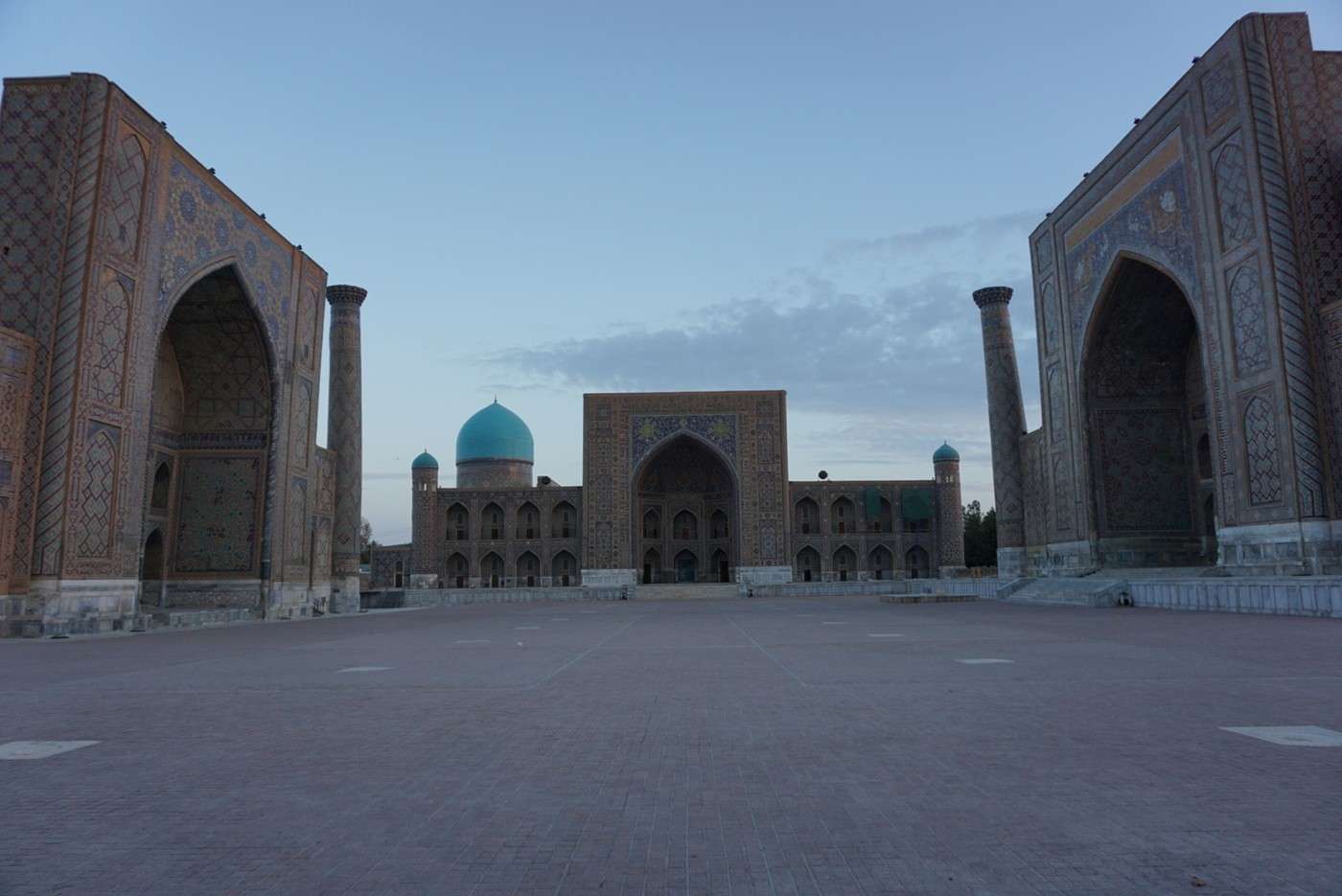
This morning, I decided to wake up really early to see Registan Square without any crowds.
I arrive around 6:00 AM, and sure enough, I’m alone! Such a magical moment!
Little by little, I watch this part of the city wake up gently: joggers passing by the square, taking out their phones to snap a quick photo before moving on, city cleaning staff with brooms in hand... I leave the esplanade and start my walk around the outside of the madrasas (though I still sneak to the side of the square, inside, very discreetly to take a few photos). In the back of the park, I hear music. I get closer and discover a group of women of all ages doing aerobics to music. No photos. I watch discreetly and move away. Nearby, another group of women is singing. Further on, I come across an elderly man walking while doing stretching exercises and arm circles. Even further, I see people walking and chatting quietly.
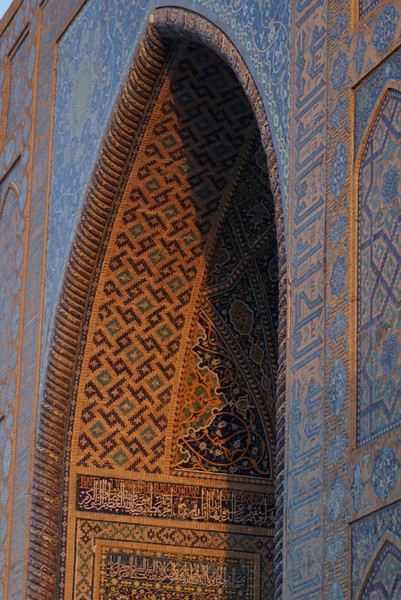
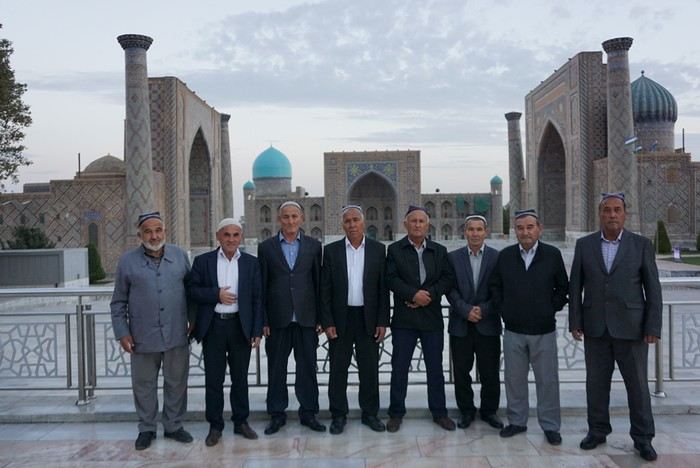
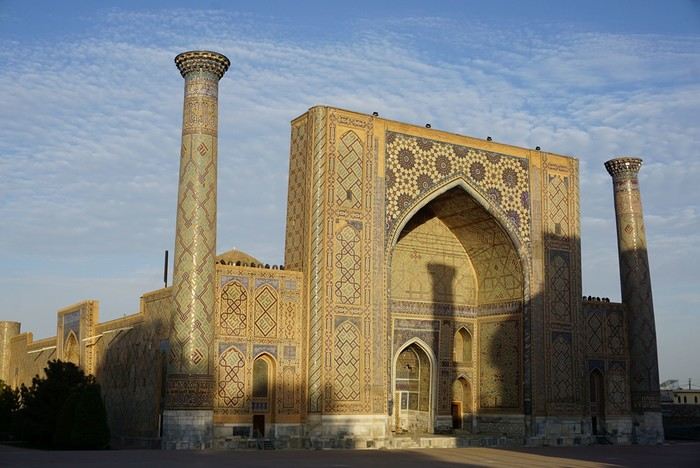 After completing the full loop, I stop again on the esplanade overlooking the square. Still empty. A group of Uzbeks (all men) approaches and lines up in front of the square. One of them steps out to take a photo of his friends. I walk over and offer to take the photo for him so he can be in it. He happily accepts. I take the opportunity to ask if I can take a photo of them with my camera. Big smiles from the whole group! They immediately stand almost at attention. A great memory! Thanks, smiles, and everyone goes their own way!
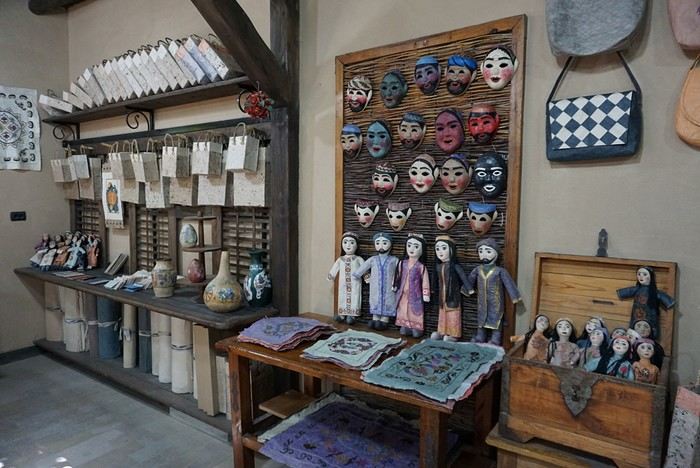
I return to the hotel a little over 2 hours later, enchanted and even amazed by this morning walk. Nasrullo joins us for breakfast because today he’s the one who’ll show us his city. We start with the reconstructed artisan village and the silk paper factory. We learn about its manufacturing process using mulberry bark (hence the name "silk paper").
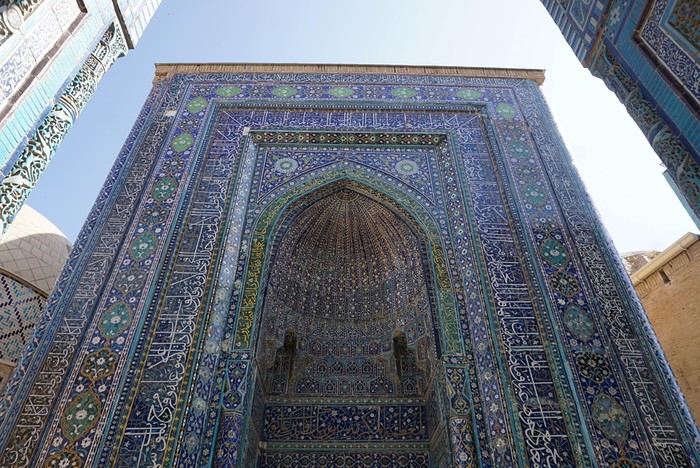
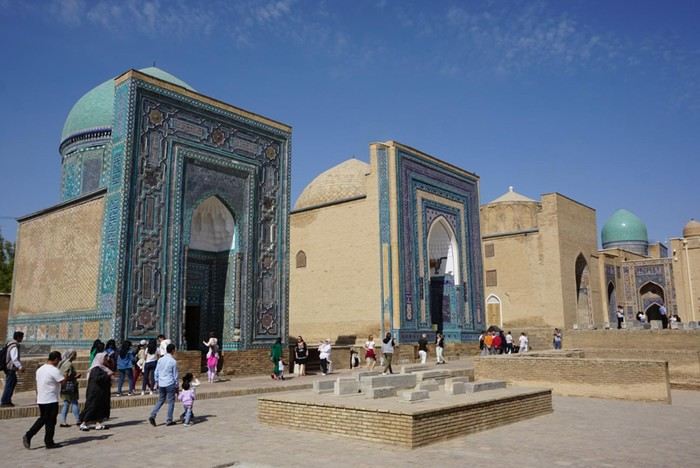
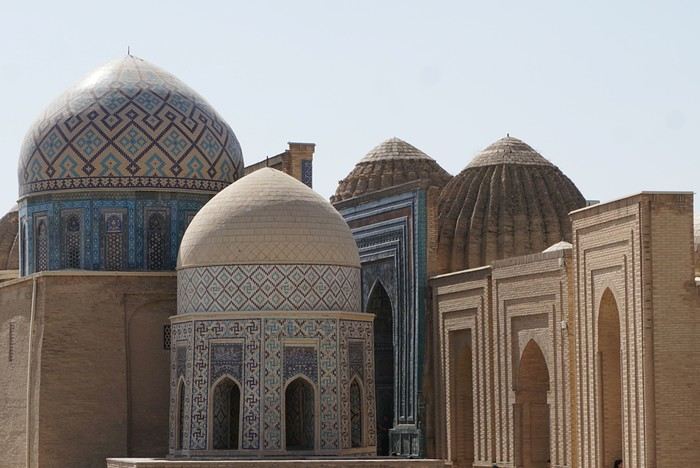
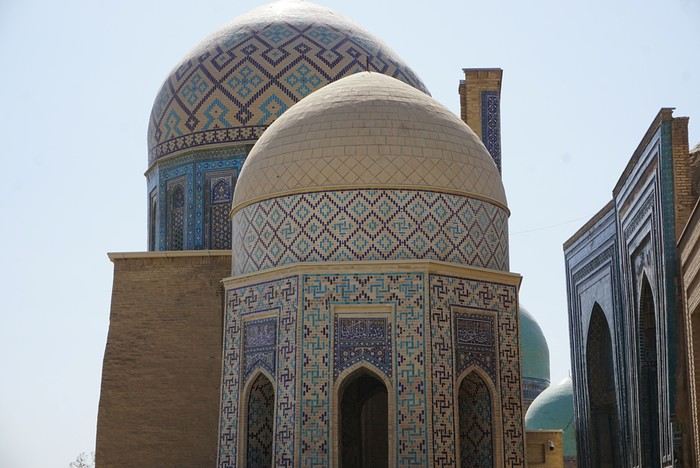
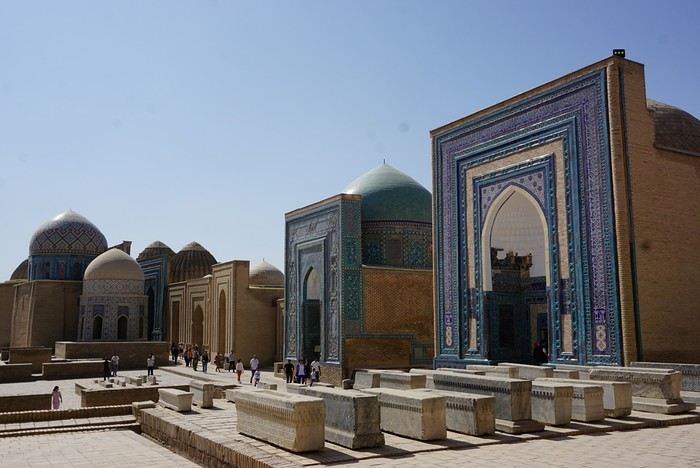
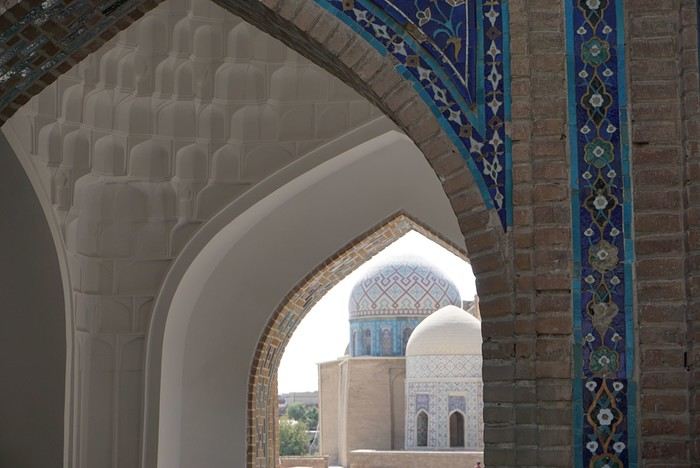
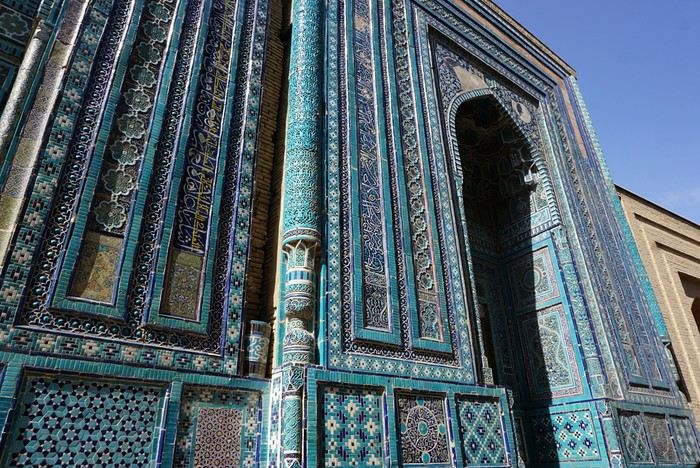
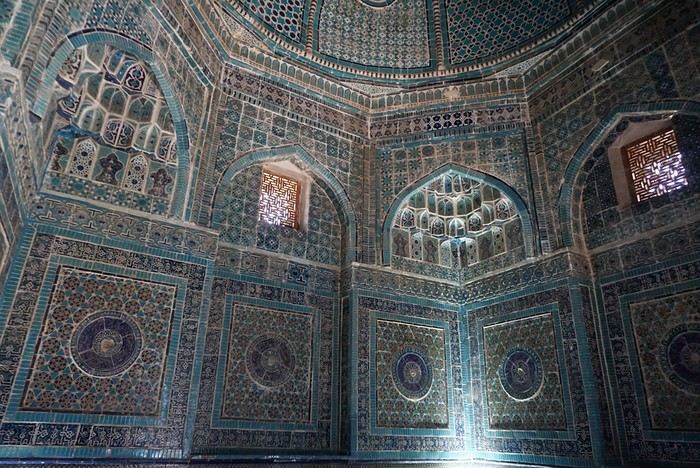
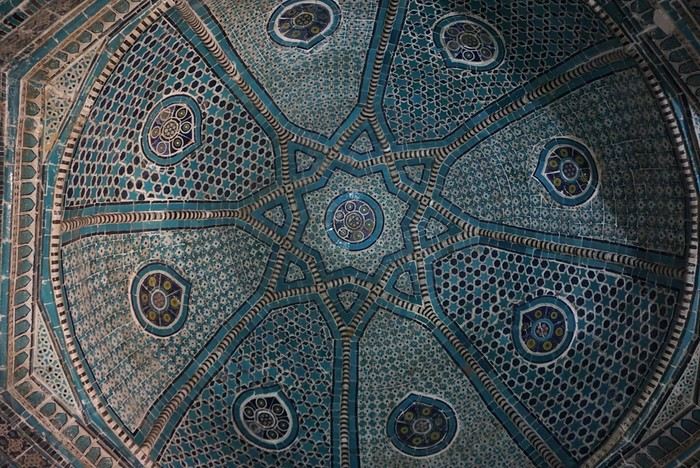
From the artisan village, we head (by car) to the stunning Shah-i-Zinda necropolis. Unlike almost all our visits so far on this trip, there are a lot of people here. But it’s so beautiful!
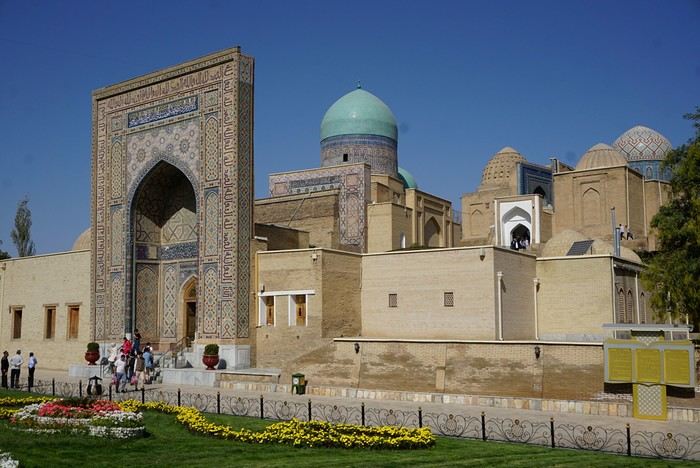
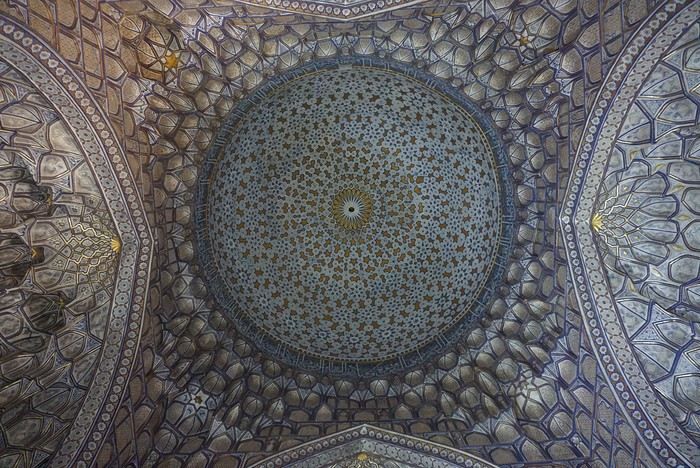
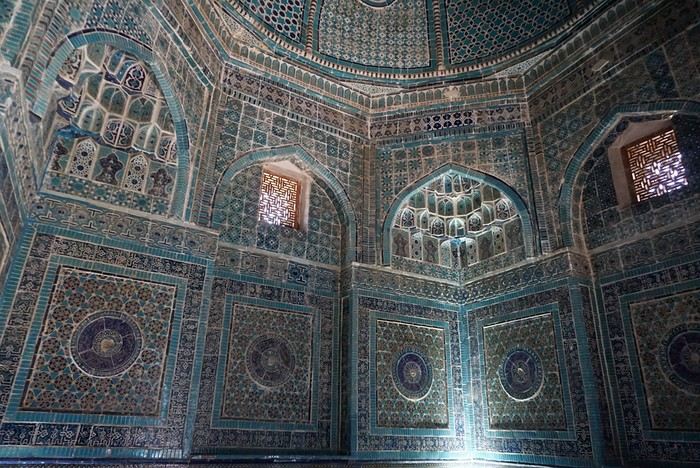
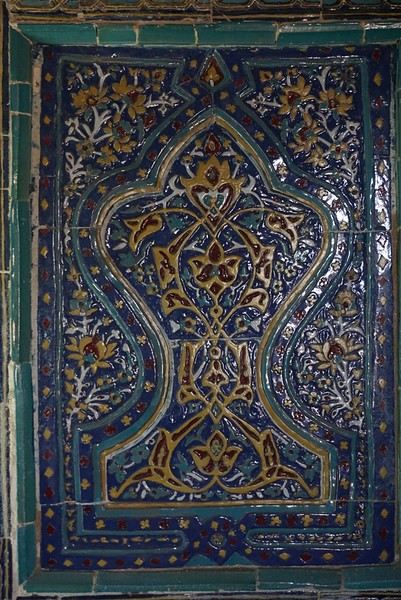
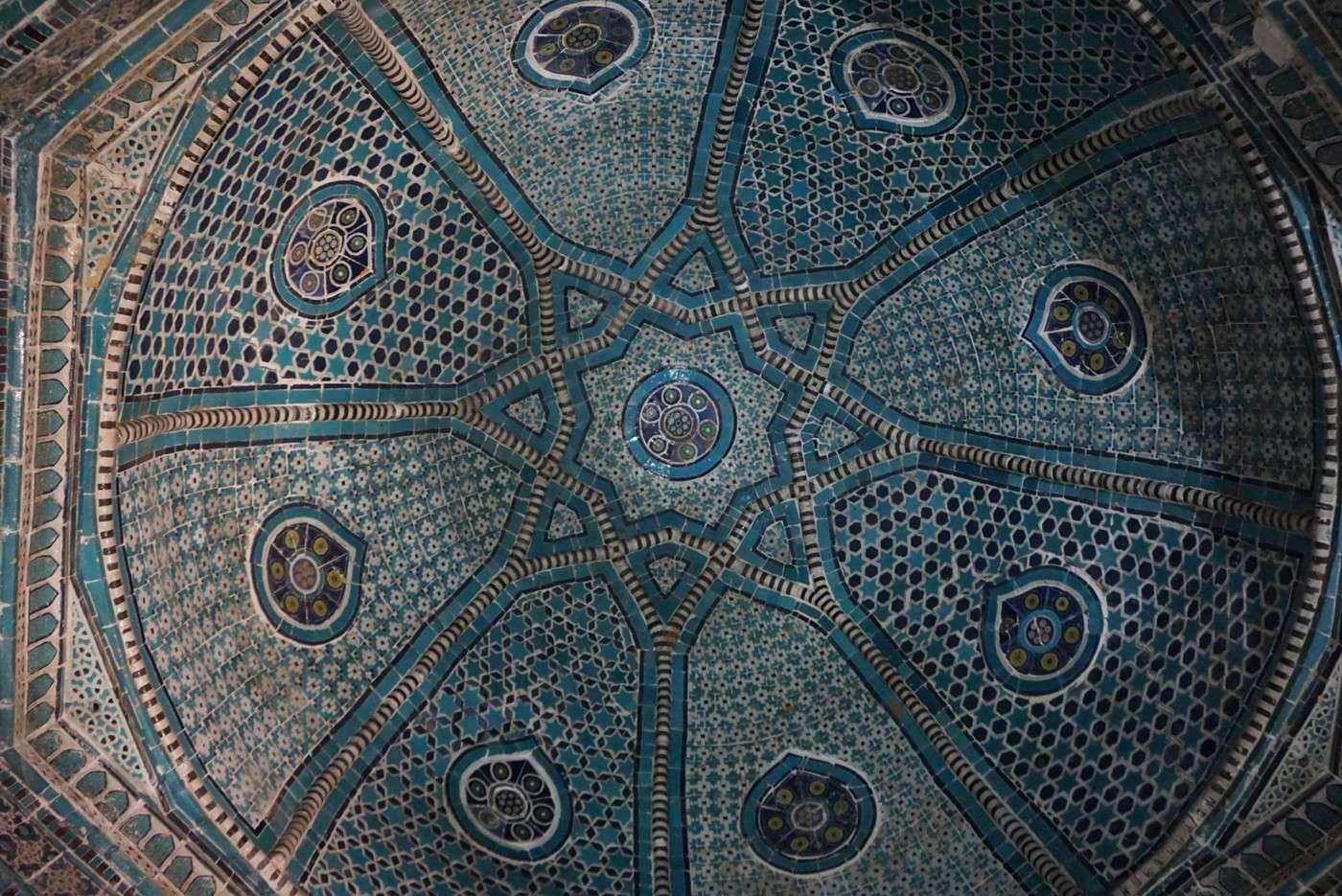
We take the "Stairway to Paradise." Pilgrims count its 40 steps as they climb. It’s a collection of mausoleums, each more beautiful than the last. The one for Shadi Mulk Aka, next to Emir Zade’s (the emir’s son), was built for Tamerlane’s niece, who was very dear to him. He had inscribed, ‘This is a tomb where a precious pearl was lost.’ It’s the oldest mausoleum in the complex, and its interior is one of the most beautiful we’ve seen: the original ceramics are stunning.
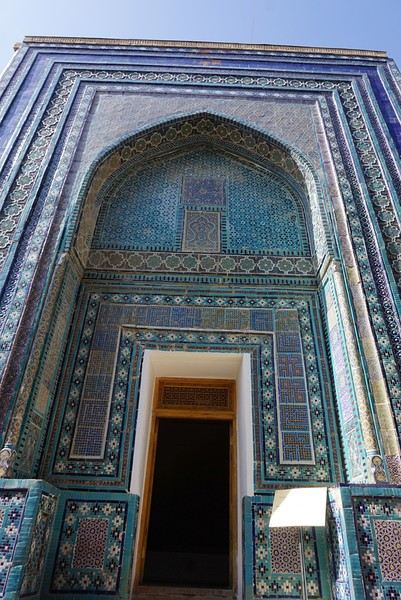
This visit is without a doubt one of the must-sees in Samarkand! I don’t know where to look (inside, outside) it’s all so breathtaking! And I’m seized by an uncontrollable (or almost) photo frenzy. Meanwhile, Nasrullo starts getting impatient because he has a surprise for us. He wants to take us to a restaurant in a Samarkand neighborhood famous among locals for its plov. The deadline to get there is 1:00 PM... We make it just in time! And their reputation is well-deserved: we feasted! Without a doubt, along with the one Javlon made in Bukhara, it’s one of the two best we had on this trip! Thanks to Nasrullo for introducing us to and inviting us to this amazing spot (I didn’t write it down, but if you’re interested, I can always ask him for it!).
 After this hearty and delicious lunch, we head to the Afrasiab Museum. Located on the hill above the Shah-i-Zinda necropolis, it’s best known for the 7th-century "Ambassadors’ Fresco." It depicts, on one wall, the Sogdian king Varkhuman receiving ambassadors from neighboring countries. On other walls, we see the monarch hunting and his wife on a boat. Another fresco illustrates the city of Samarkand celebrating Nowruz.
After the visit, we drive down the hill to the Mausoleum of Daniel. Its uniqueness lies in the fact that this prophet is shared by the three monotheistic religions: Muslim, Christian, and Jewish. His tomb has become a pilgrimage site. Except it seems Daniel never actually came to Uzbekistan!... And like all holy sites, there’s a so-called sacred spring where pilgrims come, often with their families, to drink and/or fill bottles.
We end our guided day at the Ulugh Beg Observatory Museum. This monarch was a great scholar, both a poet and mathematician. Passionate about astronomy, he built a huge observatory that housed the largest sextant in the world. He published an astronomical catalog that remained a reference until the early 20th century, so accurate were his discoveries (over a thousand stars) and measurements (error rate of less than 1°). Unfortunately, his son, manipulated by religious extremists, had him assassinated and destroyed the observatory, of which only an 11-meter underground arc of the sextant remains today.
Back at our hotel in the mid-afternoon, I decide to explore the ‘Russian’ part of Samarkand. That’s how I find and visit, almost side by side, the Orthodox, Christian, and Armenian churches. I was able to go inside all three: services were being held in the first two, and the guardian of the third opened it just for me. So happy to have a visitor, he kept explaining things to me—though I understood nothing since he was speaking in Uzbek... Too bad!
A little further on, I passed by the synagogue, which was closed.
On my way back to the hotel, I walked along other avenues, crossed parks, and finally arrived, at nightfall, from the back of Registan Square. And once again, I couldn’t resist! Photos!
Note: Too many photos. Impossible to choose just 10 (site limit per post). So I’ll share two photo-only posts to complete the overview of this magnificent day.
Little by little, I watch this part of the city wake up gently: joggers passing by the square, taking out their phones to snap a quick photo before moving on, city cleaning staff with brooms in hand... I leave the esplanade and start my walk around the outside of the madrasas (though I still sneak to the side of the square, inside, very discreetly to take a few photos). In the back of the park, I hear music. I get closer and discover a group of women of all ages doing aerobics to music. No photos. I watch discreetly and move away. Nearby, another group of women is singing. Further on, I come across an elderly man walking while doing stretching exercises and arm circles. Even further, I see people walking and chatting quietly.
I return to the hotel a little over 2 hours later, enchanted and even amazed by this morning walk. Nasrullo joins us for breakfast because today he’s the one who’ll show us his city. We start with the reconstructed artisan village and the silk paper factory. We learn about its manufacturing process using mulberry bark (hence the name "silk paper").
From the artisan village, we head (by car) to the stunning Shah-i-Zinda necropolis. Unlike almost all our visits so far on this trip, there are a lot of people here. But it’s so beautiful!
We take the "Stairway to Paradise." Pilgrims count its 40 steps as they climb. It’s a collection of mausoleums, each more beautiful than the last. The one for Shadi Mulk Aka, next to Emir Zade’s (the emir’s son), was built for Tamerlane’s niece, who was very dear to him. He had inscribed, ‘This is a tomb where a precious pearl was lost.’ It’s the oldest mausoleum in the complex, and its interior is one of the most beautiful we’ve seen: the original ceramics are stunning.
This visit is without a doubt one of the must-sees in Samarkand! I don’t know where to look (inside, outside) it’s all so breathtaking! And I’m seized by an uncontrollable (or almost) photo frenzy. Meanwhile, Nasrullo starts getting impatient because he has a surprise for us. He wants to take us to a restaurant in a Samarkand neighborhood famous among locals for its plov. The deadline to get there is 1:00 PM... We make it just in time! And their reputation is well-deserved: we feasted! Without a doubt, along with the one Javlon made in Bukhara, it’s one of the two best we had on this trip! Thanks to Nasrullo for introducing us to and inviting us to this amazing spot (I didn’t write it down, but if you’re interested, I can always ask him for it!).
Note: Too many photos. Impossible to choose just 10 (site limit per post). So I’ll share two photo-only posts to complete the overview of this magnificent day.