
On the Boeing flying me back to Southern Africa, I could say at home—I feel that good here. Especially since they’ve recently claimed that the cradle of humanity is near Johannesburg (back in the day when Madame Taubira and I shared the same Papuan ancestor, though I hesitate to bring it up now—these days, she’s guarding the seals of office while I’m getting rained on tonight). Anyway, on this Boeing, my Indian neighbor is squeezed in like a Jumbo and… well, let’s just say he’s not smelling like roses.
But African nights have their own scents.
Night fades as we fly over southern Zambia, or so the screen (of my not-so-white night) tells me. In a dizzying spiral, I see snow covering Africa. No green, no red—just fluffy white. A whale-like snore snaps me back to reality: it hasn’t snowed; we’re above the clouds.
I tell myself that once we cross the Zambezi, at this time of year and hour, with a bit of luck, the clouds and snoring will be behind us. The snoring’s gone, but the clouds block my view of the land until we slice through them and fly over an endless sprawl: Johannesburg.
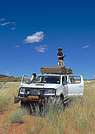
After a lightning-fast plane change, I’m speeding under the clouds at the wheel of a pumpkin-orange Polo, which, in 400 kilometers, will transform into a Defender-carriage(1)—if I make it before noon.
Tonight, as I collapse into an armchair under the corrugated iron awning of the house, the morning’s clouds unleash a downpour, heightening the pleasure of the first sip of brandy but failing to douse the fiery taste of spiced biltong. The storm is metallic, like a derailment, and lightning torments the tropical garden.
Martha, who serves breakfast, asks worriedly if I live in Marseille—she saw on TV that it’s a very dangerous city. Martha still lives in the township of Bloemfontein.
(1) I can already see some of you (2) laughing, knowing full well that a Defender’s comfort hasn’t improved much since the grand carriages of the 17th century. (2) For the uninitiated, corrugated iron roads are dirt, sand, or gravel tracks common in Australia and Southern Africa. They warp under the elements, giving the impression, when you drive on them, of rolling over corrugated iron.