
It’s always the same story
You arrive from the country’s center and drive west, most often departing from Windhoek, or from Mariental this time for us. The road is still paved. From the crest of a rise, you catch your first glimpse of the horizon blocked by a continuous, regular relief—the foothills of the Namib. Further on, the asphalt gives way, gravel clatters against the metal, the car sways, and your heart races.
You’re now in the highlands on a track that climbs imperceptibly to 1600m—an altitude for a Breton used to living at sea level. Is that what’s making you dizzy?
You cross farms vast enough to hold a mountain, and at the end of a pass, a depression unfolds that brings tears to your eyes because it’s the quintessence of African nature—the kind you see in films and books.
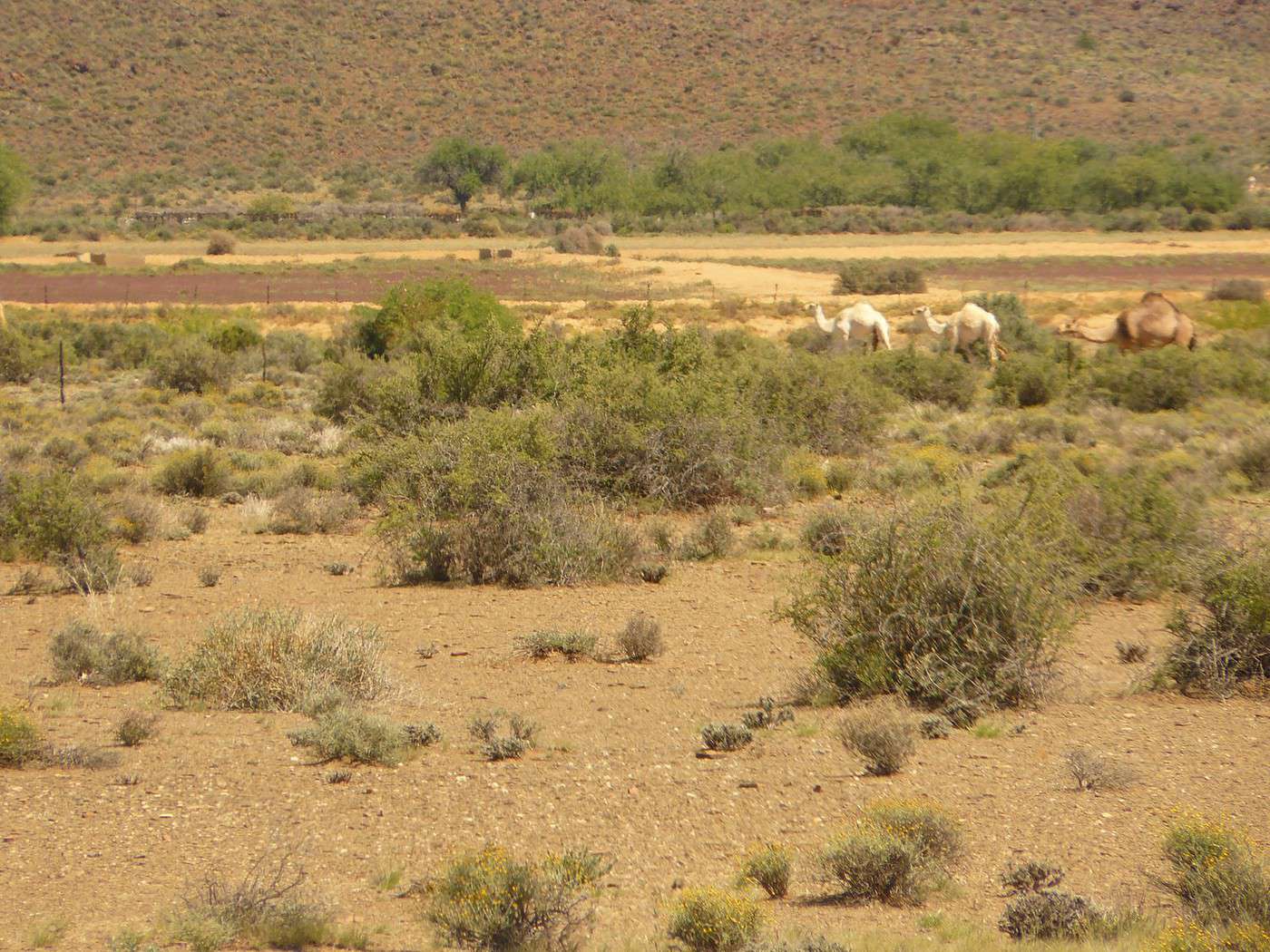
You turn onto a sandy track that cuts through the veld. Oryx and springboks share the sparse pastures with cows and sheep. The former race alongside the car, while the latter watch you calmly.
Suddenly, the sun is so low it blinds you. Time to stop, light a fire, grill a piece of lamb, then some thoughts, and finally, sleep right there.
And at dawn, caught off guard by the sun, surrender.
You’ll leave Koimasis Ranch with regret, through a savanna ringed by mountains (my Ngorongoro, since I’ve never seen the real one). There’s no doubt that places like this are where the word beauty was invented.
Traveling Solo
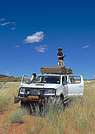
At the now-mythical Solitaire, what I glimpse at the campsite entrance—half-hidden by the wall and trees—leaves me stunned: a very old, instantly recognizable Land Rover 110, so customized it’s unmistakable, parked there. I approach. A hammock is strung between the roof rack and a tree, and in the hammock, Peter is lounging.
It’s exactly the same scene as during our last visit in March 2011!
Peter, lanky and in his fifties, is a logistics manager for UNICEF in Kenya and spends his vacations in Namibia to “get away from the world.” Dutch, he’s lived in Africa for 25 years. His 30-year-old Land Rover 200Tdi (he bought it new in Europe and can’t imagine parting with it) has clocked 1.2 million km and is on its third engine. Together, they cover the 4500 km between Nairobi and Windhoek in 7 days! This time, crossing Tanzania, he was attacked at night by armed road bandits with sticks and stones, and the car still bears the scars. He credits his escape to the work light mounted on the back of the roof rack, which let him reverse at full speed to get away.
He says without hesitation that the straight six engine in our Toyota is the best engine in the world!
Solitaire is under construction: a new restaurant has risen from the sand, thatched and well-ventilated, more pleasant than the old one, which four men are dismantling stone by stone with sledgehammers and crowbars. The new restaurant still serves the best desserts in the desert, and we grab a few muffins for the road.
An Astronomy Farm
Hakos Farm, near Gamsberg Pass, sits at an altitude of 183,500 cm and has an astronomical observatory. Unfortunately, the clouds deny us any stargazing—or even the stars walk, which takes you into the night with a telescope slung over your shoulder in search of stars.
As a consolation prize, a sign points to a fall (waterfall) with no distance indicated, and I love small falls.
We’re on the trail now, descending steadily, sometimes plunging into the escarpment—but no waterfall in sight! Zebras bolt, a large troop of baboons does too, with the males bringing up the rear.
We reach them after 3000 light-seconds only to discover they’re a dizzying 1200 cm tall with an impressive flow rate of 0.000 m³/second: they’re dry, and—trustingly—we didn’t bring any water. All that’s left is to climb back up the equivalent of an Eiffel Tower in elevation gain, and not at rocket speed! But back at camp, a cascade of sparkling water bottled nearby in the Naukluft awaits us.
Oh! I almost forgot the camping price: 200 Namibian dollars (17 €), which, while not astronomical, is one of the highest we’ve seen so far.
We leave this farm without regret, taking a track hugging the mountain that drops 500m into a landscape that at first reminds us of Lesotho—until a black horseman herds his flock in the alpine pasture. But in Lesotho, the waterfalls never run dry, never betray you.