People from here
The old obese doctor wheezes as loudly as the ancient, decrepit air conditioner that sweeps his long, straggly hair. He inquires with a chin tilt, undresses you with a glance, examines without a word, pokes, prods, and returns to his seat. Writes a prescription and hands it over his desk.
*
With hair like a savanna at the end of the dry season and a tiny, pursed mouth where two squirrel-like incisors peek out, the pharmacist returns with two one-liter jars—one filled with cortisone tablets, the other with antibiotic capsules. I give her a wide-eyed look, she laughs and reassures me: none of this is for me. She counts out the meds until she reaches the prescribed amount and puts the rest back in reserve.
The computer system makes me the oldest human alive: I was born on December 30, 1899. In no hurry for facial recognition to arrive here—it’s already causing Jeanne so much trouble.
*
A stubborn chemical engineer, he cooks up essential oils from dagga in his kitchen. His young wife, anorexic and vegan (which came first, the egg or the chicken? I don’t know), barely weighs 40 kilos but still nurses her 14-month-old baby, who’s as chubby as the vials his father sells.
*
1.5m, 45 kg, all knotted muscle, versus 2.80m, 35 kg, and a few knots: today’s all-category fight. The San man wins against the tree. I saw him this morning on the trail, armed with a saw (but no referee in this wild ring). Now he’s carrying his victim to the township but has to set his load down every twenty meters to catch his breath. He lets us load the trunk onto the car roof. We don’t share a single word but likely share many struggles. He gestures to explain he’ll chop it up and sell the logs to eat.
*
A scrawny guy loads big rocks into a trailer while his hulking boss lounges around.
*
Tall, thin to the point of frailty, and delicate in build, he’s a veterinarian. Based on a farm a short distance from town, he’s also a market gardener. Once a week, Brett offers his biodynamic veggies to a select few, glances quickly at the baskets, and names his price on the spot. The stall’s empty before the harvest is even done.
On the arid heights stand upright stones, simply placed in a slight rocky hollow, like in the palm of a hand. A rocky acropolis.
One was knocked over by the storm. Focused, finding the right footing, this anti-Samson puts it back with disconcerting ease.
*
She’d been radiant and sporty in her fifties, solidly middle-class. She could afford health insurance—not the full Social Security kind, but still. Though she lives over a week’s walk from the ocean, a crab got its claws into her. It won’t let go, unlike her insurance.
*
On top of his job, the man with the gentle Dracula smile works here one day a week. He asks me not to pay him for the next six months—instead, to be his savings account (a nice break from credit). The lump sum at the end of September will cover his wife’s needed surgery.
*
In the middle of the bush, this packed bus is stuck waiting for the road to clear. Foreign tourists roll down the windows and offer leftovers to the road workers. I take my place in line, but when it’s my turn, all I get are jeers. Next time, to play the clown, I’ll sacrifice to blackface.
*
Just before seven, four hundred high schoolers flood the town. They’ve walked between thirty minutes and an hour. All wear uniforms: gray pants or skirts, white shirts, and navy-blue sweaters. The girls have swapped short skirts for longer ones to cover their legs—better protected from the early chill and constant leering.
*
You won’t believe it: Penelope is a man! (Yes, I know, Homer, all those stories we’ve been told.) Freshly freed from professional constraints, he set out to create Hanging Gardens in the desert and promised his wife a long trip to Europe once his work was done. A true-false improviser, he undoes in a week what he built the previous one.
*
Racial mixer
It spins like a windmill in the doldrums.
Only a handful of Coloured couples live in the historic town, as if returning home after exile. Outside school, their kids are bored in the empty streets.
In the township, a few dozen White people see themselves as downwardly mobile. They’re on first-name terms with the Black African folks in their same situation, but the newly rich snub them.
This mixer needs to be plugged in.
*
The Japanese women
Without prejudice to nationality laws—many were born here—they’re the most numerous foreigners. Their silhouettes are as tortured as a geisha’s bound feet, their eyes almond-shaped, their charm like a tank’s. That’s how those conceived in Japan are. When it works, it’s often copied. But Japanese cars have the self-sacrifice of a samurai and the resilience of a tractor.
*
Circles in the desert
There she is again, full and round. A rabbit’s gestation, almost thirteen times a year: the moon sets the pace.
Near the herb garden, thirty resting cyclists form a silent circle, sipping beers—quite the change from the single-file straw.
In front of the brick oven where the fire roars, the callipygian pizzaiola deftly wields a long rake to gather the embers, blows through a blowpipe taller than she is to clear the ash, and aims an electronic thermometer like others would a speed gun.
A final pinch of bush herbs, and she slides the pizzas in. I chose the chef’s specialty, who thought it wise to replace prosciutto with kudu carpaccio. Not being Parmesan, I flinch. As for my tablemate’s pizza, it’d make a Neapolitan mount their scooter in protest.
The fairy circles feel far away now.
*
Barbie and the tin soldiers
We tolerate a few squatters in the eaves. These geckos go hunting as soon as night falls, patrolling the walls. The best hideout is in the shadow of the terrace light deflectors.
There, they’re invisible snipers for the dazzled insects fluttering in the light like mindless internet users. When one pauses mid-flight, tries to land, it rarely escapes.
For us, it’s a tiny, budget-friendly, comfortable safari.
Once the surprise wears off, our evening guests adopt gendered behaviors: she covers her eyes at every attack, he cheers at the success of the assault.
*
Mirror, mirror on the wall
In this trendy, responsible, sustainable, and solidarity-driven restaurant (phew!), the base of the reception counter is lined with mirrors.
From my assigned spot, I see clients arrive. I only glimpse their legs—up to the groin or belly button, depending on height and distance. A little game starts: what’s above the girls’ skirts, what hat goes with those shoes, and what face matches that walk?
The mirror doesn’t lie: the bottom often gives away the top.
*
Bittersweet
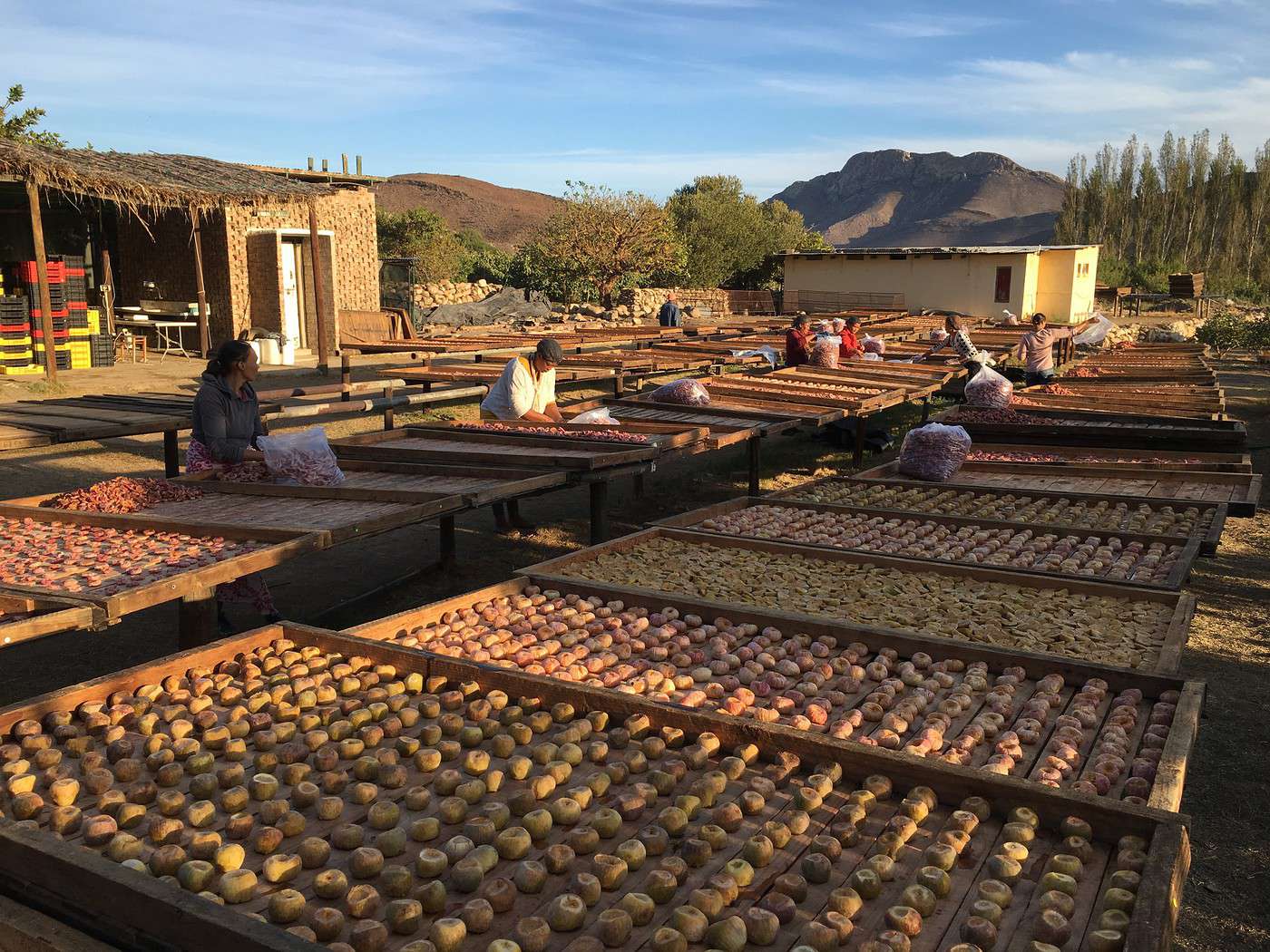
Day breaks effortlessly as the two trucks leave town. In the beds, packed tight to hold on and keep warm, those on the outside clinging to the bars, two hundred seasonal workers have taken their places. A half-hour of dusty, bumpy track brings them to the farm, which the vehicles suddenly cross at a crawl—the fruit trees don’t like dust.
This morning, I’m along for the ride.
While a ladder is unfolded for the women, the men jump from the trucks and immediately load them with crates of packaged fruit that will be in exporters’ warehouses within hours.
The trucks will return empty: triangular trade is a thing of the past—fair trade is in.
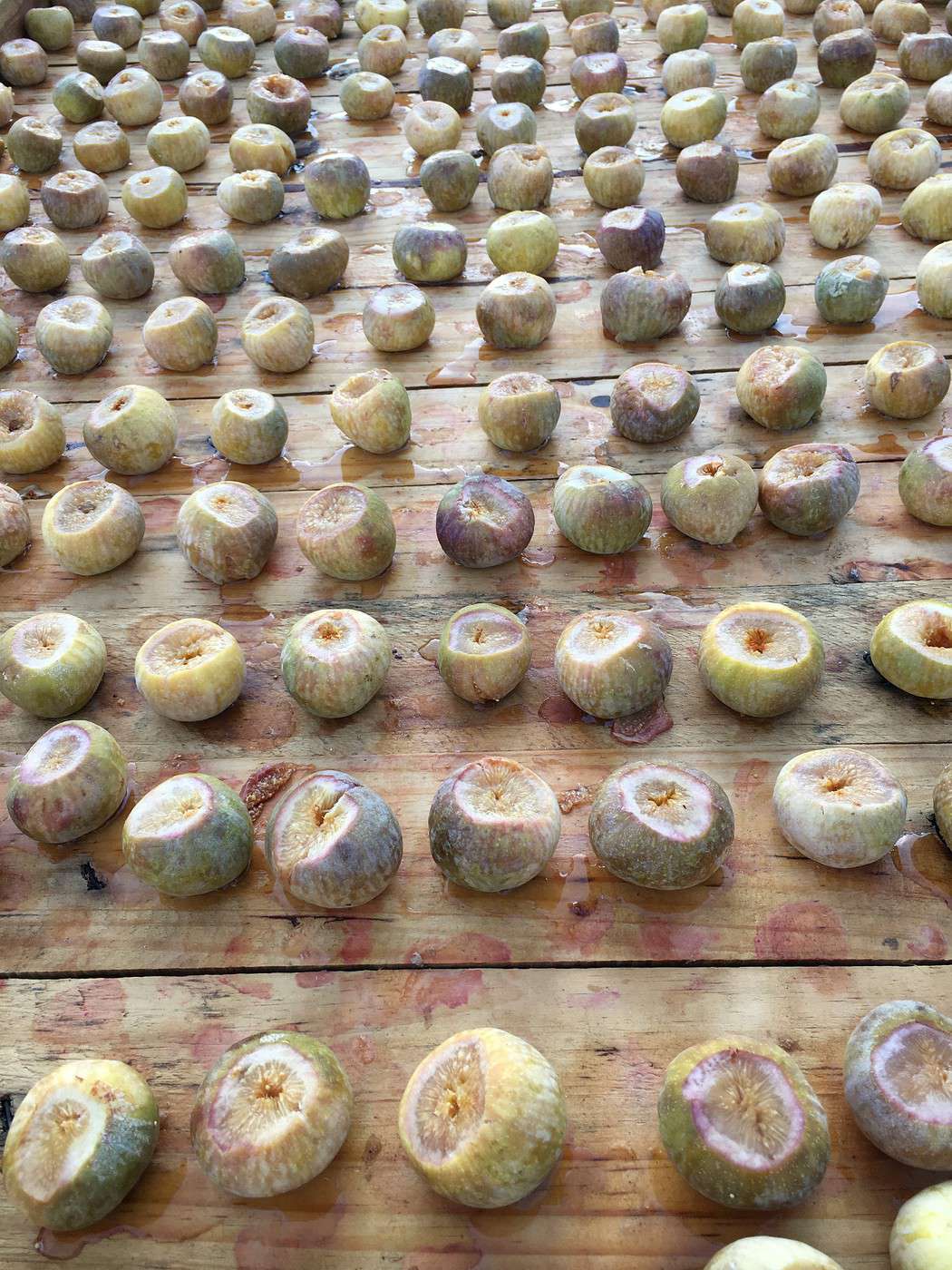
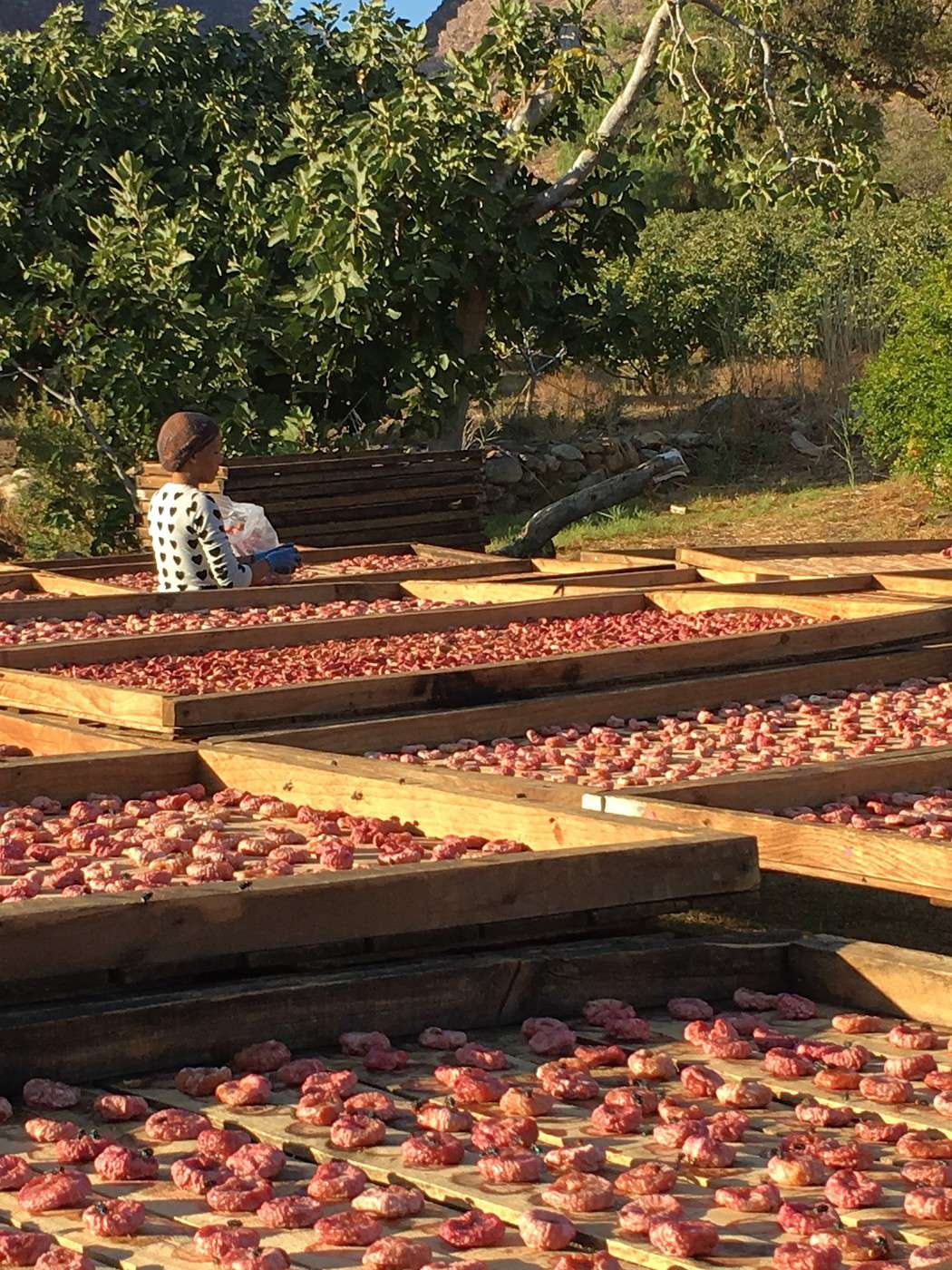
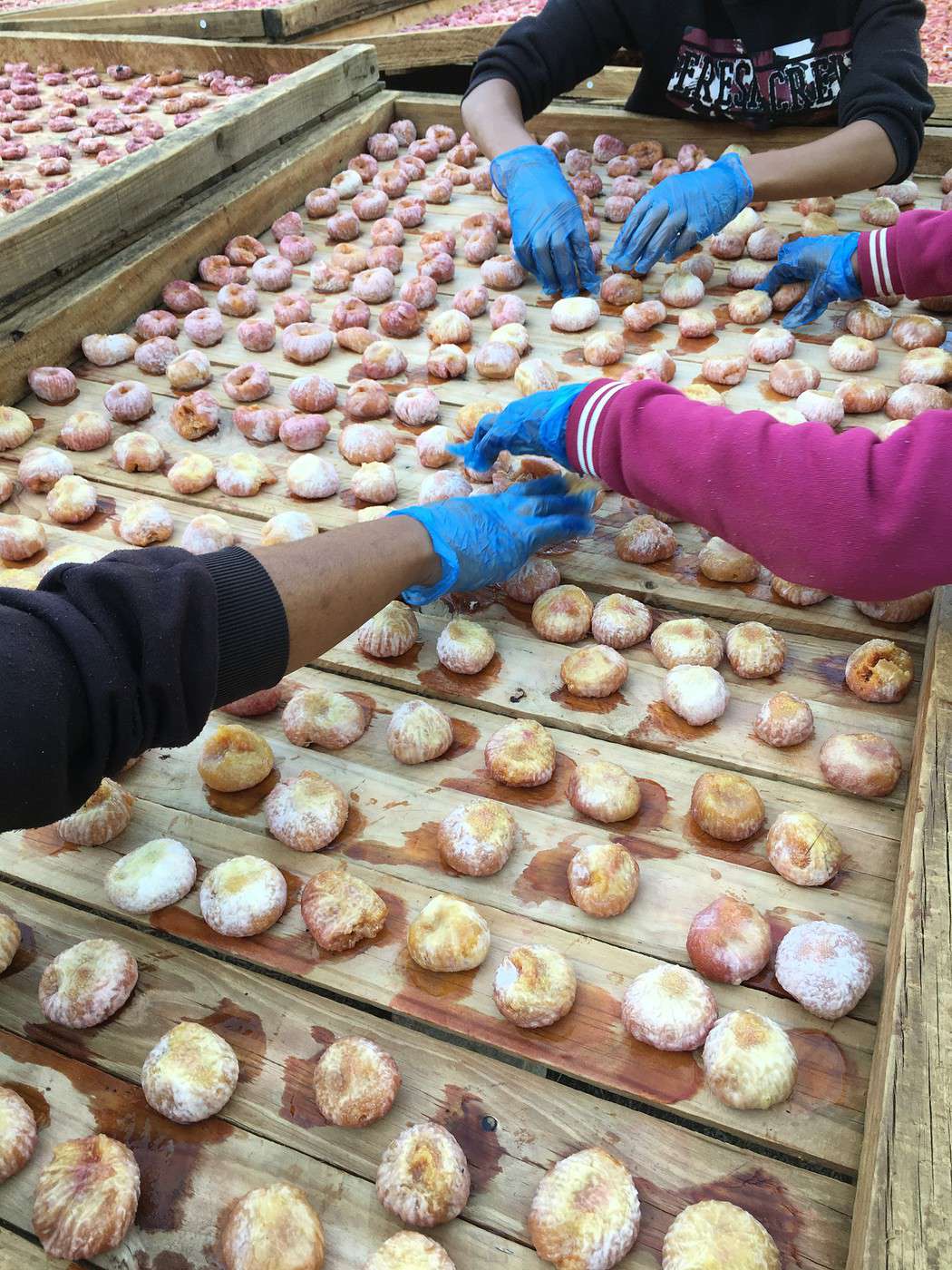
The men handle the picking, the women the processing. Washing buckets and crates, snipping stems, peeling, arranging on drying racks, turning the figs one by one, every morning. The farm sits in a valley forming a natural amphitheater—a solar oven. In five days, the fruit is dry.
The most damaged ones become beauty products, chutney, or jam. All processed on-site. The star of the production is a remarkable panforte.
Rarely seen beauty here, between Black Venus and golden Eve, my guide teases me with my questions.
The boss drives through the rows in an ancient pickup that was once a Land Rover, growling in Afrikaans. The workers laugh.


*
The Russians
For three years, they’ve been flirting with me, half-reclined in a shop window’s chaise longue. I’ve tried the Strasbourg ones, dabbled with the Toulouse ones, but had never tasted a Russian.
Well, now I have, and the verdict is in: pink, stiff, flavorless, no matter how you prepare them. Russians, go home!
Even as a joke, I know it’s no longer acceptable to say such things.
If some guardian, some defender—or worse, some virago whose orientation this compass-less era can’t define—if any of them make it here and feel the rightful urge to handcuff me with guts and make me swallow a rosary of them, let my apologies be accepted—and don’t turn them into blood sausage.