in Thèmes › Voyager en camping-car
Converting a heavy-duty bus/coach/truck into a motorhome (page 158 of 161)
Discussion started by Patrick26 on 2004-06-14
3213 replies
This thread has been translated into English.
Converting a heavy-duty camper van from a bus/coach/truck
François57 · 2007-06-16 · Message 3141 of 3214
No worries, Gasmobil... only the uninitiated won't get it... (lol!)
But yes, it's Ampere-hours.
You blew my mind on the previous page... finally some clear answers—I had no idea capacity changed based on discharge rate.
And great comparison of electricity to water. Small note, though:
Ampere-hours aren’t a flow rate, but a quantity (like a 500 man-day project could be 5 workers for 100 days). After all, an ampere is already a joule/second conversion, where the joule is the base unit—like liters/second.
So, as you explained: 1 liter of water per hour vs. 1 liter of water per day is like 1 ampere-hour per hour vs. 1 ampere-hour per day, or 1 ampere vs. 1/24 ampere.
For prolonged stationary use, be careful not to use the engine batteries—they’re designed differently: short bursts of high power or just for running electrical devices while driving. Though you’d need the right to toast bread while rolling.
Plus, looking at what’s sold in camper accessories (super expensive but fairly reliable), the manuals recommend discharges of 30% to 90% for house batteries. Are they made for that? Like draining 90 Ah from a 120 Ah battery? But those manuals also say you get three times more charge cycles if you only discharge to 1/3, and the weird part: proportionality (use a third of the battery, you can recharge it 1000 times; use 90%, and it’s 300 recharges—like emptying a bucket).
So I figure either their docs are wrong (my guess), or you were talking about starter batteries (but I think you know this stuff well).
I’ll have to call you once I dive into the bus’s electrical system.
Another question: leaving my coach parked for a week made it impossible to restart because the tachograph (no disc currently) keeps running (the vehicle manual even says to remove its fuse during long stops). Ben had the same issue with the same battery set, and adding a circuit breaker now prevents it.
What’s the risk to my starter batteries if they’ve been drained for a week by a tiny clock to the point the coach won’t restart?
Vehicle downgrade
Watch out, LeGX47. It’s not enough to just create a partition to stop loads—your vehicle could be reclassified as a box truck (not sure of the exact term), meaning it’d be subject to goods transport regulations and must pass the roadworthiness test loaded to 2/3 of its payload capacity. (Imagine hauling 5 tons of paving stones every year to wreck your suspension and suffer for it.)
I’ve thought about this—Gasmobil knows the rules, and the DRIRE told me that if it’s neither a camper van nor a box truck, I’d need another justification for the conversion (the infamous VASP Nspc).
Here’s how I’m doing it: I’m installing all permanent partitions on a 40x40 batten frame (piping and wiring will run through the frame, so I’m just creating the first layer of the partition to finish the conversion without dismantling).
That’s enough to make it an exhibition bus that fits into one of the VASP categories. Then, weigh the vehicle, submit the RTI file, and visit the local DRIRE for a conditional approval pending a successful roadworthiness test.
And boom! You save 270 € in parafiscal tax when creating your registration certificate and only pay the fiscal horsepower rate (half the price per HP of a passenger vehicle).
Converting a heavy-duty bus/car/coach into a motorhome
Jose6440 · 2007-06-17 · Message 3142 of 3214
hey gasmobil
for an expert like you, I’m sure you already know it’s a mistake—it’s definitely Ah 🤪
but since I’ve got you here, do you know how much power a converter needs to start a 220V fridge?
Because with a 500W converter and a peak power of 1000W, it’s not quite enough—or do I need to add something else? 😊 Thanks!
see ya, jose
Converting a heavy-duty camper van from a bus/coach/truck
Gasmobil · 2007-06-17 · Message 3143 of 3214
Hi there.
I can't answer that just yet—first, to determine the power of your converter, you need to know what you're working with, meaning the power of your fridge's motor.
Check if there's a plate somewhere behind your fridge that shows the max current. The issue with fridges is that the motor starts under load, so it draws power right away.
That's why you generally need to account for a starting current that's 5 to 7 times higher than the motor's nominal current when it's already running.
From there, you can figure out the size of your converter.
Best regards.
Converting a heavy-duty camper van from a bus/coach/truck
GX47 · 2007-06-17 · Message 3144 of 3214
For your batteries draining to 0 in a week, they're shot. That happened to me with my old ones. If you can, you should recharge them with a pro charger at a very slow rate, but you'll need to replace them because it takes longer to drain two 120Ah batteries.
The slow-charge trick came from my battery supplier buddy. You take an old one, drain it to 0 very slowly by connecting a 21W indicator bulb or better, a 5W one, to the terminals. Then you find a forced-amperage charger (very expensive and hard to find), set it to a max of 3A, and leave it charging for 3 days or more depending on the amperage. Your battery will be like new (but won’t last forever, as Gazmobil pointed out). I replaced the forced charger with a cheap supermarket one (15 €). Actually, it doesn’t have the power to charge a 120Ah battery and doesn’t reach 3A. Normally, you can only do this once, but I’ve revived batteries recharged this way by my buddy—two 120Ah 6V batteries—and they lasted me 12 more years with several recharges. Meanwhile, the batteries in my current tractor (two 160Ah 6V ones) died completely after just 3 full discharges in 6 years. The internal materials just aren’t the same anymore.
Converting a heavy-duty camper van from a bus/coach/truck
Gasmobil · 2007-06-17 · Message 3145 of 3214
Hi there.
The issue is that if your starter batteries are deeply discharged, as far as I'm concerned, they're done for.
Basically, a battery in good working order exchanges lead ions between the electrolyte and the plates—one way to produce current and the other way when recharging to return to its initial state.
When a battery is deeply discharged, this exchange is no longer possible because the ions change state, almost like a "crystallization" that locks the chemistry, making the battery inert.
Of course, not all discharges are equal—if you haven’t gone too low and you're still at the limit, you might be able to save your battery with a special, powerful charger that "shocks" it to wake it up, so to speak.
Be careful with open-circuit voltages—even a dead battery will show around 24 V when empty. As soon as you put even a small load on it, the voltage plummets!
Best regards.
Converting a heavy-duty bus/coach/truck into a motorhome
François57 · 2007-06-17 · Message 3146 of 3214
Yeah, actually the engine wouldn’t start, but I could turn on all the lights, the heaters were running, and the rear fans too...
So if I have the old batteries (the ones that came with the bus), would it be enough to recharge them really slowly?
Another question: can you repair batteries by opening them up, replacing the internal cells, and refilling the acid?
Converting a heavy-duty camper van from a bus/coach/truck
Gasmobil · 2007-06-17 · Message 3147 of 3214
No, you can't change the elements, and the electrolyte is properly balanced from the start. If it's low, you should only add demineralized water—otherwise, you'll alter the electrolyte concentration.
If only the starter isn’t engaging but everything else still works, I think you can try a good recharge with a high-capacity charger that delivers strong current to give it a little jolt and get it out of that state.
That’s why I’m pro-solar (despite what some people say). You don’t have to worry about anything, and when you arrive, you can always be sure you’ll be able to start up without installing a battery cutoff and all that hassle!!
Best regards.
Converting a heavy-duty camper van from a bus/coach/truck
François57 · 2007-06-17 · Message 3148 of 3214
Yeah, I get you—it’s really just the price of the panel that throws me off a bit (around 10 € per watt in France). But since I’m from Moselle, where the sun isn’t always around, I’m going for a wind power backup. I found a site offering 700-watt wind turbines for about 500 €. Wingspan of 1.20m, mounted on a 3m mast, and I’ll need a system to lower it onto the roof between the solar panels when we’re on the move.
But I’m all for combining all three systems: solar, wind, and recharging with the alternator + an electric generator if needed.
And your arguments slowly convinced me to go for 24V: two batteries in series are more efficient than two in parallel at 12V because the current draw isn’t proportional. I’m still on the fence, though—if most standard campers use 12V, there must be a reason, right? Even though they could easily integrate inverters, regulators, etc., to recharge via the vehicle’s alternator.
Where can I find reliable 24V accessories, preferably not too expensive, like in specialty camper shops?
Converting a heavy-duty camper van from a bus/coach/truck
Gasmobil · 2007-06-17 · Message 3149 of 3214
I completely agree with combining all three charging methods. Personally, I had considered wind power but decided against it because of the noise.
For solar, I found options at around 6 euros per watt.
For the equipment, I planned for 12V, 24V, and 220V.
12V via a converter (not from Narbonne Acc, too expensive) for everything like the satellite antenna, radar, and rearview camera. You can also find 24V versions, but they're still too pricey since they're niche—better to invest in a converter, it’s cheaper in the long run.
24V for the Webasto (not the original one—it’s too power-hungry and way too noisy), a smaller model, and energy-saving lighting (check out energiedouce.com or I can’t remember where else).
220V only for the extractor hood and the fridge. Same principle as the 12V gear—much cheaper in 220V and more than makes up for the cost of the converter (www.comptoirdusolaire.com).
Avoid specialized stores like the plague—they’re ridiculously expensive. For reference, check out the sites I mentioned; they’re way cheaper and offer more options.
Best regards.
Converting a heavy-duty camper van from a bus/coach/truck
ScaniaSuisse · 2007-06-17 · Message 3150 of 3214
Hi everyone.
Wow, I sure asked a lot with my battery question...
Anyway, I'm happy—the answers were interesting and informative, thanks!
But... there's always a but, I've got another one, yep...
They say you shouldn’t connect batteries in parallel if they don’t have the same capacity within a 10% tolerance. Okay, let’s forget the 10%—my question is this:
I have two sets of batteries: one set of 2x12V 180Ah and another set of 2x12V 160Ah (to be precise, 4x6V). Is it possible, to respect the rules of parallel batteries, to connect 1x180Ah + 1x160Ah in series and then do the same again to put them in parallel?
I’d say the 4x160Ah are second-hand and, above all, free—that’s why I’m wondering if I really can’t use them... whereas the 2x180Ah are new.
To wrap up, I’m thinking of connecting my 2x180Ah in series to get 24V and then hooking up an inverter, using the vehicle’s alternator to charge. And possibly, to extend battery life, adding another set of 2x180Ah in parallel if I can’t use my 160Ah.
What do you think, gasmobil?
Thanks in advance!
Swiss greetings,
Didier
Outfitting a heavy-duty camper in a bus/coach/truck
Gasmobil · 2007-06-17 · Message 3151 of 3214
Hey there, Swiss buddy!!
If I were you (but I’m not ;)), I wouldn’t add my 4 160Ah batteries to your 2 180Ah ones.
First off, you’ll be starting out with a battery bank that’s not very homogeneous—neither in capacity nor in lifespan—but honestly, that’s not a huge deal on that front.
As I’ve mentioned in one of my previous posts, if you can, it’s always better to put 2 "big" batteries in parallel rather than 4 "small" ones.
I can tell I can’t get out of this—I’ll have to explain why.
Okay, first of all, every battery is made up of independent 2V cells, all connected in series. And no, a 6V, 12V, or 24V battery doesn’t technically or chemically exist—we can only make 2V x X cells depending on the desired voltage.
Each 2V cell behaves like a mini battery with its own voltage and internal resistance. They’re all manufactured the same way with the same materials, but—yep, there’s a but—some cells will "give" 2.1V, for example, while others only 1.9V. I know, it’s annoying.
They have different efficiencies. We give them all the same energy to charge since they’re in series and the same current flows through all of them, yet when it’s all said and done, the individual voltages aren’t the same.
But where’s the problem, you might ask? I’m getting there, stay cool. 😎 It’s not always easy to explain in writing what you know or practice!!!
Let’s say, just to be nice, that there’s only one cell with a lower efficiency than the others.
Over successive charges and discharges, the difference between the good cells and the "weaker" one will grow. This has several harmful effects: The battery’s voltage will drop day by day, cycle by cycle, because since all the cells are in series, if we exaggerate and the cell drops to 1.5V (just an example for the demo—this isn’t actually possible, okay??), you’ll have a battery delivering 11.5V instead of 12V. As we can see, every battery is slightly different, and when you put batteries in parallel, the ones with better efficiency will always try to "compensate" for the deficiencies of their neighbors. The more you put in parallel, the more you potentially amplify this phenomenon. Over time, with charge and discharge cycles, the "weak link" widens the gap with its "good" neighbors. So if, after prolonged use, the good cells are near deep discharge, the "weak link" is already deep in it—and if one cell is toast, the whole battery has to be replaced since they’re all connected.
So the more big batteries you put in parallel—but in smaller numbers—the more you reduce this problem because you’re reducing the number of 2V cells in circulation.
Of course, there’s a workaround: THE FAMOUS EQUALIZATION CHARGE!!!
But for that, you’ll need an expensive charger, like GX47 started talking about—a charger where you can control the charging current and voltage.
With that kind of setup, you slightly increase the nominal charging voltage while keeping the charging current unchanged. The good cells won’t like it and will start bubbling (or "boiling," as some say), but you’ll force the weak link—which needed more voltage than the others due to its lower efficiency—to nearly catch up to the "good" ones. This process smooths out the differences, equalizes them—hence the name.
Use this method sparingly and with good control, because cells don’t really like it. 🏴☠️
Best regards.
Converting a heavy-duty camper from a bus/coach/truck
ScaniaSuisse · 2007-06-17 · Message 3152 of 3214
T H A N K S for this info!
Okay, I think I’ve got it—I’ll go buy two new 180Ah batteries, so I’ll have a bank of 4, 2x2 in parallel, all brand new, giving me 24V at 360Ah.
Because, like you said earlier, "In short, the greater your batteries’ capacity, the longer their lifespan will be."
This will solve for me: charging using the coach’s alternator the "smaller" cable diameter and a larger available capacity that will "wear out" the batteries less over time (at equal consumption, obviously)Alright, now all that’s left is to do it... 😏
Anyway, I think you and Patrick are in Valence—with a bit of luck, we might cross paths when I head south (around Arles), but I don’t know when.
Thanks again!
Swiss greetings,
Didier
Converting a heavy-duty bus/coach into a motorhome
François57 · 2007-06-17 · Message 3153 of 3214
By the way, regarding the Scania setup in Switzerland—if I understood correctly, they're going to install two sets of two 180 Ah batteries in parallel.
So that’ll give them 360 x 2 Ah (since capacity adds up whether in parallel or series).
Otherwise, is it really impossible to modify my batteries? Can’t the electrolyte be recreated? Another question: originally, my vehicle came with four 3-cell batteries wired in series. The coach started right up when I picked it up, but by the time I got home the following week, I couldn’t start it again (probably drained by the tachograph—I’d just gotten the vehicle and didn’t have the manual, so I had no idea it was off the battery cutoff and that all I needed to do was remove a fuse).
After recharging, I still couldn’t restart it. So I opened all the caps, and one cell was bubbling when I tried to start it. Okay, fair enough—the seller had a spare battery and gave it to me. I replaced the faulty one (let’s say defective), and then another one started bubbling.
We tested with a pipette that measured acid concentration, and only the first cell was failing. We didn’t detect the other one.
Another question: why did the coach start right away when I first picked it up, but I’ve never been able to recharge the batteries since?
Also, can I get 24V by wiring five 3-cell batteries in series?
Converting a heavy-duty camper van from a bus/coach/truck
Hotware · 2007-06-18 · Message 3154 of 3214
Oh no, capacity adds up in parallel, not in series.
Let’s say you have a bank of 2 x 12V 100Ah batteries.
You can have 200Ah at 12V (parallel) or 100Ah at 24V (series).
Either way, it’ll represent the same amount of energy.
What really causes problems in batteries isn’t so much the electrolyte as the lead plates, because those are the ones that oxidize.
In the case of deep discharge, crystals can form "bridges" between the lead plates, which short-circuits the cells. The short-circuited ones reduce the charging capacity and output voltage.
Here’s a breakdown of the differences between battery types for those wondering:Starter: needs high current for a short time—lots of thin lead plates (which oxidize quickly in case of deep discharge) to maximize surface area and thus peak power.Semi-stationary (or marine): a mix between starter and stationary.Stationary (or solar): thick lead plates, which oxidize much more slowly and allow more charge/discharge cycles. Since there are fewer plates, the peak power is quite low and won’t be enough to start an engine.Gel: a stationary battery where the electrolyte is replaced with gel. Advantages: you can install them in any position, no need to top up levels, and better current density.Why such price differences? Lead is expensive, and the more you have, the better...
Weight is a good indicator of a battery’s capacity—lead is heavy. Avoid camper van batteries; some sellers cut corners, and they’re often just starter batteries... Check and compare weights before buying
Converting a heavy-duty camper van from a bus/coach/truck
GX47 · 2007-06-18 · Message 3155 of 3214
One week isn’t enough time for the clock to drain good batteries—it takes several weeks. Mine sat for a whole month without moving, and the clock was still connected.
🙁 Unfortunately, this can happen:
either your seller is honest and the battery just died right away,
or the seller is a bit shady or clever and...
When someone wants to sell a vehicle and knows the batteries are shot, the compression isn’t great, or the starter’s worn out, they’ll give it a boost beforehand or start the vehicle in parallel, let the engine warm up a bit, then let it cool down. After half an hour, the outside seems cold, but the inside is still warm, and there’s still trapped gas in the combustion chambers—the thing starts on the first try😄😮.
You see this with air-suspension buses—they’re lifted when you arrive—but not on an S53, unless the seller forgot to operate the door several times to release the air. That’s why it’s worth showing up an hour early—I’ve done it often, and suddenly, the engine that usually starts right up won’t even cough this morning???!!!😏
When I sold mine, I was swamped with work. It had been three weeks since it last ran—maybe even longer. Anyway, it had been parked there for over a month. It needed one preheat cycle, whereas it usually started without one, even in winter. The inside was all damp, and even the exhaust started smoking white after a few minutes (it was evaporating the moisture inside). It took forever to get going. At first, I regretted not starting it up beforehand—new batteries could’ve been dead—but afterward, since everything quickly went back to normal and the buyer knew his stuff, I didn’t regret it.
For your batteries, if one cell is dead, as Gazmobil explained, it’s game over.
If you want, I can give you a last-resort trick, but no guarantees: fully discharge your batteries slowly, empty them completely, then refill with new demineralized water (1.5 € for 5L). Find a pro charger with a boost function, or try a cheap one, and leave them charging for at least 3 days.
Put them back in and see what happens (no guarantee if you can’t shock the dead cell like Gazmobil said). At best, it’ll only cost you 4 x 5L jugs; at worst, you’ll add 4 new batteries to the cost of the jugs😏. If your batteries have 4 or 5 good cells and one won’t take a charge, it’s toast.
It’s also possible your faulty cell is short-circuiting—a common issue with new batteries (happens overnight)—and in that case, it’s not even worth trying to fix—straight to the bin. Pros have a tester for this; otherwise, measure the voltage. If you’ve got around 5V per battery, you’re good. If it’s under 4V, bin it immediately.
But you need to charge each battery separately at 6V, not two in series at 12V (for the reasons Gazmobil already explained).
One time, with a worn-out cell, I charged a battery at 12V—so spread across 5 cells, let’s say🤪—it drained instantly at the first turn of the key without even engaging the starter. (All the lights went out😕)
I don’t get the last question—5 x (3x2V) = 30V, not 24V. Did you mean 4 x 6V batteries?
Converting a heavy-duty camper van from a bus/coach/truck
François57 · 2007-06-19 · Message 3156 of 3214
We already discussed this with GX 47 a few dozen pages back. Indeed, amperage adds up in parallel, not in series.
Don’t confuse Amps and Amp-.hours.
Don’t confuse liters/second and liters.
But one quantity stays fixed (unless there’s a proportionality issue due to chemistry, as Gazmobil explained). Otherwise, why bother with two 180 Ah batteries if one would be enough? It’s like taking two 10-liter buckets—you’ve got 20 liters total. Whether you draw from them in series or one by one, you still get 20 liters. However, you can set up a 12V or 24V system—the power stays the same, but the current doubles since the voltage drops. A TV will always use 100W, but not with the same current in 12V as in 24V.
Amps measure the volume PER second of electricity.
Amp-hours, then, measure the VOLUME of electricity (with EDF, you pay for watt-hours, not watts).
But seriously, they could’ve just stuck with joules—you’d have capacity in joules and flow in joules/second.
Converting a bus or truck into a motorhome
François57 · 2007-06-19 · Message 3157 of 3214
No, I meant that by hooking up 5 dodgy batteries instead of 4, I could maybe still get 24 volts (let's say I have 2 or 3 cells with a short circuit or that are faulty).
but does that work or not?
as for my S53, it starts right away, so no problem there. on the other hand, it does smoke a bit, even quite a bit when accelerating, but since it hadn't started for several months, I was told that comes from condensation in the circuit. is that normal?
Converting a motorhome in a heavy bus/coach/truck
GX47 · 2007-06-19 · Message 3158 of 3214
🙁 No, not the batteries. Bad elements will drain the good ones and you'll have no power—they'll collapse like the one I charged to 12V with a faulty element. You might just have one bad 6V messing up the other 3.
The day you switch to 12V, it's cheaper. 😉
Well, condensation doesn't last forever, but it does exist and sometimes it takes a while. There can also be tiny water leaks that resolve themselves.
You'll only notice it in use, depending on whether it's burning water. That said, with a heavy vehicle, you always have to check the water like the oil, because engines tend to burn a bit of oil depending on age, and the same can happen with water on some engines.
My 797 didn't burn any, while everyone tells me it normally should. 😐 Who knows...
Anyway, in your case, if it's not running, considering the weather, you definitely have a lot of condensation. 😕
Generally, after 1 or 2 minutes it starts producing white smoke, gets worse, then improves and disappears after a few kilometers once the engine warms up (mine took 10 kilometers), but it also depends on the exhaust length. Often engine condensation settles in the exhaust and lasts...
I had a GS (air-cooled, mind you) that dripped water from the exhaust 😮, but it wasn't running on water! 😏
Setting up a motorhome in a bus/car/truck
Pandrée · 2007-06-19 · Message 3159 of 3214
Hi everyone
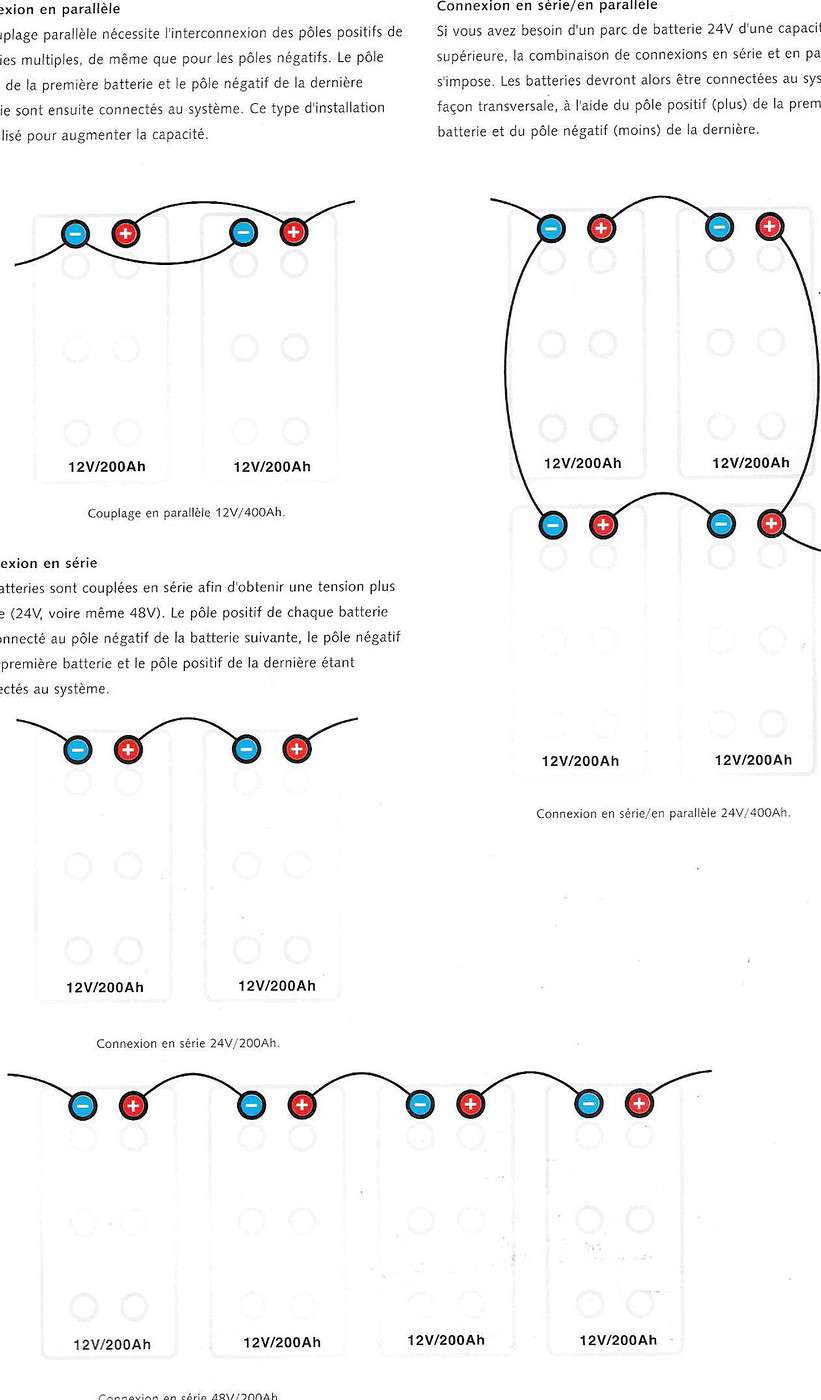
You can also increase the amperages and voltage by connecting them in series/parallel. At that point, you'd need 4 batteries. Image attached.
Converting a Bus/Coach/Truck into a Heavy Camper Van
Franois · 2007-06-20 · Message 3160 of 3214
Good evening,
I'm not familiar with your tachometers, but in Switzerland on the old models they use much more fuel if you leave it on 'work' with the needle constantly deflecting.
I connected mine after the circuit breaker and I reset it before leaving.
Best regards and good evening