in Thèmes › Croisières
Costa Concordia: the investigation (page 23 of 39)
Discussion started by Mookat on 2012-01-22
763 replies
This thread has been translated into English.
Costa Concordia: the investigation
Arsene83 · 2012-03-17 · Message 441 of 764
Excuse me Major for posting the following "homemade" translation of Corsairt's long post that I found very interesting, but perhaps I'm a bit biased...
In January 2012, the Costa Concordia cruise ship ran aground in dangerous waters, costing lives and alarming the industry. Frances Cook speaks to industry experts about the technology and procedures needed to help passengers and crew in perilous situations.
Although the Concordia incident was a tragic disaster, with 17 confirmed deaths and many missing, disasters of this magnitude are fortunately rare nowadays. However, regular accidents, albeit on a smaller scale, still occur at sea. According to the Maritime Accident Review, in 2009, 626 ships were involved in 540 serious accidents in EU waters, accidents such as shipwrecks, collisions, groundings and fires.
However, in terms of passenger ships, 135 (121 ferries and 14 cruise ships) were reported as being involved in accidents in 2009, with a loss of life of four in 2009 and six in 2008.
In the EMSA review (European Maritime Safety Agency) notes that there were several accidents in 2009 that "could have had a worse outcome". The Concordia disaster perhaps best embodies this potential for averted disaster, under the spotlight this industry has led to a review of its safety and emergency procedures
"In the EMSA review (European Maritime Safety Agency) notes that there were several accidents in 2009 that 'could have had a worse outcome'."
On February 9, 2012, a new emergency policy was announced. Under the International Convention for the Safety of Life at Sea (SOLAS), passenger drills will now take place before departure from port.
On the Concordia, 700 passengers boarded at Civitavecchia a few hours before the accident and had not been briefed on muster stations. Because this was supposed to be done the next day (the policy at the time required this to be done within 24 hours).
In an emergency situation, such as that of the Concordia on January 13, what emergency procedures should be followed?
"The emergency procedure is to gather everyone at the muster station," said Dr Tom Allan, an international maritime consultant. "If the captain then decides to abandon ship, passengers are escorted from their muster station to the lifeboat station where they are then loaded onto lifeboats. For the majority of ships, the lifeboats are then lowered so that they are level with the embarkation deck and passengers enter through the lifeboat entrances. This general principle is the same on all ships.
The list affecting lifeboats
Although many Concordia passengers managed to escape in lifeboats, the ship's list, which was about 20 degrees, hampered evacuation efforts. Lifeboats are designed to operate with a negative list of 20 degrees.
"If the list is more than 20 degrees, it will be extremely difficult to launch the lifeboats," confirmed Allan. "Even attempts to move people from one side of the ship to the other become more difficult; transverse corridors become tunnels, shafts. Normally an evacuation should take place well before reaching this point."
Cruise route issues
According to Lloyd's List Intelligence, automatic tracking systems showed that the route Captain Francesco Schettino took the Concordia that night was much closer to the island than on the previous cruise, that of January 6, 2012.
However, they also show a pre-approved route taken in August 2011 that passed near the island. Piet Luigi Foschi, president of Costa Cruises, confirmed at a press conference that this pre-approved close route was "no less than 500 meters" from the island. Video footage shows the captain interviewed confirming that the ship was less than 300 meters from the shore. He explained in another interview that he was sailing along the coast with the "tourist navigation system" and that the "rocks were detected not at the front of the ship, but when they were on the side". He also claimed that the nautical chart showed there was "enough water at 100-150 meters from the rocks", which is why, at 300 meters, he believed the ship would not touch.
Navigation technology
But could navigation technology really have failed?
"Every ship knows where it is with submerged hazards, that's what the electronic chart does for you, and as for floating hazards, the radar," explained John Davis, marketing director at Kelvin Hughes. "Thus, identification of floating and submerged hazards should be sufficient."
He added: "Navigation equipment goes through a long approval process before it is on a ship. The IMO has set performance standards and the IEC has created test programs so that all navigation equipment is rigorously tested before getting approval to equip a ship."
Design issues 'for the new generation of ships'
Even as investigators work on the causes of accidents, questions have been raised about the design of cruise ships, which have changed dramatically since the Titanic 100 years ago.
"Although there have been criticisms surrounding the evacuation of the Concordia, Allan says that the fact that 99.5% of people were rescued in such a situation was no small feat."
"Most modern cruise ships are built on the same deck plan, off-axis (Translator's note: 'beam' I don't know the nautical term) beam?, with a draft of about 10m to enter shallow anchorages, and have a short length to accommodate berth cabins," said Captain Paul Townsend.
"Can you imagine all the large buildings in the world with the same deep draft (same?)?"
He added: "our naval architects are usually employed by the ship owner and not independent, they design this floating block of apartments - where this generation is double the previous one - carrying 4,000 passengers and 1,000 crew members. This allows greater efficiency in catering and costs and, consequently, profits, but in terms of ship length, there is no more room for lifeboats along the sides."
Allan, however, stated that the same standards apply to all cruise ships, regardless of size, when it comes to evacuation and safety. "You have to show that you can load and lower the lifeboats within 30 minutes when evacuation is announced," he said. Over the past 40 years, the shipping industry has focused on improving ship structure and improvements in hull design, stability systems, propulsion systems and navigation equipment have been made, and yet the maritime accident rate is still very high
Personnel and system errors
"Although many Concordia passengers managed to escape in lifeboats, with a list of about 20 degrees, evacuation efforts were hampered."
"Why? With all the improvements and regulatory changes we implemented over the last decade, have we not significantly reduced the risk of incidents?" said Davis.
"Because the ship's structure and system reliability are the relatively small part in the maritime safety equation. The system is a system of people, and in the human-system error equation (Translator's note: I resist human error) human error features prominently in accident situations, about 75-96% of maritime accidents are due, at least in part, to some form of system error."
Areas where measures can be taken to minimize risks in design include: bridge layout, navigation equipment: focusing on the following: ship speed (ship schedule), crewing levels, crew attitude, maintenance and training.
Townsend believes that failures are often a combination of design and management problems. "I was captain of a RoRo passenger ship the night of the Herald of Free Enterprise disaster (it capsized and 193 people lost their lives) and we had a relief captain traveling with me, so we were able to discuss the matter. Our initial beliefs were completely wrong, the real error was in the design and management."
The importance of training
Effective crew training is essential for the proper operation of a cruise ship. Although there have been criticisms surrounding the Concordia evacuation, Allan says that the fact that 99.5% of people were rescued in this situation was no small feat.
"The crew", "No matter what is said, we must take just a little credit for that. Training must have been lacking somewhere and that's what was demonstrated there," he said.
There will be lessons learned from the Concordia incident, even if these only emerge following the official investigation.
"There are always lessons to be learned about ship evacuation," said Allan. "All operators must provide training in passenger control and management - how you control passengers, especially when panic sets in, is probably the most difficult."
Costa Concordia: the investigation
Corsairt · 2012-03-17 · Message 442 of 764
article/US Congress security hearings
Last month, the US Congress heard the Cruise Line International Association (CLIA) defend its member cruise lines on the issue of passenger and crew safety aboard large cruise ships. An extraordinary plea? Perhaps routine, at least in this type of context. This face-to-face meeting seems to have been part of the tightly-knit measures undertaken by the United States regarding security for its citizens following the terrorist acts that occurred on its soil, measures aimed in this case at passengers who become, in a sense, captive clientele propelled on the high seas.
The CLIA pointed out to Congress that "people are far safer aboard a cruise ship than in practically any community in the United States, even though incidents can occur on rare occasions."
Just like the air transport industry, the cruise industry relies on statistics to claim its highly secure profile. In this regard, on March 27 last year, the Federal Bureau of Investigation (FBI) filed a report in which a picture is drawn of crimes committed aboard cruise ships over the past five years, at least those reported to the FBI: from 2002 to February 2007, 184 crimes occurred on ships belonging to pleasure cruise companies registered in the United States. Of this number, 84 (46 %) involved crew members as suspects.
In 55 % of cases, the crimes were sexual in nature (the majority in private cabins, half smelled of alcohol and 37 % of these cases involved employees as suspects). Forty (22 %) of the 184 reported crimes were physical assaults other than sexual (mainly assaults between men and in all imaginable public places on a cruise ship).
Included in this category are the 12 reported disappearances (five cases apparently resulting from alcohol abuse and four from suicide) and the 13 deaths declared aboard a cruise ship (at least two appear to be homicides — a murderer pleaded guilty in one of the two cases — and the others are still under investigation).
The CLIA's presentation put into perspective the number of crimes that occur aboard — a number which, according to FBI records, is rising — versus the number of passengers who take a cruise each year. It would be honest to state that, all things considered, crimes are quite rare (184 in five years, for some 12 million passengers per year).
In preparation for its docking in Washington for this official meeting, the association was also issuing a notice intended for travel industry players, especially those having direct contact with consumers. It notably states that "in the event of an incident, the cruise line takes all allegations and all facts very seriously, reports them to the relevant competent authorities and fully cooperates in any investigation."
"The relevant competent authorities"? "Which one, when and how? That is the question," recently said Christopher Shays, a member of Congress, speaking about passenger disappearances. "Voyages on the high seas propel passengers and crew members into an environment that is both isolated and distant. And, for this reason, everyone inevitably finds themselves in a position of vulnerability and everyone is exposed to risks," he added.
"The issue also rests on the economic aspect," recently raised Jim Santini, general counsel of the National Tour Association and lobbyist for the American travel industry for years, during an interview conducted by the editor of the American magazine Travel Trade (www.traveltrade.com). "Certainly, cruise lines, like all players in the travel industry, must put in place security procedures. But these must not however have a negative impact on the industry's economy," added Mr. Santini.
On this subject, even with incidents and crimes such as those mentioned, cruise enthusiasts probably have nothing to fear; obviously, all bodies holding any power to dictate conduct to this cruise industry are currently running at full throttle on the issue.
The cruise industry would be likely to considerably shake the reputation of the United States if a large-scale incident were to occur. On the one hand, many large cruise operators, even if they are of non-American origin, are registered in the United States for tax reasons; on the other hand, imagine the splash if a terrorist attack targeted a cruise ship with 3400 passengers and 2000 crew members.
The cruise sector is also in the crosshairs of high security because it brings billions of beautiful dollars to the States ($32.4 billion US in the US economy alone in 2005), jobs for thousands of Americans (130 000 just in Florida, one of the leading states for cruises) and decisive support to politicians...
Which cruise line is best prepared in case of a crime? For three years now, the FBI has been mandating the Miami division of its Evidence Response Team (ERT) to give ongoing training sessions to captains and security officers aboard the cruise ships of Carnival Cruise Lines and Royal Caribbean International. On the training menu: preservation of a crime scene for investigation and inquiry purposes, a general overview of counter-terrorism from a maritime perspective, and basic interview techniques for gathering information.
Also, the FBI recently mandated the Tampa division of its ERT to teach its investigation concepts to Disney Cruise Lines. The FBI plans, "in the near future", the same treatment for Princess Cruise Lines. For the others, the FBI is currently putting together a PowerPoint presentation on the subject...
- it's not just toilets that get clogged on boats, let's keep our heads before speculating
Costa Concordia: the investigation
Echovictor · 2012-03-18 · Message 443 of 764
News of the day:
Thieves reportedly managed to get close to the wreck last night, despite the laser security and seismic recorders, and steal the bell, which was 8m below sea level ...
Costa Concordia: the investigation
Corsairt · 2012-03-18 · Message 444 of 764
oh yes!
it's the fog bell from the bow - heavy stuff -
the bell, the spirit of the Concordia, is on the bridge with the flag colors
- Kretino should have saved her, but he preferred to flee with a briefcase of documents
and a phone - which have since disappeared - Kretino's honor???...
Costa Concordia: the investigation
Arsene83 · 2012-03-19 · Message 445 of 764
Thanks rcoucou for these remarks
I'll pick up where the text left off
1) a ship can hit a reef at full speed head-on or broadside if someone is crazy enough to do it
In the Concordia case there was a tacit agreement to make this maneuver between the Captain and the Company, so shared responsibility....
Well no, the first court ruling clears the Company...
2) I question the all-electronic control systems, very sensitive to water and fire interference
Agreed with Rcoucou, we see it in other areas
3) I question the all-electric controls (even the toilets)🤪
In the ALLEGRA case this caused inconvenience to passengers, whereas a mechanical gravity system would have allowed more comfort and hygiene
4) the communication system with rescue services, especially in the open sea
There it's more serious but I didn't develop this topic on the forum but privately with knowledgeable people.
There will be other incidents concerning communication links.
Here too the ALLEGRA example is worth pondering.
5) launching the lifeboats in case of heavy list and them getting stuck
There should be drills during cruises with volunteer passengers to draw lessons and best practices in order to understand these cases and define the rules and solve the difficulties without making the ship list but when the sea is rough.
6) the slowness of passenger evacuation (the use of rope ladders, you'd think we were back in the Middle Ages)🤪
Without removing these ladders though, we need to find a balance in these abandon-ship maneuvers.
Only feedback will allow us to better understand and facilitate the work of the staff who must direct these actions.
Note that on the Concordia few supervisory staff participated in the evacuation of the ship.
The videos are numerous enough to verify this point
A point raised by Mattaf concerns panic.
Having witnessed the start of panic, in these shipwreck cases all staff must be able to participate in drills to understand passengers' fear mechanisms.
We must practice in an orderly way with conviction if we don't want certain actions to turn into harmful attitudes, hence an organization in agreement with passengers during the safety briefings.
actually you more or less reach the experts' conclusions transcribed by CORSAIRT in the block that I had the "pleasure"😛 of translating
Costa Concordia: the investigation
Corsairt · 2012-03-19 · Message 446 of 764
hi,
you're right about the electronics, let's get back to the motor-paddle.... don't you know it?
then you're left with the dugout canoe... and the chidanlio method
you're mixing everything up, taking shortcuts that aren't facts.....
Costa Concordia: the investigation
Stephanie41 · 2012-03-19 · Message 447 of 764
😉you broke the godille bike, now you've only got to paddle, encore, etc...
famous song !!
have a good evening with music !😉
Steph😛
Costa Concordia: the investigation
Corsairt · 2012-03-19 · Message 448 of 764
but how does the motor-paddle work??? (the latest 100-ton gross tonnage boat is called Blue Berry, equipped with a motor-paddle)
still too modern for those who are fed up with electronics and electric fairy lights on cruise ships, 100 years ago there was the Titanic, the supposedly modern barge (even for the time) we need to go back to that, hurry up a few days after the sinking the first modern cruise ship La France (1912) was launched, collective memory has been largely polluted by the history of Anglo-Saxon liners, making us forget French-built ships - and yet there was no comparison - I'll leave you to it, gentlemen, the rebels against technology; White Star, I'm keeping the CGT -stayed ashore-
Costa Concordia: the investigation
Rcoucou · 2012-03-19 · Message 449 of 764
A Motogodille (a trademark back then, forgotten since) is one of the first practical outboard motors, made in France by a Parisian industrialist, Baron Gabriel Trouche.
With its propeller shaft angling off obliquely, like the oar of the manual Breton godille, the Motogodille, born in 1904, resembles the car engine adaptations still used today in Thailand (long tail boats).
but it still works...😉 and always
worst case, you replace it with a paddle or oar 😉
you can also turn cruise ships into galleys
though right now it looks a lot like that 🤪
😉 hi again
Costa Concordia: the investigation
Corsairt · 2012-03-20 · Message 450 of 764
News from Italy, a luxury cruise ship hits a container ship in Vietnam

Vietnam V, the Silver Shadow cruise ship hit a Vietnamese container ship in Ha Long Bay. The cause was thick fog, it can happen, but of course, hearing one piece of news after another (Concordia, Allegra, etc.) is always more impressive.
The Silversea company said the Shadow was the victim of an accident, not negligence. Little damage was done to the bow and the safety of the cruise passengers was not compromised. The ship, fully operational, continued its tour. The company also stated that a thorough investigation is being conducted into the incident.
And then the media quickly spring into action, spinning allegations from cruise passengers aboard about safety, and also remind us that in April we will celebrate the centenary of the Titanic sinking, perhaps we won't have to wait to see another ship go down.

Costa Concordia: the investigation
Toilapol · 2012-03-20 · Message 451 of 764
Costa Concordia: the investigation
Arsene83 · 2012-03-21 · Message 452 of 764
More scare than harm,
you can't compare a fender bender while parallel parking a truck on the highway.
The Concordia still hit a rock at over 15 knots.
Costa Concordia: the investigation
Arsene83 · 2012-03-23 · Message 453 of 764
Costa Concordia: the investigation
PAP86 · 2012-03-23 · Message 454 of 764
come on, let them make an effort... only two left! 😐
Costa Concordia: the investigation
Arsene83 · 2012-03-29 · Message 455 of 764
The operation to raise the wrecked Italian cruise ship Costa Concordia will begin in May and will take at least 10 months.
This was announced by Costa Cruises CEO Gianni Onorato, who owned the ship. The tender has already been announced: bidders will be required to meet a number of strict requirements.
The ship must be raised in one piece to avoid fuel leaks. An engineering mistake could have turned into an environmental disaster. Once raised, this cruise ship will be sent to the scrapyard.
Has anyone ever heard of such an operation?
Costa Concordia: the investigation
Mattaf · 2012-03-29 · Message 456 of 764
Hi Arsène!
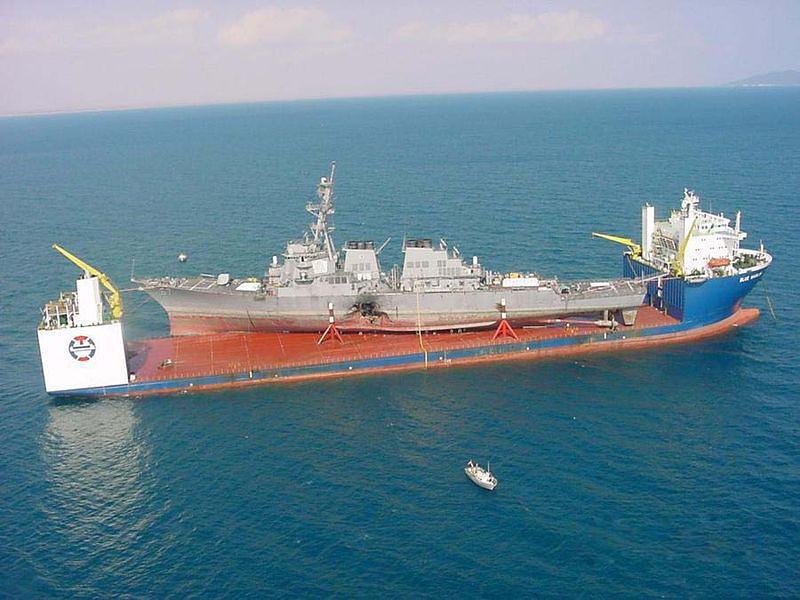
Yes, that's done. The USS Cole was brought back to Norfolk on a barge after the attack. Similarly, nowadays ship sections are built in Dantzig and these are transported by barge to St Nazaire.
As for lifting something 300 meters long, I don't know. The USS Cole is only 150m long. I also know that this is done on old rusty Russian submarines that can no longer even be towed. Again, the biggest ones are around 170m long.
To my knowledge, the world's largest "barge" (a carrier ship) is a little over 200 m long (it must be around 220-230m). It's the Blue Marlin.
What I don't quite understand is whether it's just about righting the Concordia to refloat it and tow it for scrapping. If it's "simply" that, then yes it's possible. The Dutch are very good at this (the Norwegians too). But I don't know how the engineers overcome the risk of capsizing during towing.
The risk, in my opinion, lies more in the righting maneuver of "twisting" the Concordia lengthwise and it breaking.
The classic on-site dismantling technique is here (in my opinion) difficult to implement, given that the hull rests at sea on a reef (and not on a dry beach, for example).
So, to be continued...
Costa Concordia: the investigation
Metallian · 2012-03-29 · Message 457 of 764
Found on the internet: the BLUE MARLIN carrying the USS COLE
Costa Concordia: the investigation
Corsairt · 2012-03-29 · Message 458 of 764
hi
for the Concordia, it's about sealing it, lightening it, to refloat it
and towing the wreck to a shipbreaking yard
Costa Concordia: the investigation
Corsairt · 2012-03-29 · Message 459 of 764
formerly USS LAFAYETTE
To prepare the pumping that should right the ship, they also need to extract the mud, and above all close the portholes and gun ports left open during the evacuation. This begins a months-long job for a team of divers. Pier 88 is also bought back by the Navy and partly dismantled to avoid damaging the stern when the righting begins91. The cleaning operations take more than a year, and it is from August 4, 1943 that the pumping begins92. On September 15, the ship is taken out of the water. On October 27, it is returned to the Navy by the firm Merritt, Chapman and Scott which took charge of it, the scaffolding having been removed. In total, the refloating of the liner cost eleven million dollars93. This technical feat allows training men for this type of operation, which they reproduce several hundred times until the end of the war94.
The ship then goes to Bayonne, in New Jersey, where a dry dock awaits it to be repaired there94. However, the hull and engines prove more damaged than expected. In the latter case, new ones must be built, which is problematic given the specificity of the equipment. Moreover, the shipyards are very busy with numerous orders. In early 1944, the project is abandoned95. A slim hope remains: President Roosevelt continues to defend a restoration project, because, he thinks, the destruction of the Normandie will necessarily be unjustifiable after the liberation. William Francis Gibbs, for his part, proposes making the ship a liner that, in peacetime as in wartime, will surpass the two British Queens (which will actually happen much later with the United States)96. The imminence of the landing and Roosevelt's death, however, definitively doom the ship. On September 20, 1945, it is declared surplus by the Navy. A year later, while France refuses to take back the wreck, the ship is bought by the Lipsett brothers who obtain the right to scrap it. The operations take place from January 7 to October 7, 194796. The operation results in a profit of one million dollars of the time97.
Costa Concordia: the investigation
Arsene83 · 2012-04-03 · Message 460 of 764
Actually, the ones who have the final say are the insurance companies!!!
Because despite the dramatic and incredible story of the TITANIC, goods abandoned at sea "sometimes" have one or more owners!
Indeed, the definition of abandonment varies from case to case, but a wreck must lie on the seabed for years or decades without anyone attempting to recover it for a court to declare it and its cargo abandoned.
It's extremely unlikely that this will happen to the Costa Concordia. A large part of the ship is above water, and its owners are actively trying to recover it.
However, the search for the APOLLO 11 engines has reignited the debate on property rights at sea.
But despite everything we hear, wreck ownership remains extremely well defined in international maritime law.
And the diver who recovered the bell from the Concordia is therefore indeed a thief and not a treasure hunter ...
...too easy!!!!😇
http://www.slate.fr/story/48961/tresor-englouti-concordia