Hi Bruno, yes, things in the technical realm are moving very fast. But has the human being changed? I’m not so sure.
People still fall into two categories: those who agonize over planning and those who go with the flow.
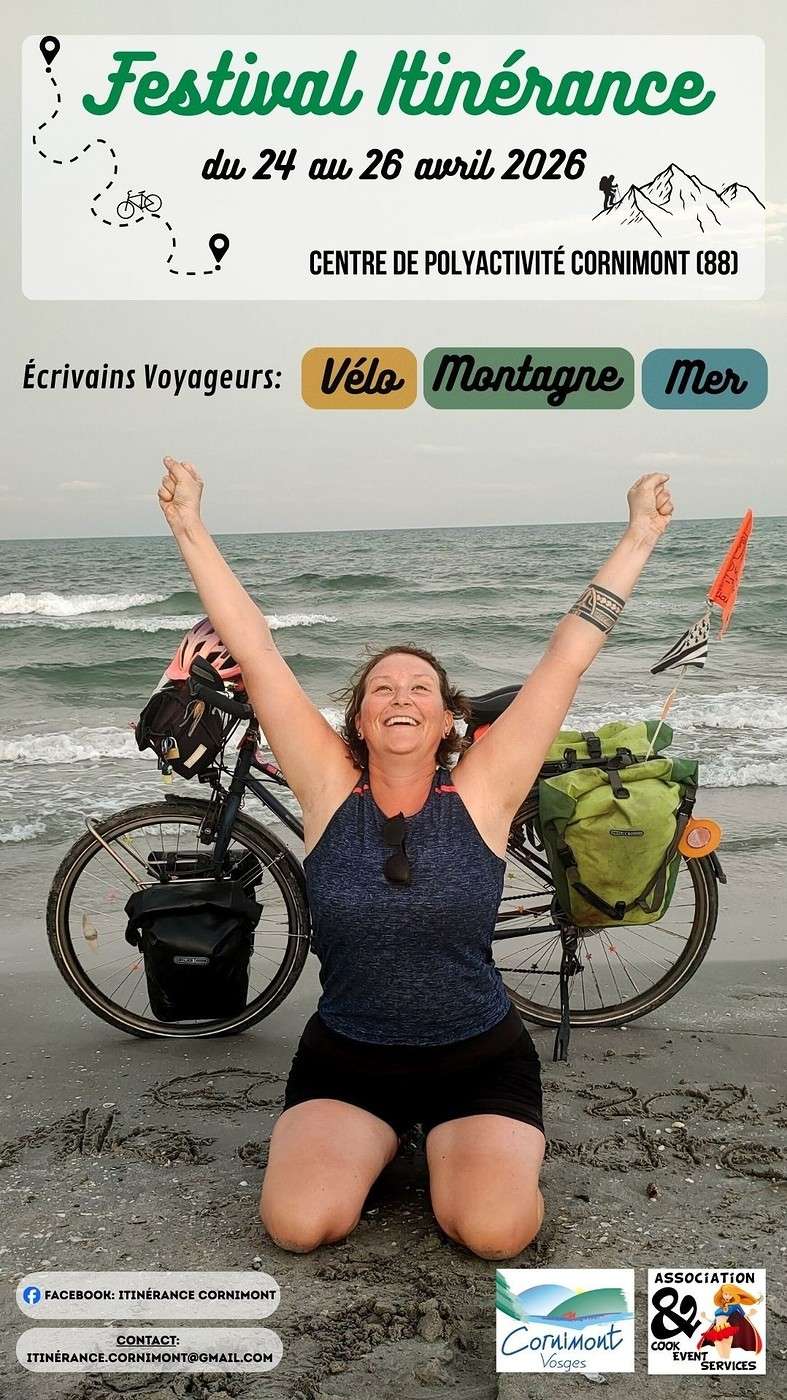
At the Itinérance festival, which I’m organizing for the second time in the Vosges, the speakers span all ages and all belong to the second category.
Here are a few examples:
Blandine Dupuis
The soul and spirit of a true adventurer
A few of her many lived experiences, which she’s put down on paper, capture her essence better than a long CV ever could.
“One day I was born, and ever since, I’ve improvised.”
Nothing was planned. I just knew I wanted to discover the world, to slowly meet people and landscapes.
So in June 2022, I set off to conquer the globe on my trusty steel two-wheeled steed, not really sure where to begin—it’s so vast!
The cold intensified and the nights grew longer at an alarming rate. One thing I wasn’t prepared for was the long, endless nights and the lack of light. I was tired all the time. I cried often. I felt alone and blamed myself for having no energy. Riding on ice was completely new to me and required so much effort with a loaded bike... The touristy side of the trip gave way to the athletic side of the adventure.
After pedaling 30,000 km across Europe, I found myself parachuted to the other side of the world.
I spoke three words of Spanish (I never studied it in school). New culture, new language, new landscapes, new flora, new fauna, new continent—I was lost, everything was so vast. I was a little scared. A lone white woman facing the unknown... A new adventure begins!!!
I didn’t really have a destination in mind. Someone had told me about the Carretera Austral. The name sounded wild... It made me want to go see. So I did what I do best: I hopped on my bike and pedaled toward... the Andes! Dragging a sciatica that had been bothering me for months and turned excruciating a few days after departure, I didn’t expect to last more than 15 days...
As I write these lines from my tent, tucked into my sleeping bag, I’ve been on the road for 7 months, and even though the need for *‘dineros’* is starting to be felt, I really don’t want to go home—this epic has been, and still is, so rich in every way.
For her, the challenge is always lurking somewhere in her motivations. Before her big solo trips, she competed in Gravel racing. You know, those races where you ride rough trails through the mountains for thousands of kilometers, completely self-sufficient, just for the joy of hugging and smiling with other competitors at the finish line.
Brigitte Fournier
She’s a great example of someone who gave her life meaning according to her own aspirations. After earning a degree from one of the most prestigious schools, she returned to her hometown of Briançon. She devoted herself to beekeeping for a long career, moving her hives along the Durance Valley. She always managed her own schedule and, as a result, spent a lot of time in the mountains and doing outdoor sports—ski touring, kitesurfing, and long-distance bike travel.
In life, you have to make decisions, which isn’t always easy, and one of her sayings hits hard when she delivers it: “You have to choose between being a dog or a wolf.” It echoes something a long-time adventurer friend of mine once said: you always leave despite a multitude of good reasons not to.
She’ll talk about one of her trips—the one she took when she retired: 18 months solo by bike across the three Americas (North, Central, and South), aptly titled *La retraite, vous y avez pensé* (Retirement, Have You Thought About It?).
I know she’s very modest and has already scolded me for talking about her like this, but I can only encourage you to come listen to her and chat with her.
Alexandra Husha
Tata Alex is a young author from Nantes. She speaks at the pace of someone eager to move forward in life and satisfy her curiosity about the world and others.
At 31, she learned she had breast cancer. The shock was brutal.
It was while hosting a Brazilian during my treatments that I discovered the world of bike travel. Though I had lost all sense of femininity, we both fell in love. When Felipe promised to come back and take me to Romania by bike, I didn’t hesitate for a second—I bought a bike.
Thanks to Grandma Jeannine’s inheritance, I bought a bike and the gear needed for long trips. In memory of Grandma, I named my bike Jeannette!
I trained gradually, despite the treatments and their powerful side effects: pain, fatigue, cognitive issues, hot flashes...
In the end, Felipe never came back... But the call of travel was stronger than anything, which is why I set off again on June 9, 2021, for a solo bike tour of Europe. I pedaled all the way to the Black Sea, with a detour through Greece and Italy. When I got home, I’d covered 8,450 km!
This trip gave me a sense of accomplishment, especially because it gave me a goal during all my treatments—and even alone, I managed to see it through!
When I returned from Romania, my nephews were loudly proclaiming that Santa Claus didn’t exist. That was all it took for me to find my next destination!
Beyond wanting to prove those little rascals wrong, I mostly needed to prove to myself that the cancer was behind me and that my body was capable of taking on big challenges again—like pedaling into headwinds in Ireland, braving torrential rain in Wales, tackling the steep hills of Chianti in Tuscany, and sharing the road with wild reindeer in Lapland!
I made it back home in November 2022 after 6 months of adventure and 10,450 km.
I share these two European tours during conferences where I show films of my travels and sign copies of my travel stories.
Julien Humbert
List of Trips:
2002-2003 “Objective Mongolia” (
http://peuplesetmusiques.free.fr/index_fr.html) North Africa, from Mumbai to Kathmandu with a trek around the Annapurnas, Southeast Asia up to Mongolia and the Republic of Tuva.
2009-2019 Tour of Europe, crossing the Sahara followed by a transatlantic sail, then 8 years in the Americas (
https://grand-sapin.blogspot.com/).
2020 Tour de France
2021 Tour de France
2022 Corsica, Belgium, Netherlands, England
2024 Round trip Cornimont-Rocamadour with a tour of the Massif Central in 3 weeks.
2025 Stevenson Trail followed by a deep dive into the southwest quarter of France and a tour of Catalonia.
Coming in 2026: A major multi-year expedition starting in early May: Tour of the Baltic aiming for the North Cape—Silk Road and South Africa.
Description:
In summary, so far:
- 50 countries visited
- A total of 12 years spent abroad, including 6 on the road and 6 living in Mexico.
- Around 100,000 km traveled in total.
A minimalist and sober traveler, Julien travels without any technological equipment (no cell phone, GPS, laptop, etc.).
He also travels without a set itinerary, preferring to simply set a general direction and let encounters shape his route.
A big fan of bivouacking, he doesn’t use any accommodation apps, travels in all weather, and lets events guide him.
Julien is my neighbor. I first saw his bike—a wreck after 7 years on the road. When he comes over for coffee at 9 AM, he can stay until midnight—the traveler who lives outside of time. Like Brigitte Fournier, he’s highly educated, but he needs to escape the framework of our lives. He’s helping me organize the 2026 festival. This morning, we filmed a short 20-minute promotional spot. The immense pleasure of talking with this kind of person! I was the timekeeper, but we could’ve talked for hours. Inevitably, the conversation turned to travel—a mix of dreams, projects, and lived experiences. He made a comment I’d never considered: one of the advantages of traveling without a return date is not having to think, *I’m halfway there*. People like him radiate a contagious joy for life, despite the terrible hardships they’ve faced.
Pierre Hérant
Pierre Hérant was born in Touraine and lives near the Mercantour mountains in Nice, which serve as his playground and training ground.
Passionate about mountains, nature, travel, and reading, he constantly combines these four themes in his accounts of his many long solo hikes and bike trips.
His books are published by Éditions Christine Bonneton for his travel stories and by Chamina Édition for the photo books that illustrate them.
Éditions Bonneton - Guides des Régions, Gastronomie & Patrimoine - Éditions Bonneton
Guides de randonnées pédestres, vélo, cheval & Beaux livres Chamina - Chamina Édition
Currently published titles include:
- « My Tour of the Hexagon by Bike – 7,600 km Along France’s Borders » (2023 for the photo book and 2024 for the travel story)
-
- « My Crossing of France on Foot – 1,750 km from Nice to Mont-Saint-Michel » (2024 for the photo book and 2025 for the travel story)
-
- « My Crossing of the Pyrenees on Foot – 775 km from the Mediterranean to the Atlantic » (2025 for the photo book and 2026 for the travel story).
His next title will be:
- « My Camino de Santiago – 750 km from Le Puy-en-Velay to Saint-Jean-Pied-de-Port » (2026 for the practical guide and photo book, 2027 for the travel story)
These books are available or can be ordered in all bookstores.
Pierre Hérant has also self-published other accounts of major sporting trips in France and various mountains around the world on Amazon in paperback and digital formats.
Amazon.fr: Pierre HERANT: books, biography, latest updates
- « At the School of Trekking in the Himalayas – Volume 1 » (2018) recounts the Annapurna Base Camp Trek and the Great Crossing of Ladakh
-
- « At the School of Trekking in the Himalayas – Volume 2 » (2019) recounts the Annapurna Circuit and the Everest High Route
-
- « In the Mountains of Japan » (2018) recounts the crossings of the Northern and Southern Japanese Alps and Mount Fuji
-
- « At the School of Trekking on Islands » (2020) recounts the crossings of Corsica via the GR 20, Réunion Island via the GR R1 and R2, and the crossing and circuit of La Palma via the GR 130 and 131
-
- « Downstream by Bike » (2021) recounts a Nice-Nantes-Bordeaux-Nice bikepacking loop of 3,700 km
-
- « At the School of Trekking in the Alps » (2024) recounts the Tour du Mont Blanc, the Crossing of the Dolomites via the Alta Via 2, and the Tour of the Oisans and Écrins via the GR 52.
A few other free-spirited travelers will also share their stories. I’ve decided to prioritize the sparkle in the speakers’ eyes and the conviction in their voices over drone footage. If I want to see stunning films, I’ll watch *The Big Blue* or *The Fifth Element*. I wrote *cavalier* thinking of Kessel. For travel storytelling, I try—imperfectly—to follow in the footsteps of Joseph Kessel or Ella Maillart. References that go back to the 1930s for Ella, and for Kessel, born in 1898, his stories span a very long period from World War I to the sixties.
So, some might accuse me of doing a little self-promotion for this festival. We look forward to seeing many of you in Cornimont in the Vosges from April 24 to 26 to exchange with these adventurers.