This thread has been translated into English.
An 80-Day Tour of Southern Africa
Voyajou · 2013-01-27 · Message 41 of 436
After which spot in the Kunene do you want to reach?
The full experience, sir! 😉
I’d be crazy to go that far north without getting lost in Marienfluss and Hartmann, right?
We’re heading as far north as possible along the Skeleton Coast, whose desolation I love. If the timing’s right, we might spend the night at Messum Crater, though it’s probably a bit too close to Swakop.
An Southern Africa Tour in 80 Days
Max68 · 2013-01-27 · Message 42 of 436
You're right, "let's go crazy"... in fact, why stop at the fool—let's take the rook and the knight too 😉
If you want to extend the route between Swakop and Messum, you can make a "detour" via Spitzkoppe. Though the Spitzkoppe–Messum track is pretty "uncertain"... which is where the knight comes in handy... okay, I'll stop there, hee hee hee
A Southern Africa Tour in 80 Days
Pierre77N · 2013-01-27 · Message 43 of 436
Hi Pierre,
We're heading north toward the Kunene.
In a fairly recent discussion, you mentioned a route as being the most beautiful in that part of the country—would you mind telling me which one?🙂
(You’re allowed multiple answers😉)
Hi Jean-Luc,
I’ll admit I’m not entirely sure which discussion you’re referring to... I must talk too much...
How much time do you have?
If I were you (parenthesis 1: weather permitting)(parenthesis 2: darn, I’m not there!), I’d do Messum, Brandberg West Mine, Ugab Rhino Camp, Palmwag (fuel), Palmwag Crowther's Trail, Purros, Orupembe (via the Hoarusib and Khumib riverbeds if there’s not too much water, otherwise via the D3707), Orupembe, Marble Mine Campsite, Rooidrom, Bloudrom, Groendrom, Hartmann, Marienfluss via the mountain, Rooidrom, Orupembe, Opuwo, Epupa. Phew!
Another option: Palmwag, Opuwo, Epupa, Van Zyl's Pass...
Keep an eye out for a black rhino in the area!
I’ll send you an email...
An 80-Day Journey Through Southern Africa
Kola · 2013-01-27 · Message 44 of 436
A regatta of butterflies...
From afar, those wings like sails in faded colors over a stretch of heat and dust...
80 days on the trails in a strange vehicle (from this perspective) for a journey through Southern Africa.
Here, a yellow and blue sail with vibrant colors returning to port on a sea of waves and foam...
78 days and a handful of hours to complete a circumnavigation... driven by the wind and against the tides.
On land, a road... and, even more numerous, side paths.
On the water, a route to chart.
On the water, a goal: victory.
On land, a journey...
On land or at sea... an adventure, a dream to follow, a sometimes hostile elsewhere that must be tamed.
From these distant lands... words that tell stories, that share, slightly hazy photos. A near-travel journal? 🙂
Back from the open sea... images, a radiant smile, crowds gathered to applaud, sea spray, and the sound of foghorns.
What’s the connection?
Two screens, one large and one small, lit up simultaneously... and impressions that intertwine.
An 80-Day Tour of Southern Africa
Voyajou · 2013-01-27 · Message 45 of 436
78 days and a handful of hours to complete a tour
Alright, okay! I’ll try to wrap it up in 77 days (but not shut up, right?)
An 80-Day Tour of Southern Africa
Lacalo · 2013-01-27 · Message 46 of 436
but not wrap it up, right?)😇
Definitely not!
Your story is delighting us...
We’re following in your wake, eagerly waiting for your impressions that make us dream...
An 80-Day Tour of Southern Africa
Voyajou · 2013-01-27 · Message 47 of 436
Hey there, lost track of the north... of the continent? We don’t see you around here often, and I’m glad I got you to come. 🙂
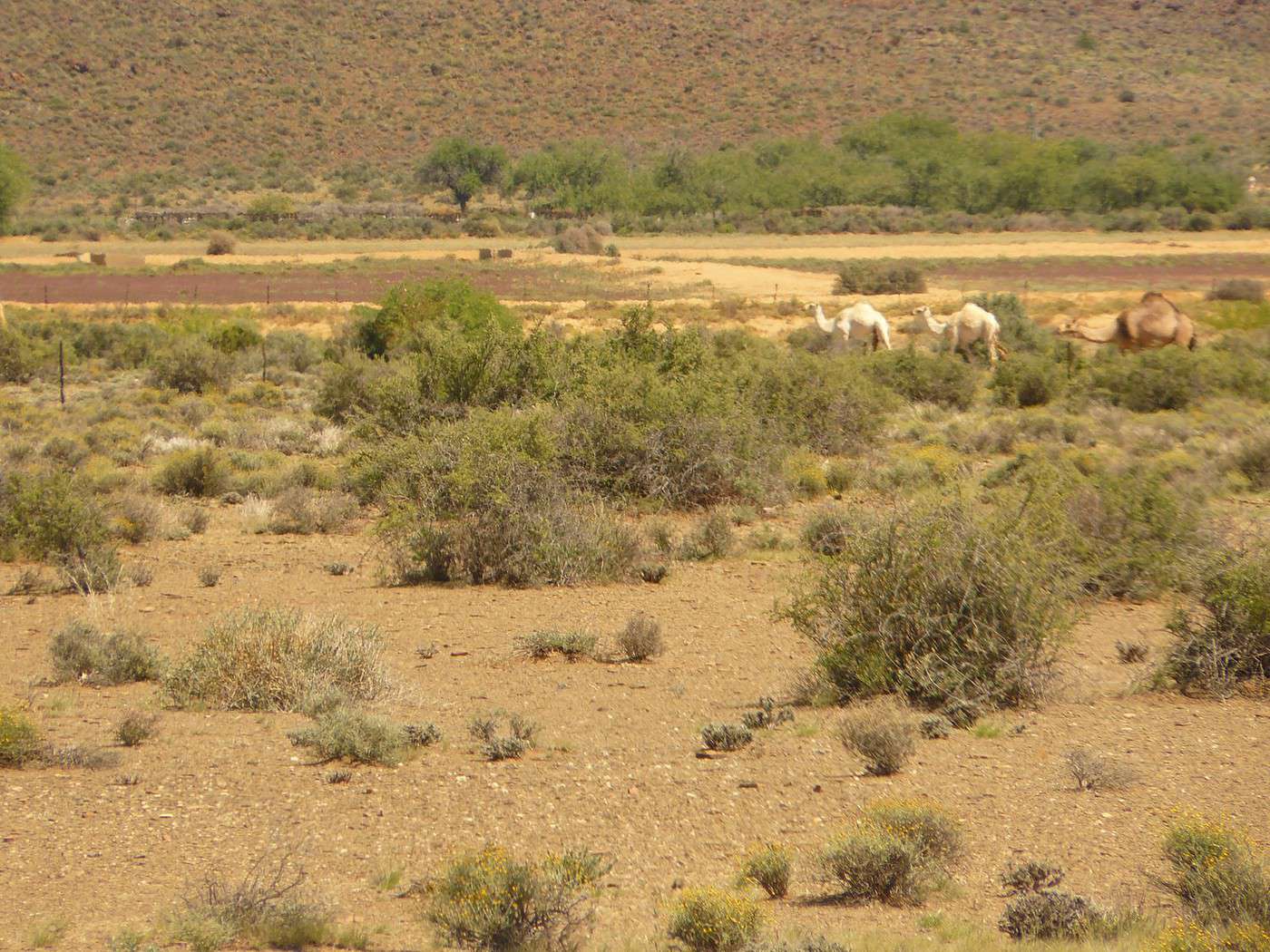
Your dunes are just as beautiful as those in the south, but here we’ve got the critters that kids dream of—and even... camels, if you’ve been keeping up.
(you noticed, I’m posting the photos off-contest... uh, travel journal!)
An 80-Day Tour of Southern Africa
Lacalo · 2013-01-27 · Message 48 of 436
Oh, but I am, I am following you...
You know, I’ve kind of been around the camels too, and I’m absolutely enchanted by all your way more exotic animals...
Plus, I love it when people tell me stories...🙂
An 80-Day Tour of Southern Africa
Voyajou · 2013-02-03 · Message 49 of 436
An ordinary day in the Kunene
After Palmwag, heading north, the track feels like it’s laid on a bed of iron-rich stones, and the 9:48 AM elephant blocking it finally raises its trunk—like a stationmaster giving the all-clear. Zebras in their sharp stripes keep watch, while springboks, kudus, and other oryx stand in as the cows eyeing us as we pass. I’m driving the train—childhood dream come true.
After Sesfontein, the last fuel stop before a week of roughing it, a winding track—sometimes following dry riverbeds—replaces the smooth gravel road.
At 12:36 PM, four giraffes in a tiny patch of shade weave their necks together like they’re trying to braid a friendship bracelet. A curious young one edges closer, then thinks better of it.
The community camp at Purros is perfectly situated on the Hoarusib River’s bank—and just as perfectly run. A wise old giraffe (or maybe she’s just on a strict diet?) with saggy skin points the way. We’ll be its only guests… almost.
Because in the middle of the night, a trumpeting roar—furious and startled—is followed by the thunder of hooves fading into the distance. You realize your "sentinel orange" setup (one hollowed-out, stuffed with hot chile—don’t feed the animals!) worked.
You *know* not to leave anything edible where an elephant can see or smell it in your tent, but you’re in a car, right? A new kind of car where the roof is a canvas tent connected straight to your week’s worth of supplies.
At dawn, Dux, the camp guard, tells us six elephants passed through overnight. We’ll spot more in the river as we leave.
The Red Drum
The spot marked on the map as Rooidrom (red drum) is just that—a red drum. That’s all there is to Rooidrom, one of the gateways to the Hartmann and Marienfluss valleys in Namibia’s far northwest.
As we take a break, a lean, wiry Himba man emerges from the dwarf mopane bushes, carefully holding a small open box of colorful stones. Jackson’s an independent prospector: he scours the desert for semi-precious stones that dealers in Opuwo, the Himba’s “capital,” buy from him.
He lives alone in a mud hut a kilometer north of Rooidrom and rests at this crossroads, hoping for passersby. He swears we’re the first people he’s seen here in five days.
Four stones—aquamarines and topazes—will bring us joy (and him some cash) for $30 (3 €).
He says he’s hungry and thirsty—how could we doubt him? I try to sell him a buttered slice of bread like mine, Breton’s honor (here, butter mixed with herbs and red earth is used as body paint—I haven’t tasted it), an apple, sugar, and water for $30, all-inclusive. He laughs off the deal but accepts the gift.
We leave him there, promising to swing by again in a few days.
The prettiest route for camping
The Hartmann Valley, known for being desolate—but of what?—is blanketed in a soft fuzz of grasses and white, blue, yellow, and purple flowers. We follow it north, stretching out between two mountain ranges. Then it narrows, blocked by a breathtaking wall of mountains and dunes, cutting off the long-awaited access to the lush banks of the Kunene River, the border between Namibia and Angola. A thousand shades of yellow, green, and gray blend and shift for no apparent reason, creating a harmonious patchwork.
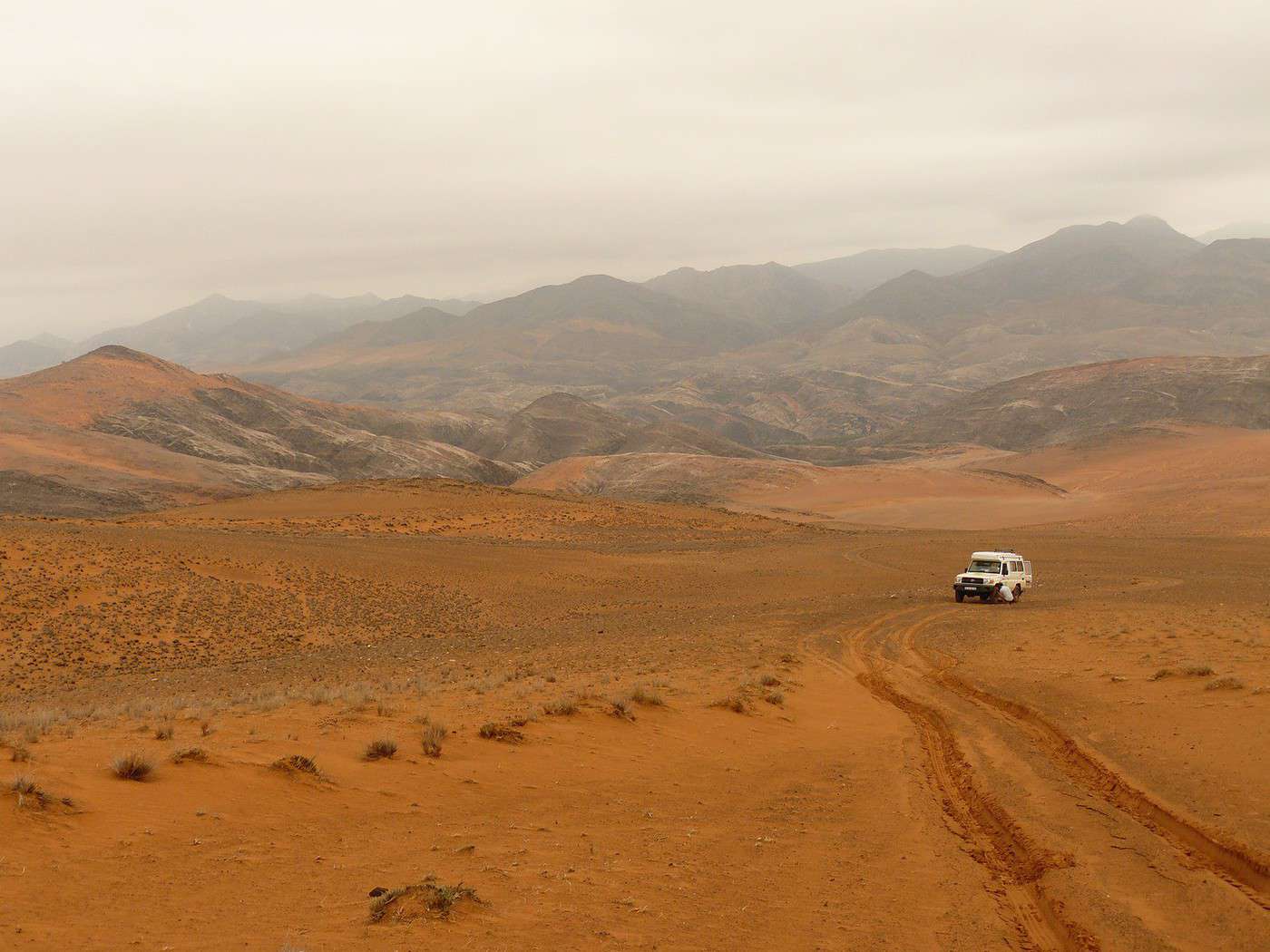
It takes us three hours—including a solid sand-stuck moment—to find the pass after glimpsing paradise multiple times.
You can reach the parallel Marienfluss Valley by crossing a low mountain range through narrow gorges, some of which are like staircases. Like any self-respecting valley, it has a watercourse—well, a dry or underground one, as is the trend here—giving life to a continuous line of trees.
While we only spotted a few Himba villages in Hartmann, they’re much more common here, though many are deserted: their residents are off with their herds of goats and cattle for the summer.
To the north, the valley opens gently toward the Kunene, unguarded. While there are no open camps for independent travelers in Hartmann, here you’ll find community camps and a closed lodge.
Both valleys are home to a whole collection of antelopes, Hartmann’s zebras, and we even spotted bat-eared foxes for the first time.
So, which is the prettiest for camping? Depends on your vibe.
Himba way of life 1: Sam’s enough?
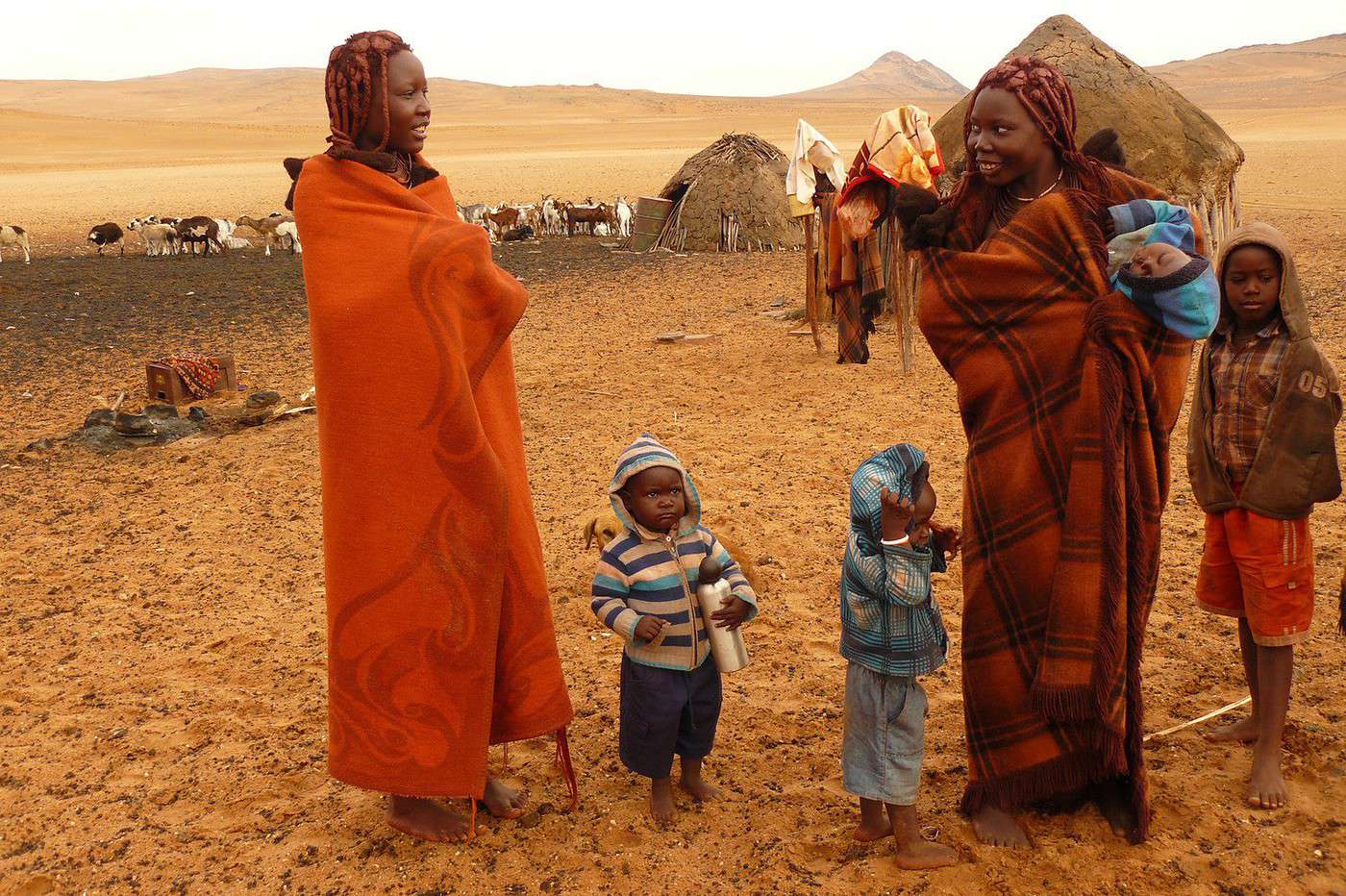
A Himba hut, like an upside-down bird’s nest, is made of a framework of bent branches sealed with a mix of earth and grasses, held together by a dung mortar. About 2 to 3 meters in diameter, you can stand upright in the center near the central pole.
It’s where everything happens—living, cooking, sleeping—with multiple generations under one roof.
A few basic utensils: a pot, a gourd, and some plump sacks of seeds hanging from the ceiling. That’s it.
The smallest villages have three or four huts arranged around a pen of upright branches or thorn bushes to corral the livestock. Larger villages are sometimes fortified with a ring of vertical wood.
Himba way of life 2: “Put your helmet on before riding your tricycle”
At sunset, four children carrying empty containers walk in a line along a gravel spit in the middle of the Kunene. The oldest, armed with a machete, leads the way, expertly hurling chosen stones at the crocodiles lounging on the shore—they don’t stick around. I’d prefer them visible on land rather than slithering underwater, but I guess the point is to teach these reptiles the equation *human = danger*.
The younger ones, dressed in loincloths, fill the containers from holes in the riverbank, carefully avoiding the flowing water (domestic accidents happen so fast). Meanwhile, the oldest keeps watch. The eldest will head back with a 20-liter container balanced on her head, swaying gracefully over the slippery stones, while the little ones struggle to keep their 5-liter containers from dragging on the ground. The oldest brings up the rear, machete at the ready.
An 80-Day Tour of Southern Africa
Rjulie95 · 2013-02-03 · Message 50 of 436
Ah, finally—I was waiting for this post so eagerly! :-) Thanks for this beautiful write-up!
Quick question: you say
The little ones dressed in loincloths fill the jerrycans from holes, carefully avoiding the flowing water
Is it because the kids don’t know how to swim that they avoid the flowing water? Because I thought the rule was "fast-moving water = no crocodiles."
And if you’ve got one or two photos... 😛
An Southern African Tour in 80 Days
Pierre77N · 2013-02-03 · Message 51 of 436
Hey Jean-Luc!
You enjoying the Wi-Fi at Marienfluss?!
Thanks for taking us along on your journey...
A Southern Africa Loop in 80 Days
Atila · 2013-02-03 · Message 52 of 436
You realize that the orange sentinel net you set up (carefully hollowing one out and stuffing it with hot chile—don’t feed the animals!) worked.
An 80-Day Tour of Southern Africa
Voyajou · 2013-02-03 · Message 53 of 436
Ah, finally—I was waiting for this post with anticipation! :-)
This week, we averaged 20 km/h, sometimes moving slower than walking speed through walls of rocks... we were just as "impatient" to get out of there! 😉
Thanks for the prose. 🙂
I doubt the Himba swim: their only water source is the Kunene River, which is infested with crocodiles.
Let me paint you a picture: imagine a sandbar extending from the shore in a crescent shape upstream. The trapped water swirls and rejoins the main current, which I may have mistakenly called "white water." The crocodiles, flushed out of the crescent, would slide into the main current. The kids avoided both the backflow in the crescent and the main current, collecting water from holes in the sandbar by removing a few pebbles. This was at Marienfluss, and the water level depends on the upstream dam management. By morning, the crescent had disappeared underwater, yet I could’ve used some of that water for breakfast.
An 80-Day Tour of Southern Africa
Voyajou · 2013-02-03 · Message 54 of 436
Hello Pierre,
You enjoying the Wi-Fi in Marienfluss?!
Nope, Marienfluss is a dry zone—
only my WiFe!
We reached Epupa Falls at noon today, first restaurant in a week tonight, and... a little dose of VF!😉
We were supposed to meet Eric here, but he’s behind schedule—he’s skipping this stop and heading straight to Puros (unless he’s eloping with his travel mate?)
A Southern Africa Tour in 80 Days
Pierre77N · 2013-02-03 · Message 55 of 436
As long as it doesn't go south... 😏
An 80-Day Tour of Southern Africa
Voyajou · 2013-02-03 · Message 56 of 436
I’d need a kilo of poisoned Attila (sorry for the redundancy) to annoy the lions in the Kalahari—do you deliver to Kaa?
An Southern Africa Tour in 80 Days
Lacalo · 2013-02-03 · Message 57 of 436
By morning, the croissant had disappeared under the water, and yet I would’ve loved one for breakfast.
Guess you’ll have to have your breakfast in the afternoon then ...😉
Thanks for this epic tale ...
Turns out crocodiles are pretty cowardly—scared off by a little pebble when there were plenty of tender arms to snack on ...
An 80-Day Tour of Southern Africa
Atila · 2013-02-03 · Message 58 of 436
An 80-Day Tour of Southern Africa
Francky4 · 2013-02-03 · Message 59 of 436
Well, here’s some lovely, useful, and constructive writing...
Have a great trip!
Franck
An 80-Day Tour of Southern Africa
Voyajou · 2013-02-04 · Message 60 of 436
And if you have one or two photos...
Here are three! 🙂
1- Morning deflation to get out of the dune after camping by the Kunene River in Hartmann Valley
2- Himbas who asked us to stop when we passed by the track near their camp (northern Hartmann Valley)
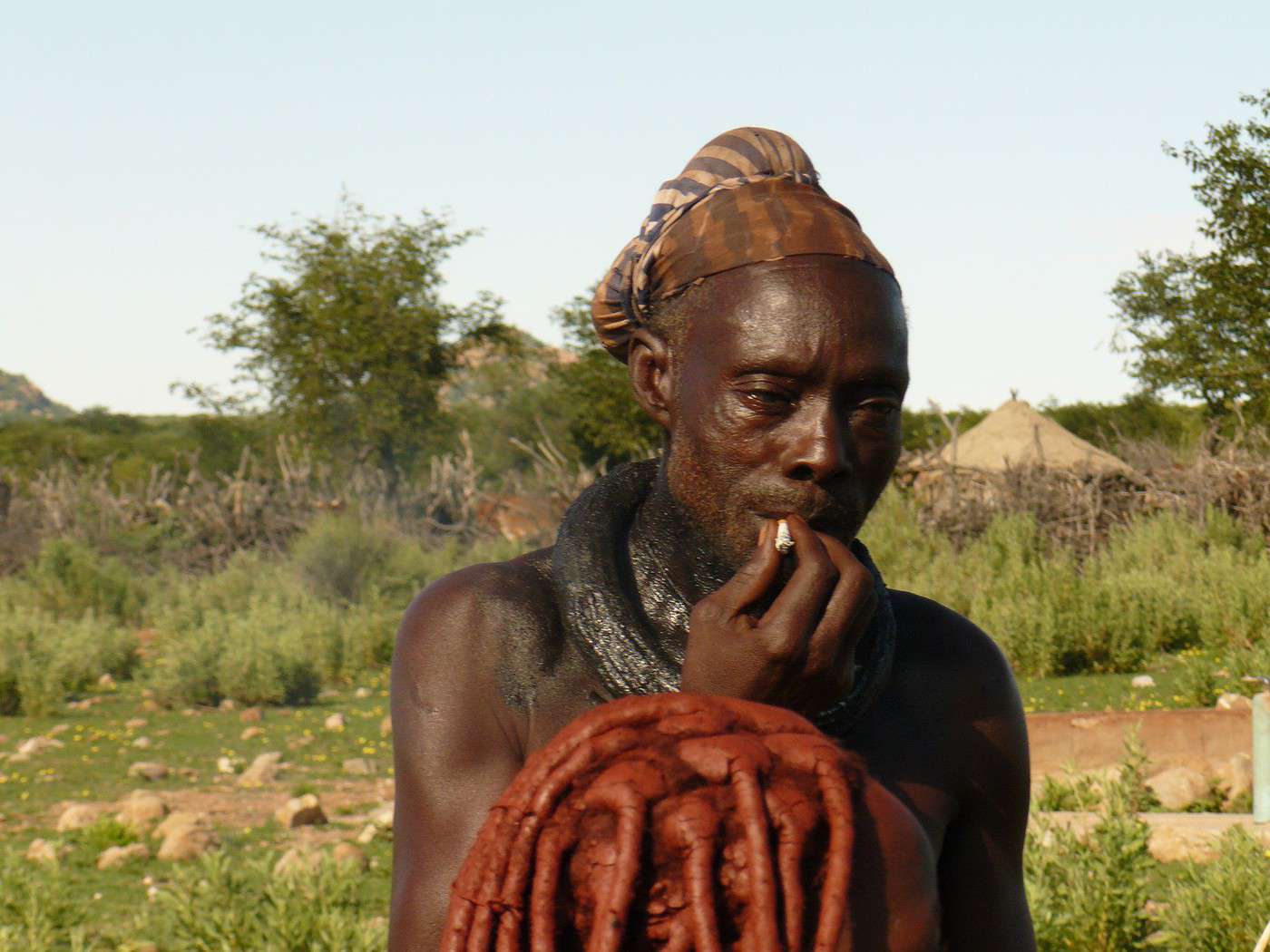
3- South of Otjihaa on the D3703, even the women bummed Marlboros off me