in Entre deux voyages › Carnets de voyage
Northern to Southern Alsace (page 3 of 6)
Discussion started by Jojoone1 on 2016-04-09
113 replies
This thread has been translated into English.
Northern to Southern Alsace
Lemonk68 · 2016-05-06 · Message 41 of 114
Great job on your writing and photos! They gave me a bit of the blues... I guess it's because I've been living in the Philippines for 5 years now.
Being Alsatian, I know the region pretty well, but not so much north of Strasbourg. I'm planning to return to Alsace at the beginning of 2018 for a few months and take several trips in May and June.
Thanks again, Joel!
Northern to Southern Alsace
Jojoone1 · 2016-05-06 · Message 42 of 114
Hi,
I sometimes read your posts on VF.
Thanks for the kind words, and sorry about the rough patch. Have a drink on us when you get there...
Northern to Southern Alsace
Jojoone1 · 2016-05-07 · Message 43 of 114
After leaving Riquewihr and joining the Wine Route, you’ll notice that the villages become much more ordinary, with a somewhat unattractive 1950s feel. There was intense fighting in this area during the winter of 1944. Period photos show true fields of ruins where, just days before, villages as rich and picturesque as others in the region once stood. Destruction rates reached 90%.
When the French and American armored divisions finally gained the upper hand, they realized that among the enemy corpses were many adolescents—some almost children. In its murderous madness, the German Reich had stooped to unimaginable depths of ignominy.
A small detour takes us to Kaysersberg. It’s worth noting that Ribeauvillé, Hunawihr, Riquewihr, and Kaysersberg are all aligned in a straight line, barely ten kilometers apart as the crow flies.
This is the birthplace of Dr. Albert Schweitzer, a physician, pastor, philosopher, amateur organist, and Nobel Peace Prize winner in 1952 for founding the leper colony in Lambaréné, Gabon.
The setting is charming, with vineyards and hills close by. Here too, the trip is well worth it for several reasons. Do I even need to mention the stunning Alsatian half-timbered houses...

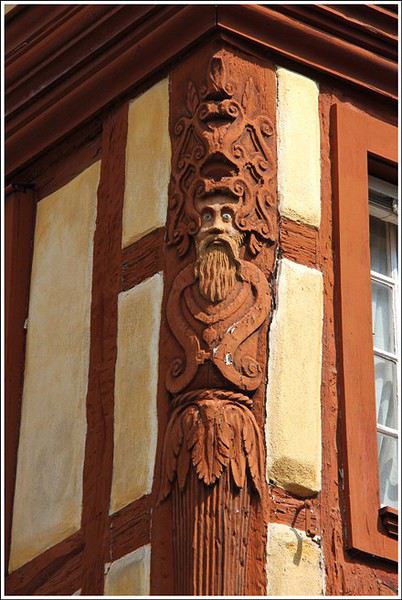
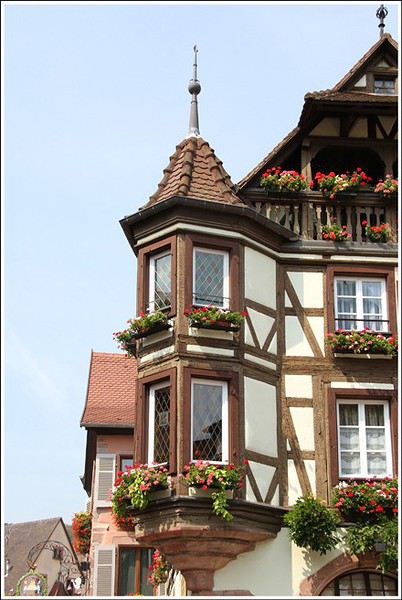
Apart from the Renaissance town hall, be sure to take a look inside the church. The wooden Christ figure (4 meters tall) will immediately catch your eye, but the real highlight is the enormous and magnificent 16th-century wooden altarpiece. Truly impressive.
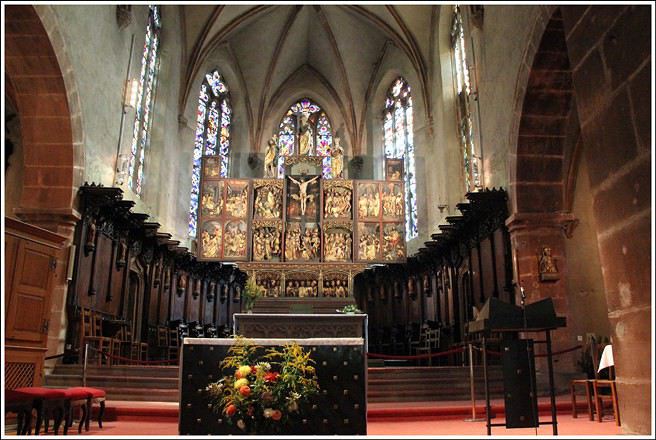
As you wander deeper into the village, you’ll see a remarkable fortified bridge from the same era, complete with arrow slits and even a tiny chapel. And of course, not far away, the ruins of the 12th-century fortress. I highly recommend visiting—it’s not a long walk, and the viewpoint is stunning.
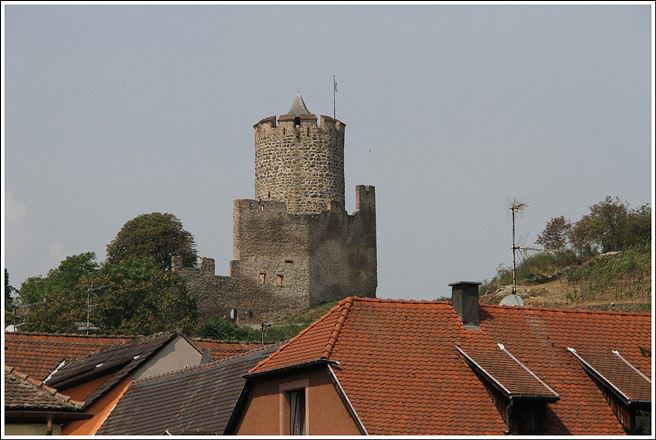
Northern to Southern Alsace
Jojoone1 · 2016-05-08 · Message 44 of 114
Let’s close with a little detour into Alsace’s gastronomy.
When it comes to this topic, everyone inevitably brings up sauerkraut. Sure, but for me, it’s not the exotic dish it might be for others. I had it once a month, and while my teenage stomach could handle that kind of feast, I’ve got to admit it’s not the pinnacle of French cuisine.
So, I’ll share a few personal highlights and tips that’ll surely make some of you happy.
When Alsatians go out to eat on Saturday and Sunday evenings, it’s usually to enjoy tarte flambée. An old colleague told me a quarter-century ago that, back in the day, villagers would gather leftovers at the end of the week and spread them on dough they baked in the oven. That’s how this specialty was born. It’s basically a pizza-like dough topped with a mix of fromage blanc and crème fraîche, generously sprinkled with bacon and onions. A few minutes in a very hot wood-fired oven, and you’re done. Those who want can get it gratinated with cheese, with mushrooms (forestière), or even as an apple tarte flambée for dessert. Over the last fifteen years, tons of variations—savory and sweet—have popped up, but in my opinion, they often distort the dish more than they enhance it. Okay, I’ll admit I’m a purist.
Like anywhere else, the chef can be great, average, or, more rarely, bad. The dough will be thin and crispy or thick and soft.
Avoid tarte flambée in big cities and the most touristy spots if you can. As I always say, you should eat it in small villages where the air smells like manure... Don’t hesitate to ask locals where they go for tarte flambée. If you follow their advice and see a bunch of cars parked outside the restaurant, you’ll know it’s a good spot. Just remember, it’s often only available on Saturday and Sunday evenings, and sometimes you’ll need to book ahead. When you eat tarte flambée in the villages, you’ll notice it’s bigger, better, and cheaper than elsewhere. In other places, it’s not always wood-fired, the dough is either undercooked or too thin, they use too much fromage blanc and not enough crème fraîche, and the bacon isn’t as good...
Here’s an example of what to look for:
youtu.be/T_Zv5HXTQds
These shots were filmed at the restaurant "En Buerehoft" (At the Farmyard) in Rottelsheim. When leaving Haguenau heading south toward Strasbourg, don’t take the expressway—stick to the old national road on the left. The first village you’ll hit is Niederschaeffolsheim. At one of the intersections, turn right toward Rottelsheim. After a few kilometers, you’re there. It’s simple: you’ll see the church, the town hall, some farmhouses, a few homes, and the restaurant.
It’s one of many little villages in the countryside where you’ll feel truly off the beaten path. Generally speaking, in Alsace, you get both quality *and* quantity. If you don’t have a huge appetite, ask what’s in the dish first—there’s often so much generosity that you might not even need an appetizer. The size of the sirloins or rib steaks? You don’t see that everywhere...
I’ll also mention that in the Vosges, there are tons of larches and fir trees. Even though bee populations have been struggling lately, they still produce a fir honey that, in my opinion, has no equal. It’s *way* better than flower, acacia, or forest honey. It’s a deep red to dark brown honey with a rich, pleasant flavor. Personally, I’ve never tasted better. A heads-up for honey lovers!
Alsace also produces the best bacon—right between German bacon (too strong and smoky) and French bacon (lighter and less flavorful). You’ll find it at good butchers, farms, or, more rarely, sold by producers on the side of the road. You’ll smell it and just *know*. Two slices fried up on a winter afternoon with toasted bread and two soft-boiled or fried eggs? You’ll thank me later. It keeps easily in a cloth, even if you’re traveling 2000 km, and freezes without a problem.
Northern to Southern Alsace
Gouezec · 2016-05-08 · Message 45 of 114
Hi there!
The video makes you want to join in! Just out of curiosity, how many people was this dish meant for?
Northern to Southern Alsace
Jojoone1 · 2016-05-08 · Message 46 of 114
At the start, they just bring you the board. As the tarts bake, the waitresses move from table to table. When you don’t want any more, you say stop, and it immediately goes to the next table (the tart, not the waitress).
You can spot the tourists because they cut their slice into small pieces and eat it with a fork. Regulars roll their slice up completely and eat it like that. Some ladies, in a more elegant gesture, fold it in half and eat it that way—but always by hand.
The board comes with a knife. The most skilled diner cuts the tart: into 4 pieces if there are two of you, 6 pieces if there are three... 8 pieces if there are eight. Though with eight people, you often have a big table and two wooden boards.
Many restaurant owners will accommodate different tastes—for example, making you a tart that’s half regular, half gratiné, or half gratiné, half mushrooms.
Back in my prime, I once ate two whole ones, but my stomach skin was *very* stretched afterward.
Of course, this is the best example of what you might be served. In cities or major tourist spots, the tarts are often half the size, less creamy, and more expensive.
In this type of countryside restaurant, other dishes are often on the menu. Those who order steaks should know they come from the local butcher. Be warned—they’re often double the size of what you’re used to being served...
Northern to Southern Alsace
Gouezec · 2016-05-08 · Message 47 of 114
I think it’s the same everywhere—you usually eat better in small restaurants that locals frequent.
The problem with your story is that my list of "must-sees" just keeps growing. Before I’ve even left, I can tell I’ll need to plan another trip to your beautiful region! 🙂
Northern to Southern Alsace
Jojoone1 · 2016-05-08 · Message 48 of 114
Note that there’s a dessert you’ll find more often in Alsace than in other regions: the Dame Blanche. In a large coupe, you’ve got vanilla scoops topped with a generous amount of whipped cream. Over the top, hot chocolate. Every time I’ve asked for the hot chocolate to be served separately, in its own container, the server has kindly obliged. Whether it’s the ice cream, the whipped cream, or the chocolate, I’ve almost always been served exceptional products. And I’m not even talking about the size of the glass coupe or the amount of product in it... here’s one that was a little smaller than usual:
youtu.be/2pvjs4ZQ0Fk
Northern to Southern Alsace
Gouezec · 2016-05-08 · Message 49 of 114
True... And you’re not even mentioning all those dishes with names that sound impossible for the uninitiated! I’m thinking especially of spaetzle—I still don’t know how they’re served, and I’m definitely planning to try them during our upcoming trip. I want to be on the lookout for those traditional dishes you don’t hear about often, unlike sauerkraut, which everyone knows.
Northern to Southern Alsace
Jojoone1 · 2016-05-08 · Message 50 of 114
Visitors will also love kougelhopf, a unique and delicious sweet brioche perfect for breakfast. This specialty also comes in a savory version for appetizers, with small bits of bacon.
In some bakeries, you’ll notice that almond croissants, éclairs, mille-feuilles, and fruit tarts are twice or even three times the size compared to elsewhere.
The following photos were taken in Eguisheim, at the bakery facing the village square.
https://youtu.be/NbxvMPpPWNgWhen you see the damage on the scale after your vacation, please be kind enough not to blame me or the Alsatians...!
Northern to Southern Alsace
Jojoone1 · 2016-05-09 · Message 51 of 114
Northern to Southern Alsace
Christine50 · 2016-05-09 · Message 52 of 114
Awesome!
Thanks so much for sharing—we’ll be in Alsace in September, so I’m reading your post carefully!
Christine from Quebec
Northern to Southern Alsace
Jojoone1 · 2016-05-11 · Message 53 of 114
Northern to Southern Alsace
Ptitgilou · 2016-05-12 · Message 54 of 114
Hi jojoone1. I’ve been following your travel journal of Alsace from north to south with great interest and a lot of pleasure. As a native Alsatian from Mulhouse myself, I’ve really enjoyed reading your posts and admiring the photos of our beautiful region. Thanks for letting me rediscover this wonderful area where life is so good.
Gilbert
Northern to Southern Alsace
Matina19 · 2016-05-12 · Message 55 of 114
Hi Joël,
Same for me—I was born in Alsace but now live in the south. I love Alsace, and we still keep a place there. It’s a pleasure following this travel journal with all the comments, photos, and anecdotes that bring back memories of my youth, its traditions, and customs. I can’t wait to read about the south, especially the Sundgau and its fried carp...
Thanks for this lovely journey.
Alsace from North to South
Jojoone1 · 2016-05-13 · Message 56 of 114
Hey Chilbert, thanks for the comment!
Practically next to Turckheim, you can't miss Colmar, the capital of Alsace wines. Every year, it hosts the Regional Alsace Wine Fair for a whole week in early August. There are concerts in the evening, and the lineup has always been surprisingly contemporary. In fact, one night back in... 1973, even Pink Floyd played there!
Art lovers won’t want to miss the Unterlinden Museum in the Dominican convent, where they can admire the famous Isenheim Altarpiece, painted by Matthias Grünewald in the early 16th century.
Miraculously, most of the city was spared from the fighting in February 1945, allowing visitors to admire some true wonders. The Pfister House leaves a strong impression with its splendid double oriel and facade paintings—outward signs of the great wealth of a merchant from days gone by.

You’ll also look up in awe at the House of Heads, another star of the city.


Colmar’s reasonable size makes it perfect for a lovely stroll. Near the center, a charming neighborhood called Little Venice winds along canals. Like with Strasbourg, we won’t give too much away so you can discover the rest for yourself—but here’s a little preview, proof through pictures...


Northern to Southern Alsace
Jojoone1 · 2016-05-15 · Message 57 of 114
Just a few kilometers past Colmar, the village of Eguisheim will charm you too. Its unique feature is its preserved medieval circulade: around the central square, the cobbled streets and alleys are arranged in a circle, often lined with many old houses.
The only Alsatian pope, Leo IX, was born here, so you’ll see his statue.
The central square alone, with its fountain, the chapel, the castle, and the storks crowning the scene, is worth the detour and a few photos. The winemakers, great restaurants, and pastry shops are, of course, all part of the scenery.


Northern to Southern Alsace
Mapi66 · 2016-05-16 · Message 58 of 114
In the Haguenau area, I really enjoyed the potters' village of Soufflenheim and Betchdorf. ...
Thanks for this really nice travel journal—it’s giving me the urge to visit Alsace again, where I go to get away once a year....
Northern to Southern Alsace
Jojoone1 · 2016-05-16 · Message 59 of 114
A lovely little road leads for 3 kilometers to Husseren-les-Châteaux.

In the village, we noticed the beautiful republican sign of a winemaker.

The forest road leads to a clearing, from where you can reach the ruins in a few minutes.


In the distance (far in the background), you can see the massive rectangular silhouette of the Hohlandsbourg, which has been restored at great expense and where you can take the kids for medieval festivals.

Northern to Southern Alsace
Jojoone1 · 2016-05-17 · Message 60 of 114
So we traveled through Alsace from north to south, but not all of the south. We would’ve needed a lot more time to visit the rest. We missed out on the Ecomusée d'Ungersheim, a little microcosm of all of Alsace in itself, the incomparable Schlumpf Museum in Mulhouse with its collection of cars—including some truly rare specimens—and many other discoveries we’ll share right here if we ever get the chance to return.
After Husseren, you can make a quick detour to Gueberschwihr. Further south, you can linger in Rouffach, which offers a château, a stunning Renaissance square, a 15th-century town hall, and an interesting church. If you still haven’t seen enough storks, take a quick trip near the old ramparts, where there’s also an enclosure.
For our part, we wanted to end on a high note with a striking site: the Murbach Abbey, about 25 kilometers southwest of Colmar. Founded in the 8th century, the abbey was completed in 1216. Little remains of it today due to the twists of history—just the façade and the choir—but it’s worth knowing that during its six centuries of glory, it was one of the richest and most powerful abbeys around.
Ending your trip with the sight of those imposing towers at the valley’s entrance, surrounded by wooded hills, makes for a beautiful finale to a stay where nature, history, and gastronomy all vied for our attention.
A few images for the details:


