in Entre deux voyages › Carnets de voyage
Langtang – Trekking in the Rain (page 4 of 6)
Discussion started by GeorgesOZ on 2025-09-28
108 replies
This thread has been translated into English.
Langtang – Trek in the Rain
AlainB69 · 2025-10-16 · Message 61 of 109
Hi, there were only a few scattered patches of snow on the ground. I got caught in a snow shower at the starting point of the highest section. I gave up on summiting the 5,000-meter peak because of the wind and the condition of the people who’d done it the day before on their way back. My only disappointment was the unbelievable air pollution in Kathmandu...
Langtang – Trekking in the Rain
Djalma · 2025-10-16 · Message 62 of 109
The pollution but also the countless motorbikes in every neighborhood of the city...
Not very pleasant to stroll through the old town.🙁
I remember when Kathmandu only had pedestrians and a few bikes...
Langtang – Trek in the Rain
GeorgesOZ · 2025-10-16 · Message 63 of 109
The pollution but also the countless motorbikes in every neighborhood of the city...
Not very pleasant to stroll through the old town. 🙁
I knew Kathmandu back when there were only pedestrians and a few bikes...
It’s true that motorbikes and scooters are a real nuisance in KTM. You can’t walk peacefully anymore, and it’s a shame because there are so many great places to see. My first visit, October 1982, was so much quieter!
Langtang – Trekking in the Rain
Nimou74 · 2025-10-16 · Message 64 of 109
Fortunately, it wasn’t too expensive, but at the end of the trek I made a complaint (on principle) to the agency: "Nepal Ecology Trek." The director seemed surprised, claiming the guide shouldn’t have acted that way...
They all say the same thing...😉
I never cost them much in that regard. Like Georges, I have very little appetite at altitude and in those rather tough conditions.
(We did our very first trek, the Annapurna Sanctuary, with the agency you mentioned).
Langtang – Trekking in the Rain
Nimou74 · 2025-10-16 · Message 65 of 109
It’s true that motorbikes and scooters are a real nuisance in KTM.
That’s true.
It’s actually surprising there aren’t more accidents in the end. At least, I haven’t seen any yet!
Waiting for the sun...😇 Maybe at the very end of your trek?
Langtang – Trekking in the Rain
GeorgesOZ · 2025-10-16 · Message 66 of 109
It’s true that motorbikes and scooters are a real nuisance in KTM.
True.
It’s even surprising there aren’t more accidents in the end. Anyway, I haven’t seen any yet!
Waiting for the sun... Maybe at the very end of your trek?
I didn’t see a single accident either, and it’s almost a miracle (if you believe in those)! We’d returned from Bhaktapur by taxi the Monday before starting the trek—it was the beginning of the big protests against the government that had turned violent (19 deaths if I remember correctly). We got stuck in a narrow street for a good hour, surrounded by crowds of people and scooters going both ways, plus tons of parked scooters on the sides (it was near a school). Honestly, I’d never seen anything like it, except maybe in Bangkok (where I rode a 650cc bike for years). Not a single accident—people were passing within centimeters of each other, absolutely mind-blowing!
As for the sun, you’ll find out soon—suspense!
Langtang – Trek in the Rain
GeorgesOZ · 2025-10-17 · Message 67 of 109
Day 7 – From Lama Hotel to Syapru Besi – Landslide
It’s been raining since last night and probably most of the night. We’re really glad we hung up everything we could in our tiny room—at least our clothes are dry, or just about. As usual, we have breakfast around 7 a.m. and hit the trail before 8 a.m.
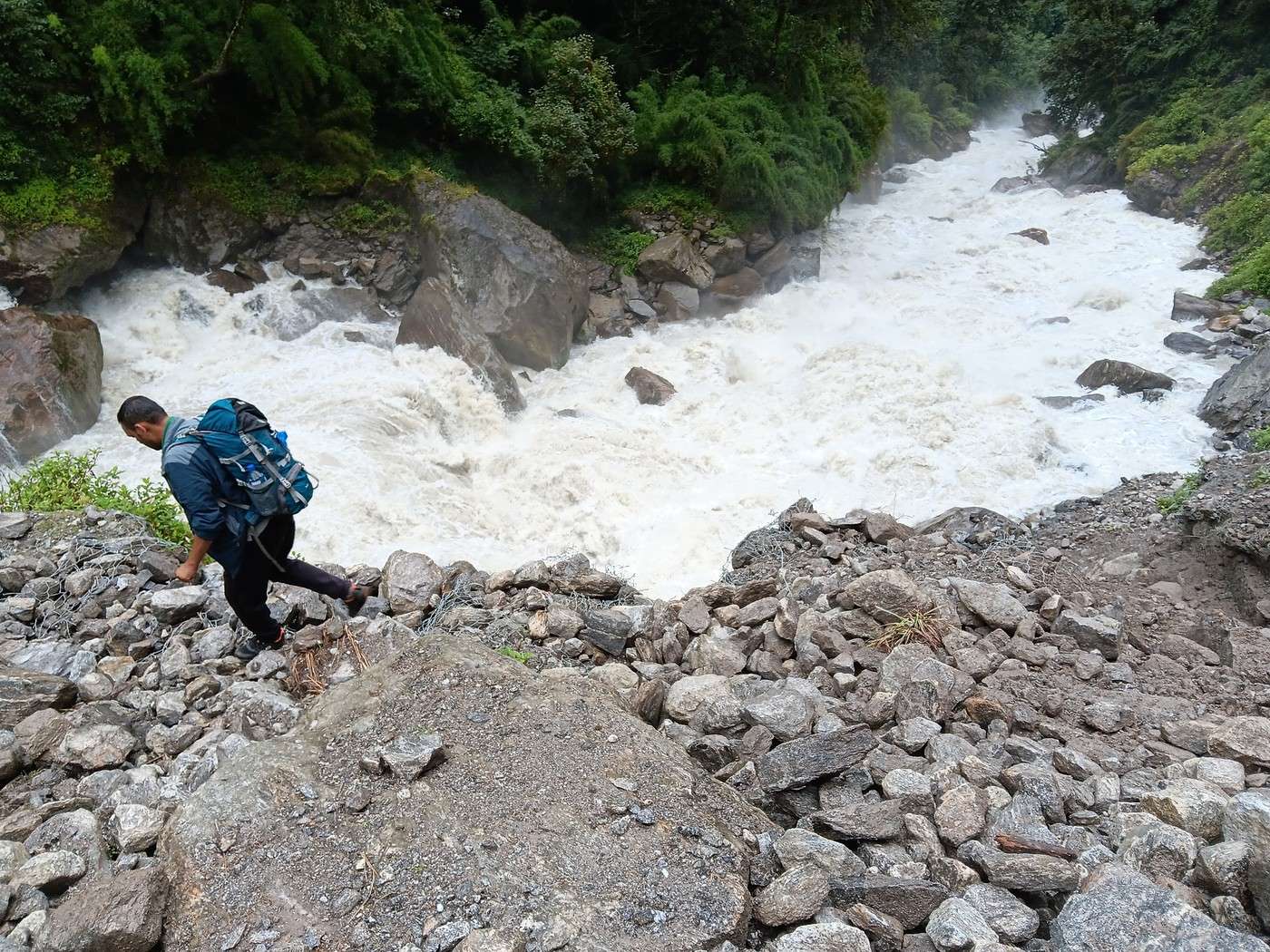
Around 8:30 a.m., we reach the most dangerous spot of our entire trek. 😠 It’s a landslide we’d already encountered on the way up. I’d had the bad idea of stepping a meter or two off the "path" and managed to climb back up by grabbing onto a big rock sticking out of the mass, which luckily was wedged in the slide and hadn’t shifted under my weight.
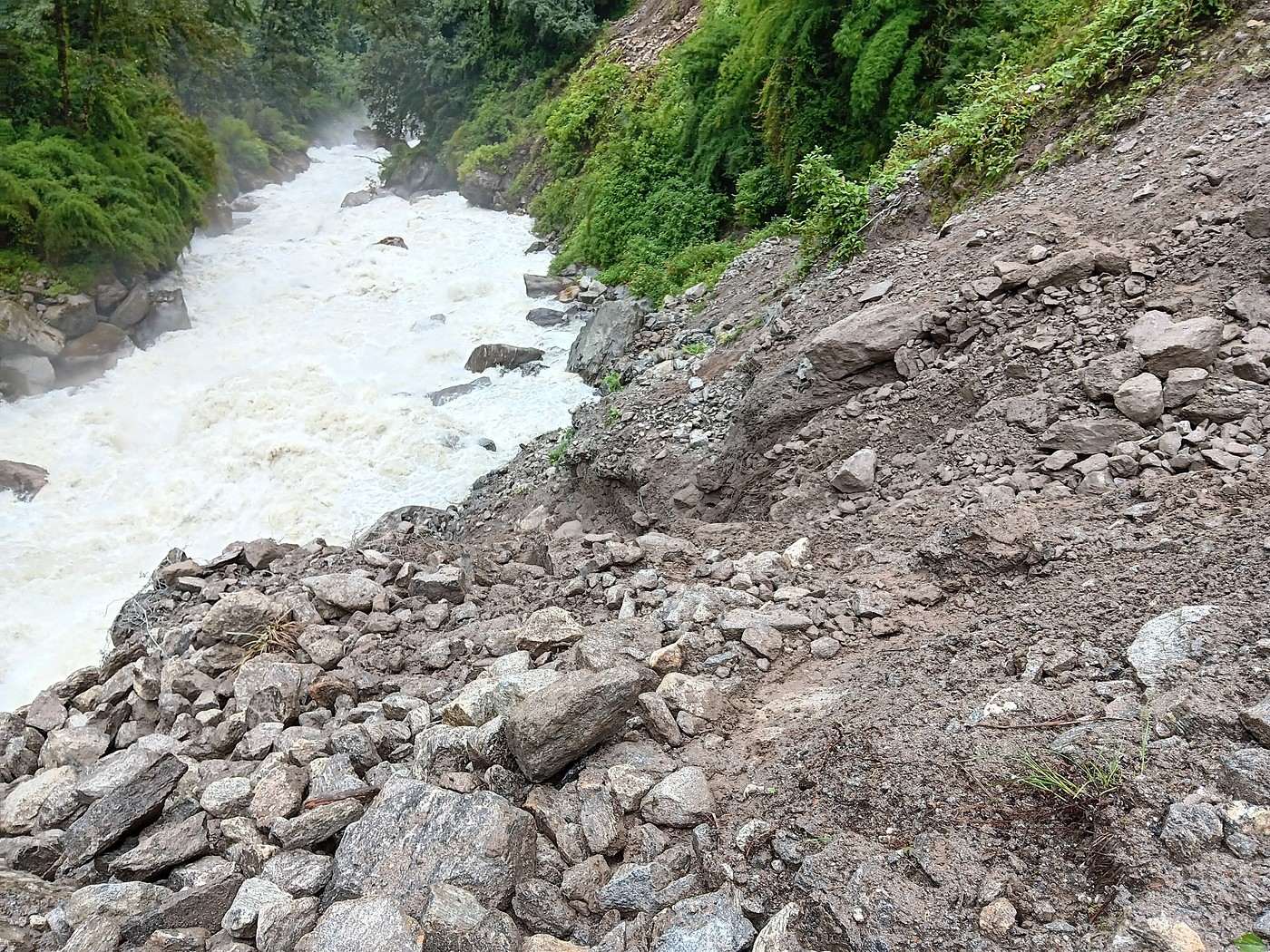
But today, it’s worse! It’s only been drizzling this morning, but with all the rain since last night, it’s slippery as hell! 🤪 And it’s clearly shifted recently!!! H climbs down a few meters to see if there’s a better passage lower down (1st photo). The photo only shows big rocks, but it’s really deceptive. It’s definitely very unstable and way too close to the Langtang River—falling in would mean certain death. 🏴☠️ So we take the usual "path." It’s not even 10 meters to cross, but it’s terrifying to look at.
Y goes first, helped by S. Luckily, she’s light and very agile. My turn. H waits on the other side and reaches out his hand. He’s trampled the muddy slope to make a foothold as wide as a foot. In a situation like this, you can’t hesitate too much—once you’re committed, you have to hurry to get to the other side. My instinct tells me that!
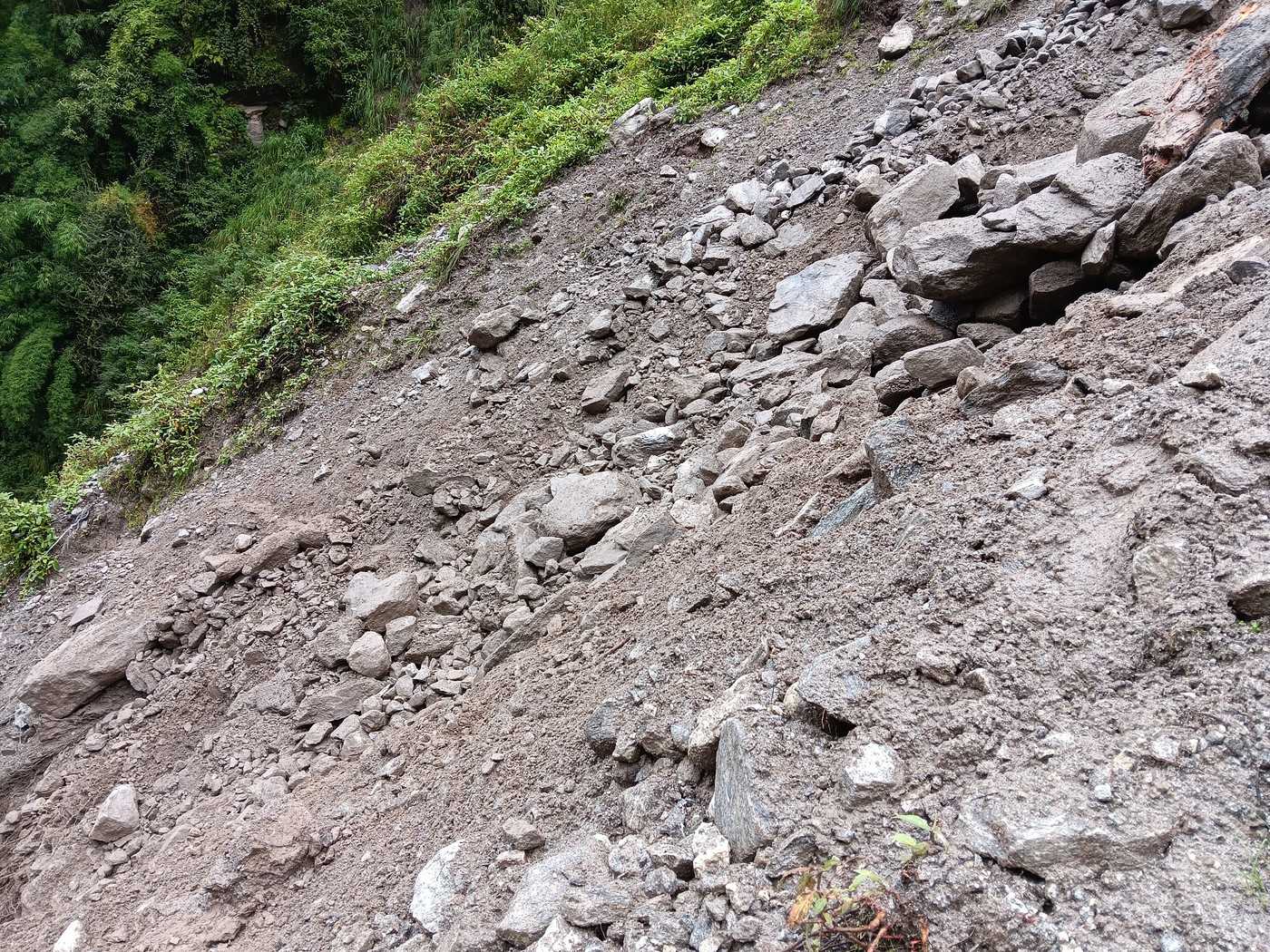
It’s so terrifying it deserves two more photos. 2nd photo: the landslide with the "path" in the center. Can you see it??????? 😇 Third photo: a few meters lower, where H went down to scout the terrain. It’s right on the edge of the river…
We’re now on the other side of the landslide. We turn around… and see the New Zealander from yesterday who just crossed too. He’s standing right at the edge of the slide to take photos. The spot is really worth it, but we shout at him not to stay there—it’s so dangerous! When he joins us, I tell him the best photos are often the ones you can’t take. A bit of my wisdom, in all humility. I’ve been in three extreme situations where there was no way to take photos.
Similarly, sometimes you witness extraordinary scenes, like local festivals in exotic countries, where you hesitate to take photos so you don’t stand out as an intruder. It’s better to stay "invisible," keep your eyes open, and enjoy the moment and the place.
Langtang – Trekking in the Rain
GeorgesOZ · 2025-10-18 · Message 68 of 109
Day 7 – From Lama Hotel to Syapru Besi (Continued) – The Bridge
A few hundred meters after the landslide, we stop at a "tea house" to catch our breath. We can’t sit outside—it’s started raining again. Inside, we run into the group of young Israelis we’d met two or three times before. One of them tells me someone died crossing the landslide in 2015. Was it related to the earthquake? No idea. I’d be surprised if there *weren’t* more deaths at that particularly dangerous spot, even if it’s not widely known. Just imagine someone slipping and falling into the Langtang! The body would probably never be found…
The Israelis confirm they’re traveling after completing their military service. I ask a few questions about it, careful not to pry. I’m aware of how sensitive the topic can be. They explain the points system used to sort and assign them to different "roles"—not necessarily combat unless they have a certain potential (if I understood correctly).
I don’t remember if it was at this tea house or another stop later, but we meet the couple from Melbourne again. It was definitely after the landslide—they were really shaken by it. The man told me their guide had to grab his belt to keep him from slipping. We also talk about how goods are transported in the Langtang Valley, especially the two men we’d (and they’d) seen in the forest carrying several wooden planks over two meters long on their backs. I’d been tempted to take a photo and regret not doing it. What a load! Maybe it was yesterday, between Langtang and Lama Hotel. Memories start to blur…
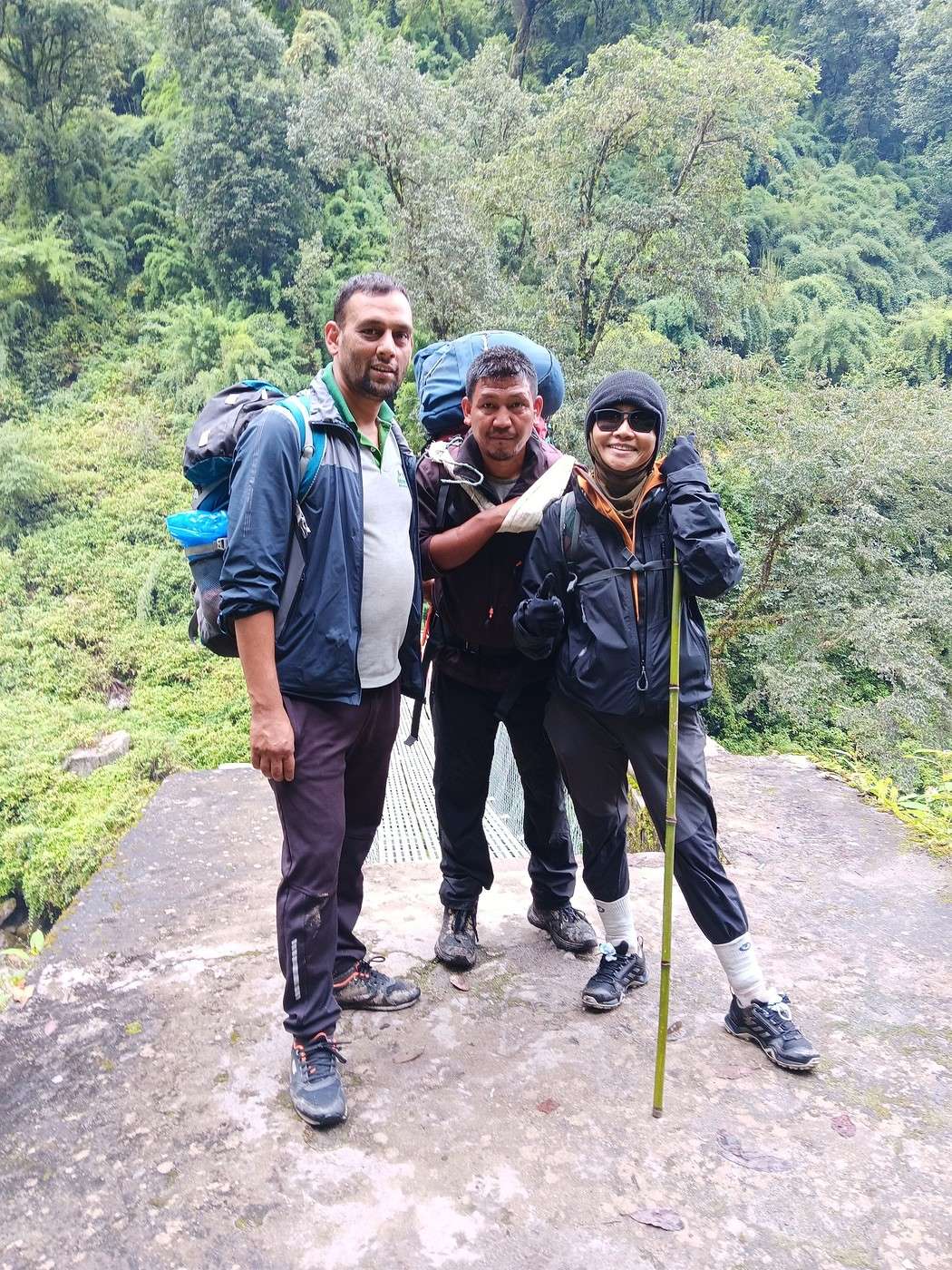
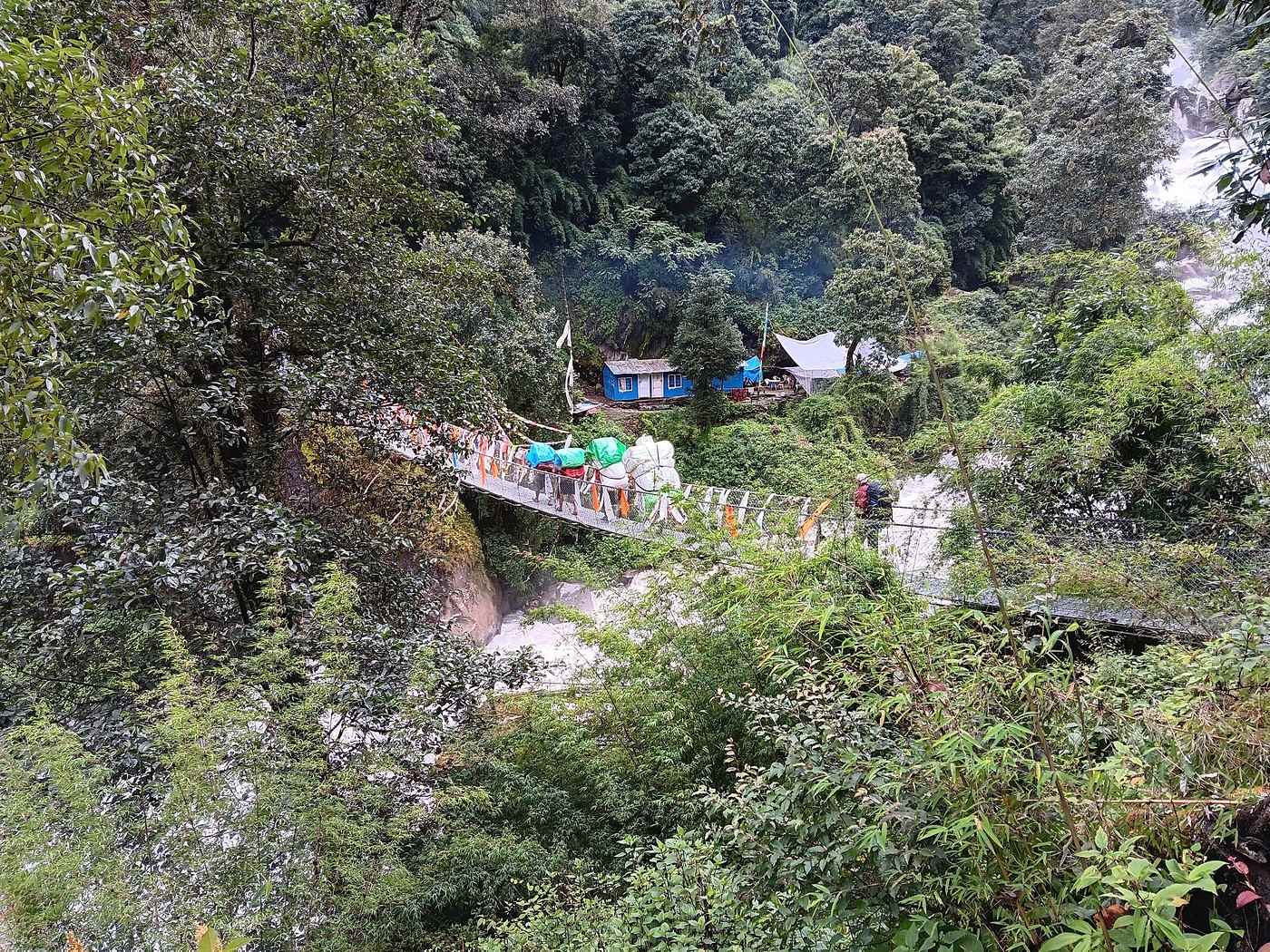
Right after the tea house, we reach the bridge over the Langtang. First photo: Y with H and S at the bridge entrance. H and S aren’t wearing hats—it’s stopped raining. It’s 9 AM, and there’s no sign of shadows—the sun’s still hiding.
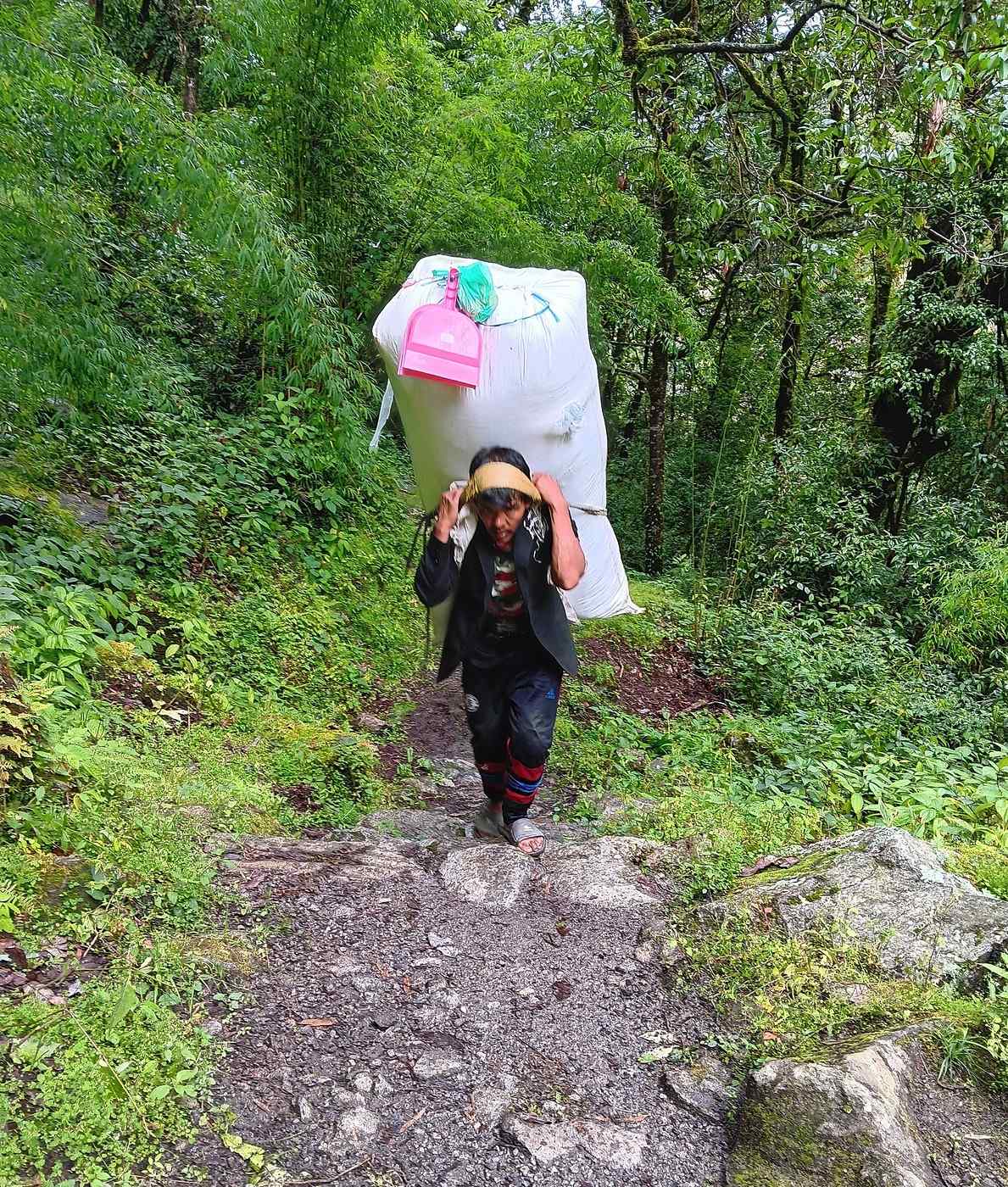
We pass a small "caravan" of porters. Again, the theme of transport in the Langtang Valley. There’s really only mules, human backs, or helicopters in extreme cases. The caravan crosses the bridge, which obviously calls for a photo (the 2nd one), though unfortunately from a distance. And ahead of us, a straggler maybe (3rd photo). Over his huge sack, a funny detail: a shovel for picking up trash, in a bright pink color! Can’t see the broom—is it in the sack? Or was it left behind as the proverbial "straw that would break the camel’s back"?
Langtang – Trekking in the Rain
Iorito · 2025-10-18 · Message 69 of 109
Hi Terry,
Which month would you recommend for the Langtang, Gosainkund, Helambu trek, taking crowd levels into account? I’ve done several trips to Nepal over the last 40 years—the last one was in 2012—but things change, and I’d like to avoid the biggest crowds. We’re trekking solo. Thanks so much for your feedback. IORA
Langtang – Trekking in the Rain
Nimou74 · 2025-10-19 · Message 70 of 109
Hello Terry,
Which month do you recommend for the Langtang, Gosainkund Helambu trek, considering the crowds? I’ve made several trips to Nepal over the past 40 years, the last one in 2012, but things change, and I’d like to avoid the biggest crowds. We’re trekking solo. Thanks so much for your feedback. IORA
Hi there,
I’ll chime in...
For clear mountain views, the best season is from late October to February.
We’ve had bad weather as early as March.
There are more people between mid-October and mid-November, but it’s not a highway by any means! It starts getting very cold by late November, but it’s manageable.
I’ll also add a small note—please don’t take it the wrong way, as this is your first post: you’re commenting on a personal travel journal that someone took the time to write and document.
Why not start a discussion on the topic or send Terry a PM?
Happy researching
Langtang – Trekking in the Rain
Iorito · 2025-10-19 · Message 71 of 109
Namaste Nimou,
Thanks for this feedback—it matches what I was thinking. I actually thought I’d reached out to Terry.
Best,
Langtang – Trekking in the Rain
Djalma · 2025-10-19 · Message 72 of 109
Which month do you recommend for the Langtang, Gosainkund, and Helambu areas, considering crowd levels?
Hi there,
It depends on the type of trek you want to do.
To go from Helambu to Langtang, there are two passes: Laurebina at around 4,800m, which is relatively easy but can be snowed in from mid-December until March.
If you return from Langtang to Helambu via Ganja La (a very difficult pass at 5,200m to be done with a guide), you’ll need to wait until April! I did it in March—it was a real struggle. We bivouacked at 4,900m at the foot of the pass in a meter of snow, then spent 3 days without seeing another soul until Tharkhekiang.
If you’re only doing the Langtang Valley from Syabru Besi to Kyangjin Gompa (like georgesOz) and even a detour to the sacred lakes of Gosainkund, you can go from February until the end of May.
Or from October 15th to early December (best period).
If you want to see the rhododendrons in bloom (trees up to 15m tall), you should go from mid-March to early May.
PS: I don’t think there’s ever a really crowded period in Langtang.
In any case, in my opinion, it’s best to avoid June to mid-October because of the monsoon.
Personally, I recommend doing the "Tamang Heritage Trail" (5 days) and continuing into the Langtang Valley—it’s fairly easy, and the whole thing can be done in about 8 days.
Langtang – Trekking in the Rain
TerryTara · 2025-10-19 · Message 73 of 109
Hello Terry,
Which month do you recommend for the Langtang, Gosainkund Helambu trek, considering the crowds? I’ve made several trips to Nepal over 40 years, the last one in 2012, but things change, and I’d like to avoid the biggest crowds. We’re trekking solo. Thanks so much for your feedback. IORA
To avoid repeating and to go a bit further, I’d say it really depends on what you’re looking for. The period between festivals is the busiest, but it’s not like Sagarmatha or the Annapurna Circuit—and even the Manaslu Circuit now. But if you want that feeling of being almost alone, I can only recommend winter, from mid-December to the end of February. I’d even push it to the end of February or a little after because snow is possible, and the views are amazing.
Yes, it’s cold, but the privilege of being almost alone—and especially being with the real locals—is worth it. Many guesthouses are run by seasonal workers during the high season, and it’s hard to know who’s a local or a year-round resident since a lot of people have a second home in Kathmandu during the winter. The experience, beyond being more solitary, is also much more authentic in my opinion. These thoughts also apply to the monsoon season, but the downside is that the mountain views are much less clear, and you’ll have to cross your fingers for a clear morning. A little asterisk for the monsoon period: during Janai Purnima, Gosainkunda isn’t exactly a haven of peace—there are about 4,000 Nepalis at the lake on average!
That said, if you’ve already traveled in Nepal, I can only recommend exploring less touristy areas. The west is wonderful, between Darchula, Rukum, and Khaptad, but the east has just as many treasures, like the Bhojpur region and the hills/mountains of Koshi Province. However, these places can be more challenging if you’re alone (without a guide or if you don’t have a basic level of Nepali). The upside? There’s almost no one there except the locals! :)
Langtang – Trek in the Rain
Iorito · 2025-10-19 · Message 74 of 109
Thanks Terry.
Langtang – Trekking in the Rain
GeorgesOZ · 2025-10-20 · Message 75 of 109
Day 7 – From Lama Hotel to Syapru Besi (Continued and Concluded)
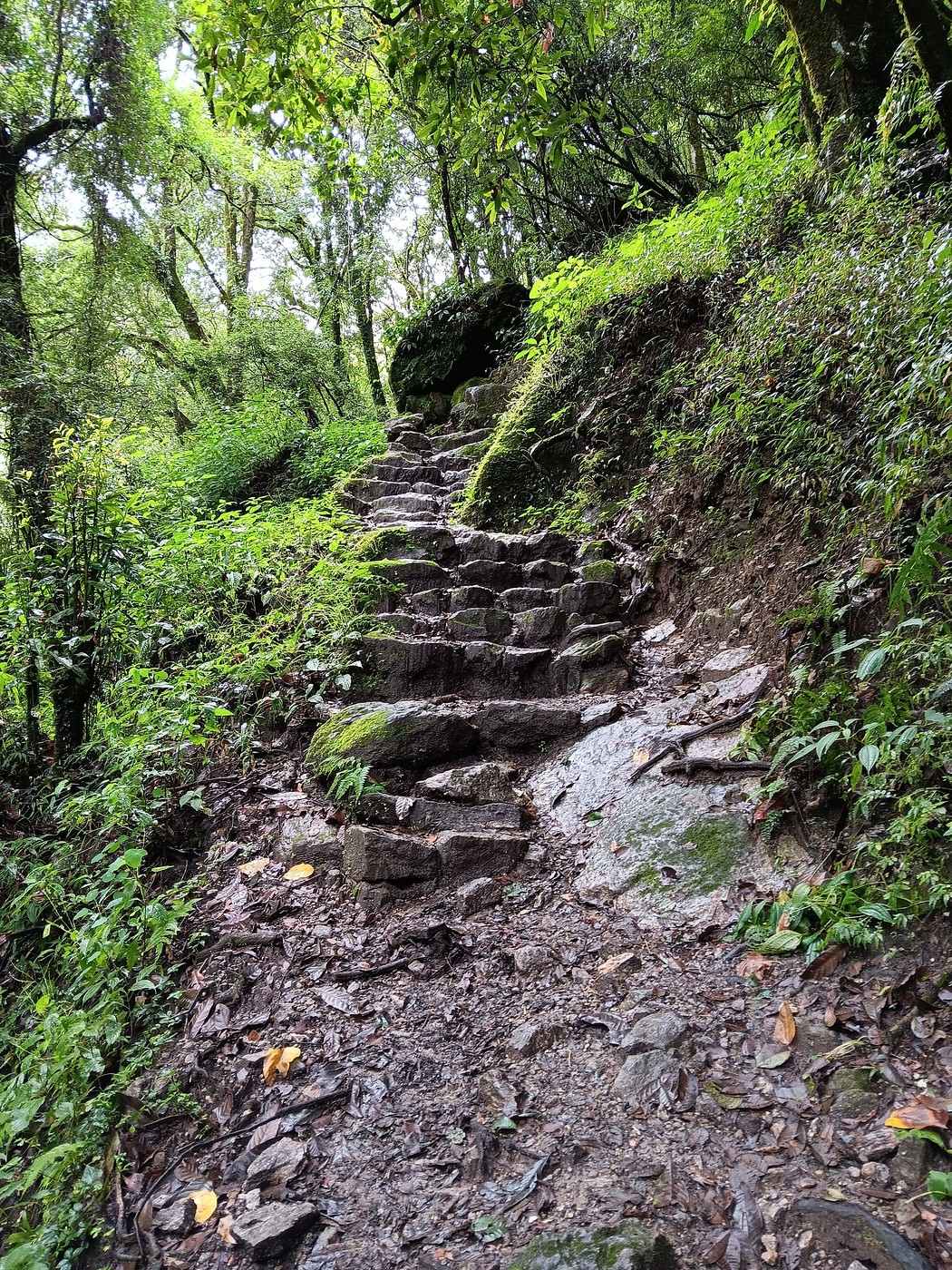
It’s just past 9 a.m. It’s not raining! 😎 But the path is tricky—there’s an endless series of stairs (if you can even call them that!) to climb up and down, and the ground is still damp. Y is way ahead of me with H. She’s in much better shape than she was on the way up! Is it because this is our last hike today, or that well-known phenomenon of horses you can barely hold back when they know they’re heading back to the stable? 😉
My first photo shows one of these “stairs.” It feels like we’re on the winding path to Mordor. Over the past few days, Y in her poncho has often reminded me of the hobbits from *The Lord of the Rings* (Frodo and company) with their funny capes. I see several hikers running up and down these “stairs,” but I’ll leave that to those who are used to it. I’m really careful about where I place my feet—it’d be so easy to sprain an ankle or take a nasty fall.
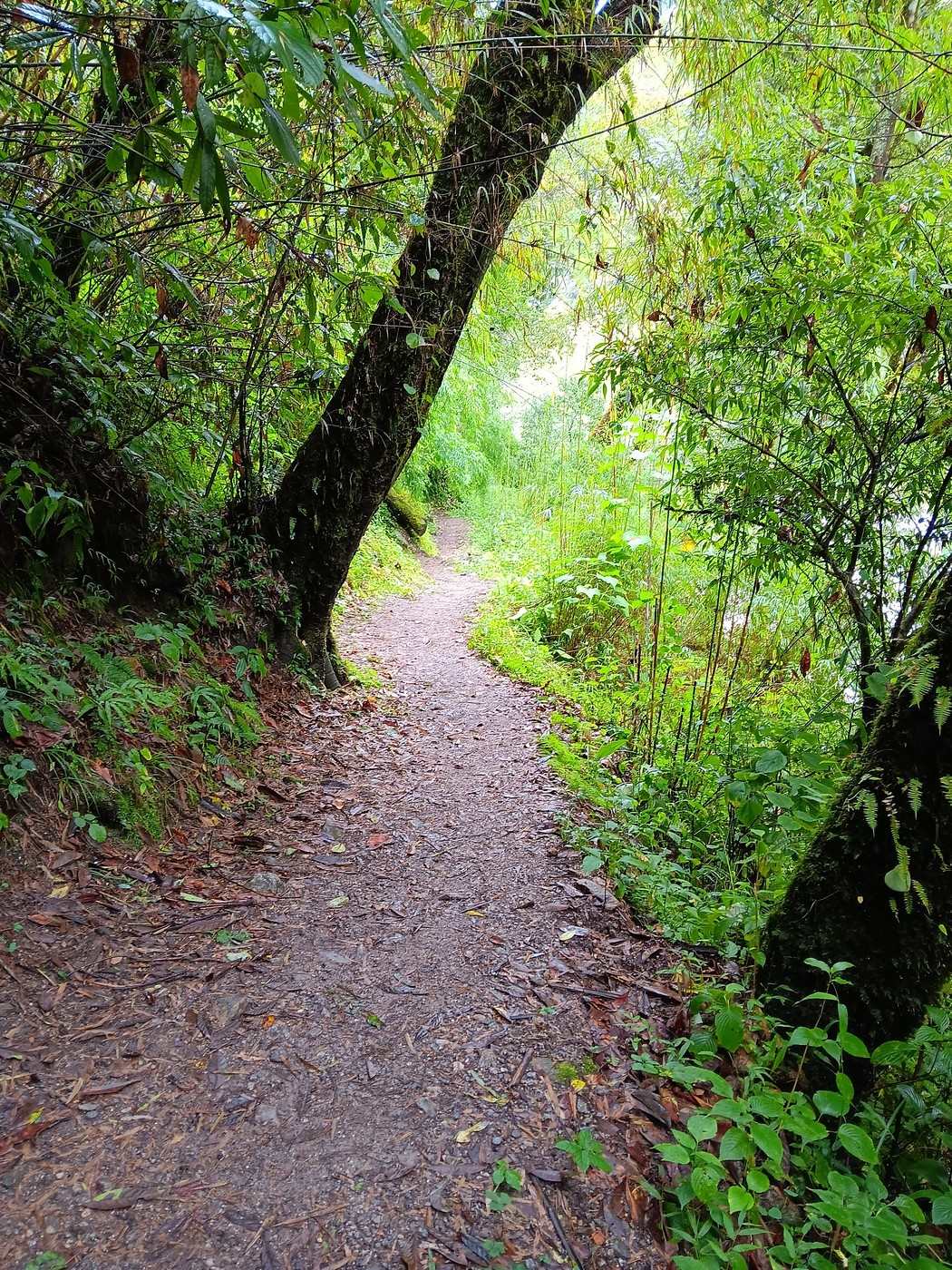
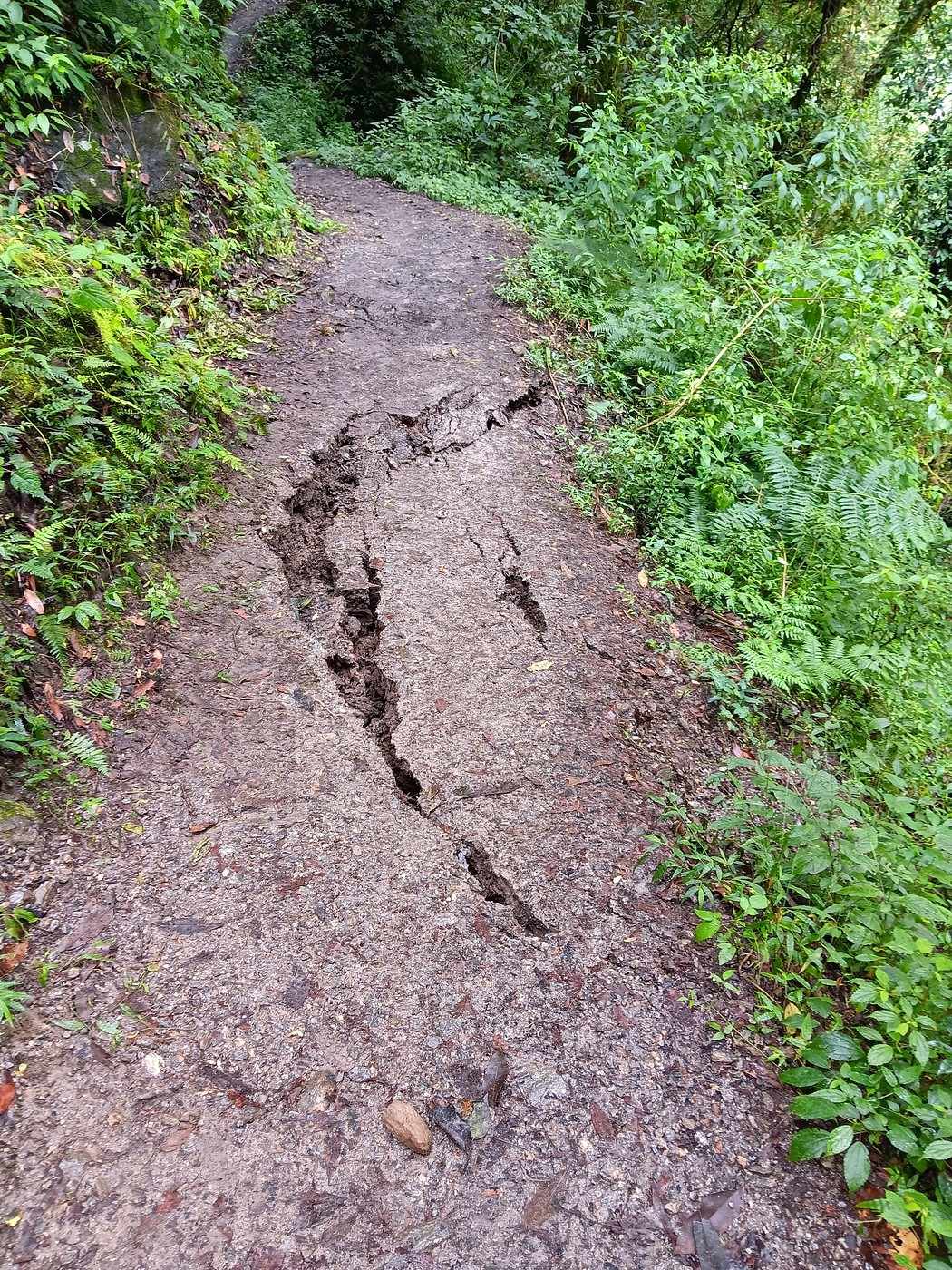
The second photo shows the path in its more relaxed version. You’d almost think you were strolling through one of France’s pretty forests. But don’t be fooled—the slope is steep right off the trail, and the Langtang River isn’t far below. 😕 My third photo proves you’ve got to keep your eyes peeled: a landslide is developing, taking out most of the path. I quickly hop over the small section that still seems stable!
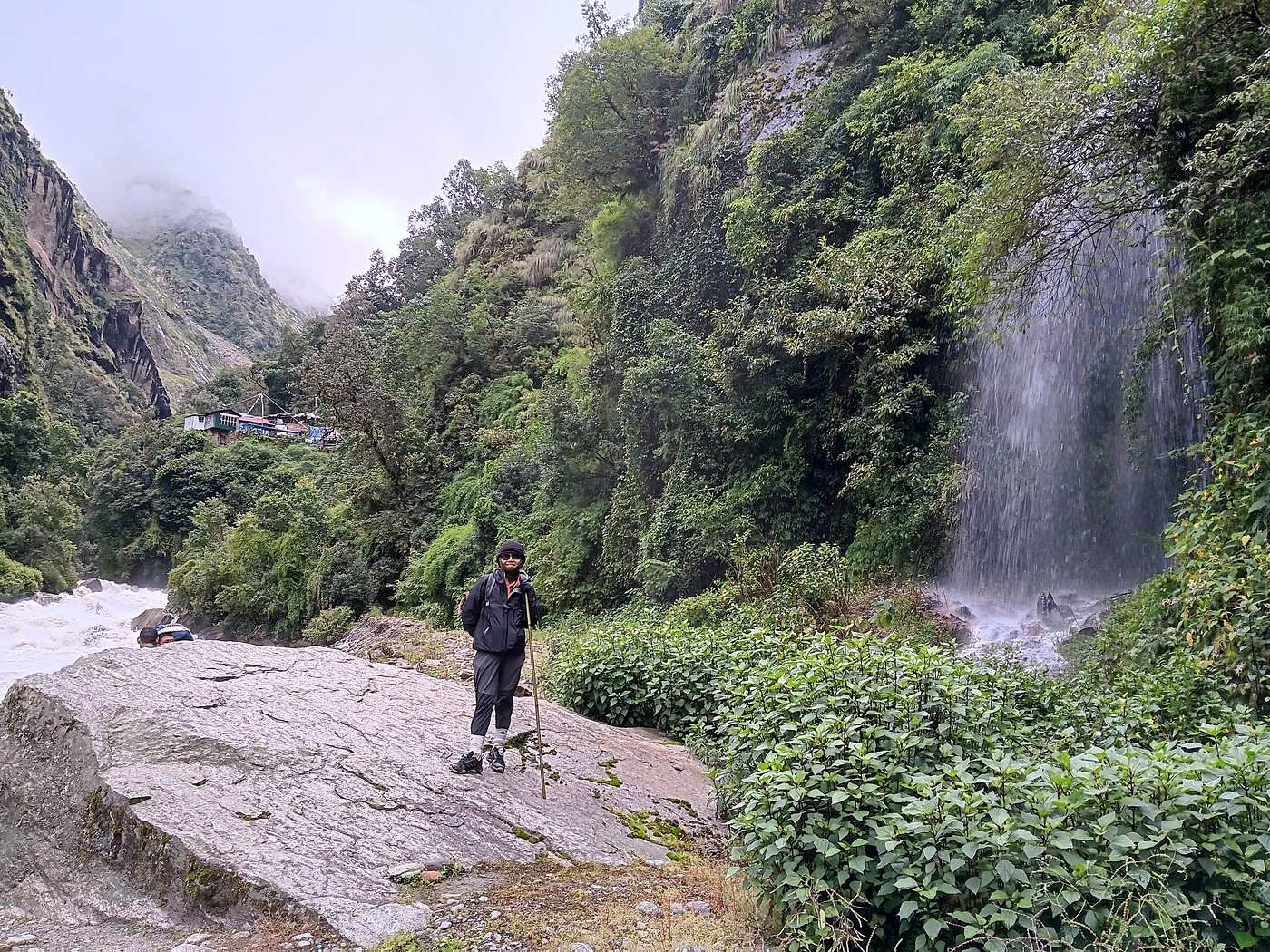
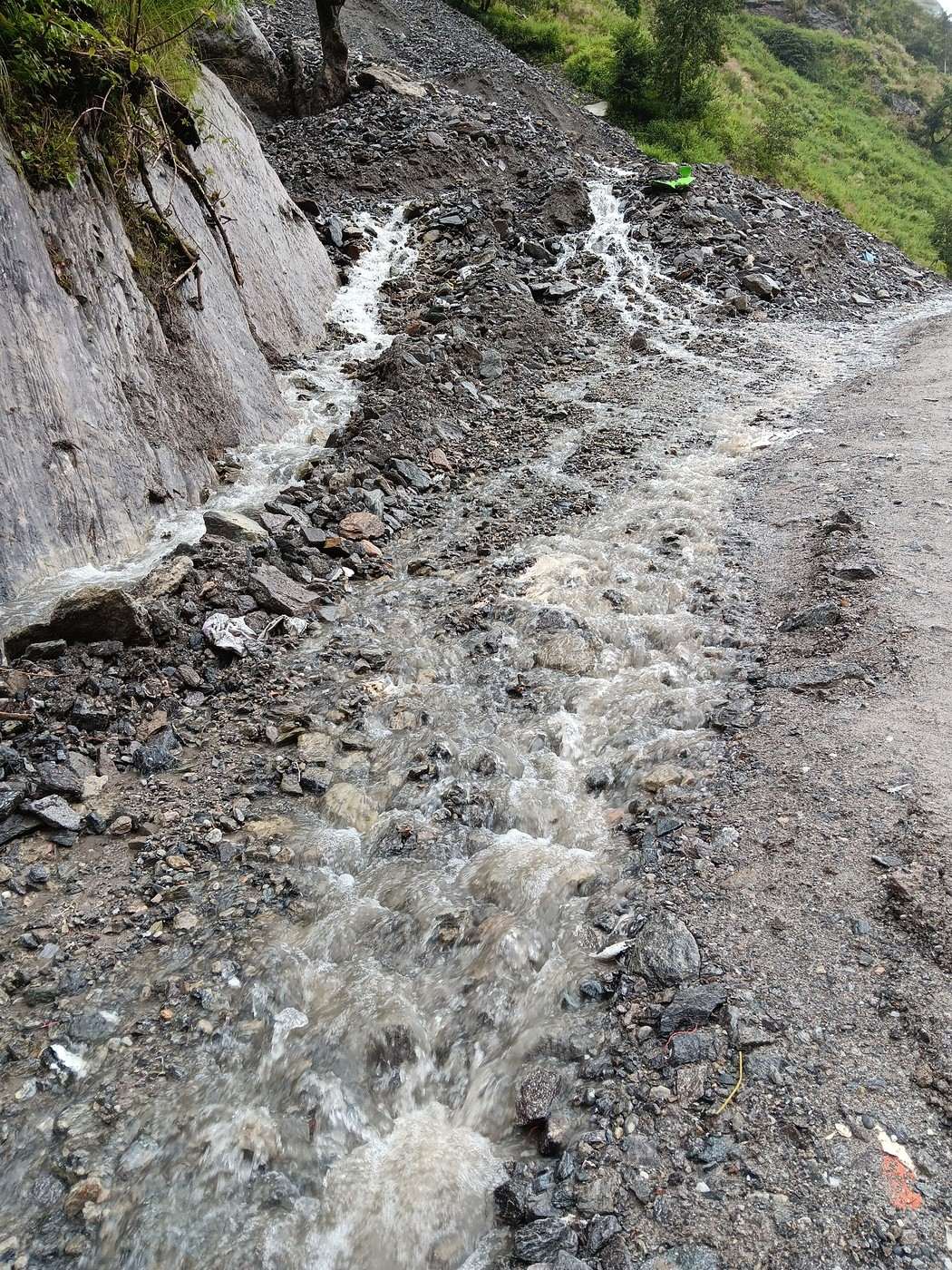
Around 11 a.m., I catch up with Y to take her photo in front of a lovely waterfall (fourth photo). It’s not raining, but the landscape is still misty. We’ve reached the last section of the trek, from the hydroelectric plant under construction to Syapru Besi. The trail is wider, but it’s still a trail, and in some places, it turns into torrents (fifth photo). There’s water everywhere!
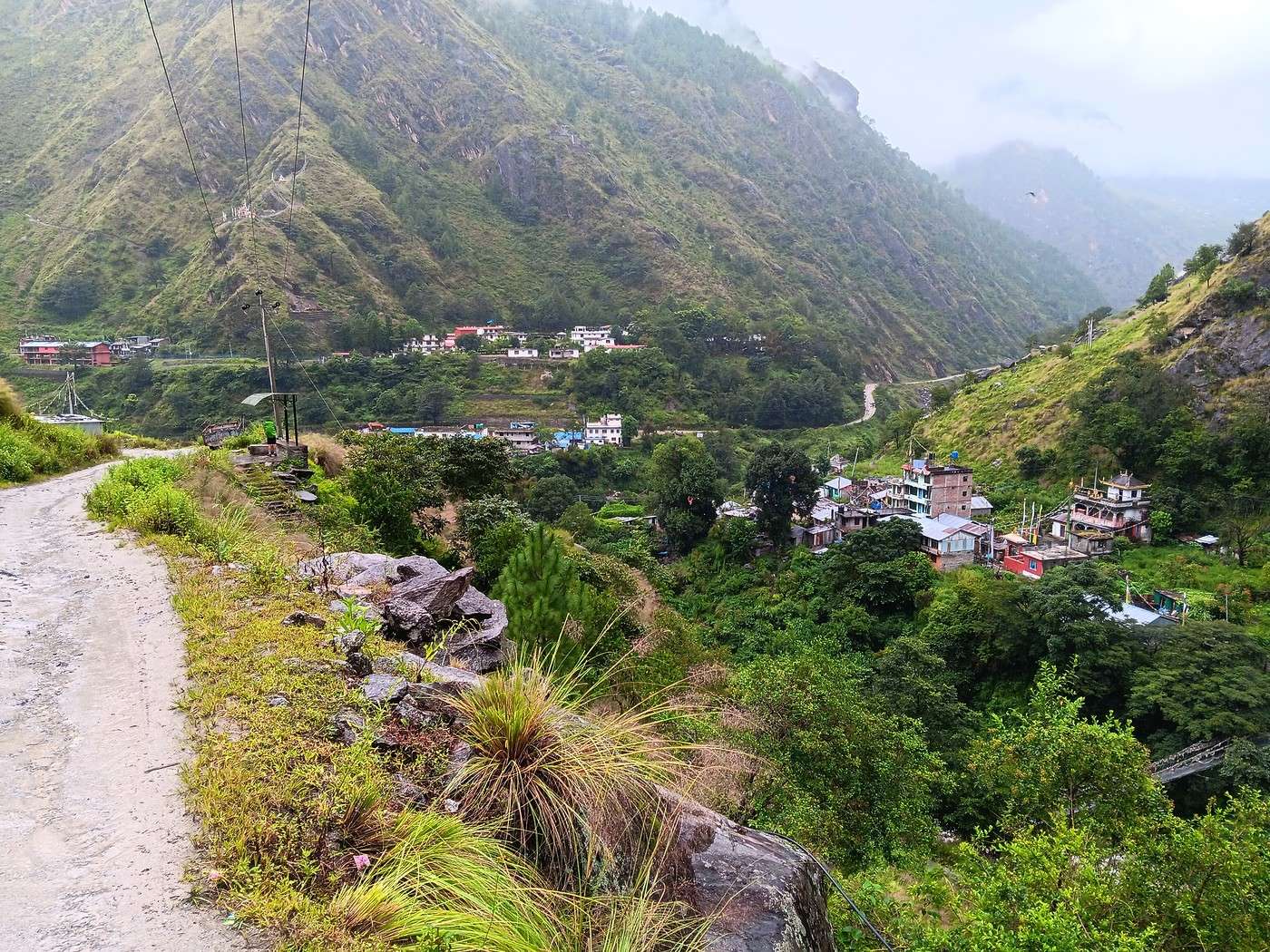
It’s past noon when we reach the outskirts of Syapru Besi. The sixth photo shows the road heading north toward the Tibetan border. And finally, the bridge over the Trishuli Ganga, just below its confluence with the Langtang. We’ve practically made it, with plenty of time for lunch. This last stretch only took us four and a half hours.
Langtang – Trek in the Rain
GeorgesOZ · 2025-10-23 · Message 76 of 109
Day 8 – Back to Kathmandu
Barely had the God of Day spread the golden braids of his blond hair across the earth; barely had the various birds, adorned with bright colors, celebrated in their sweet concerts the presence of the beautiful Dawn, who, rising from the bed of her elderly husband, advanced while scattering roses on the horizon of the Trishuli Ganga, when Y and I, scorning the comforts of sleep, bravely descended the stairs to appear in the dining room of our GH.
I wonder who’ll react to this lyrical passage—I swiped it from a famous writer! 😉 Sometimes, I feel like you’ve got to shock readers to snap them out of their passivity!
So, to sum up: early wake-up and breakfast as usual!
Departure by jeep around 8 a.m. The landslide that forced us to walk the last 2 km to Syapru Besi a few days ago has been cleared. The road is open!
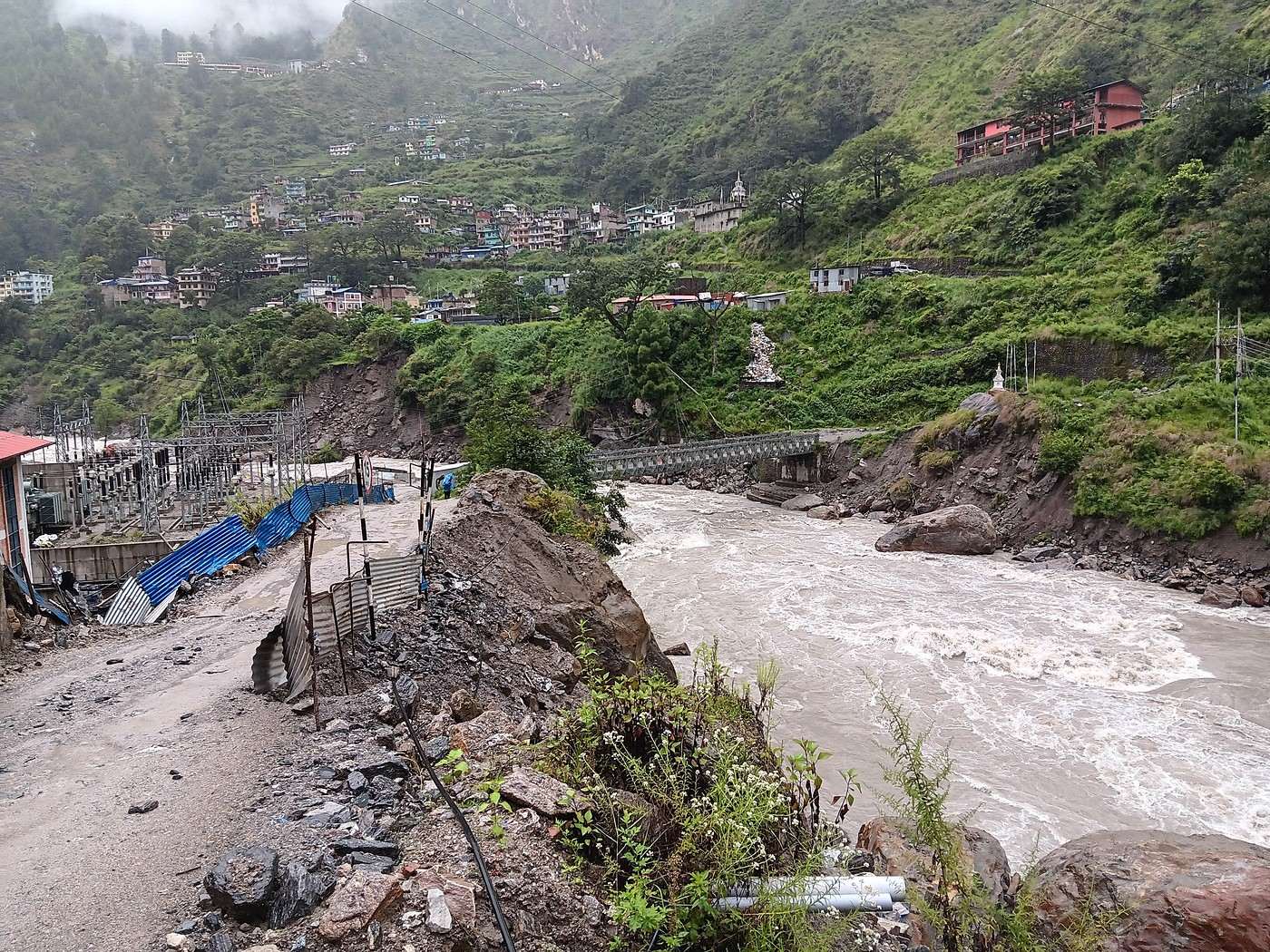
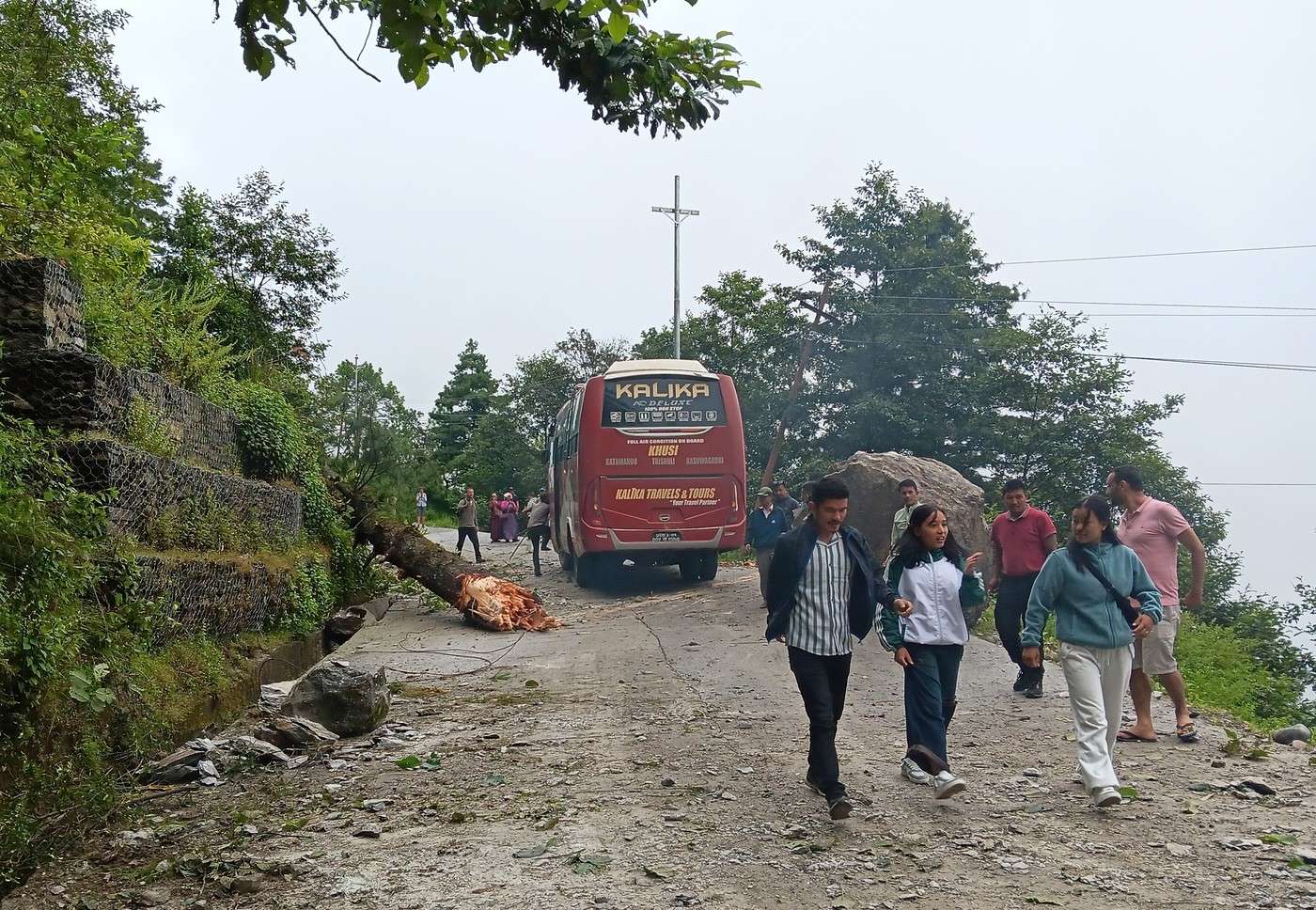
But... barely half an hour into the trip, we’re stuck behind a dozen vehicles. What’s going on? There was a new landslide just as a bus was passing. The bus seems to have avoided the worst: a huge boulder stopped right at the edge of the road before tumbling down toward the Trishuli Ganga below. Needless to say, if that rock had hit the bus, it definitely wouldn’t have been in any shape to continue!
The bus is sideways on the road. The first photo shows why: while swerving to avoid the boulder, the bus got stuck right on a tree trunk that was probably part of the landslide. I can only imagine the braking to avoid disaster! It took a while for the bus to free itself from the trunk and get back on track. But we’re moving again!
It’s 9 a.m. We stop for about ten minutes in a small village, probably for some formality. Maybe it’s the exit from Langtang National Park?
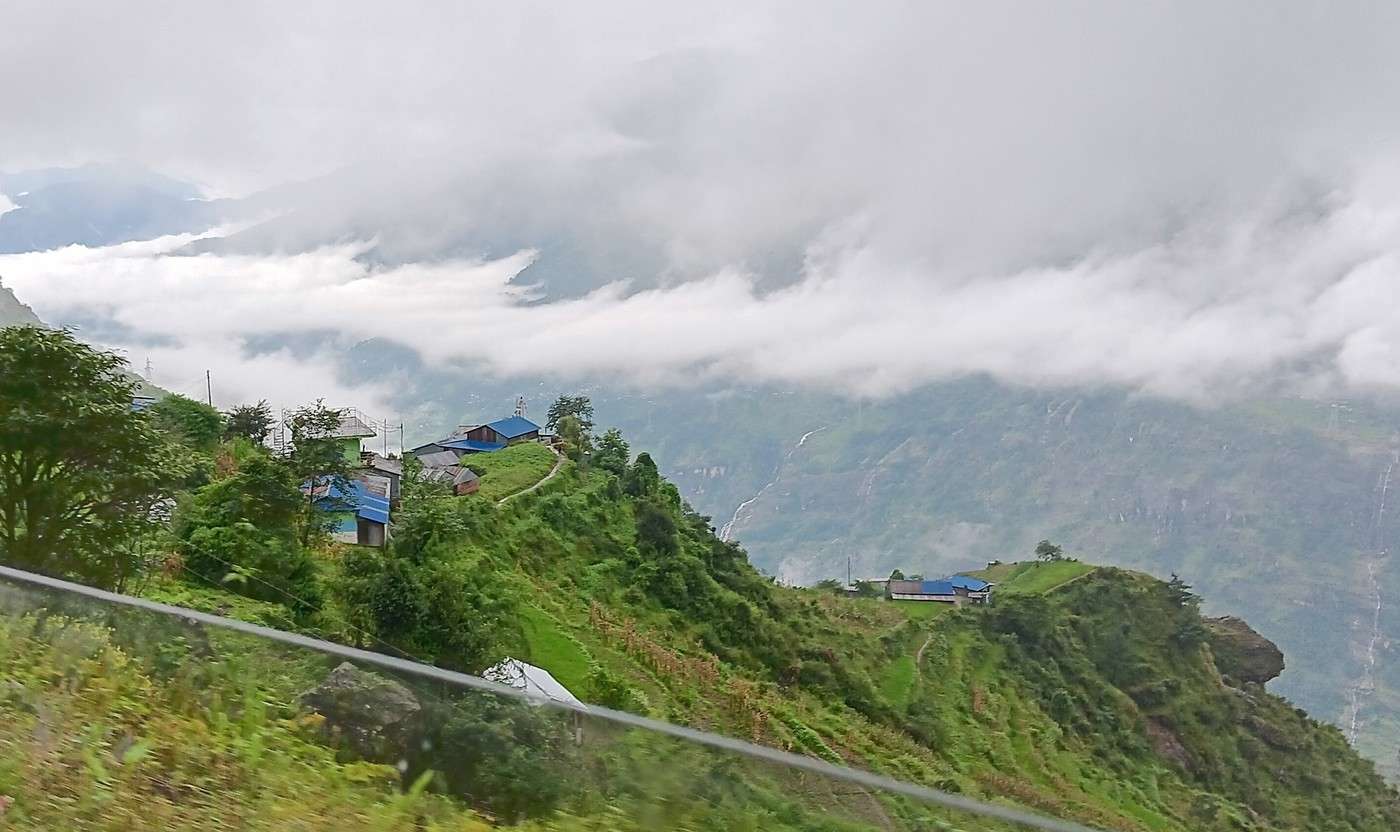
It’s not raining, but the landscape is very foggy. You can’t see the mountain peaks on the other side of the Trishuli Ganga, whose course we’re following. The slopes are steep, but there are houses and crops everywhere (second photo, taken on the fly—if you can call it that—from the jeep). I’ll share a link to a short video too; you can see the mountain on the other side of the valley and the river far below. It’s filmed from the moving jeep, so you’ll see how much it’s shaking—the road isn’t exactly top-notch!
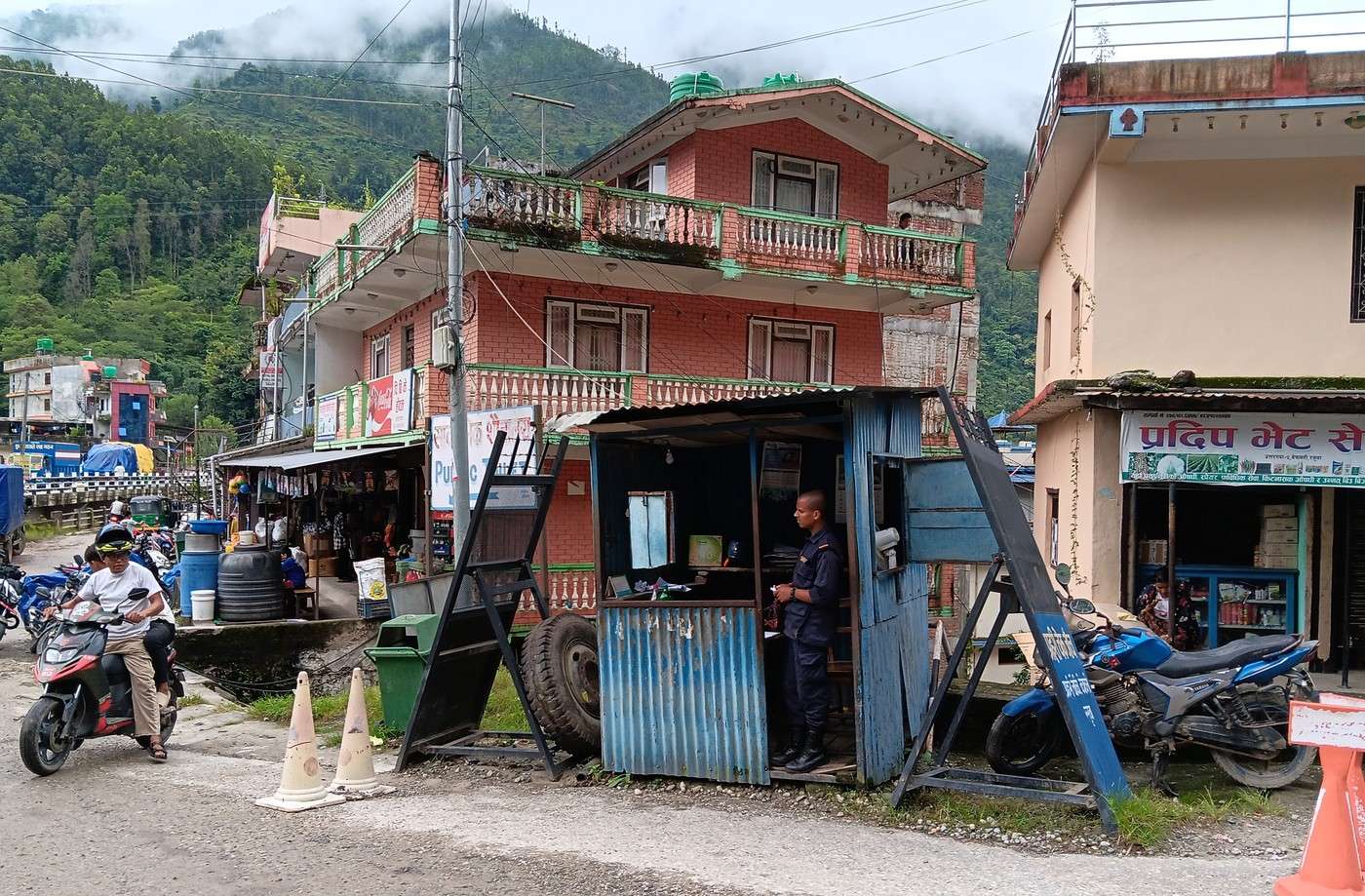
https://youtu.be/MZ7Z_ywuYNcAround 11 a.m., another stop for an administrative check near Nuwakot / Bidur. The third photo: the checkpoint is really impressive!
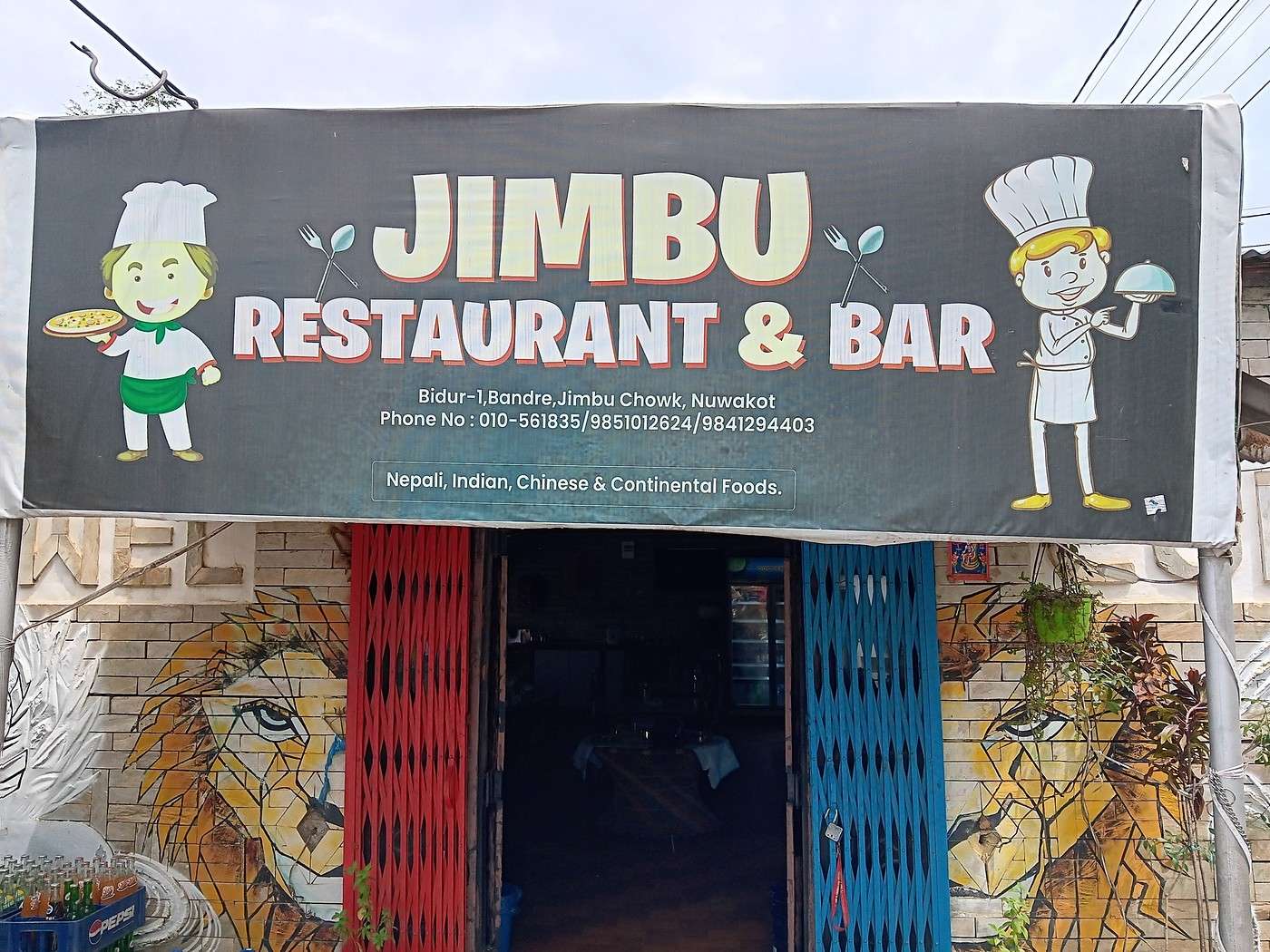
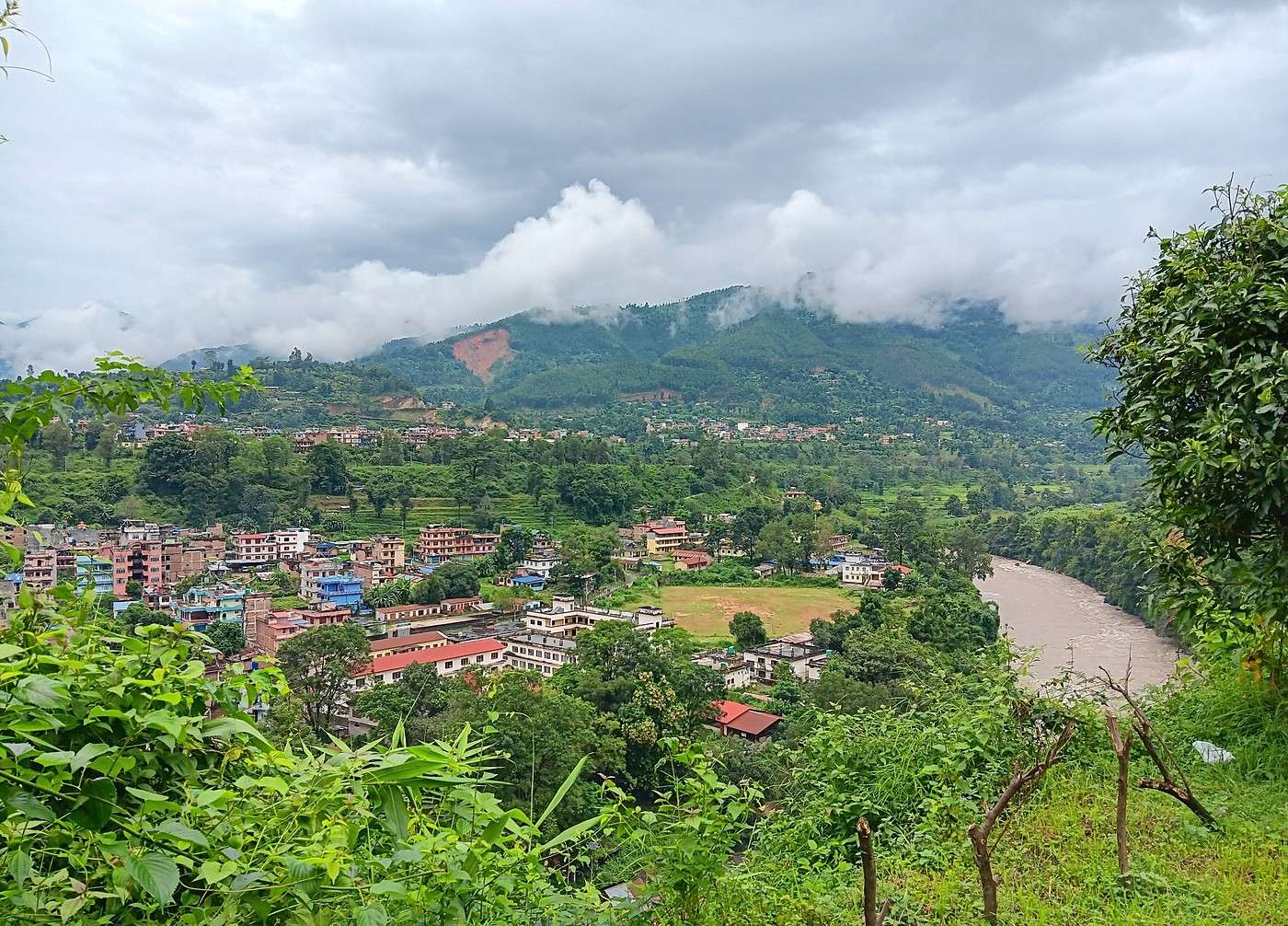
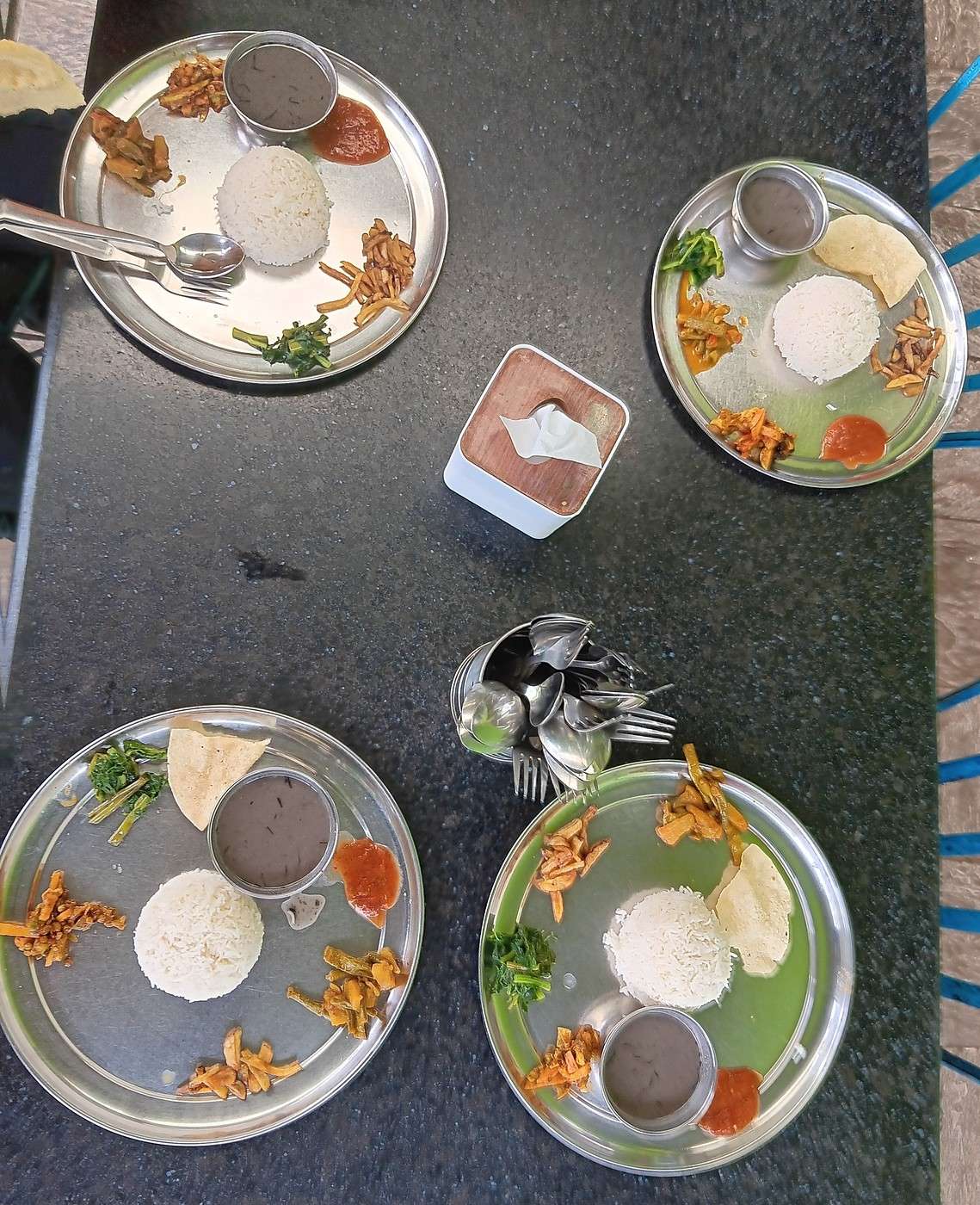
Just before reaching Nuwakot, halfway between Syapru Besi and Kathmandu, we stop again at a checkpoint (fourth photo). If I understand correctly, we’re crossing from one administrative district to another. It’s 11 a.m. We stop shortly after for lunch. It’s the Jimbu restaurant, where we’d already stopped on the way there (fifth photo). It has a lovely garden out back with a great view of the Trishuli Ganga (fifth photo again). There are a lot of people inside, so we sit at a table outside. It’s not raining, and it’s barely rained all day—what a relief! The dal bhat they serve us is delicious (sixth photo), a sign we’re back in “civilization.”
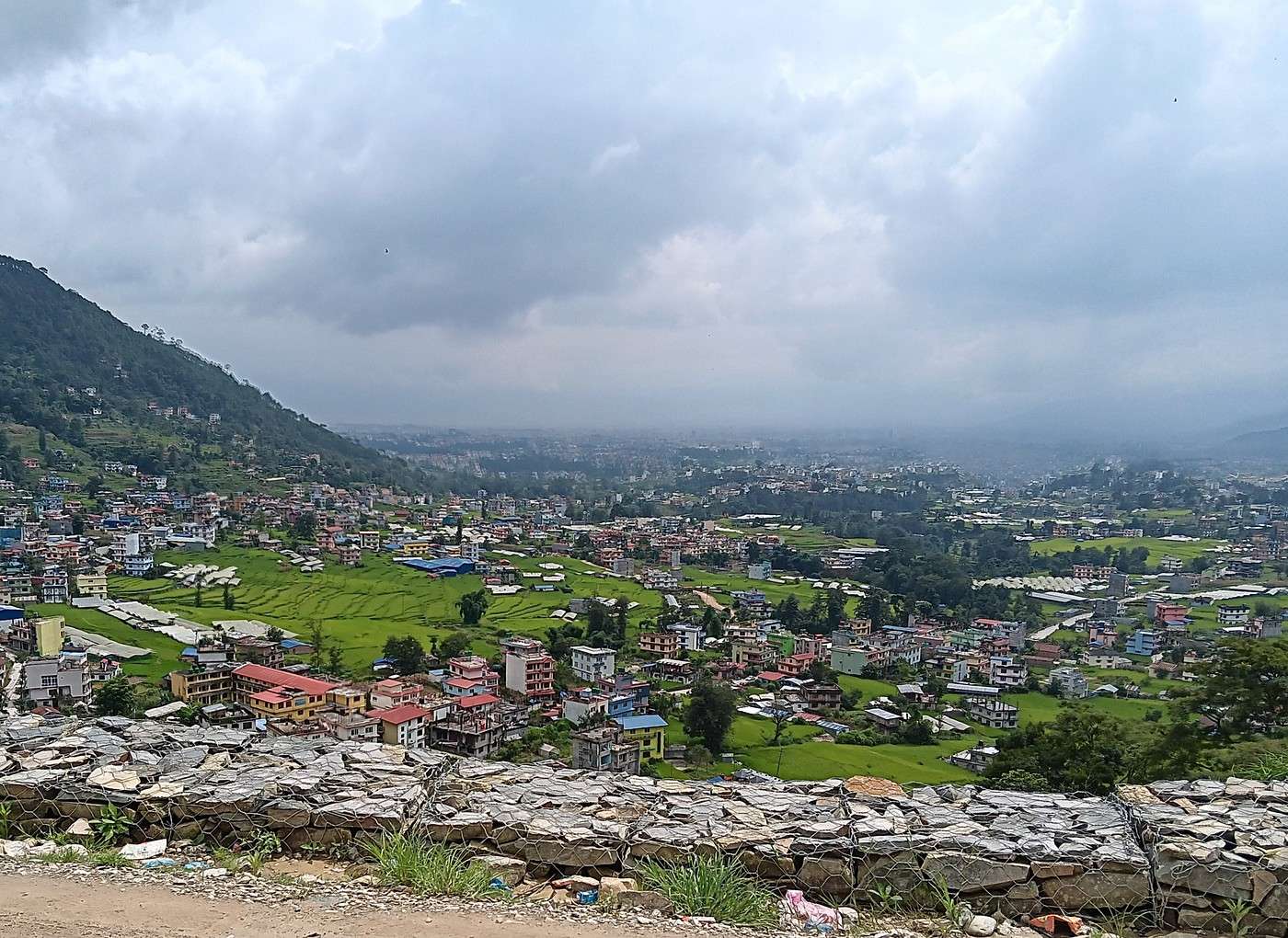
Another good fifty kilometers to Kathmandu. We follow the Likhu River for several kilometers, then there’s still some mountain driving ahead. Y took a double dose of their meds and is handling the many twists, turns, braking, and acceleration just fine. We reach the outskirts of Kathmandu around 1 p.m.—seventh photo, lots of lush green rice paddies, but traffic is picking up fast—ah, back to civilization! We arrive at our hotel in Thamel around 2 p.m. It took us 6 hours to get here from Syapru Besi.
Langtang – Trek in the Rain
Djalma · 2025-10-23 · Message 77 of 109
The dal bhat we were served is really good (6th photo), a sign that we’re back in "civilization."
Nice presentation! But I’ll note that the 4 portions wouldn’t be enough for a single Nepali porter!😉 Don’t tell me the Nepalis (if there were any at the table) had the same amount on their plates... or else they were refilled 3 times!
We arrive at our hotel in Thamel around 2 p.m. It took us 6 hours to make the trip from Syapru Besi.
Conditions have improved a lot. Before, it was closer to 8 hours... in the dry season.
Langtang – Trek in the Rain
Huguetter · 2025-10-23 · Message 78 of 109
Hi there,
I’m reading your post with pleasure but also a bit of sadness.
We went in 2018—the big circuit with Tamang and Gosainkunda.
It was late November and it was already really cold…
All along the trail, prayer flags marked the spots where people had lost their lives during the 2015 earthquake…
It was a special trek, different from all the others we’ve done in Nepal.
Langtang – Trekking in the Rain
GeorgesOZ · 2025-10-23 · Message 79 of 109
The dal bhat we were served is really good (6th photo), a sign that we’re back in "civilization."
Nice presentation! But I notice that the 4 portions wouldn’t be enough for a single Nepali porter! ;) Don’t tell me the Nepalis (if there were any at the table) had the same amount on their plates... or else they must’ve gone back for seconds three times!
Yes, we were indeed sitting at the table with our guide and our porter! But given your question, I’ll clarify that one of the servers came back to offer us seconds, and they probably helped themselves to more. :)
Also, the dal was better than usual, even compared to what we’d had several times in KTM. I’ll mention in passing that Nepali dal is quite similar to a black-colored soup (a certain type of lentils), and it’s always the same recipe, whereas in India there’s more variety and it’s always noticeably better, in our opinion (Y will agree with me).
We arrive at our hotel in Thamel around 2 p.m. It took us 6 hours to make the trip from Syapru Besi.
Conditions have improved a lot. Before, it was closer to 8 hours... in the dry season. ;)
What must it have been like! :|
Langtang – Trekking in the Rain
GeorgesOZ · 2025-10-23 · Message 80 of 109
Hello
I read your feedback with pleasure but also a bit of sadness.
We went there in 2018, the big loop with Tamang and Gosinkung.
It was late November and it was already very cold.....
All along the trail, prayer flags marked the spots where people had lost their lives during the 2015 earthquake.....
It was a special trek, different from all the others we’ve done in Nepal.
Thanks for your comment. Question: could you clarify how this trek is different from the others, aside from the context of the devastation caused by the earthquake?
There have been several interesting discussions about other treks in Nepal—I’m asking in that same spirit. 🙂