in Entre deux voyages › Carnets de voyage
Peru-Bolivia 2017: A Month in the Andes (page 4 of 8)
Discussion started by Montagnard74 on 2017-02-08
140 replies
This thread has been translated into English.
Peru-Bolivia 2017: A Month in the Andes
Fifinedu59 · 2017-03-12 · Message 61 of 141
Hi montagnard74
I’m dropping in on your travel journal to thank you for all the info—it’s a real pleasure reading your posts. My family and I usually plan our trips ourselves, just like you (if I understood correctly), because we don’t like organized tours and prefer to take our time. We’re thinking of spending a month in Peru in 2018, and Bolivia too—is it as easy to book things there as it is in North America? (I don’t speak a word of Spanish :/) Should I go through an agency that’s offering a private self-drive tour with a guide and private driver (I met them at the last travel show)?
I’m asking because planning the trip—figuring out the sites, must-sees, routes, etc.—is part of the fun for us. Thanks again for sharing your story! ;)
Peru-Bolivia 2017: A Month in the Andes
Holigirl · 2017-03-12 · Message 62 of 141
Hi Bruno,
What stunning landscapes!
Awesome travel journal as always!!!
Thanks for sharing 🙂
Peru-Bolivia 2017: A Month in the Andes
Bluequark · 2017-03-12 · Message 63 of 141
Good evening,
This travel journal is great. I can’t wait for the next part!
Peru-Bolivia 2017: A Month in the Andes
Montagnard74 · 2017-03-13 · Message 64 of 141
Hey Luc, thanks for the comment!
What day of the week were you at the Desaguadero border?
I think some days are busier than others.
We were there on the 4th, a Wednesday. Were people returning from New Year’s? I couldn’t say... But it was *so* long!! 😕
Peru-Bolivia 2017: A Month in the Andes
Montagnard74 · 2017-03-13 · Message 65 of 141
Hi there.
You’re absolutely right, and I’m totally wrong!! 🏴☠️
Indeed, the 120 soles work out to about 34 or 35 €.
And after double-checking, the night at our host’s place was charged at 105 soles, so roughly 30 €...
Thanks for the correction!
Peru-Bolivia 2017: A Month in the Andes
Montagnard74 · 2017-03-13 · Message 66 of 141
Hi Delphine,
I’m dropping in on your travel journal to thank you for all the info—it’s a real pleasure to read you.
You’re welcome! And welcome! It’s a pleasure to share!
My family and I usually "plan" our trips ourselves because, like you if I understood correctly, we don’t like organized tours and prefer to take our time. We’re thinking of spending a month in Peru in 2018, and Bolivia is also an option—is it as easy to book things there as it is in North America? (I don’t speak a word of Spanish :/) Or should I go through an agency that offers a private self-drive tour with a guide and private driver (I met one at the last travel show)?
It’s always tricky to answer this kind of question when you don’t know how resourceful the person is.
I don’t know North America (I’ll save that for later!!), but being independent in Peru and Bolivia is a piece of cake. First, because they’re used to it, locals who deal with tourists speak English, and second, because it’s very tourist-friendly (sometimes even too much so...). So if you stick to the well-trodden paths, you won’t have any issues and will save a ton of money (given the agency markups...). That said, if it’s for 2018, you’ve got time to learn some Spanish!
Peru-Bolivia 2017: A Month in the Andes
Montagnard74 · 2017-03-13 · Message 67 of 141
Thanks for your encouragement!! 😏
Peru-Bolivia 2017: A Month in the Andes
Montagnard74 · 2017-03-13 · Message 68 of 141
Amazing travel journal as always!!!
Thanks for sharing 🙂
😊😊😊
Peru-Bolivia 2017: A Month in the Andes
Montagnard74 · 2017-03-13 · Message 69 of 141
This travel journal is amazing. Can't wait for the next part!
Thanks for the comment!
I'm on it!!
Peru-Bolivia 2017: A Month in the Andes
Fifinedu59 · 2017-03-13 · Message 70 of 141
Hi montagnard74,
Wow, that was fast! 😉 When it comes to getting by, I book my flight tickets and excursions, as well as all our overnight stays (we really love camping or staying with locals because what matters most to us is the human connections). We rent a car to go wherever we please.
I take my little family’s wishes into account and try to make everyone happy by gathering tips from all over the forum—that’s why I start planning so far in advance.
For Spanish, I solved the problem by bringing my eldest daughter along... she’s a Spanish teacher😏
I had some doubts this time because travel guides say it’s not recommended to drive there and that in some places, it’s even dangerous to walk around.
Is it easy to find French-speaking guides, or are they mostly Spanish/English-speaking?
Thanks again, and looking forward to reading your replies.
Peru-Bolivia 2017: A Month in the Andes
Montagnard74 · 2017-03-13 · Message 71 of 141
Day 19: Taking on the Sacred Valley!!
Even though we’re still here for nearly a week, there’s so much to see that we can’t afford to dawdle!!
This morning, we set off with a packed itinerary and plenty of tips from our friend and host William. On the agenda: Chinchero, the village and ruins; Moray and its "targets"; Maras and its salt flats. Then back to Cusco.
First, we need to get to Calle Grau to find a collectivo that, for 6 soles per person, drops us off in Chinchero. The trip goes smoothly—the road is beautiful, and the bus is new.
Once there, we enter the village armed with our golden tickets: the famous (and pricey—130 soles!) *boleto turistico*...
Our first stop is a small chapel at the village entrance, where a traditional religious ceremony is taking place. We keep a low profile, but I can’t resist using the zoom...
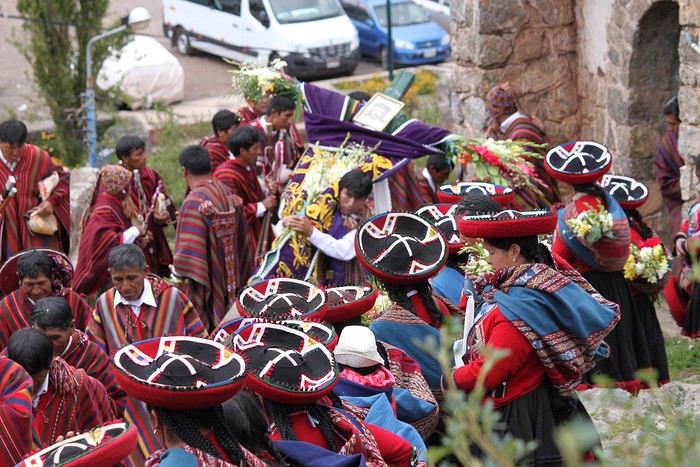
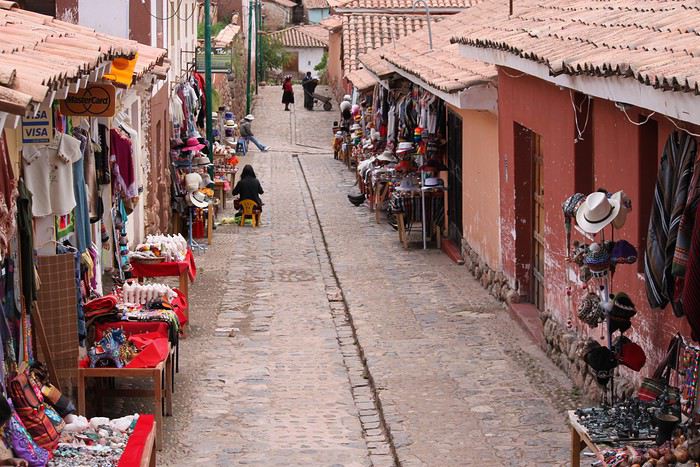
We continue exploring the village streets, barely noticed by the weavers in traditional dress, busy at their work. The village is almost deserted, and we wander until we reach the church. We skip the visit because another ceremony is happening inside, and we don’t want to intrude.
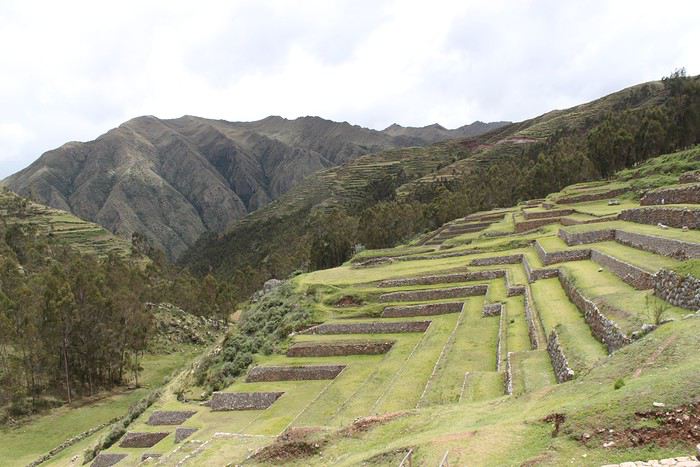
Behind the church, beyond the promontory, stunning Incan terraces unfold before us. William had warned us: *go around, it’s worth it*. And sure enough, we find ourselves exploring the site completely alone, soaking up this timeless moment. Here and there, a few villagers tend to their oxen, barely disturbing the silence that makes these ruins even more majestic...
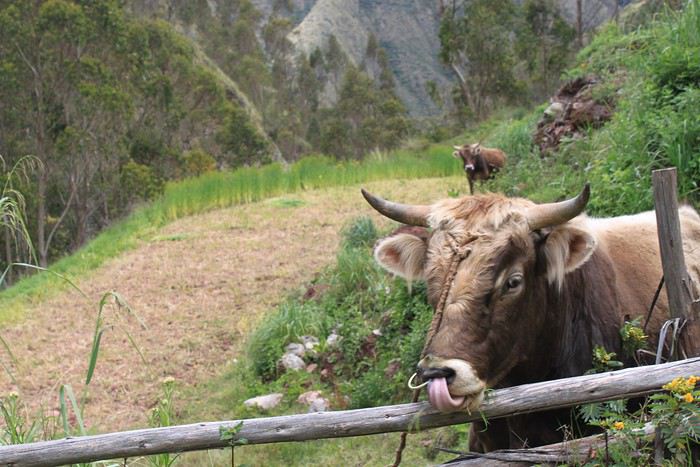
Back in "town," it’s already lunchtime. We grab a meal at a local eatery for 6 soles—breaded fish and fresh veggies on the menu.
Then we set out to find a taxi for Moray and Maras. Quite a few drivers are waiting for customers, and we head toward a young guy who seems less pushy. Still, he tries to overcharge us, quoting 80 soles for the ride. Luckily, a kind Peruvian woman comes to our rescue, proudly using her fluent English to talk our driver down to a more reasonable 50 soles. We also explain (and he struggles to understand) that he just needs to drop us off in Maras—no waiting required...
Off we go in his rattletrap of a car—shock absorbers and driveshaft shot, brakes screeching like crazy. I quickly realize this isn’t a real taxi... Whether the kid stole his dad’s car to make some extra cash or not will remain a mystery. Either way, through completely wrecked dirt roads, he takes us to our first stop: the terraces of Moray. Since we haven’t paid him yet, we’re sure he’ll wait...
Here, a major Incan curiosity: three perfectly preserved amphitheater-like terraces, so strange (I call them the Incan "targets"). They’re said to have been agricultural research centers, where each circle simulated a different microclimate for studying and growing plants.
Impressive!
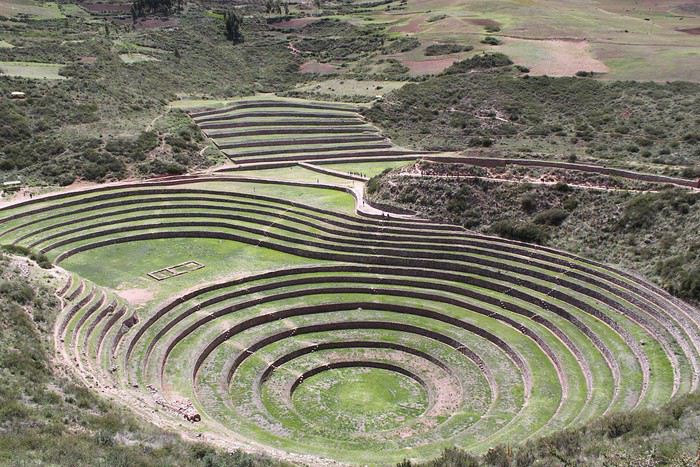
Forty-five minutes later, we’re back in our "jalopy" heading to our second stop: Maras. The small village is deserted this afternoon, and it’s time to make our driver understand we want to walk to the salt flats via the trail—and that he can leave now. I’ll never forget his stunned face, baffled that these tourists don’t even want to enjoy his chariot... He even follows us for a bit, just to make sure we won’t call him back...
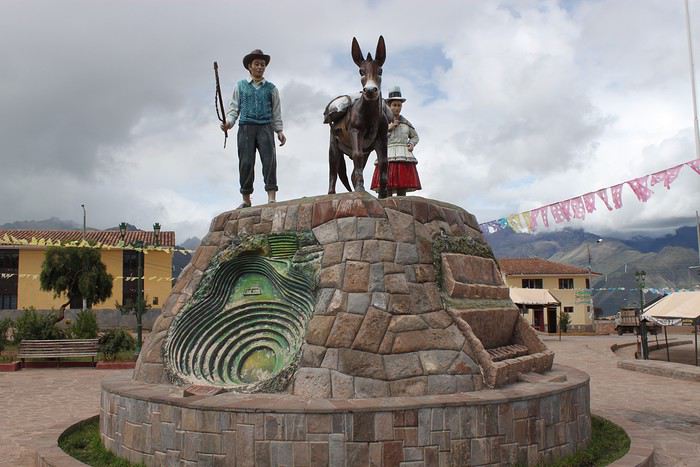
But no, we trek the 4 km to the salt flats, barely bothered by the storm rumbling around us (though we do get a little wet...). It takes us just 45 minutes to descend to the *Salines*, carefully dodging mountain bikers zooming down the same path at full speed...
And then the salt terraces reveal their breathtaking spectacle—a sort of Asian oasis in the middle of this Andean mountain. The sight of thousands of pools where a salty river flows from who-knows-where (Fabgreg, help!!!) is surreal...
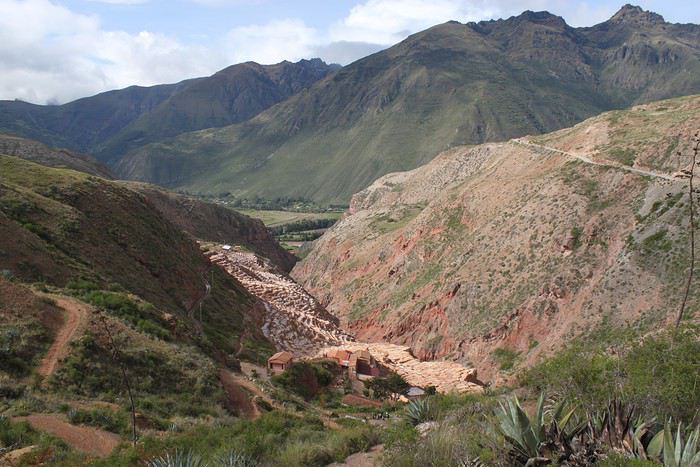
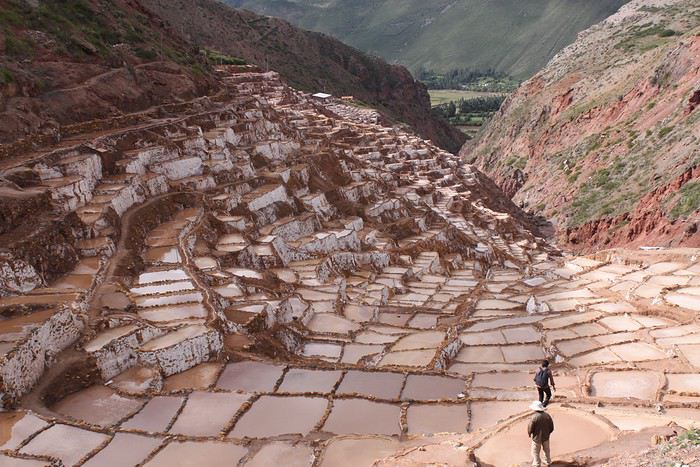
But the hike isn’t over yet—we’ve planned to reach the valley on foot, descending via a donkey trail to Taramba, on the road between Ollantaytambo and Urubamba. Another pleasant hour of walking...
There, it’s tough to flag down a collectivo—they’re all packed with people from Ollantaytambo—but a young Peruvian girl helps us stop a van, which drops us at the Urubamba bus station. The day is already winding down, and we make the trip back to Cusco by collectivo in the dark. After a quick street dinner, we return to William’s place—tonight’s sleep will be *very* restorative!!!
Peru-Bolivia 2017: A Month in the Andes
Montagnard74 · 2017-03-13 · Message 72 of 141
Well, if your daughter is a Spanish teacher, I don’t see the problem....
Most guides are at least Spanish/English, less often French...
As for driving, I haven’t tried it, but I’ll admit it didn’t tempt me. The distances are long, the roads often chaotic, and the driving can be "sporty" at times, especially in cities. Especially since public transport is actually pretty cheap and very well organized.
I’d encourage you to start a discussion when the time comes to shed some light on things—every question gets answered here!
Peru-Bolivia 2017: A Month in the Andes
Montagnard74 · 2017-03-13 · Message 73 of 141
Day 20: Cusco, Gifts, and... Rest!!
Because let’s be honest, the 6 hours of hiking the day before had really lit up our calves, so we decide to take a break today. Well, not exactly a full break, since the schedule is still pretty packed!
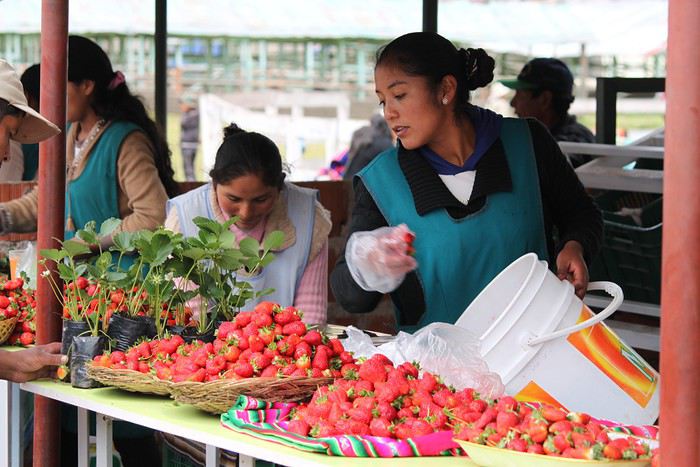
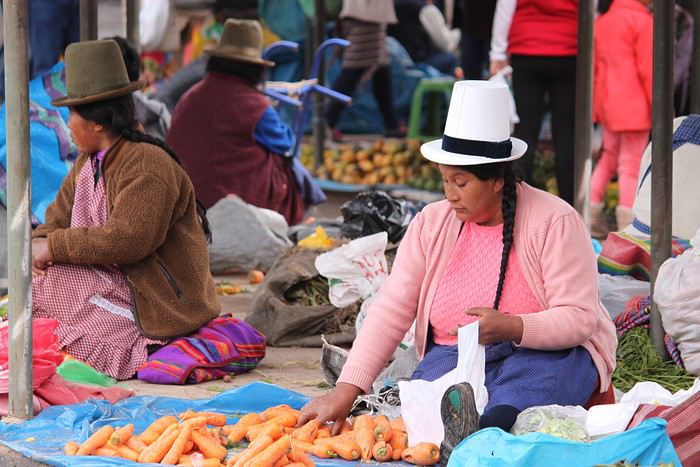
First up, a market! Recommended by William, this food market—the agricultural heart of the city in the Santiago district—isn’t touristy at all. In fact, we’re the only gringos inside this huge enclosure. It lets us taste familiar fruits (Peruvian pineapple, strawberries in January?!) and unknown ones, breathe in unusual scents, and soak up the city’s vibe and daily life... And, as you’ve probably guessed, I *love* markets!!
We head back up to Tullumayo Avenue and Avenida del Sol for a more practical stop at one of the city’s many artisan markets. This one has everything you’d expect in terms of Peruvian souvenirs, and we don’t hold back from filling our bags. The bargaining is pretty low-key—it happens naturally, and you can tell the vendors are in the off-season and eager to sell.
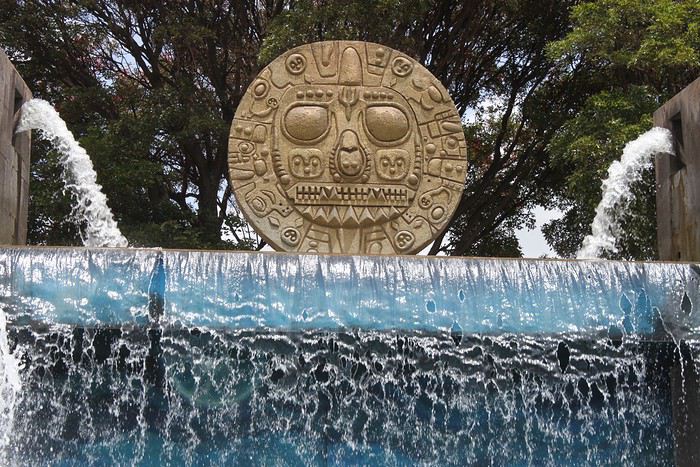
Back to William’s place after a quick lunch to drop off our purchases and rest a bit.
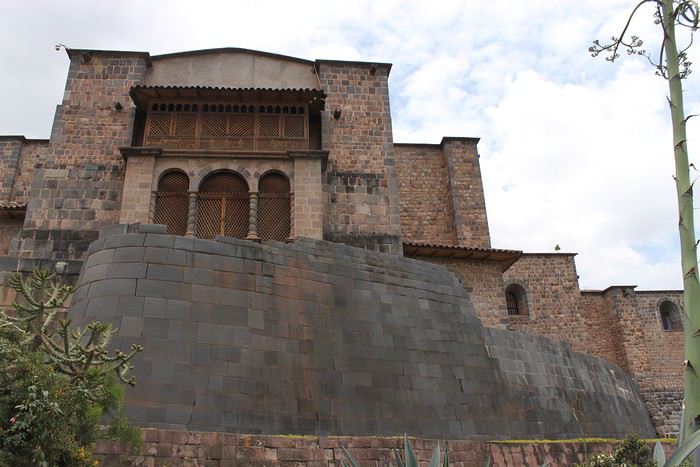
Then, a cultural afternoon with visits to some of the city’s must-sees: the Convento de Santo Domingo and the Templo del Sol Coricancha, an incredible monastery built on an Inca temple.
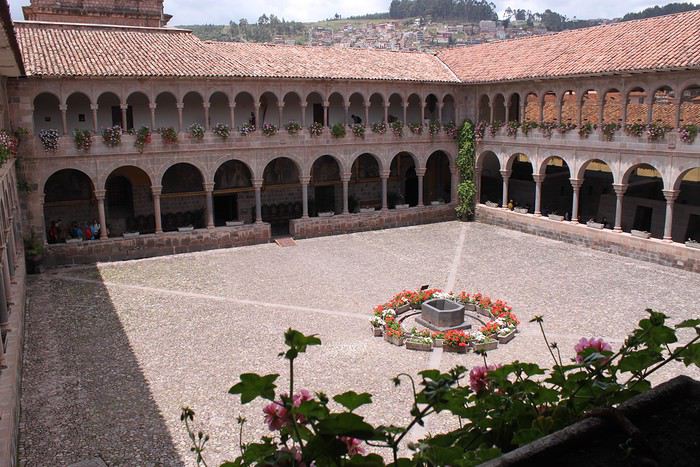
Next, the Monastery of La Merced, the Casa Concha museum (which tells the story of the discovery of Machu Picchu), and we wrap up with the Choco Museo—more commercial than educational, but it’s a great excuse for a cocoa break!!
A long Wi-Fi break in a monument to North American culture: the Starbucks on Plaza de Armas lets us catch up with family via FaceTime.
One last stop at the San Pedro Artisan Market, which is more touristy since it’s closer to Plaza de Armas.
To finish off, a small vegetarian soup in the San Blas district, and another jam-packed day!!
Peru-Bolivia 2017: A Month in the Andes
FabGreg · 2017-03-13 · Message 74 of 141
Strawberries in January?!
January, sure, but in the Southern Hemisphere, so it’s the equivalent of our July in the Northern Hemisphere. Not that surprising.
The ones I tried had very firm flesh—too firm, actually—but they were tasty. Still, not enough to make me switch from French gariguettes.
Casa Concha, a museum that recounts the history of the discovery of Machu Picchu.
A bit reductive if I may say so. True, the film shown in the very first room focuses on that 1911 discovery. It’s a good reminder of the historical (and at least controversial) role of Yale University, which provided all the artifacts displayed in this museum.
After visiting, I think the main interest of this museum is putting the Machu Picchu site into its natural context (see ecological tiers), economic (trade hub), religious (position relative to the apus), and social (occupations practiced) perspectives.
More than the artifacts, it’s the explanatory texts and mini-documentaries that present the state of archaeological research on this extraordinary site. Many questions remain open, based on hypotheses, but at least they’re well-argued. It’s a far cry from the persistent myths repeated year after year by guides at the Machu Picchu site… or poorly researched travel guides. For example, the myth of the Virgins of the Sun, which stemmed from a misinterpretation of the male-female ratio among skeletons found at the site. Nearly 50-50 after a re-examination in the 1950s, but the legend lives on.
Highly recommended for archaeology enthusiasts.
Fabrice
Peru-Bolivia 2017: A Month in the Andes
FabGreg · 2017-03-13 · Message 75 of 141
a salty river coming from who knows where (fabgreg, help!!!)...
Not easy to answer.
On a conceptual level, saltwater is just water and salt. No problem explaining the presence of water in the mountains—rainwater accumulates and eventually surfaces as springs.
If this water is salty, it means it passed underground through a salt deposit before emerging at the source. Almost like a paraphrase of Bourvil and his iron-rich water...
To take the analysis further, where does this salt deposit come from? Like all salt deposits, it’s a marine sediment. Before the Andes rose, a sea covered these regions. The most astonishing remnant of this sea is the Salar de Uyuni, a unique feature due to the surrounding relief (a basin where water evaporated like a salt pan).
In the case of the Salinas de Maras, here’s what I noted in my Peru travel journal in 2006 (unpublished):
Over a total area of 9 to 10 hectares, more than 3,000 basins are staggered on a 45° slope. With an average surface area of 5 m², these basins are fed by the warm water (25°C) of a saline spring located at the top of the valley, called "Qoripujio." From the stream flowing at the bottom of the valley, diversions channel this salty water into settling basins on the sunny slope.
Note: this salt exploitation already existed before the Incas.
But these basins aren’t necessary to observe the water’s salinity. In August (dry season), I was surprised to see salt deposits along the stream when, like you, I followed the path in the Quebrada de Pinchingoto to Taramba. Probably not visible in January during the rainy season due to insufficient sunlight.
Like you for this day’s program, but not quite the same—when I arrived in Taramba, I caught a combi to Ollantaytambo, where I visited the Inca site before taking the evening train to Aguas Calientes. A very efficient way to get closer to Machu Picchu.
Fabrice
Peru-Bolivia 2017: A Month in the Andes
Montagnard74 · 2017-03-14 · Message 76 of 141
Thanks, Fabrice, for the clarifications.
Well, about the 🍄, I knew, but I admit that finding Salines in that spot really threw us off...
It’s great to have some scientific backing in this travel journal! 👍
Peru-Bolivia 2017: A Month in the Andes
FabGreg · 2017-03-14 · Message 77 of 141
It's great to have some scientific backing in this travel journal
Sarcastic or just a shameless flatterer 😉
I’m just a humble traveler, a bit curious about what I discover on my trips. Some questions get answered, while others leave us with just leads (see the saline source).
the presence of salt flats in that spot had us baffled...
You can also find salt flats in the heart of the European continent.
Even more surprising, many deposits on the Tibetan Plateau, which in the past were the origin of the lucrative Salt Route with India. No doubt distant traces of the long-gone Tethys Sea. A reminder that human presence on this Earth is just a speck of time on the geological scale.
Fabrice
Peru-Bolivia 2017: A Month in the Andes
Soso1801 · 2017-03-19 · Message 78 of 141
Hi there, I just read your travel journal! It’s super interesting and really makes me want to go!! I’m also planning to head off to explore South America in about two months.
Throughout your trip, you mention altitude, but it seems like everything went really well for both of you in terms of acclimatization (except for La Paz and the slopes). You didn’t suffer from altitude sickness at all???
Because that’s one of the things I’m a little worried about... not being able to adapt and "ruining" my trip 😐! I’m in "normal" physical shape for a city dweller—hardly sporty, never been to the mountains... yay!
Peru-Bolivia 2017: A Month in the Andes
Montagnard74 · 2017-03-21 · Message 79 of 141
Hi Sophie.
A bit of time to reply, but work’s eating up all my time (and skiing too...)
As my username suggests, I live in Haute-Savoie, and altitude’s my thing! 😛
Just kidding! Altitude sickness was one of our concerns too, which is why I planned the trip with the option to turn back if things went south.
We didn’t suffer too much from *soroche*, except when we arrived in Puno, as I mentioned. I had a terrible night with unbearable headaches and vomiting. But the next day, I was climbing up to Amantani at 4,300m!!
I did what you’ll read everywhere for this: acclimate your body.
We left Lima (altitude 0) and stayed 2 days in Arequipa at 2,300m. And 2 days is the *minimum*...
Did that save us from altitude sickness? Partly, but we also added a few tricks:
- Coca mate (coca leaf infusions) in industrial quantities—morning, noon, and night.
- Ibuprofen 400 at the first sign of a headache.
- And for me, an 8-day course of Diamox, brought from France, which is a vasodilator that helps blood circulate faster and oxygenate the brain.
After this draconian regimen, combined with smoking (yes, I smoke...) inversely proportional to altitude, our bodies produced their dose of red blood cells, and we were *real* Peruvians!!
So, if I have just one piece of advice: plan a gradual ascent, pack some meds, and get into tea! And most importantly, plan to stabilize at a mid-altitude or descend if things aren’t going well... We saw people in Cusco, already at 3,300m, feeling *very* unwell...
One last thing: age, physical condition, or fitness level don’t matter. You either get *soroche* or you don’t—your body decides!
Peru-Bolivia 2017: A Month in the Andes
Rjulie95 · 2017-03-21 · Message 80 of 141
Was that what kept us from getting sick? Partly, but we also added a few tricks:
- Coca mate (infusions made from coca leaves) in industrial quantities, morning, noon, and night.
- 400 mg ibuprofen at the slightest sign of a headache,
- and for me, an 8-day course of Diamox, brought from France, which is a vasodilator that helps blood circulate faster and oxygenate the brain.
Good thing you avoided the drug test, or you’d have been busted 😛


