in Entre deux voyages › Carnets de voyage
Inside South Africa (page 5 of 11)
Discussion started by Voyajou on 2016-10-30
212 replies
This thread has been translated into English.
Inside South Africa
Voyajou · 2017-11-15 · Message 81 of 213
Is this hotel in your area?
Still on the lookout for great spots, Régis.
Yes, this historic hotel is in the small town you're thinking of. 🙂
Inside South Africa
Diamina · 2017-11-15 · Message 82 of 213
hey V...ou,
Brake gnawed, I approach their table to let them know it’s not certain the meager audience is interested, especially in French.
The little lady pauses, then resumes two notches lower; Robert’s eyes go round like he’s just spotted the sixth big five.
How annoying are these thoughtless people!!! I can just picture the faces they must’ve pulled!!! I’ve had the chance to make that kind of remark in an elevator, to a French couple in the US who were commenting on my sister and me, thinking we were Italian!!!!!!!
I pulled out my slingshot, which has kept more than one baboon in check at camp. The target’s smaller, my aim’s improved. As for projectiles, no worries: I’ve got a pile of river gravel waiting for walkways (about 162,000 projectiles).
Are you sure about your count? Did you collect them yourself, or was it a bulk delivery?? Is the condition for building the walkway that there must be exactly 162,000 pebbles?? 🤪 😄
Next, I’m reporting you to BB for aggression toward those poor birds, the doves, who, on top of it all, try to serenade you!!!! They’re amazed by your presence in these southern lands..... 🤪
Oh yes, they told me so....😏
With that sense of charity that’s inherent to him, the guy next to me on the bench jabs his elbow into my ribs, snapping me out of my daydream: I’d dozed off during the reverend’s sermon—we know the drill—which is the required entry ticket to hear the famed male choir’s melody.
grrrr pschitt grrrrrrrrr pchittttt..... What!!!! You mean he didn’t appreciate the sweet melody coming from your deep reflection?
Okay, I’ll try to catch up!!
Tchimbé raid pa molli!!
Inside South Africa
Ticapi · 2017-11-15 · Message 83 of 213
Note that it's possible to hike around the Zeitz MOCAA using the black spiral staircases that serve the five or six levels. 😏
Inside South Africa
Voyajou · 2017-11-17 · Message 84 of 213
Your shamelessness, thinking you could pass for Italians—did they only travel by elevator? 😮
Are you sure about your count? ... that there are exactly 162,000 pebbles??
Considering the truck’s chute delivered a perfect cone, and we know its diameter and height, applying Professor Gelato’s famous formula gives us the pile’s volume. Since the delivered size is 20/30, it’s elementary to get the number of projectiles: 162,000, by the wheelbarrow!
Inside South Africa
Voyajou · 2017-11-17 · Message 85 of 213
« Africa, My Desire »
Every year, a festival dedicated to contemporary literature in Afrikaans takes place here. For this edition, a few English-language authors are featured, including an incorruptible judge who resembles Eva Joly—though upright—and has survived three assassination attempts.
The conferences, discussions, and roundtables fill small venues to capacity. A concert we can’t miss closes the Festival: « Africa, My Desire », written in French on the poster.
Under the auspices of the Cape Town Music Academy, a South African composer set West African and Malagasy French-language poems to music.
Intriguing.
She plays the piano standing up, white like her, accompanied by a Black rhythm section, a white bass, other black-and-white keyboards, a subdued gray drummer, and three Congolese singers—including one woman.
No African instruments, and hardly any African sounds either. There’s rhythm, but it’s not blues.
Disorienting.
She recites the texts flatly, in a toneless, heavily accented voice, neutralized by the Congolese choirs’ far more expressive French—voices we’d have loved to hear reciting their elders’ poems, even if the texts themselves were weak.
Disappointing.
In the end, it feels like instrumentalization, amplified by a staging that never quite found its footing.
For a successful intercultural collaboration (perhaps because it’s a duo of equals?), listen to Amanke Dionti (Ablaye Cissoko & Volker Goetze).
P.S. Listening to the Afrique mon désir CD leaves a better impression. The mixing is more polished, and above all, there’s a warm-voiced accordionist who passed away shortly after the recording.
*
Sundial
Their life in Johannesburg was a race against time. The house in the veld where they retreated is surrounded by terraces, pergolas, and stoeps. Moving in the opposite direction of the sun’s arc, from dawn to dusk, these two shadows circle it. Often, she precedes him by a few minutes, but in winter, their path is always shorter.
*
Time Share
For some time now, homo glandus has been trying out sharing the same living space at different times, but it seems far from a cure-all.
For them, necessity makes strange bedfellows: the porcupine and the warthog share the same crude burrow—the first shelters there from the sun during the day, the second spends the night there.
In my stretch of desert, two old buildings and one under construction. No permits.
*
I So Wanted to Hate You
This is the second time, twenty years apart, that French correspondents for a left-leaning sturgeon-like newspaper (the kind that swims with the current) in South Africa have been won over by the personality they’re interviewing—despite themselves, freed from the hexagonal prism.
*
Duetists
As often happens, the storm rages beyond the mountain range, so its heart-wrenching music doesn’t reach us. Only its aerial light show entertains us.
The unleashed pianist responds in kind. Together, they improvise happy clashes.
*
Mat-e!
Once a week, introductory chess lessons are held at the POP Centre (Path Out of Poverty), a sort of community center in the heart of the township. A small group of young people—no girls, thankfully, because how would I have written « people »? Individuals?—come to learn how to anticipate several moves (moves that are hard to predict at home).
Eight of them are selected for the South African championship, and they need fresh-blooded sparring partners, but there’s a dire shortage of white players here. For Black players, facing white opponents isn’t an everyday opportunity in this country. I take the hits, I dish them out, forehead to forehead.
In chess, at the start of the game, the white pieces have the move (they play first). That advantage gives them the choice of opening and a one-move head start. Of course, it doesn’t stop Black players from sometimes defeating them, but still. It’s high time—let’s say as soon as the primordial battle for inclusive grammar is won—to challenge this inequality-creating convention.
At the end of the evening, Shaun, the dark-skinned teacher, challenges me to a game. He drew the white pieces. With Black, I’m inevitably unsettled.
I watch his diagonals (he has a reputation as a wild player).
How many moves will it take him to checkmate me?
(Far more than I feared, and I even came close to beating him.)
*
Servant
Determinism being what it is, few readers—how many, really?—know about this servant. Yet the services she provides are invaluable, greatly boosting the productivity of the working man.
Here, she’s replaced by a male servant (everyone knows how enviable women’s status is in Africa), who scurries from the breakdown to the bakkie at the whim of the plumber, electrician, or mechanic’s terse orders: 13mm spanner! Flathead screwdriver! Multigrips!
Needless to say, the latter is often white, and the assistant never is.
The widespread adoption of rolling tool carts, like those found in modern workshops, offering all tools at hand, would destroy too many jobs in a country where one in three people is unemployed.
*
(It’s the year of poultry)
For want of thrushes, the furious wind strips the jacarandas, dressing the earth in a mauve floral gown.
Inside South Africa
Voyajou · 2017-12-01 · Message 86 of 213
Imitation?
He was born in the street, no more paved than the house was cemented.
Before puberty, he joined a remote farm.
Resourceful, he returned deflowered to the township and set himself up as a gardener.
First, he hired a brother-in-law, then a cousin, two uncles. Unfortunately, the grandfather was no longer operational.
Now there are about ten of them—the largest garden maintenance business in the small town, ahead of the municipality—unlike in other regions.
He just changed his car for a bakkie, the local Rolex, the thing that marks you as the boss.
Parading from one job site to another, a Samsung grafted to his ear or eye, alone in the cab, the others piled into the back with the lawnmower, shovels, and pitchforks.
He ostentatiously enjoys his breakfast on the café terrace while his guys manicure the garden.
Like a white man.
*
Nothing to do with it
Anton is a police officer and, off-duty, a metalworker. When he’s done welding up troublemakers, he welds scrap metal with the same professionalism and care for fine workmanship.
Between the crackling arcs and the scream of a grinder, I ask him questions.
His police station is the only permanent one for the entire Municipality, covering an area of six thousand square kilometers. A Finistère, also bordered by infinity, but where the ocean has receded. Fewer than fifteen thousand inhabitants. There are about forty police officers, only half of them in the field. Alcohol, drugs, domestic violence, theft, rape, sometimes a murder—that’s the daily routine.
Postscript that has nothing to do with it, though. In this same territory, on the white market (because the black market, by definition...), about fifty houses are for sale, hardly any building plots, but just as many farms, each larger than a Breton commune. This isn’t Morbihan.
*
Keep running!
Every Saturday morning, several dozen brave souls line up at seven o’clock for a five-kilometer race. This morning: fifty Black runners, twenty white, sixty young, ten older. For my part, I’m on the clock.
The route through the bush forms a figure-eight, traced like a kindergarten drawing. Shortly after the start, the line of runners forms a rainbow in the chaos on the slopes of the kopjie, before turning around the maze built atop a small structure, skirting multicolored glass-fragment fish, and finally starting the descent over the rocks.
Everyone came in whatever shoes they had: brand-name sneakers, knockoffs, flip-flops, barefoot.
The first runner finishes in 19'44''23.
First white runner in seventh place (no Kenyans here, though).
First girl, Black, in twenty-fifth place; first white girl in thirty-second.
First flip-flops in fortieth place, first barefoot runners in forty-ninth.
The last ones, who came to walk, will finish in an unrecorded hour.
Every child participant gets a ticket for a pancake to enjoy at the Saturday market, two kilometers away. The few available cars are swarmed: each day has enough trouble of its own. Record for the Land Rover: fifteen passengers, two curled up on the fridge, heads nearly touching the sky.
*
Dog’s life
Paul was the youngest born in Ireland into a family poorer than poor. His father died before he was born, in the war that followed the war to end all wars. His sisters were placed in those chaotic Catholic institutions that burned through everything—one lost her life there.
Not lacking in brains, he continued his studies in England. Needless to say, the disdain tied to his origins was in his skin. To escape that suffocating environment, he accepted a construction site management job in South Africa at twenty-five. He was set in concrete by a local woman, like rebar.
Of those who couldn’t stand apartheid, he couldn’t stand it almost physically. He believed a woman is a woman (same for men), regardless of her origins. What mattered was who she was, what he did (and vice versa).
*
Spinach doctor
For years, he’s been settled on the border between the white town and the township, behind warehouses where both sides have business. He treated those who paid and, at best, the others. On his land, he trained guys in organic market gardening and arboriculture before entrusting them with discretionary management. In exchange, he’s an honorary vegetarian.
Basket in hand, we follow Havelin through an improbable succession of paths and beds, more English-style than French. It’s an open market, but the garden decides, not the customer. A few green zucchinis, then yellow ones, two tomatoes, a white eggplant, white onions, red ones, a nice handful of spinach, a cucumber, butter beans. Then, picked from the tree: apricots, blackberries, and raspberries. A quick glance at the basket, weighing about three kilos: 20 rands!
I’ll teach them the rules of commerce: the same quantity of lower quality costs three times as much at the nearby supermarket.
Let’s move on to animal proteins: sheep, geese, chickens, ducks. But that’s a reserved domain.
Stop by the butcher on the way home.
*
A drink!
The town’s founders, the De Beers and the Lotzes, then their allies, the Cordiers, du Plessis, and de Villiers, were buried in a private cemetery. One hundred fifty graves, most of them simple cairns, which until recently disappeared into a thicket of dense acacias, blooming with succulents—but no appetite for long.
The cemetery has been cleared, stripped bare, with only a few trees left struggling to provide shade. Now the ancestors are in full sun, as if it hadn’t been enough during their lifetimes. Adjoining the cemetery, a 150-cubic-meter concrete cistern, unfortunately abandoned.
The thirty or so gravestones face east with their laments. The only one bearing the deceased’s name on the west side, located at the entrance and well-maintained, is that of an Avenant, Johannes by first name.
It’s also the last grave dug here, the year apartheid ended. Is it pure coincidence? Did these families choose exile then?
*
Aside
Apartheid: did you know this term was built from French?
In South Africa, the dividing line was based on ethnicity, skin color, and hair texture. So, rightly, we remember this political system for its racist character. But while it was racist in practice, its foundations were more complex. Its architects spoke of identity, culture, autonomy, separate development.
So here’s a vision of social and political organization that’s very current and widespread... in Europe.
(For the record, in the early nineties, opposite consequences of the domino-Gorbachev effect: South Africa abandoned separate development while the Balkans went to war over it. And now, Catalonia—a nervous breakdown.)
*
Inside South Africa
Max68 · 2017-12-09 · Message 87 of 213
Your tables are still so pleasant to read, even if they're very black and white 😉
Looks like you're really getting involved in the local life 🙂
Thanks 🙂
Inside South Africa
Voyajou · 2017-12-09 · Message 88 of 213
You got a picture... in color. 😉
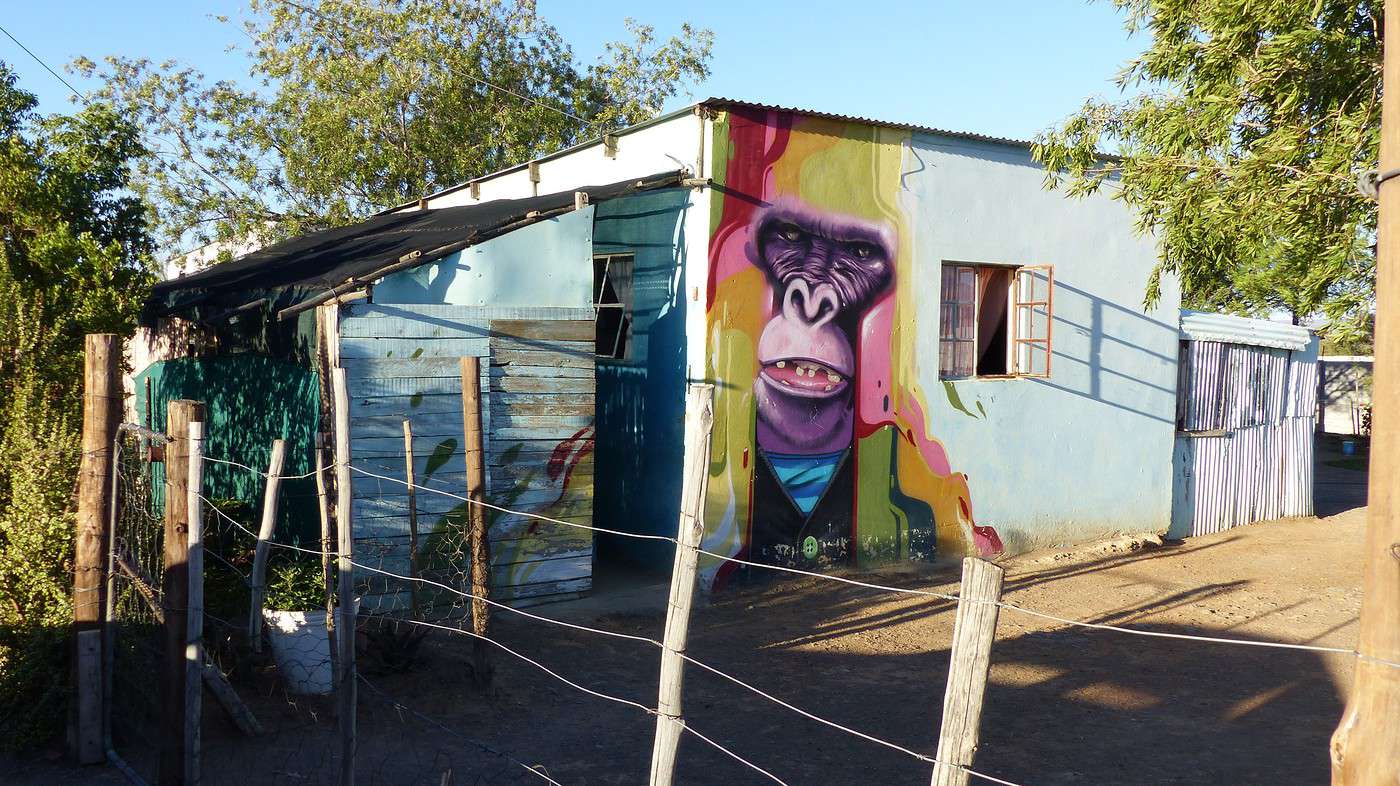
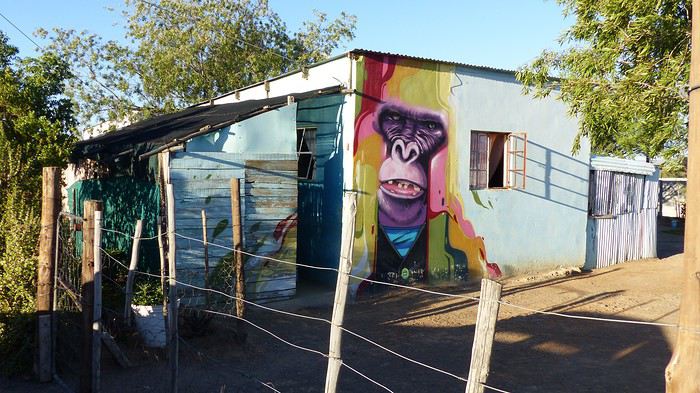
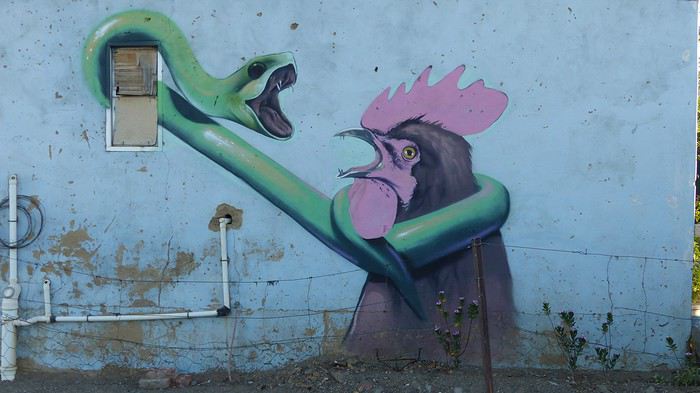
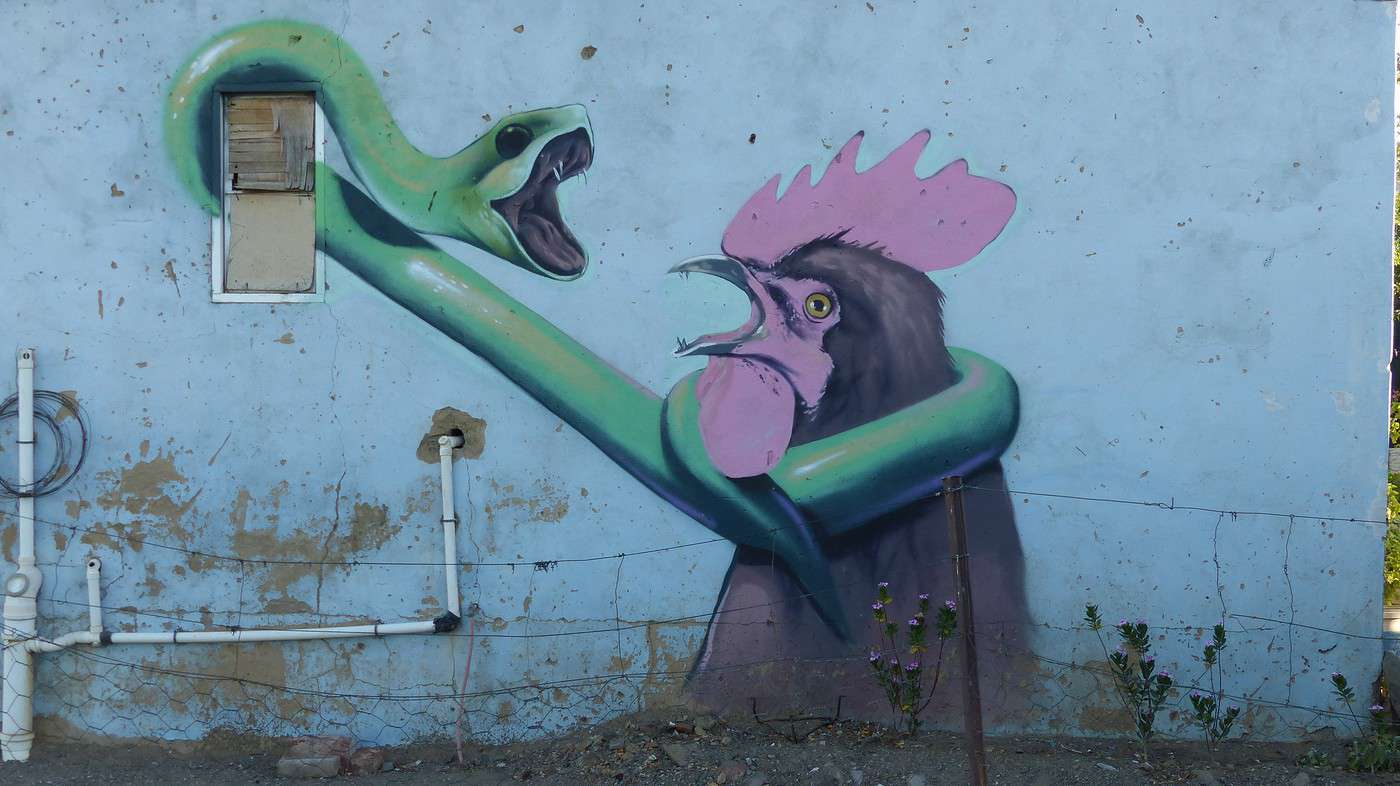
Mural in the township. (I’ll write a bit about them.)
Inside South Africa
Diamina · 2017-12-09 · Message 89 of 213
Hi there,
Now that I’ve finished filling out my reports for parent-teacher meetings, I can finally dive into reading and commenting.
Aparté
Apartheid: did you know that this term was actually built from French?
Thanks to you, I learned something new!
South Africa was abandoning separate development
But thanks to Mandela, the whites kept control of the economy, and the Black population only got a few crumbs, right?
And now, Catalonia, a nervous breakdown
Hey Voyou, forgetting your "e’s" now??
In this increasingly globalized world, I think identity crises are only going to become more common.
Just traded in his car for a bakkie—the local Rolex, the ride that says you’re the boss.
Parading from one construction site to another, Samsung grafted to his ear or eye, alone in the cab while the others are crammed into the back with the lawnmower, shovels, and pitchforks.
Savoring his breakfast ostentatiously on the café terrace while his guys manicure the garden.
Like a white man.
It’s the same here. Black people who’ve made it flaunt their success and adopt the same condescending attitudes as the *békés* (descendants of the old colonists)!!!
For my part, I’m participating on the timing side.
Oh!!! I was expecting you to be actively running in the race, with the latest shoes and a well-deserved trophy haircut. Oh well! At least were you diligent with your timekeeping?
Record for the Land Rover: fifteen passengers, two of them curled up on the fridge, their heads nearly touching the sky.
Uh… are there Land Rover buses over there??? 🤪
Inside South Africa
Voyajou · 2017-12-11 · Message 90 of 213
(Half-dead laptop, iPhone in a coma, car running on three wheels—I’m replying as best I can)
A fit of rage
What? You haven’t heard about the ongoing reform of French grammar (that sexist, even macho tool)? Calling a fit of rage feminine is degrading. We’re entitled to our fits of rage too. 🤪
You, who’s used to hurricanes (m.), should be at the forefront of knowing the difference between seeing your house blown away by Robert or by Angela.
Mandela
Now that’s a broad and complex question, way too risky to tackle here. For how many centuries have the *békés* lost the privileges that underpin their current wealth?
Mandela was a pragmatist, not a dogmatist. Revenge wasn’t his driving force, nor was scapegoating his policy. South Africans owe him this young country where there’s still so much to do—more than in France, but far less than in Zimbabwe, where a quarter of the population has sought economic refuge in... South Africa.
(In PE, I chose the ‘motorsports’ option.)
Lovely trills from this singer.
Inside South Africa
Zabazou · 2017-12-11 · Message 91 of 213
(Half-paralyzed computer, iPhone on its last legs, car running on three wheels—I’m answering as best I can)
A nervous breakdown
What? You haven’t heard about the ongoing reform of French grammar (that sexist, even macho tool)? Calling a nervous breakdown feminine is degrading. We’re entitled to our nervous breakdowns too. 🤪
You, who’s used to hurricanes (m.), should know the difference between seeing your house blown away by Robert or by Angela.
Mandela
Now that’s a broad and complex question—too risky to tackle here. For how many centuries have the *békés* lost the privileges that underpin their current wealth?
Mandela was a pragmatist, not a dogmatist. Revenge wasn’t his driving force, nor was scapegoating his policy. South Africans owe him this young country where there’s still so much to do. More than in France, but far less than in Zimbabwe, where a quarter of the population has sought economic refuge in... South Africa.
(In PE, I chose the ‘motorsports’ option.)
Lovely trills from this singer.
This singer? ... There’s something of Amélie in him...
Inside South Africa
Y7sag6er1 · 2017-12-11 · Message 92 of 213
AAAAAAAAAAAAAAAH you should get your South African road trip novel published!
And ahhhhhhhhh Ablaye Sissoko, a little guy who’s come a long way—
his brother now teaches kora in Paris.
I love reading your posts, and I still miss the great Karoo a bit...😐
Welcome to the three-legged car club...
Inside South Africa
Diamina · 2017-12-11 · Message 93 of 213
(Half-paralyzed computer, iPhone in a coma, car on three legs, I’m answering you as best I can)
Don’t tell me you’re also lying there tetraplegic, typing with a spatula in your mouth!!!!!!!
For how many centuries have the békés lost the privileges that form the basis of their current wealth?
That’s exactly the problem—they’ve never lost their privileges!!!!!!
They kept all the land, all the money, all the businesses. The French state substantially compensated them for the loss of their slaves, but the slaves themselves got nothing but their so-called freedom. And they paid their former slaves starvation wages, which those workers were forced to spend on the plantation just to buy food.
Mandela was a pragmatist, not a dogmatist. Revenge wasn’t his driving force, nor was scapegoating his policy.
About Mandela, you’re right—better to let it go. Exhausted, worn out, drained, separated from his comrades for months, he reached his limits and gave in. Oh well!
Lovely trills from that singer.
A beautiful flight, for sure!!!
(In PE, I chose the ‘motor sports’ option.)
Ah!!! So the "P" stands for "physics" of fluids, then???
Cheers,
Inside South Africa
Diamina · 2017-12-11 · Message 94 of 213
(Half-paralyzed laptop, iPhone in a coma, car on three legs, I’m replying as best I can)
Don’t tell me you’re also lying there tetraplegic, typing with a spatula in your mouth!!!!!!!
For how many centuries have the békés lost the privileges that form the basis of their current wealth?
That’s exactly the problem—they’ve never lost their privileges!!!!!!
They kept all the land, all the money, all the businesses. The French state substantially compensated them for the loss of their slaves, but the slaves themselves got nothing but their so-called freedom. And they paid their former slaves starvation wages, which those workers were forced to spend on the plantation just to buy food.
Mandela was a pragmatist, not a dogmatist. Revenge wasn’t his driving force, nor was scapegoating his policy.
About Mandela, you’re right—better to drop it. Exhausted, worn out, drained, separated from his comrades for months, he reached his limits and gave in. Too bad!
Lovely trills from that singer.
A beautiful flight of song, absolutely!!!
(In PE, I chose the ‘motor sports’ option.)
Ah!!! So the "P" stands for the "physics" of fluids, huh???
Cheers
Inside South Africa
Rjulie95 · 2017-12-11 · Message 95 of 213
For Mandela, you're right, it's better to let it go. Tired, exhausted, wiped out, separated from his companions for several months, he found his limits and gave in. Too bad!
There’s the opposite example in Zimbabwe: all the land was taken from the farmers and redistributed. That country was Africa’s breadbasket... and now it’s nothing but misery. I don’t think Mandela gave in; he just thought that for the future of his country, he couldn’t follow Zimbabwe’s example—and thankfully so, at that.
Inside South Africa
Voyajou · 2017-12-12 · Message 96 of 213
From this singer... there's something of Amélie in him.
“Another manifestation of ethnocentrism”: that’s what I thought when I first read your report about Amélie (Catacomb, I presume?).
I couldn’t leave it in doubt. The idea that the murals in the township could be inspired by Belgian—or even Western—culture was unthinkable. How far back would we have to go? Could the Bushmen’s rock paintings be plagiarized from Lascaux?
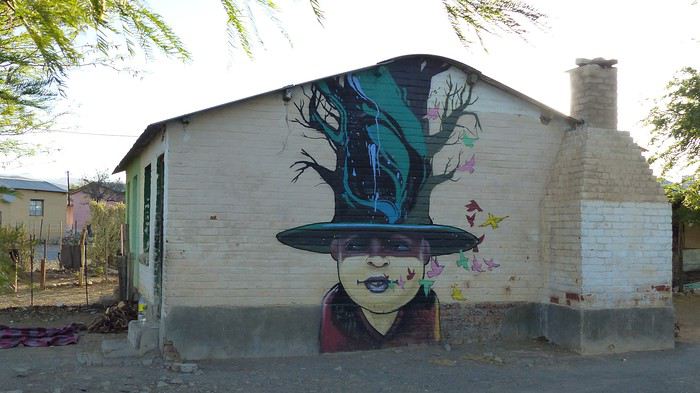
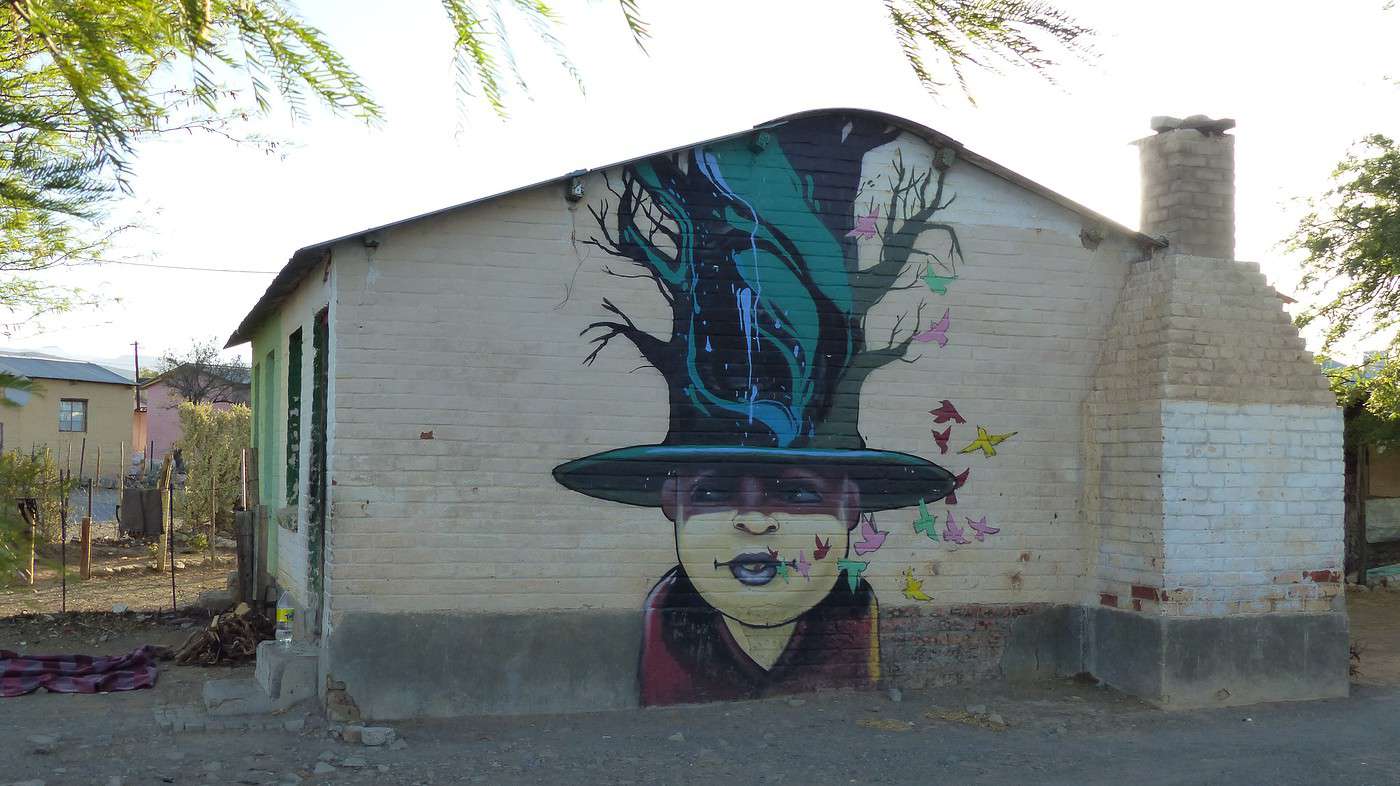
I owed it to us to investigate, so I went to the site last night hoping to meet the artist. I finally found him in an unpainted corrugated-iron shelter at the back of a courtyard. He wasn’t holding a spray can or brush but a poker, which he used to poke at his headgear before answering. I confirmed it: he was wearing a stovepipe hat that was gently smoking (thicker puffs during the interview he graciously granted me). Here’s the account of our conversation, freely translated from Afrikaans.
- Good evening, sir.
- Yeah?
- (showing him Amélie on the screen) You’re the artist, right?
- Could be.
- ...
- What for?
Anyway, I’ll cut it short. He doesn’t read (Amélie O’Tomb?). Seems annoyed that a foreigner used his work as inspiration for a costume. I play along, hinting at a big payout for damages.
Turns out the painting is a portrait of his wife, who got tired of tangled roots and flew away with the birds one morning. Since she left, he claims the mural is a matrimonial ad. He’s cultivating a new ficus whose roots wrap around a black pipe, and he insists the chosen one must come with birds. I promise to bring the bride a black coat (I’m heading back soon and will make a detour through Belgium).
And in this other one, can you spot the protagonists?
Inside South Africa
Voyajou · 2017-12-12 · Message 97 of 213
... you should get your road-trip novel published...
But would I need to find a publisher? And later, sign autographs for lines of leeks? Would I need to hire a ghostwriter?
What’s present in all Southern African countries but not in Lesotho?
It’s... it’s...

Inside South Africa
Y7sag6er1 · 2017-12-12 · Message 98 of 213
oh wow, this really takes me back to my family’s history...
This super-rich cousin of mine owned 4,000 hectares of sugarcane fields—and maybe even more I’m forgetting—who kicked out the household staff from the "manager’s" house for fear they’d claim ownership. And yet, and yet, they deserved it so much. Now they live in little gray-brick shacks, but my cousin’s wife, who plays tennis with her friends in Empangeni, told me, "But they have a TV."
One day, my cousin—a big-shot lawyer fighting for the white cause—took me to his new pepper-processing plant. I saw the girls working on the assembly line, and I told him it’d be nice if they worked with music. Africa without music isn’t Africa.
That day was the breaking point.
And yet, those kids were born in Lesotho, the country where everyone sings, laughs, and eats spinach at noon. I just didn’t get it.
Still, I told him thanks—because of him, I saw the Big Five in Hluhluwe Park and Richards Bay, smoked cigarettes with his gardener, and cried a lot.
Inside South Africa
Y7sag6er1 · 2017-12-12 · Message 99 of 213
What do you mean another "nègre"? 😮
Hey there, elephants, if you only knew you're here because of the fox from Sudan...
Anyway, for the full story, you’d have to go behind the waterfall with a few cans of Loxton, alright! 😉
Inside South Africa
Y7sag6er1 · 2017-12-12 · Message 100 of 213