in Thèmes › Voyager en camping-car
Converting a heavy-duty bus/coach/truck into a motorhome (page 52 of 161)
Discussion started by Patrick26 on 2004-06-14
3213 replies
This thread has been translated into English.
Converting a heavy-duty camper into a bus/coach/truck
Quick · 2006-09-23 · Message 1021 of 3214
hi there,
I’m a newbie expat in Martinique with my wife and two kids. We’re planning to return to mainland France in 2007, and there’s no way we’re going back to being cooped up in a 50 m² flat at 700 € rent a month (not counting taxes, utilities, deposits, and all the red tape from those lovely estate agencies!).
I worked for two years as a workshop technician at a motorhome dealership, and the idea of a live-in bus had crossed my mind.
So, I’ve got a few questions for you all (thanks in advance for your replies!):
I don’t have a heavy-vehicle licence—what do I need to get (I want to keep 9 seats in the bus)?
Will the homologation process be easier if the work (electricity, gas, water) is done by a professional (I’ve got good contacts with my old boss)?
And finally, to keep this first post short, any idea what the annual insurance cost might be? (I’m not a fan of insurers, just like estate agencies!)
That’s all for today—if any of you happen to pass by (without your bus, given the ocean between us!), don’t hesitate to drop in for a quick hello. In the meantime, I’m digging through every page of the forum—there’s plenty to do!!
See you soon, Quick
Converting a heavy-duty camper van from a bus/coach/truck
Mrkonn · 2006-09-23 · Message 1022 of 3214
😉Hey everyone, welcome to the new folks!
I met a guy who has a converted bus and is going to do another one with a van COC—he doesn’t have any issues.
All the vans we’ve seen are in the same boat; nobody’s had problems.
Otherwise, what do you think about installing composting toilets instead of chemical ones?
Converting a heavy-duty camper van from a bus/coach/truck
Mrkonn · 2006-09-23 · Message 1023 of 3214
Hey quick,
you’ll need a category C license (heavy goods) and for insurance, you’ll have to shop around.
Between 400 € and 900 €—it all depends on your no-claims bonus too ;)
Converting a heavy-duty camper van from a bus/coach/truck
Quick · 2006-09-23 · Message 1024 of 3214
Hi everyone!
I’m on page 10 of the forum and just remembered that a friend of my dad’s, who had a replica AC Cobra, used to drive around France with UK plates (it couldn’t be registered in France, but no problem in the UK).
Does anyone know the UK legislation for converting a coach, given that we’re all now European citizens? Having an address with friends in the UK and driving with UK plates shouldn’t be an issue!
It might be a crazy idea, but if it’s easier over there, why not!
Later,
Quick
Converting a heavy-duty camper van from a bus/coach/truck
AMAsxmx · 2006-09-23 · Message 1025 of 3214
Hey there seb😉.
Your presence on the forum is gonna reassure some of us, me included!🙂
Welcome aboard, even if you’ve been lurking around for a while.
Everything we need to make our projects happen is right here in the forum—how cool is that?..
Thanks, guys
Converting a bus/car/truck into a heavy-duty motorhome
Shanko · 2006-09-23 · Message 1026 of 3214
hi and welcome! :) it's clear we can find tons of info on how to get there, so thanks everyone;
anyway here I am again with my electrical questions...
I'm giving up on solar (for now) since we'll be parked in the shade in Haute-Savoie during winter...
anyway, just so I understand how it works: how long does a generator take to recharge a battery?
I know the question is silly since I'm not giving any specs for the generator or battery, but for those who use one, how does it actually work? A generator pollutes and makes noise, plus the cost of electricity is pretty high (or so I think). So either I find another spot (um, not possible I think) to park and rely on solar, or I just pray that with a generator, we won't be deafened for 10 hours while the batteries recharge... basically, I'm just asking for some reassurance here...
cheers, pierrick
Converting a heavy-duty camper into a bus/coach/truck
Geromino · 2006-09-23 · Message 1027 of 3214
Hey, so how's it going if you live year-round in a bus—pros, cons, etc.?
Bye!
If it helps:
http://cgi.ebay.fr/...3AMEWA%3AIT&rd=1
Converting a heavy-duty camper van from a bus/coach/truck
Gasmobil · 2006-09-24 · Message 1028 of 3214
Welcome Junior, and a big thank you.
I didn’t get the chance to see you at that famous weekend—we only know each other through phone calls.
Most members of this forum are here, in principle, to exchange info. In reality, it’s always the same people who share the details.
For you, it’s completely the opposite: you don’t need anything here and you’re only here to GIVE in the broadest sense of the word.
So, a huge thank you for this selfless act.
Best regards, Gaël.
Converting a heavy-duty camper van from a bus/coach/truck
SJunior · 2006-09-24 · Message 1029 of 3214
A big thank you to everyone for these welcome messages...
It's true that for now, I'm more likely to "give" (if you need anything) than take info since I don’t have a real project yet, but who knows, maybe one day? Plus, it’s always rewarding to be useful! 😉
Looking forward to meeting you, Gasmobil (I know from Patrick that giving "altruistic" info isn’t new to you and your wife 🙂)
Cheers everyone
Setting up a motorhome in a heavy-duty bus, coach, or truck
Gasmobil · 2006-09-24 · Message 1030 of 3214
You're right, without giving any specific values it's not easy to give a precise answer.
Actually you have to work backwards. Before knowing which generator you need, you have to assess your energy needs, and once you roughly know how many Ah you'll need, you'll need to size your battery bank based on the autonomy you want without the generator. ATTENTION: the more you draw from a battery at once, the more its capacity decreases and its aging increases (it's in one or two of my previous posts).
Once you know how many amp-hours your battery bank consists of, then and only then you'll be able to choose a generator powerful enough to supply your battery charger.
In practice, nothing stops you from charging for 1 hour one day and 3 hours the next. It all depends on what you'll have consumed.
Setting up a heavy-duty motorhome in a bus/car/truck
Shanko · 2006-09-24 · Message 1031 of 3214
Yeah gasmobil, you're absolutely right – I'm coming at this backwards. First thing, I gotta figure out what I actually need (and yeah, that's definitely the logical place to start) then work out everything else to meet those needs. I'm doing it all wrong, ugh – off to a great start – the motorhome isn't even here and I'm already jumping to the finish... thanks for the response.
Setting up a heavy motorhome in a bus/coach/truck
Patrick26 · 2006-09-24 · Message 1032 of 3214
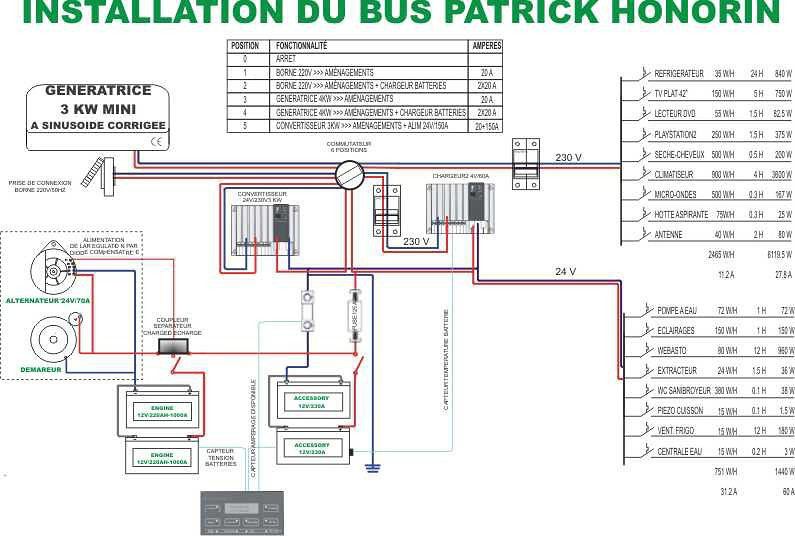
Around page 30 (if I remember correctly) I attached a schematic of a bus electrical installation.
With this schematic, there's a table of daily power consumption for each piece of equipment. You might be able to get some inspiration from it....
Here's the link to the post where you can find the schematic:
http://voyageforum.com/v.f?post=635472;search_string=;#635472
PATRICK26
Setting up a heavy motorhome in a bus/van/truck
Shanko · 2006-09-24 · Message 1033 of 3214
Hi patrick26. Your electrical diagram is a good example for me since the appliances in your motorhome are essentially the same ones that will be in mine. It will differ mainly in the usage times of the appliances.
Thanks for the reply, that'll definitely help me out 😉
pierrick
Converting a bus/truck into a motorhome
Gasmobil · 2006-09-24 · Message 1034 of 3214
Pros and cons really depend on each person.
What I mean is that maybe something that's an advantage from one person's perspective could be a disadvantage for another. We all have our own viewpoint.
For my own use – that is, purely for vacations –
the advantages are: The freedom to come and go as you please. Not having to necessarily plan where you're going, and being able to change your mind from moment to moment while traveling.
(I know that's related to what I just said)
The disadvantages are: Finding a level enough spot in the evening for the night. Finding where to refill water, but especially finding a proper place to dump greywater. Dealing with the hostile looks from locals due to bad behavior by other motorhome users.
For residential use:
as an advantage I see no property tax and the legal status of a residence.
as disadvantages, limited space year-round, having to refill water and empty tanks all year long.
Setting up a heavy-duty camper van in a bus/coach/truck
François57 · 2006-09-24 · Message 1035 of 3214
Yes, you're right, the voltages add up, but battery capacity is in amp-hours, that is amps multiplied by hours (a 75 A.h battery will draw one amp for 75 hours or 75 amps for one hour)
Where I agree with you is that in series the current stays the same, so 1 amp stays 1 amp.
But if you put 2 batteries of 75 A.h in series, you'll have a total capacity of 150 A.h, and you're going to consume the same AMOUNT of electricity, even if the currents are different. Otherwise at that point we could think about running at 220V in the camper, because indeed if you're drawing 5 amps at 24 volts, you'll draw 0.5 at 220, but you're still going to drain all the batteries anyway.
That's basically what you're saying too, since you buy 2 batteries of 12V/200 A.h then you have 2 times more runtime. That makes sense because you're buying 2 batteries so you have 2 times your capacity, whether it's at 12 or 24 volts (whether in parallel or series)
So there you have it and all that, but for the gas (really dangerous) there I'm still trusting your word.
As for battery wear and charging, it's true you'll discharge them less quickly (and if you have 2 in parallel at 12V that wear evenly it'll be the same anyway) but I'm skeptical about that too, because at Narbonne Accessoire, they were offering me a battery and the manufacturer's notice states:
1000 charge/discharge cycles at 30% discharge versus only 300 cycles at 80% discharge.
But you're still using 50% more of your battery so you come out even (in other words you're drawing more from it, but you'll charge it less often) so in my opinion that's the same there too.
On the other hand for your problem with damaging your engine batteries you need to couple your auxiliary batteries to the alternator with a battery isolator, but after that I'm not exactly sure how, but the whole point is you shouldn't drain one battery that's going to want to rebalance with your auxiliary battery
Setting up a motorhome in a bus/coach/truck
Patrick26 · 2006-09-24 · Message 1036 of 3214
HEY, HEY....
so about the batteries.....(I hadn't really weighed in on this yet!)
françois57: when you say: a 75 A.h battery will consume one amp for 75 hours or 75 amps for one hour
that's wrong! but no worries!😛
a 75ah will indeed give you 75 amps for one hour (theoretical value), but well over 1 amp for 75 hours!
indeed, the chemical transfer inside your battery, if done very slowly, will cause very little electron loss in the electrolyte (to simplify!), and at 1 amp per hour, your 75 amp-hour battery should give you 1 amp for over 100 hours!
on the other hand, nothing stops you from drawing 100 amps from your battery. but only occasionally and for short periods. to be honest, it'll actually be good for it! yes, it'll help unstick the sulfate! but don't overdo it....
for cycles, you need to do the math...
if you have 500 amps of cell batteries:
1000 cycles at 30/100 give 150,000 amps available
300 cycles at 80/100 give 120,000 amps available
700 cycles at 50/100 give 175,000 amps available!
me, I've chosen to recharge my batteries before they're completely empty (at 50/100!), that way I have the maximum amps available and...always a little juice in reserve!
and then 700 cycles at 50/100 of my 560 amps of batteries (2 of 280 amps, according to my consumption calculation, if I live in it full time, I change my batteries every 4622.6 days, that's over 12 years....
280 A of batteries X 2 = 560 amps that I use at 50/100.
So I have 280 amps available per cycle.
700 cycles at 280 amps gives me 196,000 amps.
My calculated daily consumption is 42.4 amps.
196,000 amps available divided by 42.4 gives me 4622.6 days
so put in at least 400 amps of GOOD batteries and ... stop asking yourself questions!
to properly charge a pack of 2 batteries of about 250 amps (2 batteries in series at 12v), you need a 3-stage charger that pushes at least 50 amps. at 30 amps you'll be just fine and at 20 you'll be tickling them!
with a 50 amp charger you'll recharge your pack from empty to 50/100 in about 7 hours. your charger will consume about 8 amps on 220v during this period. don't hesitate to use a 70 amp charger! a 500 amp pack will handle it just fine.
so, in order:
a generator that gives you 10 amps at 220v (no need to rectify it, in principle, the charger will handle it just fine). apart from the charger, nothing else plugged into the generator!
otherwise you'd need to protect the 220v equipment with circuit breakers, and you'd need to install a system to "correct the current" for the fridge, TV, etc....
the charger connected to the cell batteries
the cell batteries
the 24v-220v converters for the RV setup
the 24v equipment is connected directly to the cell batteries
don't forget fuses between the converters and equipment for 220v and fuses between the battery and equipment for 24v
from the engine alternator, install a pilot-wire separator coupler on the specific regulation for one set of starter batteries and one set of cell batteries (important to raise the voltage slightly. slow-discharge batteries need to be charged with a current slightly stronger than regular batteries)
inside the RV, you install:
a cell battery level gauge with alarm
a generator start button, or better, a relay connected to the alarm that will start the generator automatically (I'll skip the details!)
all that's left is to install a big disconnect switch to cut all the power....
there you go....
for those who didn't quite understand, you NEVER live on the generator! always on the batteries!
the generator only recharges the batteries.
the converters act as isolation transformers (for those with little electrical knowledge, converters "isolate" you from the element producing the current; the battery, for its part, produces nothing—it just stores).
for 24v, be careful with cable and wire gauges—check the standards.
for 220v, you must use only certain types of wires and cables (flexible, braided)—for the gauges, it's like at home!
220v outlets must have a ground pin that should be connected to the generator's differential (which serves no real purpose given the converters, but it's the standard!) and to the plug you use to connect to the campground pedestal.
watch out, for those who want to use campground pedestals!
they're often rated for 10 amps!
so you need to "adjust" your setup. look at my diagram—if the hair dryer doesn't run at the same time as the A/C, I stay under 10 amps!
the rest continues to be powered by the batteries. when I'm away, I run the charger on just the circuit it needs, since only the fridge is running!
and there, no need to run the generator! in one night of camping a week, I've got all my electrical autonomy sorted, without solar panels (I'd need a full roof of them to get a 50 amp charging current), plus I do my tank dumps, fill my 900 liters of water, and we're off on the adventure....
hey.... do I really even need a generator? (humor)
I'm attaching my installation diagram as an image
happy thinking, everyone!
PATRICK26
Setting up a heavy motorhome in a bus/truck/vehicle
Patrick26 · 2006-09-24 · Message 1037 of 3214
Our "friends" the Americans.......
The winners of the 2005 STELLA Awards have just been announced. This year's harvest is particularly outrageous. We remind you that the Stella Awards take their name from Stella Liebeck, that 81-year-old woman who spilled coffee on herself and subsequently sued McDonald's, which she won.
This landmark case inspired the creation of the Stella Awards, which reward the most grotesque and ridiculous winning lawsuits in America.
First place
And the grand winner of the year is Mr. Merv Grazinski from Oklahoma City.
Mr Grazinski had bought himself a brand new Winnebago motorhome. Coming home after a football game, he took the highway, put the vehicle in automatic transmission at 100 km/h using cruise control, and quietly left the steering wheel to go make himself a coffee in the rear cabin. Unsurprisingly, the vehicle deviated from its course, left the road and flipped over. Mr Grazinski sued Winnebago on the grounds that nothing in the owner's manual indicated it was dangerous to leave the wheel after engaging the automatic speed control!
The jury awarded him $1,750,000 (one million seven hundred fifty thousand dollars!!!) and a brand new Winnebago. The company has since modified the manuals for its vehicles, just in case another of their customers was a complete idiot of the same kind!
Long live America!!!!
As for us, we don't risk this kind of problem. Our motorhomes, we make them ourselves!
PATRICK26
Setting up a motorhome in a bus/truck/coach
Kersode · 2006-09-25 · Message 1038 of 3214
Patrick, hi, following your last message I don't see what a braided flexible cable is – do you happen to know its reference number? As for the camping hook-up, I imagine that's the electrical connection available at campsites, and I didn't understand the procedure about the fridge when you're away with the switch.
See you soon,
jlc
Setting up a heavy-duty motorhome in a bus/coach/truck
Gasmobil · 2006-09-25 · Message 1039 of 3214
I notice that GX47's posts and mine haven't really cleared things up. Let's look at things one by one and in order.
The power of a device is expressed in Watts(W).
The supply voltage is expressed in Volts(V).
The current consumed is expressed in Amperes(A).
There's a really handy formula to work out the current consumed by a device if you know its power and supply voltage.
This magic formula works for direct current and also for alternating current, but in the latter case only for purely resistive loads (so cosine=1).
Here's the formula: P(in W) = U(in V) x I(in amps) for example 120(W) = 12(V) x 10(A).
Which gives an equivalent equation that also says 120(W)/12(V)=10(A).
So you can see that if you divide the power by the voltage, you get the current.
Keep the same power and double the voltage: 120(W)/24(V)=5(A)
By multiplying the voltage by 2, you divide the current consumed by 2.
And that's what makes this so important. As Patrick26 and I have already explained in the previous posts on this topic, the easier you go on a battery, the more power it gives you, and the less you discharge it—which also saves you recharge cycles.
Let me explain again:
A battery's capacity varies depending on the discharge current. An essential concept! Battery capacity is rated based on the discharge current. For example, a BSG68 is a battery whose 68 Ah capacity is rated by fully discharging it (which is highly not recommended for battery life!) at a current equal to 1/100 of the capacity (0.68A). This means, and it's clearly explained in the document alongside, that this same battery discharged at a current equal to 1/20 of its capacity (2.75A) will only present a capacity of 55Ah, and at C/10 (Capacity over 10) 50Ah, meaning a current of 5 A for ten hours.
Obviously, with a current of more than 5A, the capacity (in Ah) will be even further reduced! Similarly, you could imagine a discharge at C/500 current (0.16A), which would give us a capacity of around 80 or 85 Ah at C/500.
That's a very practical concept, but also a "very flexible" one that's worth keeping an eye on.
As for battery configurations, whether in parallel or in series, either way you're doubling your runtime, so why switch to 24V? Less line losses. Smaller cables and fuses. Compatibility with the vehicle's original voltage. Better battery charging (I'll explain why below for the brave ones).
With series and parallel configurations, you're doubling your runtime but not the capacity—be careful not to mix things up. With a series configuration, you double the voltage but not the amp-hours of the battery. There are indeed 2 times more Ah available, but two 100 AH batteries each in series only make a 100 Ah battery, just at 24V. The doubling of runtime comes from the fact that by doubling the voltage, you halve the current consumed. With a parallel configuration, you double the capacity but not the voltage. To double both voltage and capacity, you need 4 batteries—2 in series in parallel with two others in series.
Another problem with 12V.
Batteries, even with equal capacity, have slightly different internal resistances unique to each one, which creates a difference during charging because each battery acts as a load and charges at its own pace, necessarily different from its neighbor's. When charging stops, the batteries are therefore charged differently, and if you disconnected them and tested them after an hour of rest, you'd have different voltages. The problem with these poor batteries is that they're all in parallel, so FORCED to be at the same voltage. Since they're charged differently, the more-charged one(s) will tend to recharge the less-charged one(s). So gradually it's always the same ones that get stressed the most and age faster. In short, it throws off your whole battery bank, and when one battery fails, the rest suffer because they're more stressed.
In series, on the other hand, there's no such problem. In fact, the series configuration forces the same current through both batteries, and since the charging voltage from the charger is also the same for both, the charging is equal.
I'm not saying this off the top of my head—I spent 4 years maintaining helicopter batteries at the aeronautical workshops of the St. Mandrier Naval Aviation Service. Coincidentally, that was also 24V—haha!!!
I don't know what else to say or explain to convince you. If you're in doubt, give me a call at 06 64 42 31 59.
Converting a heavy bus/coach/truck into a motorhome
GX47 · 2006-09-25 · Message 1040 of 3214
HA the magic of electricity...
😄 IT'S UNSOLVABLE 😄 because it's psychological! by principle it bothers people so we don't understand anything 😏 the more you explain the less we understand 😏 we could make a whole post about it 😐
before I was an electrician, now I'm a magician, it's only the name that changes, the result's the same, people don't understand a thing. 😄😄😄
🙂 yet electricity is so simple... or is it magic? 😮
GX47